SWIFT Reportedly is Teaming Up with Ethereum Network Linea for Major Blockchain Test

SWIFT, the backbone of global banking, has reportedly chosen Linea, an Ethereum-based network, to test moving its messaging system onto blockchain technology. This pilot program involves more than a dozen major banks and could change how money moves around the world.
Major Banks Join the Experiment
BNP Paribas and BNY Mellon are among the big names participating in this test. A source from one participating bank called it “a major technological transformation for the international interbank payments industry.”
The project will take several months to complete, according to a source from a participating bank. Banks chose Linea after months of negotiations because it offers strong privacy features that traditional banks need.
Linea uses zero-knowledge proofs, a type of advanced encryption that lets banks test blockchain features without exposing sensitive customer data. This addresses one of the biggest concerns banks have about using public blockchain networks.
How This Changes Banking
Right now, SWIFT only sends payment instructions between banks – it doesn’t actually move money. Banks rely on older systems with multiple steps and middlemen, which critics say makes transactions slow and expensive.
The Linea pilot aims to combine messaging and settlement into one blockchain transaction. This would let all parties track payments in real-time while cutting costs.
SWIFT processes the equivalent of the world’s entire GDP roughly every three days through its network, according to the organization’s website. Moving even part of this volume to blockchain could have massive effects on global finance.
Stablecoin Plans in the Works
The pilot also explores creating a stablecoin-like settlement token for banks. This would transform SWIFT from just a messaging service into a platform that actually handles value transfer.
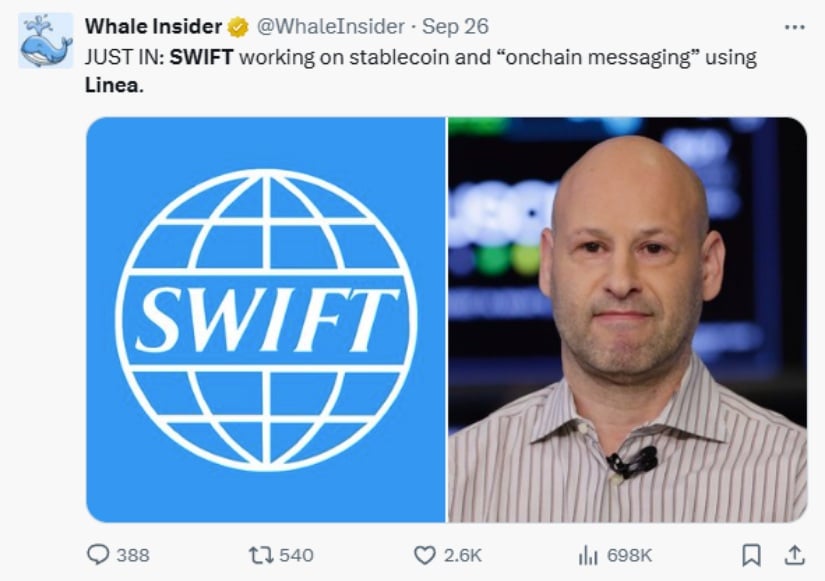
Source: @WhaleInsider
However, according to The Big Whale’s report, stablecoins are only “under consideration” and the interbank token project remains under review. No official releases have been confirmed.
If successful, this would put SWIFT in direct competition with blockchain payment networks like Ripple, which has long promoted itself as a faster, cheaper alternative to traditional banking rails.
Market Reacts Positively
News of the partnership sent Linea’s token price up over 14% within hours of the announcement. The token jumped from $0.02544 to $0.02814 as trading volume increased by 6%.
This follows SWIFT’s broader push into digital assets. The organization completed tokenized fund settlement tests with UBS and Chainlink in November 2024. It also launched live digital asset trials across North America, Europe, and Asia in October 2024.
The banking world is watching closely. Stablecoin markets have grown to over $295 billion, up 42% since January, according to industry data. Traditional financial institutions increasingly see digital assets as the future of money.
What This Means for the Future
This pilot represents more than just another blockchain experiment. It signals that established financial infrastructure is ready to embrace new technology while maintaining regulatory compliance.
Success could speed up regulatory approval for blockchain-based settlements worldwide. It might also encourage other major financial networks to adopt similar technology.
The pilot builds on SWIFT’s participation in the Bank for International Settlements’ Project Agora and collaboration with central bank digital currency initiatives. These efforts show the organization’s commitment to staying relevant as finance goes digital.
The Bottom Line
SWIFT’s blockchain pilot with Linea could reshape global banking if successful. The combination of established financial infrastructure with cutting-edge blockchain technology offers a path forward that satisfies both innovation and regulation.
While official confirmation is still pending, the involvement of major banks suggests this is a serious effort rather than just another proof-of-concept. The coming months will determine whether traditional finance and blockchain can work together at scale.
You May Also Like
Trust Wallet’s Decisive Move: Full Compensation for $7M Hack Victims

Cashing In On University Patents Means Giving Up On Our Innovation Future