A new partnership aims to unlock retail access to government bonds through blockchain tokenization, lowering barriers to investment and expanding financial inclusion across Africa.A new partnership aims to unlock retail access to government bonds through blockchain tokenization, lowering barriers to investment and expanding financial inclusion across Africa.

Tokenization Platform Libeara Partners GFX to Drive Pan-African Financial Inclusion
Tokenization Platform Libeara Partners GFX to Drive Pan-African Financial Inclusion

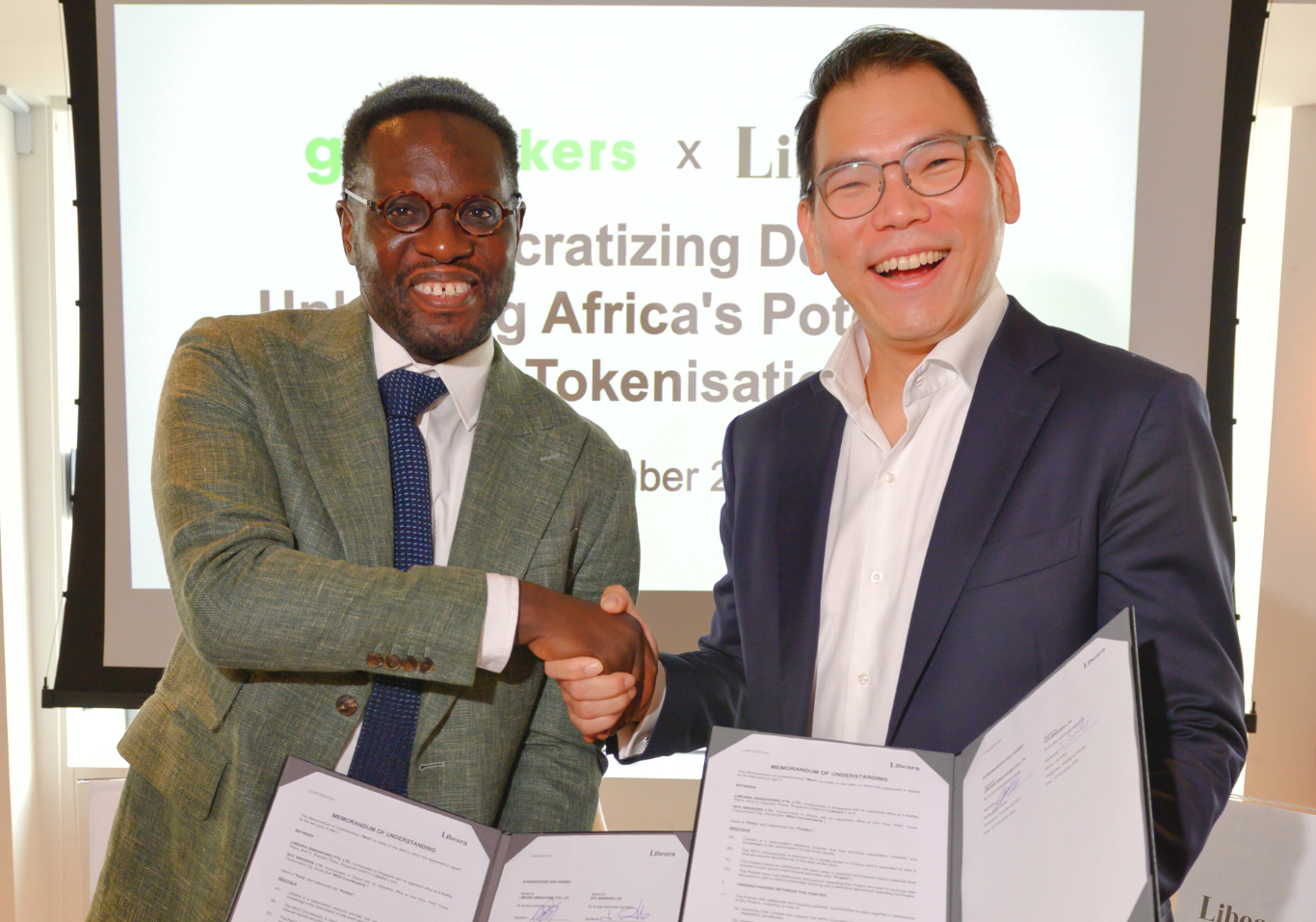
In a landmark move for financial innovation, Ghana-based brokerage firm GFX announced today that it has entered into a strategic partnership with Libeara, a tokenization platform backed by Standard Chartered Ventures, to explore the tokenisation of government-issued financial instruments, with the aim of providing inclusive access to regulated financial instruments across Africa.   

The partnership, unveiled Thursday at the Singapore FinTech Festival, marks a significant milestone in the growing pace of innovation in African financial markets.

For many ordinary Africans, investing directly in their own country’s development through government bonds or other state-backed financial instruments remains a challenge, primarily due to prohibitively high minimum investment amounts, which reserve such investments for institutional investors and the wealthy, leaving the broader public sidelined from such opportunities which would otherwise promote personal savings, stability and wealth creation.

The reasons behind the high minimum investment amounts are multifaceted and rooted in the realities of not just Africa’s markets, but many emerging public debt markets globally. One of the key considerations is the need to weigh the high administrative cost of managing a large number of smaller investors against the more pragmatic “institutional-first" approach, which allows governments to raise substantial capital more efficiently, but require much higher minimum investment amounts. 

Representing government bonds as digital tokens on a blockchain allows tokenization to deliver efficiency in how these assets can be traded and managed. The use of smart contracts to automate settlement and compliance workflows drastically reduces reconciliation time, counterparty risk, and operational costs. The resulting cost savings make lower minimum investments viable which in turn opens access to retail investors.

"On a continent where the majority of savings remain outside the traditional financial system, our mission is to create a new bridge: one where anyone with a smartphone and five dollars in their pocket can invest in their nation's future with dignity," said Joe Anka, CEO of GFX. 

Assets will be tokenized using Libeara’s tokenisation platform; the same digital infrastructure supports over $1 billion in regulated on-chain real world assets today.

 “Libeara is bringing the real-world assets on-chain one step at a time, in a safe and compliant manner, and we are proud to make headway into the African continent through this initiative,” said Aaron Gwak, founder and CEO of Libeara.

“This partnership highlights the importance of tokenization serving real-world needs – enabling financial inclusion in underserved markets. We believe that access to stable, high-quality financial instruments should not be the privilege of the few – but a fundamental right for all, so that everyday Africans can own a piece of their nation’s economic future,” he added. 

The Bank of Ghana is making strides in ensuring safe, regulated innovation in digital assets with its forthcoming Virtual Asset Services Providers (VASP) Bill, which will establish the regulatory framework to allow this novel application of blockchain technology to regulated real-world assets to scale securely and in compliance with the existing local laws. The Bank of Ghana will oversee the new framework with the Securities and Exchange Commission of Ghana to ensure investor protection and the continuous innovation of the Ghanaian financial services sector.

In the interim, the Bank of Ghana’s regulatory sandbox provides a controlled environment for innovators to test digital asset and blockchain-based financial solutions under real market conditions, but within a framework of regulatory supervision and risk mitigation before the VASP Bill regime takes effect.

➢ Stay ahead of the curve. Join Blockhead on Telegram today for all the latest in crypto.
+ Follow Blockhead on Google News
Disclaimer: The articles reposted on this site are sourced from public platforms and are provided for informational purposes only. They do not necessarily reflect the views of MEXC. All rights remain with the original authors. If you believe any content infringes on third-party rights, please contact [email protected] for removal. MEXC makes no guarantees regarding the accuracy, completeness, or timeliness of the content and is not responsible for any actions taken based on the information provided. The content does not constitute financial, legal, or other professional advice, nor should it be considered a recommendation or endorsement by MEXC.

You May Also Like

Santander’s Openbank Sparks Crypto Frenzy in Germany

Santander’s Openbank Sparks Crypto Frenzy in Germany

 In Germany, the digital bank Santander Openbank introduces trading in crypto, which offers BTC, ETH, LTC, POL, and ADA in the MiCA framework of the EU. Santander, the largest bank in Spain, has officially introduced cryptocurrency trading to its clients in Germany, using its digital division, Openbank.  With this new service, users can purchase, sell, […] The post Santander’s Openbank Sparks Crypto Frenzy in Germany appeared first on Live Bitcoin News.
Share
LiveBitcoinNews2025/09/18 04:30
China Blocks Nvidia’s RTX Pro 6000D as Local Chips Rise

China Blocks Nvidia’s RTX Pro 6000D as Local Chips Rise

The post China Blocks Nvidia’s RTX Pro 6000D as Local Chips Rise appeared on BitcoinEthereumNews.com. China Blocks Nvidia’s RTX Pro 6000D as Local Chips Rise China’s internet regulator has ordered the country’s biggest technology firms, including Alibaba and ByteDance, to stop purchasing Nvidia’s RTX Pro 6000D GPUs. According to the Financial Times, the move shuts down the last major channel for mass supplies of American chips to the Chinese market. Why Beijing Halted Nvidia Purchases Chinese companies had planned to buy tens of thousands of RTX Pro 6000D accelerators and had already begun testing them in servers. But regulators intervened, halting the purchases and signaling stricter controls than earlier measures placed on Nvidia’s H20 chip. Image: Nvidia An audit compared Huawei and Cambricon processors, along with chips developed by Alibaba and Baidu, against Nvidia’s export-approved products. Regulators concluded that Chinese chips had reached performance levels comparable to the restricted U.S. models. This assessment pushed authorities to advise firms to rely more heavily on domestic processors, further tightening Nvidia’s already limited position in China. China’s Drive Toward Tech Independence The decision highlights Beijing’s focus on import substitution — developing self-sufficient chip production to reduce reliance on U.S. supplies. “The signal is now clear: all attention is focused on building a domestic ecosystem,” said a representative of a leading Chinese tech company. Nvidia had unveiled the RTX Pro 6000D in July 2025 during CEO Jensen Huang’s visit to Beijing, in an attempt to keep a foothold in China after Washington restricted exports of its most advanced chips. But momentum is shifting. Industry sources told the Financial Times that Chinese manufacturers plan to triple AI chip production next year to meet growing demand. They believe “domestic supply will now be sufficient without Nvidia.” What It Means for the Future With Huawei, Cambricon, Alibaba, and Baidu stepping up, China is positioning itself for long-term technological independence. Nvidia, meanwhile, faces…
Share
BitcoinEthereumNews2025/09/18 01:37
Ripple-Backed Evernorth Faces $220M Loss on XRP Holdings Amid Market Slump

Ripple-Backed Evernorth Faces $220M Loss on XRP Holdings Amid Market Slump

TLDR Evernorth invested $947M in XRP, now valued at $724M, a loss of over $220M. XRP’s price dropped 16% in the last 30 days, leading to Evernorth’s paper losses
Share
Coincentral2025/12/26 03:56