Bitcoin Cash gains 7% and reaches $647, hitting highs not seen since last April: the movement fits into a risk-on climate.Bitcoin Cash gains 7% and reaches $647, hitting highs not seen since last April: the movement fits into a risk-on climate.

Bitcoin Cash: price +7% at $647, breakout and key levels (09/18/2025)
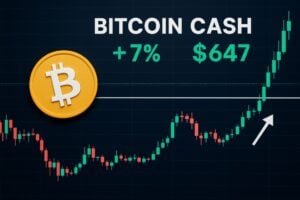
Bitcoin Cash gains 7% and reaches $647, at highs not seen since last April: the movement fits into a risk-on climate, driven by speculation of new US ETFs Reuters and by a technical breakout that revives the trend. In this context, here’s what changes and which levels to follow.

According to data collected by our research desk, there has been an increase in participation on spot and futures order books for BCH over the last 48 hours, with heightened activity on major exchanges.

The analysts from the team also observe a relative increase in open interest, an element that has helped sustain the movement during the breakout. For more insights into the exchanges and prices of Bitcoin Cash (BCH), please refer to our latest report.

Rally in numbers: what happened

The price of BCH has advanced by 7% in the last 24 hours, peaking at $646 and an intraday update to $647. According to data from CoinDesk, the rebound brings the asset back to the highs observed since April 2024, after weeks of bearish pressure that had slowed the momentum.

The return of liquidity to the market and the improvement in sentiment – also highlighted by the recent Fed rate cut, as reported by Reuters – have favored widespread buying.

Indeed, short-term trading activity has also increased, demonstrating greater risk tolerance and a rotation towards high-beta assets.

Key Metrics (update September 18, 2025)

  • Indicative price: $647 (intraday)
  • 24h Change: +7%
  • 24h Range: data updating
  • 24h Volume: data updating
  • Market cap: data being updated
  • Circulating supply: data being updated
  • Price source: CoinDesk; sentiment: Santiment (X)

Why BCH Rose: Macro and Regulatory Context

The BCH rally fits into a more favorable macro context. Expectations of lower rates in the USA – confirmed by the recent Fed rate cut Reuters – have helped reduce stress on the dollar, pushing more volatile assets towards greater consolidation. In this framework, the debate on new US crypto ETFs has galvanized institutional interest.

On the regulatory front, decisions like that of the Securities and Exchange Commission to approve generic standards for the listing of ETFs linked to commodities and crypto support sentiment, although the concrete outcomes remain yet to be defined.

For further insights and weekly analyses on flows towards digital asset products, refer also to industry reports such as CoinShares Research. While awaiting further details, for official documents refer to the institutional portals of the Federal Reserve and the SEC.

The excitement around crypto ETFs has historically favored the expansion of spot demand, catalyzing further investments.

Technical Analysis: Breakouts and Levels to Monitor

The technical framework has further strengthened with a confirmed breakout in July, which saw the price of BCH surpass the upper line of a channel formed by the highs of April 2024 and December 2024, and the lows of August 2024 and April 2025.

That said, the exit from the structure indicates the absorption of bearish pressure and an improvement in momentum.

Key Technical Levels

  • Immediate resistance: $700 area (psychological)
  • Key resistance: $719, corresponding to the 2024 high
  • Dynamic supports: area of the broken channel (retest), with a focus on recent local lows
  • Historical context: channel reference highs – April 2024 and December 2024; lows – August 2024 and April 2025

A close above $700 would confirm the signal of strength. Conversely, a clear rejection of these supports would increase the risk of a return of volatility.

Market on Track: Rotation to Altcoins

The risk-on climate has also involved other mid-cap altcoins. In recent movements, tokens like DOT, SUI, JUP, and NEAR have shown resilience, while smaller cryptocurrencies like PENGU have recorded double-digit shifts, highlighting the market’s inclination to seek returns in a context of growing confidence.

  • Mid-cap in focus: DOT, SUI, JUP, NEAR
  • Speculative/meme: PENGU
  • Common driver: improvement in sentiment and greater risk appetite

Regulatory Impact: What Can Change

Clearer standards for the listing of crypto ETFs could reduce uncertainty and simplify the arrival of new products. However, approval times and requirements remain at the discretion of the authorities, with processes that could be prolonged and require additional documentation.

The message for the market is that greater regulatory transparency could encourage more stable capital inflows, while maintaining a risk buffer that could reignite volatility in the absence of definitive decisions.

Stability of the $647 Level: Assessment and Scenarios

The intraday level at $647 marks an improvement in momentum, but it does not represent a definitive threshold. Its confirmation will depend on trading volumes and the price reaction in the resistance zones at $700–$719.

In this context, a breakout above these levels could validate the continuation of the trend, while a strong rejection could push the price towards the channel supports.

Transitions and Reading the Big Picture

In summary, the recent BCH rally stems from the intersection of three factors: a more favorable macroeconomic context, an evolving regulatory narrative, and a credible technical signal.

The synergy between these elements amplifies the potential trend, while still leaving room for possible corrections in case of surprises related to rates, regulation, or liquidity.

Note on sources and data

  • Price and changes: CoinDesk
  • Sentiment and on-chain activity: Santiment on X
  • Official documents: Federal Reserve; SEC

To be integrated, when available: precise timestamp of the peak (UTC/CET time), volumes and market cap at the time of the intraday high, direct link to the specific SEC document on the listing standards mentioned.

Conclusion

The movement of BCH combines technical elements and macroeconomic factors. The recent breakout strengthens the token’s outlook, while the anticipation of lower rates and the approval of crypto ETFs supports sentiment.
The next hurdles to overcome are the $700 area and the resistance at $719, levels that will provide crucial indications on the continuation of the trend.

Market Opportunity
GAINS Logo
GAINS Price(GAINS)
$0.011
$0.011$0.011
-1.69%
USD
GAINS (GAINS) Live Price Chart
Disclaimer: The articles reposted on this site are sourced from public platforms and are provided for informational purposes only. They do not necessarily reflect the views of MEXC. All rights remain with the original authors. If you believe any content infringes on third-party rights, please contact [email protected] for removal. MEXC makes no guarantees regarding the accuracy, completeness, or timeliness of the content and is not responsible for any actions taken based on the information provided. The content does not constitute financial, legal, or other professional advice, nor should it be considered a recommendation or endorsement by MEXC.

You May Also Like

21Shares Launches JitoSOL Staking ETP on Euronext for European Investors

21Shares Launches JitoSOL Staking ETP on Euronext for European Investors

21Shares launches JitoSOL staking ETP on Euronext, offering European investors regulated access to Solana staking rewards with additional yield opportunities.Read
Share
Coinstats2026/01/30 12:53
Digital Asset Infrastructure Firm Talos Raises $45M, Valuation Hits $1.5 Billion

Digital Asset Infrastructure Firm Talos Raises $45M, Valuation Hits $1.5 Billion

Robinhood, Sony and trading firms back Series B extension as institutional crypto trading platform expands into traditional asset tokenization
Share
Blockhead2026/01/30 13:30
Summarize Any Stock’s Earnings Call in Seconds Using FMP API

Summarize Any Stock’s Earnings Call in Seconds Using FMP API

Turn lengthy earnings call transcripts into one-page insights using the Financial Modeling Prep APIPhoto by Bich Tran Earnings calls are packed with insights. They tell you how a company performed, what management expects in the future, and what analysts are worried about. The challenge is that these transcripts often stretch across dozens of pages, making it tough to separate the key takeaways from the noise. With the right tools, you don’t need to spend hours reading every line. By combining the Financial Modeling Prep (FMP) API with Groq’s lightning-fast LLMs, you can transform any earnings call into a concise summary in seconds. The FMP API provides reliable access to complete transcripts, while Groq handles the heavy lifting of distilling them into clear, actionable highlights. In this article, we’ll build a Python workflow that brings these two together. You’ll see how to fetch transcripts for any stock, prepare the text, and instantly generate a one-page summary. Whether you’re tracking Apple, NVIDIA, or your favorite growth stock, the process works the same — fast, accurate, and ready whenever you are. Fetching Earnings Transcripts with FMP API The first step is to pull the raw transcript data. FMP makes this simple with dedicated endpoints for earnings calls. If you want the latest transcripts across the market, you can use the stable endpoint /stable/earning-call-transcript-latest. For a specific stock, the v3 endpoint lets you request transcripts by symbol, quarter, and year using the pattern: https://financialmodelingprep.com/api/v3/earning_call_transcript/{symbol}?quarter={q}&year={y}&apikey=YOUR_API_KEY here’s how you can fetch NVIDIA’s transcript for a given quarter: import requestsAPI_KEY = "your_api_key"symbol = "NVDA"quarter = 2year = 2024url = f"https://financialmodelingprep.com/api/v3/earning_call_transcript/{symbol}?quarter={quarter}&year={year}&apikey={API_KEY}"response = requests.get(url)data = response.json()# Inspect the keysprint(data.keys())# Access transcript contentif "content" in data[0]: transcript_text = data[0]["content"] print(transcript_text[:500]) # preview first 500 characters The response typically includes details like the company symbol, quarter, year, and the full transcript text. If you aren’t sure which quarter to query, the “latest transcripts” endpoint is the quickest way to always stay up to date. Cleaning and Preparing Transcript Data Raw transcripts from the API often include long paragraphs, speaker tags, and formatting artifacts. Before sending them to an LLM, it helps to organize the text into a cleaner structure. Most transcripts follow a pattern: prepared remarks from executives first, followed by a Q&A session with analysts. Separating these sections gives better control when prompting the model. In Python, you can parse the transcript and strip out unnecessary characters. A simple way is to split by markers such as “Operator” or “Question-and-Answer.” Once separated, you can create two blocks — Prepared Remarks and Q&A — that will later be summarized independently. This ensures the model handles each section within context and avoids missing important details. Here’s a small example of how you might start preparing the data: import re# Example: using the transcript_text we fetched earliertext = transcript_text# Remove extra spaces and line breaksclean_text = re.sub(r'\s+', ' ', text).strip()# Split sections (this is a heuristic; real-world transcripts vary slightly)if "Question-and-Answer" in clean_text: prepared, qna = clean_text.split("Question-and-Answer", 1)else: prepared, qna = clean_text, ""print("Prepared Remarks Preview:\n", prepared[:500])print("\nQ&A Preview:\n", qna[:500]) With the transcript cleaned and divided, you’re ready to feed it into Groq’s LLM. Chunking may be necessary if the text is very long. A good approach is to break it into segments of a few thousand tokens, summarize each part, and then merge the summaries in a final pass. Summarizing with Groq LLM Now that the transcript is clean and split into Prepared Remarks and Q&A, we’ll use Groq to generate a crisp one-pager. The idea is simple: summarize each section separately (for focus and accuracy), then synthesize a final brief. Prompt design (concise and factual) Use a short, repeatable template that pushes for neutral, investor-ready language: You are an equity research analyst. Summarize the following earnings call sectionfor {symbol} ({quarter} {year}). Be factual and concise.Return:1) TL;DR (3–5 bullets)2) Results vs. guidance (what improved/worsened)3) Forward outlook (specific statements)4) Risks / watch-outs5) Q&A takeaways (if present)Text:<<<{section_text}>>> Python: calling Groq and getting a clean summary Groq provides an OpenAI-compatible API. Set your GROQ_API_KEY and pick a fast, high-quality model (e.g., a Llama-3.1 70B variant). We’ll write a helper to summarize any text block, then run it for both sections and merge. import osimport textwrapimport requestsGROQ_API_KEY = os.environ.get("GROQ_API_KEY") or "your_groq_api_key"GROQ_BASE_URL = "https://api.groq.com/openai/v1" # OpenAI-compatibleMODEL = "llama-3.1-70b" # choose your preferred Groq modeldef call_groq(prompt, temperature=0.2, max_tokens=1200): url = f"{GROQ_BASE_URL}/chat/completions" headers = { "Authorization": f"Bearer {GROQ_API_KEY}", "Content-Type": "application/json", } payload = { "model": MODEL, "messages": [ {"role": "system", "content": "You are a precise, neutral equity research analyst."}, {"role": "user", "content": prompt}, ], "temperature": temperature, "max_tokens": max_tokens, } r = requests.post(url, headers=headers, json=payload, timeout=60) r.raise_for_status() return r.json()["choices"][0]["message"]["content"].strip()def build_prompt(section_text, symbol, quarter, year): template = """ You are an equity research analyst. Summarize the following earnings call section for {symbol} ({quarter} {year}). Be factual and concise. Return: 1) TL;DR (3–5 bullets) 2) Results vs. guidance (what improved/worsened) 3) Forward outlook (specific statements) 4) Risks / watch-outs 5) Q&A takeaways (if present) Text: <<< {section_text} >>> """ return textwrap.dedent(template).format( symbol=symbol, quarter=quarter, year=year, section_text=section_text )def summarize_section(section_text, symbol="NVDA", quarter="Q2", year="2024"): if not section_text or section_text.strip() == "": return "(No content found for this section.)" prompt = build_prompt(section_text, symbol, quarter, year) return call_groq(prompt)# Example usage with the cleaned splits from Section 3prepared_summary = summarize_section(prepared, symbol="NVDA", quarter="Q2", year="2024")qna_summary = summarize_section(qna, symbol="NVDA", quarter="Q2", year="2024")final_one_pager = f"""# {symbol} Earnings One-Pager — {quarter} {year}## Prepared Remarks — Key Points{prepared_summary}## Q&A Highlights{qna_summary}""".strip()print(final_one_pager[:1200]) # preview Tips that keep quality high: Keep temperature low (≈0.2) for factual tone. If a section is extremely long, chunk at ~5–8k tokens, summarize each chunk with the same prompt, then ask the model to merge chunk summaries into one section summary before producing the final one-pager. If you also fetched headline numbers (EPS/revenue, guidance) earlier, prepend them to the prompt as brief context to help the model anchor on the right outcomes. Building the End-to-End Pipeline At this point, we have all the building blocks: the FMP API to fetch transcripts, a cleaning step to structure the data, and Groq LLM to generate concise summaries. The final step is to connect everything into a single workflow that can take any ticker and return a one-page earnings call summary. The flow looks like this: Input a stock ticker (for example, NVDA). Use FMP to fetch the latest transcript. Clean and split the text into Prepared Remarks and Q&A. Send each section to Groq for summarization. Merge the outputs into a neatly formatted earnings one-pager. Here’s how it comes together in Python: def summarize_earnings_call(symbol, quarter, year, api_key, groq_key): # Step 1: Fetch transcript from FMP url = f"https://financialmodelingprep.com/api/v3/earning_call_transcript/{symbol}?quarter={quarter}&year={year}&apikey={api_key}" resp = requests.get(url) resp.raise_for_status() data = resp.json() if not data or "content" not in data[0]: return f"No transcript found for {symbol} {quarter} {year}" text = data[0]["content"] # Step 2: Clean and split clean_text = re.sub(r'\s+', ' ', text).strip() if "Question-and-Answer" in clean_text: prepared, qna = clean_text.split("Question-and-Answer", 1) else: prepared, qna = clean_text, "" # Step 3: Summarize with Groq prepared_summary = summarize_section(prepared, symbol, quarter, year) qna_summary = summarize_section(qna, symbol, quarter, year) # Step 4: Merge into final one-pager return f"""# {symbol} Earnings One-Pager — {quarter} {year}## Prepared Remarks{prepared_summary}## Q&A Highlights{qna_summary}""".strip()# Example runprint(summarize_earnings_call("NVDA", 2, 2024, API_KEY, GROQ_API_KEY)) With this setup, generating a summary becomes as simple as calling one function with a ticker and date. You can run it inside a notebook, integrate it into a research workflow, or even schedule it to trigger after each new earnings release. Free Stock Market API and Financial Statements API... Conclusion Earnings calls no longer need to feel overwhelming. With the Financial Modeling Prep API, you can instantly access any company’s transcript, and with Groq LLM, you can turn that raw text into a sharp, actionable summary in seconds. This pipeline saves hours of reading and ensures you never miss the key results, guidance, or risks hidden in lengthy remarks. Whether you track tech giants like NVIDIA or smaller growth stocks, the process is the same — fast, reliable, and powered by the flexibility of FMP’s data. Summarize Any Stock’s Earnings Call in Seconds Using FMP API was originally published in Coinmonks on Medium, where people are continuing the conversation by highlighting and responding to this story
Share
Medium2025/09/18 14:40