The industry is realizing that Bitcoin was deliberately designed to prioritize simple, deterministic validation over complex on-chain execution. This design choiceThe industry is realizing that Bitcoin was deliberately designed to prioritize simple, deterministic validation over complex on-chain execution. This design choice

Why Bitcoin Prioritizes Simple Validation Over Complex Execution

2026/01/01 02:00

The industry is realizing that Bitcoin was deliberately designed to prioritize simple, deterministic validation over complex on-chain execution. This design choice minimizes resource requirements, preserves decentralization, and reduces systemic risk even if it means pushing complex logic, programmability, and heavy computation to higher layers or external systems.

How Bitcoin Avoids Complex State Transitions

The fundamental limitation of Bitcoin is its inability to run heavy verification logic at a low cost, a core constraint that every BitVM-based bridge must navigate. According to the GOAT Network post on X, to address these issues, they are introducing a BitVM2 design that will ensure disputes are affordable enough to be executed under real fee conditions. The security mechanism is addressed through optimistic verification using garbled circuits (GC).

This operator, which is set to launch soon, publishes the garbled-circuit artifacts off-chain, while committing only the relevant labels on-chain. If the computation is correct, no on-chain action will be required. Meanwhile, if something is wrong, a challenger does not need to replay an expensive computation on-chain. 

Instead, they produce a minimal fraud-proof to reveal the output “0” label that contradicts the operator’s claimed result. At that point, the on-chain step is about demonstrating a contradiction, which will reduce the cost of disputes and change the economics of security. 

A practical detail in BitVM designs is that the garbled circuit size matters, and pairing heavy verification can cause bloated circuits. To avoid this, BitVM2 integrates a designated-verifier SNARK, which reduces verifier complexity so that the garbled circuits remain within realistic size limits. For end users, the implication is that the cheaper, more reliable depute paths make it harder for the bridge to stall when the fees spike. 

Public Companies Are Becoming Bitcoin’s Strongest Buyers

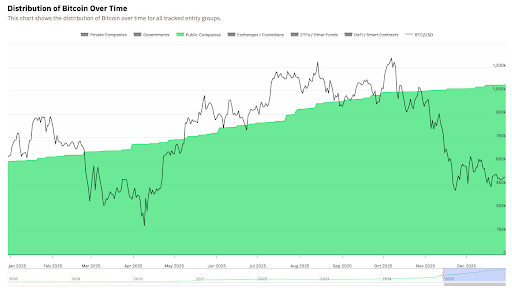
While several projects are being introduced to improve the efficiency of Bitcoin, seasoned crypto expert and the founder of the Wealth Mastery Newspaper, Lark Davis, has revealed that many public companies are aggressively accumulating BTC. Currently, public companies collectively hold 1.09 million BTC, representing 5.1% of the total BTC supply, which is a new all-time high.

However, the latest major aggressive purchases have come from MicroStrategy and Metaplanet. Strategy just announced another 1,200 BTC purchase, pushing its total holdings to 672,000 BTC. Asia-based firm Metaplanet also bought an additional 4,200 BTC in December, bringing its total holdings to 35,000 BTC.
Bitcoin

Davis pointed out that other recent purchases have come from Cango Inc., Bitdeer Technologies, and Anap Holdings. While retail investors are demonstrating weakening sentiment, public companies or institutional investors continue to stack regardless of the ongoing market.

Bitcoin
Market Opportunity
Core DAO Logo
Core DAO Price(CORE)
$0.0946
$0.0946$0.0946
-3.46%
USD
Core DAO (CORE) Live Price Chart
Disclaimer: The articles reposted on this site are sourced from public platforms and are provided for informational purposes only. They do not necessarily reflect the views of MEXC. All rights remain with the original authors. If you believe any content infringes on third-party rights, please contact [email protected] for removal. MEXC makes no guarantees regarding the accuracy, completeness, or timeliness of the content and is not responsible for any actions taken based on the information provided. The content does not constitute financial, legal, or other professional advice, nor should it be considered a recommendation or endorsement by MEXC.

You May Also Like

Vitalik Buterin Withdraws 16,384 ETH to Fund Open-Source Technology and Privacy Projects

Vitalik Buterin Withdraws 16,384 ETH to Fund Open-Source Technology and Privacy Projects

TLDR: Buterin withdrew 16,384 ETH to personally fund open-source projects as Ethereum Foundation reduces spending.  The initiative supports secure hardware, privacy
Share
Blockonomi2026/01/30 16:39
What is the most promising crypto right now? A practical checklist

What is the most promising crypto right now? A practical checklist

Crypto interest often spikes after headlines. This guide helps everyday readers turn curiosity into repeatable checks that limit obvious execution risks. We focus
Share
Coinstats2026/01/30 15:52
Inside Upexi’s SOL play: staking yield and locked token deals

Inside Upexi’s SOL play: staking yield and locked token deals

The post Inside Upexi’s SOL play: staking yield and locked token deals appeared on BitcoinEthereumNews.com. Upexi is the largest public company holding Solana tokens and uses a SOL strategy to build its holdings and generate additional revenue through staking. In an interview with crypto.news, Upexi CEO Allan Marshall explains why the company executed a large equity private placement to build a crypto treasury, citing MicroStrategy’s playbook and a more accommodating U.S. policy backdrop. Summary Upexi is the largest public holder of Solana, using equity raises to build a SOL treasury and earn staking yield. Upexi CEO Allan Marshall spoke with crypto.news in an interview. Corporate strategy focuses on accretive issuances, staking, and discounted locked SOL purchases, not venture investing. Upexi markets itself as a “new institutional gateway to Solana’s (SOL) speed, scale, and rapidly growing ecosystem.” But it isn’t alone, as it joins a handful of rival companies also building Solana treasuries, while dozens of other public entities are focusing on other coins. Speaking to crypto.news, Marshall discusses strategy and market perception. He notes that Upexi is focused on accretive capital raises, staking, and discounted, locked SOL purchases rather than venture investing. He also discusses how the company measures progress through an “adjusted SOL per share” metric designed to remove timing and leverage effects. We also discuss the company’s risk management strategies, which include a buy-and-hold approach, no hedging, disciplined use of leverage, and custody with qualified providers. The entire interview transcript is below: crypto.news: Upexi is now the largest corporate holder of Solana with over 2 million SOL in treasury. Why did you make such a dramatic shift now? Was there something specific that happened in the past few months that gave you the confidence to commit so heavily to a crypto treasury at this time? Allan Marshall: Upexi did the first large-scale equity private placement to create an altcoin treasury, and there were…
Share
BitcoinEthereumNews2025/09/20 02:51