Ethereum co-founder Vitalik Buterin has signaled a renewed commitment to decentralized social networks for 2026, arguing that platforms built on shared, open dataEthereum co-founder Vitalik Buterin has signaled a renewed commitment to decentralized social networks for 2026, arguing that platforms built on shared, open data

Vitalik Buterin Says He’ll Return to Decentralized Social in 2026

Vitalik Buterin Says He'll Return To Decentralized Social In 2026

Ethereum co-founder Vitalik Buterin has signaled a renewed commitment to decentralized social networks for 2026, arguing that platforms built on shared, open data layers are essential to fostering real competition and mass communication that serves users rather than engagement metrics. In a year marked by broader interest in SocialFi, Buterin has redirected much of his online activity toward decentralized platforms, noting that his 2026 posts have been accessed through Firefly, a cross-client interface that unifies access to X, Lens, Farcaster and Bluesky.

“If we want a better society, we need better mass communication tools,” Buterin said, arguing that decentralization enables competition by allowing multiple clients to operate on a shared social data layer. He criticized many crypto-native social projects for relying on speculative tokens as a substitute for meaningful innovation, arguing that SocialFi experiments have repeatedly failed by rewarding pre-existing social capital and short-term price speculation instead of content quality and constructive discourse. He contrasted these efforts with creator-subscription models such as Substack, which he said better align incentives around high-quality content. Calling for broader community participation, he urged users and builders to spend more time in decentralized social ecosystems, saying the industry must move beyond a single centralized “info warzone” and toward a more competitive frontier where new forms of online interaction can emerge.

The state of decentralized social media

Decentralized social media, or SocialFi, refers to platforms built on open or blockchain-based networks where user identities, content and social graphs are not controlled by a single company. While protocols such as Lens and Farcaster have gained early traction, the sector has so far struggled to translate that momentum into sustained mass-market adoption.

On Wednesday, core infrastructure provider Neynar acquired Farcaster from Merkle. Farcaster co-founder Dan Romero announced the news, saying that “after five years, it’s clear Farcaster needs a new approach and leadership to reach its full potential.”

Lens also underwent a leadership transition this week, as Aave transferred stewardship of the open-source social protocol to Mask Network, tasking the Web3 social company with advancing consumer-ready, on-chain social applications.

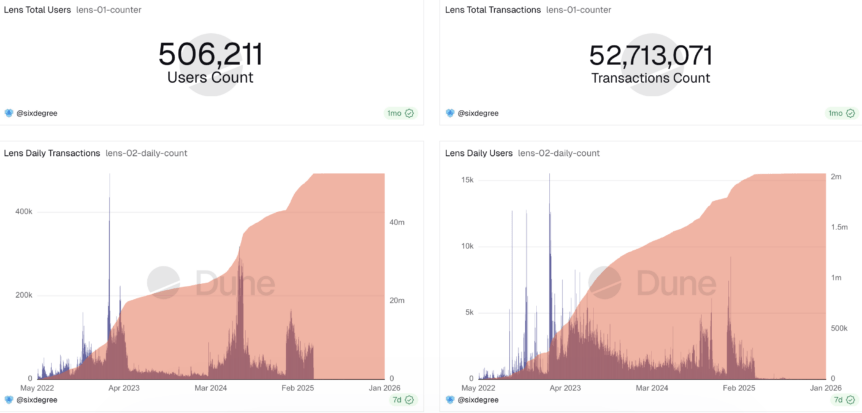
Farcaster features more than two million total registered users and hundreds of thousands of daily interactions, measured by posts and reactions. Lens has accumulated about 506,000 users, according to Dune Analytics data.

Source: Dune Analytics Ethereum, Vitalik Buterin, SocialFiSource: Dune Analytics
This article was originally published as Vitalik Buterin Says He’ll Return to Decentralized Social in 2026 on Crypto Breaking News – your trusted source for crypto news, Bitcoin news, and blockchain updates.

Market Opportunity
LightLink Logo
LightLink Price(LL)
$0.004443
$0.004443$0.004443
+0.49%
USD
LightLink (LL) Live Price Chart
Disclaimer: The articles reposted on this site are sourced from public platforms and are provided for informational purposes only. They do not necessarily reflect the views of MEXC. All rights remain with the original authors. If you believe any content infringes on third-party rights, please contact [email protected] for removal. MEXC makes no guarantees regarding the accuracy, completeness, or timeliness of the content and is not responsible for any actions taken based on the information provided. The content does not constitute financial, legal, or other professional advice, nor should it be considered a recommendation or endorsement by MEXC.

You May Also Like

Bitcoin ETFs Surge with 20,685 BTC Inflows, Marking Strongest Week

Bitcoin ETFs Surge with 20,685 BTC Inflows, Marking Strongest Week

TLDR Bitcoin ETFs recorded their strongest weekly inflows since July, reaching 20,685 BTC. U.S. Bitcoin ETFs contributed nearly 97% of the total inflows last week. The surge in Bitcoin ETF inflows pushed holdings to a new high of 1.32 million BTC. Fidelity’s FBTC product accounted for 36% of the total inflows, marking an 18-month high. [...] The post Bitcoin ETFs Surge with 20,685 BTC Inflows, Marking Strongest Week appeared first on CoinCentral.
Share
Coincentral2025/09/18 02:30
XAG/USD retreats toward $113.00 on profit-taking pressure

XAG/USD retreats toward $113.00 on profit-taking pressure

The post XAG/USD retreats toward $113.00 on profit-taking pressure appeared on BitcoinEthereumNews.com. Silver price (XAG/USD) halts its seven-day winning streak
Share
BitcoinEthereumNews2026/01/30 10:21
BTC Leverage Builds Near $120K, Big Test Ahead

BTC Leverage Builds Near $120K, Big Test Ahead

The post BTC Leverage Builds Near $120K, Big Test Ahead appeared on BitcoinEthereumNews.com. Key Insights: Heavy leverage builds at $118K–$120K, turning the zone into Bitcoin’s next critical resistance test. Rejection from point of interest with delta divergences suggests cooling momentum after the recent FOMC-driven spike. Support levels at $114K–$115K may attract buyers if BTC fails to break above $120K. BTC Leverage Builds Near $120K, Big Test Ahead Bitcoin was trading around $117,099, with daily volume close to $59.1 billion. The price has seen a marginal 0.01% gain over the past 24 hours and a 2% rise in the past week. Data shared by Killa points to heavy leverage building between $118,000 and $120,000. Heatmap charts back this up, showing dense liquidity bands in that zone. Such clusters of orders often act as magnets for price action, as markets tend to move where liquidity is stacked. Price Action Around the POI Analysis from JoelXBT highlights how Bitcoin tapped into a key point of interest (POI) during the recent FOMC-driven spike. This move coincided with what was called the “zone of max delta pain”, a level where aggressive volume left imbalances in order flow. Source: JoelXBT /X Following the test of this area, BTC faced rejection and began to pull back. Delta indicators revealed extended divergences, with price rising while buyer strength weakened. That mismatch suggests demand failed to keep up with the pace of the rally, leaving room for short-term cooling. Resistance and Support Levels The $118K–$120K range now stands as a major resistance band. A clean move through $120K could force leveraged shorts to cover, potentially driving further upside. On the downside, smaller liquidity clusters are visible near $114K–$115K. If rejection holds at the top, these levels are likely to act as the first supports where buyers may attempt to step in. Market Outlook Bitcoin’s next decisive move will likely form around the…
Share
BitcoinEthereumNews2025/09/18 16:40