Solana (SOL) price analysis: Testing $80 support with resistance at $85.50. ETF outflows return while RWA wallet count overtakes Ethereum for first time. The postSolana (SOL) price analysis: Testing $80 support with resistance at $85.50. ETF outflows return while RWA wallet count overtakes Ethereum for first time. The post

Solana (SOL) Price Analysis: Can $80 Support Hold Against Mounting Pressure?

2026/03/09 16:32
3 min read
For feedback or concerns regarding this content, please contact us at [email protected]

Key Takeaways

  • SOL touched $80.29 after breaking through critical support zones at $88 and $85
  • Immediate resistance appears at $85.50 where a bearish trend line has formed on the hourly timeframe
  • Despite $24 million in weekly ETF inflows, the final two trading sessions showed withdrawals
  • Derivatives Open Interest climbed 1% to reach $5.01 billion, while long liquidations totaled $15.52 million over 24 hours
  • The network surpassed Ethereum in wallet addresses holding RWAs, though ETH maintains a dominant $15.5 billion versus SOL’s $1.8 billion in total value

Solana experienced significant downward pressure throughout the previous week, plunging to $80.29 before mounting a modest recovery attempt. Current trading activity keeps the asset beneath the $85 threshold and the 100-hour simple moving average.
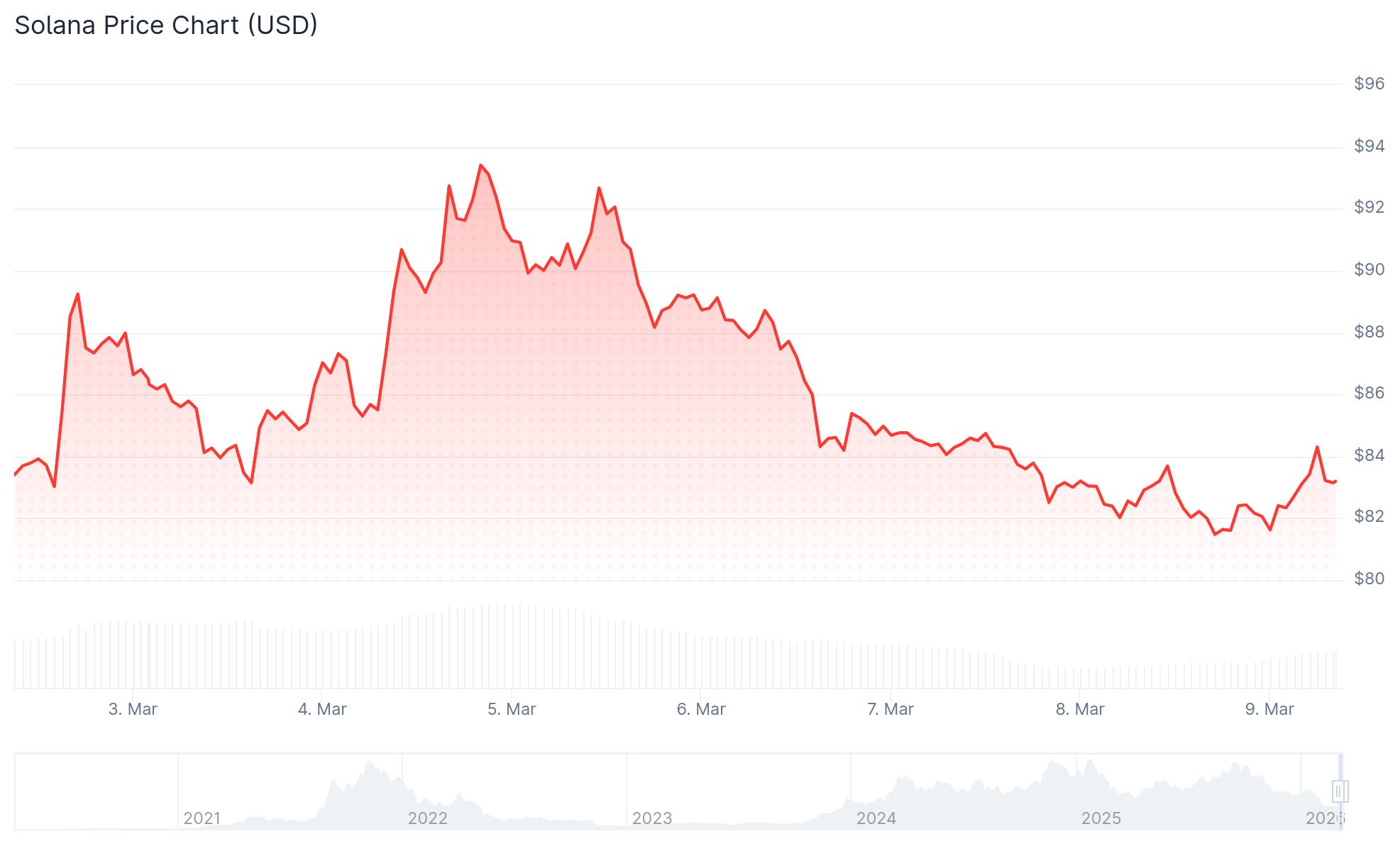
Solana (SOL) PriceSolana (SOL) Price

The decline materialized after bulls failed to defend the $90 level. SOL subsequently breached support at both $88 and $85 before establishing its recent bottom near the $80 mark.

Hourly chart analysis reveals a bearish trend line positioned at $85.50, currently serving as the primary near-term obstacle. The 50% Fibonacci retracement level from the latest selloff rests at $87.20, followed by more substantial resistance at $88.80.

Should SOL reclaim territory above $88.80, bulls would target $95 initially, with $102 representing the subsequent objective. Conversely, a breakdown beneath $80 would expose support zones at $72, followed by $65.

Monday’s session brought approximately 2% recovery following four consecutive days of declines. Nevertheless, the overarching technical picture remains negative. The token continues trading underneath its 50-day, 100-day, and 200-day exponential moving averages.

The Relative Strength Index registers 43, positioned below the neutral threshold of 50. Meanwhile, the MACD histogram displays contraction, signaling diminishing bullish momentum.

ETF Activity Reflects Market Uncertainty

United States-based spot Solana exchange-traded funds maintain approximately $800 million worth of SOL holdings. Total cumulative inflows reached $957 million through Friday, indicating institutional investors largely maintained their positions despite recent volatility.

Source: SoSoValue

The previous week registered $24 million in net positive flows. However, Thursday and Friday produced outflows of $5.23 million and $8.23 million respectively.

Market observers attribute the week-ending withdrawals to wider market headwinds stemming from escalating crude oil prices and mounting geopolitical uncertainty.

Derivatives market data shows Open Interest advanced 1% during a 24-hour period to $5.01 billion. Funding rates improved from -0.0161% to -0.0006%, suggesting decreased bearish sentiment among derivatives traders.

Despite this improvement, liquidations reached $19.79 million across the same timeframe. Long position eliminations accounted for $15.52 million of that total.

RWA Adoption Milestone Achieved

Solana now boasts 154,942 unique wallet addresses containing tokenized real-world assets, surpassing Ethereum’s count of 153,592. This marks the initial occurrence of Solana leading Ethereum in this particular measurement.

The expansion stems predominantly from retail market participants acquiring tokenized equity in corporations such as Tesla and Nvidia via Solana’s economical transaction fee structure.

Ethereum maintains dominance in total value locked, however, commanding $15.5 billion in tokenized RWA holdings against Solana’s $1.8 billion. The Ethereum ecosystem also accommodates 663 tokenization initiatives compared to Solana’s 345.

Major financial institutions including BlackRock and Fidelity leverage Ethereum for offerings like tokenized government securities and money market instruments. While Solana has attracted certain institutional deployments from BlackRock, its RWA ecosystem remains predominantly retail-focused.

SOL’s primary support level appears at $78.35, representing the final significant floor before $67.50, established by the February 6 low.

The post Solana (SOL) Price Analysis: Can $80 Support Hold Against Mounting Pressure? appeared first on Blockonomi.

Market Opportunity
Solana Logo
Solana Price(SOL)
$83.69
$83.69$83.69
+1.97%
USD
Solana (SOL) Live Price Chart
Disclaimer: The articles reposted on this site are sourced from public platforms and are provided for informational purposes only. They do not necessarily reflect the views of MEXC. All rights remain with the original authors. If you believe any content infringes on third-party rights, please contact [email protected] for removal. MEXC makes no guarantees regarding the accuracy, completeness, or timeliness of the content and is not responsible for any actions taken based on the information provided. The content does not constitute financial, legal, or other professional advice, nor should it be considered a recommendation or endorsement by MEXC.

You May Also Like

Crucial ETH Unstaking Period: Vitalik Buterin’s Unwavering Defense for Network Security

Crucial ETH Unstaking Period: Vitalik Buterin’s Unwavering Defense for Network Security

BitcoinWorld Crucial ETH Unstaking Period: Vitalik Buterin’s Unwavering Defense for Network Security Ever wondered why withdrawing your staked Ethereum (ETH) isn’t an instant process? It’s a question that often sparks debate within the crypto community. Ethereum founder Vitalik Buterin recently stepped forward to defend the network’s approximately 45-day ETH unstaking period, asserting its crucial role in safeguarding the network’s integrity. This lengthy waiting time, while sometimes seen as an inconvenience, is a deliberate design choice with profound implications for security. Why is the ETH Unstaking Period a Vital Security Measure? Vitalik Buterin’s defense comes amidst comparisons to other networks, like Solana, which boast significantly shorter unstaking times. He drew a compelling parallel to military operations, explaining that an army cannot function effectively if its soldiers can simply abandon their posts at a moment’s notice. Similarly, a blockchain network requires a stable and committed validator set to maintain its security. The current ETH unstaking period isn’t merely an arbitrary delay. It acts as a critical buffer, providing the network with sufficient time to detect and respond to potential malicious activities. If validators could instantly exit, it would open doors for sophisticated attacks, jeopardizing the entire system. Currently, Ethereum boasts over one million active validators, collectively staking approximately 35.6 million ETH, representing about 30% of the total supply. This massive commitment underpins the network’s robust security model, and the unstaking period helps preserve this stability. Network Security: Ethereum’s Paramount Concern A shorter ETH unstaking period might seem appealing for liquidity, but it introduces significant risks. Imagine a scenario where a large number of validators, potentially colluding, could quickly withdraw their stake after committing a malicious act. Without a substantial delay, the network would have limited time to penalize them or mitigate the damage. This “exit queue” mechanism is designed to prevent sudden validator exodus, which could lead to: Reduced decentralization: A rapid drop in active validators could concentrate power among fewer participants. Increased vulnerability to attacks: A smaller, less stable validator set is easier to compromise. Network instability: Frequent and unpredictable changes in validator numbers can lead to performance issues and consensus failures. Therefore, the extended period is not a bug; it’s a feature. It’s a calculated trade-off between immediate liquidity for stakers and the foundational security of the entire Ethereum ecosystem. Ethereum vs. Solana: Different Approaches to Unstaking When discussing the ETH unstaking period, many point to networks like Solana, which offers a much quicker two-day unstaking process. While this might seem like an advantage for stakers seeking rapid access to their funds, it reflects fundamental differences in network architecture and security philosophies. Solana’s design prioritizes speed and immediate liquidity, often relying on different consensus mechanisms and validator economics to manage security risks. Ethereum, on the other hand, with its proof-of-stake evolution from proof-of-work, has adopted a more cautious approach to ensure its transition and long-term stability are uncompromised. Each network makes design choices based on its unique goals and threat models. Ethereum’s substantial value and its role as a foundational layer for countless dApps necessitate an extremely robust security posture, making the current unstaking duration a deliberate and necessary component. What Does the ETH Unstaking Period Mean for Stakers? For individuals and institutions staking ETH, understanding the ETH unstaking period is crucial for managing expectations and investment strategies. It means that while staking offers attractive rewards, it also comes with a commitment to the network’s long-term health. Here are key considerations for stakers: Liquidity Planning: Stakers should view their staked ETH as a longer-term commitment, not immediately liquid capital. Risk Management: The delay inherently reduces the ability to react quickly to market volatility with staked assets. Network Contribution: By participating, stakers contribute directly to the security and decentralization of Ethereum, reinforcing its value proposition. While the current waiting period may not be “optimal” in every sense, as Buterin acknowledged, simply shortening it without addressing the underlying security implications would be a dangerous gamble for the network’s reliability. In conclusion, Vitalik Buterin’s defense of the lengthy ETH unstaking period underscores a fundamental principle: network security cannot be compromised for the sake of convenience. It is a vital mechanism that protects Ethereum’s integrity, ensuring its stability and trustworthiness as a leading blockchain platform. This deliberate design choice, while requiring patience from stakers, ultimately fortifies the entire ecosystem against potential threats, paving the way for a more secure and reliable decentralized future. Frequently Asked Questions (FAQs) Q1: What is the main reason for Ethereum’s long unstaking period? A1: The primary reason is network security. A lengthy ETH unstaking period prevents malicious actors from quickly withdrawing their stake after an attack, giving the network time to detect and penalize them, thus maintaining stability and integrity. Q2: How long is the current ETH unstaking period? A2: The current ETH unstaking period is approximately 45 days. This duration can fluctuate based on network conditions and the number of validators in the exit queue. Q3: How does Ethereum’s unstaking period compare to other blockchains? A3: Ethereum’s unstaking period is notably longer than some other networks, such as Solana, which has a two-day period. This difference reflects varying network architectures and security priorities. Q4: Does the unstaking period affect ETH stakers? A4: Yes, it means stakers need to plan their liquidity carefully, as their staked ETH is not immediately accessible. It encourages a longer-term commitment to the network, aligning staker interests with Ethereum’s stability. Q5: Could the ETH unstaking period be shortened in the future? A5: While Vitalik Buterin acknowledged the current period might not be “optimal,” any significant shortening would likely require extensive research and network upgrades to ensure security isn’t compromised. For now, the focus remains on maintaining robust network defenses. Found this article insightful? Share it with your friends and fellow crypto enthusiasts on social media to spread awareness about the critical role of the ETH unstaking period in Ethereum’s security! To learn more about the latest Ethereum trends, explore our article on key developments shaping Ethereum’s institutional adoption. This post Crucial ETH Unstaking Period: Vitalik Buterin’s Unwavering Defense for Network Security first appeared on BitcoinWorld.
Share
Coinstats2025/09/18 15:30
White House adviser: Cryptocurrency bill is "very close" to passage

White House adviser: Cryptocurrency bill is "very close" to passage

PANews reported on June 18 that according to Jinshi, a US White House adviser said that the cryptocurrency bill is "very close" to passage, which will create demand for the
Share
PANews2025/06/18 23:52
SEC approves Grayscale’s multi-crypto fund with XRP, SOL and ADA

SEC approves Grayscale’s multi-crypto fund with XRP, SOL and ADA

GDLC's approval coincides with SEC adopting generic listing standards for crypto ETFs, which would expedite the launch process.
Share
Coinstats2025/09/18 10:26