Crypto heavyweight Tether is reportedly in early-stage discussions to raise between $15-20B in a private equity round, offering about 3% of its equity. If successful, the deal could peg the company’s valuation at nearly $500B, placing it among the world’s most valuable private firms alongside names like OpenAI and SpaceX, and joining elite company at […]Crypto heavyweight Tether is reportedly in early-stage discussions to raise between $15-20B in a private equity round, offering about 3% of its equity. If successful, the deal could peg the company’s valuation at nearly $500B, placing it among the world’s most valuable private firms alongside names like OpenAI and SpaceX, and joining elite company at […]

Best Crypto to Buy Now Before Tether Goes Public in Potential $500B Raise

5 min read

Crypto heavyweight Tether is reportedly in early-stage discussions to raise between $15-20B in a private equity round, offering about 3% of its equity.

If successful, the deal could peg the company’s valuation at nearly $500B, placing it among the world’s most valuable private firms alongside names like OpenAI and SpaceX, and joining elite company at a stroke.

This would likely raise crypto adoption and investor interest in the industry, creating hype.

It should be high time you paid attention to the best cryptos to buy (like Bitcoin Hyper) if you don’t want to miss this speeding train.

Fundraise Reveals the Scale of Tether’s Ambition

Tether’s deal would involve new equity issuance, rather than existing shareholders selling down their stakes, according to the source.

Cantor Fitzgerald is reported to be the lead advisor; the company owns roughly a 5% stake in Tether already, a share worth $25B if Tether’s IPO achieved the upper range of its valuation.

That’s speculative, of course – the final terms and valuation of the IPO may differ substantially.

Still, the proposed terms indicate just how ambitious Tether’s plans are. Tether issues the $USDT stablecoin, the largest such crypto, with a circulating supply of $173B. That supply has increased steadily over the past year, as demand for stablecoins has grown.
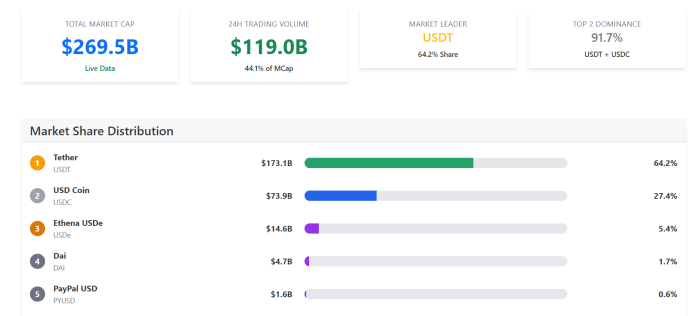
Stablecoin market overview.


More growth means more profits in Tether’s case; the company reported exceptionally strong profitability of $4.9B in Q2 2025 alone. That financial strength gives Tether a powerful base for any IPO plans.

U.S. Push and Regulatory Context

Part of those plans include a move into the U.S. market. Tether appointed Bo Hines, a former U.S. crypto policy official, as strategic adviser, and plans to launch a U.S.-oriented $USAT stablecoin.

USAT presentation page.

Why now? Regulatory headwinds that historically restrained its U.S. operations largely vanished earlier this year with the passing of the GENIUS stablecoin act.

That has created an opportunity for Tether – currently headquartered in South America – to expand and cater its operations to the US market.

Despite the hype, there are several uncertainties. The deal is still preliminary, so the valuation, stake dilution, and raise amount could all shift materially.

There’s also a bigger question; with Tether already highly profitable, why go public at all? Possible reasons include accelerating U.S. expansion, regulatory compliance, product diversification, or building reserves, but investors will want transparency over how the funds are deployed.

Regardless of how this plays out, even rumors of Tether’s move are enough to surge investors’ interest. Here are three of the best cryptos under $1 that could explode soon.

1. Bitcoin Hyper ($HYPER) – Faster, Cheaper, Better Bitcoin Layer 2

Bitcoin’s big, bad, and beautiful, with a $2.2T+ market cap and constant predictions of $150K, $200K, or even $1.5M.

But it’s also slow, with an average of 7 TPS, and has a low throughput; add a lot of traffic, and congestion can cause transaction speeds to drop and fees to jump. That’s where Bitcoin Hyper ($HYPER) comes in.

Leveraging a Canonical Bridge on the Solana Virtual Machine, Bitcoin Hyper introduces a Layer 2 that allows investors to bridge Bitcoin and create wrapped Bitcoin.

On the Hyper Layer 2, that wrapped Bitcoin can be swapped, traded, and deployed across the full range of decentralised finance in a way Bitcoin couldn’t be before now.

dApps, smart contracts, DAOs, NFT marketplaces, even GameFi applications: they could all come alive on Bitcoin through Bitcoin Hyper’s L2.
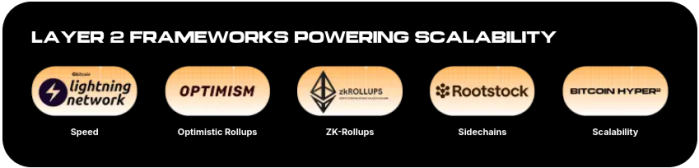
Bitcoin Hyper framework scalability and comparison.

The Bitcoin Hyper presale just passed $18M raised in the presale and shows no sign of slowing down.The token price is now set at $0.012975 but it won’t stay this cheap for too long. Our Bitcoin Hyper price prediction estimates a 2,366% increase by the end of the year.

Learn how to buy $HYPER, and check out our complete guide on what Bitcoin Hyper is and how it works.

Visit the $HYPER presale page to join before the next price increase.

2. Snorter Token ($SNORT) – Buy. Sell. Snipe. Win.

The best meme coins never see the light of day. They trade underground, rising and fading away again, but not before savvy investors make millions. The hardest part of trading them is finding them, and that’s where the Snorter Bot changes the game.

Snorter Bot and the Snorter Token ($SNORT) provide a cutting-edge meme coin trading tool.
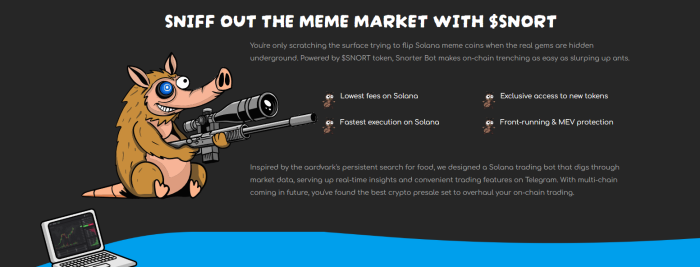
Snorter Token utility as shown on the presale page.

Native to Telegram and focused on Solana meme coins, Snorter sniffs out the best small-cap gems and gives traders all the tools they need to make winning plays. Those include:

  • Automated sniping
  • Rugpull protection
  • Copy trading
  • Honeypot detection
  • Limit orders

What is Snorter Token? It’s the tool that powers the best crypto trading bot. With over $4M raised, the presale continues to power forward towards the TGE.

Buy $SNORt at just $0.1053 before the presale ends in less than 26 days.

3. Aster ($ASTER) – 2,500% Gains for Up-and-Coming DeFi Platform

Back by CZ and benefiting from a wave of incoming TVL, Aster (the platform) has been on a roll recently. But $ASTER, the native utility token, has done even better.

In a single month since launch, $ASTER’s price increased over 2,500%.
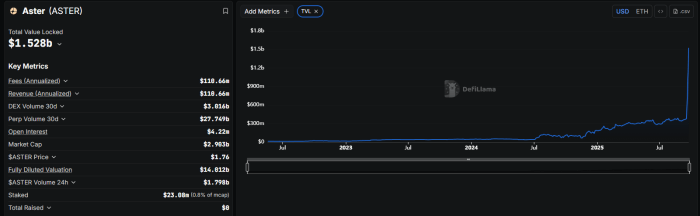
Aster TVL growth showing an abrupt climb recently.

That makes $ASTER one of the best plays of the resurgent DeFi scene. The platform, a decentralized perpetual contracts tool, has even drawn interest away from longstanding competitors in the field like Hyperliquid.

While $ASTER isn’t likely to grow at this rate forever, it’s already a proven contender.

Tether’s influence extends beyond its crypto business, holding tens of billions in U.S. Treasury bills, making it one of the largest non-sovereign purchasers of U.S. Treasuries.

Tether’s move might prompt re-assessments of how stablecoin issuers are valued compared to more traditional financial firms – and open the door for projects like $HYPER and $SNORT to skyrocket.

Recap: Bitcoin Hyper ($HYPER) is a utility-heavy altcoin focused on upscaling Bitcoin to modern demands, while Snorter Token ($SNORT) gives you the fastest and cheapest trading bot on Solana. And Aster ($ASTER) is a top DeFi buy right now.

Authored by Bogdan Patru, Bitcoinist – https://bitcoinist.com/best-crypto-to-buy-now-before-tether-goes-public

Market Opportunity
Wink Logo
Wink Price(LIKE)
$0.001984
$0.001984$0.001984
+2.26%
USD
Wink (LIKE) Live Price Chart
Disclaimer: The articles reposted on this site are sourced from public platforms and are provided for informational purposes only. They do not necessarily reflect the views of MEXC. All rights remain with the original authors. If you believe any content infringes on third-party rights, please contact [email protected] for removal. MEXC makes no guarantees regarding the accuracy, completeness, or timeliness of the content and is not responsible for any actions taken based on the information provided. The content does not constitute financial, legal, or other professional advice, nor should it be considered a recommendation or endorsement by MEXC.

You May Also Like

Trading time: Tonight, the US GDP and the upcoming non-farm data will become the market focus. Institutions are bullish on BTC to $120,000 in the second quarter.

Trading time: Tonight, the US GDP and the upcoming non-farm data will become the market focus. Institutions are bullish on BTC to $120,000 in the second quarter.

Daily market key data review and trend analysis, produced by PANews.
Share
PANews2025/04/30 13:50
Ethereum Fusaka Upgrade Set for December 3 Mainnet Launch, Blob Capacity to Double

Ethereum Fusaka Upgrade Set for December 3 Mainnet Launch, Blob Capacity to Double

Ethereum developers confirmed the Fusaka upgrade will activate on mainnet on December 3, 2025, following a systematic testnet rollout beginning on October 1 on Holesky. The major hard fork will implement around 11-12 Ethereum Improvement Proposals targeting scalability, node efficiency, and data availability improvements without adding new user-facing features. According to Christine Kim, the upgrade introduces a phased blob capacity expansion through Blob Parameter Only forks occurring two weeks after Fusaka activation. Initially maintaining current blob limits of 6/9 target/max, the first BPO fork will increase capacity to 10/15 blobs one week later. A second BPO fork will further expand limits to 14/21 blobs, more than doubling total capacity within two weeks. Strategic Infrastructure Overhaul Fusaka prioritizes backend protocol improvements over user-facing features, focusing on making Ethereum faster and less resource-intensive. The upgrade includes PeerDAS implementation through EIP-7594, allowing validator nodes to verify data by sampling small pieces rather than downloading entire blobs. This reduces bandwidth and storage requirements while enhancing Layer 2 rollup scalability. The upgrade builds on recent gas limit increases from 30 million to 45 million gas, with ongoing discussions for further expansion. EIP-7935 proposes increasing limits to 150 million gas, potentially enabling significantly higher transaction throughput. These improvements complement broader scalability efforts, including EIP-9698, which suggests a 100x gas limit increase over two years to reach 2,000 transactions per second. Fusaka removes the previously planned EVM Object Format redesign to reduce complexity while maintaining focus on essential infrastructure improvements. The upgrade introduces bounded base fees for blob transactions via EIP-7918, creating more predictable transaction costs for data-heavy applications. Enhanced spam resistance and security improvements strengthen network resilience against scalability bottlenecks and attacks. Technical Implementation and Testing Timeline The Fusaka rollout follows a conservative four-phase approach across Ethereum testnets before mainnet deployment. Holesky upgrade occurs October 1, followed by Sepolia on October 14 and Hoodi on October 28. Each testnet will undergo the complete BPO fork sequence to validate the blob capacity expansion mechanism. BPO forks activate automatically based on predetermined epochs rather than requiring separate hard fork processes. On mainnet, the first BPO fork launches December 17, increasing blob capacity to 10/15 target/max. The second BPO fork activates January 7, 2026, reaching the final capacity of 14/21 blobs. This automated approach enables flexible blob scaling without requiring full network upgrades. Notably, node operators face release deadlines ranging from September 25 for Holesky to November 3 for mainnet preparation. The staggered timeline, according to the developers, allows comprehensive testing while giving infrastructure providers sufficient preparation time. Speculatively, the developers use this backward-compatible approach to ensure smooth transitions with minimal disruption to existing applications. PeerDAS implementation reduces node resource demands, potentially increasing network decentralization by lowering barriers for smaller operators. The technology enables more efficient data availability sampling, crucial for supporting growing Layer 2 rollup adoption. Overall, these improvements, combined with increased gas limits, will enable Ethereum to handle higher transaction volumes while maintaining security guarantees. Addressing Network Scalability Pressures The Fusaka upgrade addresses mounting pressure for Ethereum base layer improvements amid criticism of Layer 2 fragmentation strategies. Critics argue that reliance on rollups has created isolated chains with limited interoperability, complicating user experiences. The upgrade’s focus on infrastructure improvements aims to enhance base layer capacity while supporting continued Layer 2 growth. The recent validator queue controversy particularly highlights ongoing network scalability challenges. According to a Cryptonews report covered yesterday, currently, over 2M ETH sits in exit queues facing 43-day delays, while entry queues process in just 7 days.Ethereum Validator Queue (Source: ValidatorQueue) However, Vitalik Buterin defended these delays as essential for network security, comparing validator commitments to military service requiring “friction in quitting.” The upgrade coincides with growing institutional interest in Ethereum infrastructure, with VanEck predicting that Layer 2 networks could reach $1 trillion market capitalization within six years. Fusaka’s emphasis on data availability and node efficiency supports Ethereum’s evolution toward seamless cross-chain interoperability. The upgrade complements initiatives like the Open Intents Framework, where Coinbase Payments recently joined as a core contributor. The initiative, if successful, will address the $21B surge in cross-chain crime. These coordinated efforts aim to unify the fragmented multichain experience while maintaining Ethereum’s security and decentralization principles
Share
CryptoNews2025/09/19 16:37
VectorUSA Achieves Fortinet’s Engage Preferred Services Partner Designation

VectorUSA Achieves Fortinet’s Engage Preferred Services Partner Designation

TORRANCE, Calif., Feb. 3, 2026 /PRNewswire/ — VectorUSA, a trusted technology solutions provider, specializes in delivering integrated IT, security, and infrastructure
Share
AI Journal2026/02/05 00:02
