As the global economy moves toward sustainability, green finance is growing as an important agent of corporate responsibility and conditional stability. Carbon credits are digital instruments that offset emissions within this ecosystem and may be used by businesses to finance initiatives that reduce or prevent greenhouse gas emissions. However, traditional carbon markets include verification gaps, uncertainty and inefficiency. The infrastructure for traceable, auditable, and tokenized carbon markets that integrate digital innovation and environmental effect is being provided by blockchain technology, which is currently changing this landscape. Systemic Inefficiencies in Legacy Carbon Registries Legacy carbon registries are based on centralized data silos, third-party verification and human verification methods. This architecture introduces operational bottlenecks, delayed authentication, and high transaction costs. The absence of a unified database has led to data duplication, inconsistent standards and even double issuance of credits across registries. From a technological standpoint, these centralized systems suffer with data provenance, or the capacity to monitor the origin, ownership, and legitimacy of carbon credits throughout their lifetime. Carbon credits are prone to greenwashing because they lack verifiable evidence of sustainability. The lack of real-time visibility further reduces market liquidity and institutional participation. Distributed Ledger Technology (DLT) as the Verification Backbone Distributed ledger technology (DLT), often referred to as blockchain, solves these issues by offering a decentralized, consensus-driven ledger that permanently logs every carbon transaction. A unique digital token can be provided for each credit, which includes metadata such as project ID, certification standards, verification timestamp, and emissions reduction measures. Blockchain eliminates single points of failure by using hash-based cryptographic verification to guarantee data integrity across multiple nodes. This decentralized verification paradigm makes the system self-auditable and impenetrable by substituting faith in the code for trust in middlemen. Furthermore, the issue, transfer, and retirement of credits are automated using smart contracts, which are self-executing code that is installed on the chain. To avoid duplicate or fraudulent reuse, the contract designates a credit as permanently retired after it has been utilized for offsetting. The integration of DLT fundamentally increases traceability and governance across the carbon asset lifecycle. Carbon Credit Tokenization and On-Chain Market Liquidity Carbon credits are converted from static registry entries into programmable digital assets by tokenization, which may then be linked into decentralized finance (DeFi) ecosystems, exchanged, or used as collateral. Transparent ownership and immediate payment are made possible by the fact that each tokenized credit is equivalent to a verifiable emission reduction. Blockchain promotes interoperability between carbon registers and marketplaces through tokenization. Whether in compliance-driven frameworks or voluntary carbon markets, credits may flow freely between ecosystems while still being fully auditable. Additionally, automatic compliance criteria may be included in smart contracts to guarantee that credits adhere to corporate ESG frameworks or jurisdictional regulations. Decentralized exchanges and liquidity pools can also be used to hold tokenized carbon assets. promoting continuous price discovery and democratizing access to climate financing. Integrating Real World Asset Frameworks with Green Finance The convergence of RWA tokenization and environmental finance marks a significant shift towards programmable sustainability. Organizations can establish hybrid systems where financial and ecological data coexist on the chain by tying blockchain tokens to verifiable physical or environmental results. Retail investors and small businesses that were previously shut out of institutional carbon markets now have access to carbon projects because to this paradigm, which permits fractional participation. In addition to lowering settlement latency, RWA tokenization preserves regulatory audit trails while facilitating almost immediate cross-border transactions. By anchoring digital tokens to verifiable real-world metrics — such as satellite imaging or IoT-based emissions monitoring — blockchain transforms sustainability from a reporting exercise into a data-driven proof-of-impact framework. Smart Contract Automation in Environmental Asset Management Smart contracts transform the way environmental assets are issued, exchanged and utilized. These self-executing applications use set logic embedded in the blockchain to eliminate human interference from essential operations. For example, once a carbon reduction project receives verification data from an accredited oracle, the contract can automatically mint a corresponding digital credit. When the credit is purchased and used, the system executes retirement functions instantly. This event driven architecture ensures transparency, compliance and auditability in real time. Combined with decentralized identity frameworks and verifiable credentials. Smart contracts create a fully automated compliance layer that can easily integrate with carbon registries. exchanges and enterprise sustainability platforms. Emergence of Regenerative Finance (ReFi) Ecosystems Regenerative finance, a new financial paradigm, extends blockchain’s contribution to sustainability beyond transparency to include active ecosystem regeneration. ReFi protocols reward users who support carbon sequestration, forestry, or renewable energy projects by using tokenomics to promote climate-positive behavior. Toucan Protocol, ClimaDAO and CeloRefi are examples of decentralized systems that have the potential to enhance environmental financing. These protocols route funds into verified impact initiatives by integrating DeFi primitives, including yield creation, liquidity provision or staking. Every transaction is guaranteed to make a quantifiable contribution to the health of the world thanks to the on-chain verification of environmental data. Governance, Interoperability, and Compliance Challenges Blockchain-based green finance has a lot of technological and legal obstacles, despite its potential. Because most older carbon registries use incompatible data formats and standards, there is still little interoperability between blockchain networks and these systems. Governance models for tokenized carbon assets must also evolve. Ensuring that decentralized systems comply with regional carbon accounting frameworks (such as Vera or the gold standard) requires cross-industry collaboration. Proof-of-stake (PoS) and layer-2 scaling solutions, which drastically lower processing needs, are helping to alleviate sustainability issues related to blockchain operations from an energy standpoint. Establishing a defined framework for digital carbon asset taxonomy will be crucial as rules develop in order to promote institutional confidence and widespread adoption. Conclusion: Building the Next-Generation Carbon Infrastructure Blockchain has moved beyond theoretical potential — it is now the technical foundation of verifiable climate finance. A Carbon Credit Platform built on blockchain combines immutable data storage, programmable automation, and cross-chain interoperability to redefine how carbon markets operate. The next evolution of green finance will be driven by data transparency, automated governance, and token-based ecosystems — a system where every digital transaction reflects a measurable environmental outcome. Through blockchain, sustainability becomes not merely an ethical commitment but a programmable financial reality. As global economies transition toward decentralized infrastructure for carbon accounting, Carbon Credit Platforms are enabling a digitally verifiable, transparent, and regenerative climate economy powered by blockchain innovation. Blockchain and Green Finance: Transforming Carbon Credit Markets Through Transparency was originally published in Coinmonks on Medium, where people are continuing the conversation by highlighting and responding to this storyAs the global economy moves toward sustainability, green finance is growing as an important agent of corporate responsibility and conditional stability. Carbon credits are digital instruments that offset emissions within this ecosystem and may be used by businesses to finance initiatives that reduce or prevent greenhouse gas emissions. However, traditional carbon markets include verification gaps, uncertainty and inefficiency. The infrastructure for traceable, auditable, and tokenized carbon markets that integrate digital innovation and environmental effect is being provided by blockchain technology, which is currently changing this landscape. Systemic Inefficiencies in Legacy Carbon Registries Legacy carbon registries are based on centralized data silos, third-party verification and human verification methods. This architecture introduces operational bottlenecks, delayed authentication, and high transaction costs. The absence of a unified database has led to data duplication, inconsistent standards and even double issuance of credits across registries. From a technological standpoint, these centralized systems suffer with data provenance, or the capacity to monitor the origin, ownership, and legitimacy of carbon credits throughout their lifetime. Carbon credits are prone to greenwashing because they lack verifiable evidence of sustainability. The lack of real-time visibility further reduces market liquidity and institutional participation. Distributed Ledger Technology (DLT) as the Verification Backbone Distributed ledger technology (DLT), often referred to as blockchain, solves these issues by offering a decentralized, consensus-driven ledger that permanently logs every carbon transaction. A unique digital token can be provided for each credit, which includes metadata such as project ID, certification standards, verification timestamp, and emissions reduction measures. Blockchain eliminates single points of failure by using hash-based cryptographic verification to guarantee data integrity across multiple nodes. This decentralized verification paradigm makes the system self-auditable and impenetrable by substituting faith in the code for trust in middlemen. Furthermore, the issue, transfer, and retirement of credits are automated using smart contracts, which are self-executing code that is installed on the chain. To avoid duplicate or fraudulent reuse, the contract designates a credit as permanently retired after it has been utilized for offsetting. The integration of DLT fundamentally increases traceability and governance across the carbon asset lifecycle. Carbon Credit Tokenization and On-Chain Market Liquidity Carbon credits are converted from static registry entries into programmable digital assets by tokenization, which may then be linked into decentralized finance (DeFi) ecosystems, exchanged, or used as collateral. Transparent ownership and immediate payment are made possible by the fact that each tokenized credit is equivalent to a verifiable emission reduction. Blockchain promotes interoperability between carbon registers and marketplaces through tokenization. Whether in compliance-driven frameworks or voluntary carbon markets, credits may flow freely between ecosystems while still being fully auditable. Additionally, automatic compliance criteria may be included in smart contracts to guarantee that credits adhere to corporate ESG frameworks or jurisdictional regulations. Decentralized exchanges and liquidity pools can also be used to hold tokenized carbon assets. promoting continuous price discovery and democratizing access to climate financing. Integrating Real World Asset Frameworks with Green Finance The convergence of RWA tokenization and environmental finance marks a significant shift towards programmable sustainability. Organizations can establish hybrid systems where financial and ecological data coexist on the chain by tying blockchain tokens to verifiable physical or environmental results. Retail investors and small businesses that were previously shut out of institutional carbon markets now have access to carbon projects because to this paradigm, which permits fractional participation. In addition to lowering settlement latency, RWA tokenization preserves regulatory audit trails while facilitating almost immediate cross-border transactions. By anchoring digital tokens to verifiable real-world metrics — such as satellite imaging or IoT-based emissions monitoring — blockchain transforms sustainability from a reporting exercise into a data-driven proof-of-impact framework. Smart Contract Automation in Environmental Asset Management Smart contracts transform the way environmental assets are issued, exchanged and utilized. These self-executing applications use set logic embedded in the blockchain to eliminate human interference from essential operations. For example, once a carbon reduction project receives verification data from an accredited oracle, the contract can automatically mint a corresponding digital credit. When the credit is purchased and used, the system executes retirement functions instantly. This event driven architecture ensures transparency, compliance and auditability in real time. Combined with decentralized identity frameworks and verifiable credentials. Smart contracts create a fully automated compliance layer that can easily integrate with carbon registries. exchanges and enterprise sustainability platforms. Emergence of Regenerative Finance (ReFi) Ecosystems Regenerative finance, a new financial paradigm, extends blockchain’s contribution to sustainability beyond transparency to include active ecosystem regeneration. ReFi protocols reward users who support carbon sequestration, forestry, or renewable energy projects by using tokenomics to promote climate-positive behavior. Toucan Protocol, ClimaDAO and CeloRefi are examples of decentralized systems that have the potential to enhance environmental financing. These protocols route funds into verified impact initiatives by integrating DeFi primitives, including yield creation, liquidity provision or staking. Every transaction is guaranteed to make a quantifiable contribution to the health of the world thanks to the on-chain verification of environmental data. Governance, Interoperability, and Compliance Challenges Blockchain-based green finance has a lot of technological and legal obstacles, despite its potential. Because most older carbon registries use incompatible data formats and standards, there is still little interoperability between blockchain networks and these systems. Governance models for tokenized carbon assets must also evolve. Ensuring that decentralized systems comply with regional carbon accounting frameworks (such as Vera or the gold standard) requires cross-industry collaboration. Proof-of-stake (PoS) and layer-2 scaling solutions, which drastically lower processing needs, are helping to alleviate sustainability issues related to blockchain operations from an energy standpoint. Establishing a defined framework for digital carbon asset taxonomy will be crucial as rules develop in order to promote institutional confidence and widespread adoption. Conclusion: Building the Next-Generation Carbon Infrastructure Blockchain has moved beyond theoretical potential — it is now the technical foundation of verifiable climate finance. A Carbon Credit Platform built on blockchain combines immutable data storage, programmable automation, and cross-chain interoperability to redefine how carbon markets operate. The next evolution of green finance will be driven by data transparency, automated governance, and token-based ecosystems — a system where every digital transaction reflects a measurable environmental outcome. Through blockchain, sustainability becomes not merely an ethical commitment but a programmable financial reality. As global economies transition toward decentralized infrastructure for carbon accounting, Carbon Credit Platforms are enabling a digitally verifiable, transparent, and regenerative climate economy powered by blockchain innovation. Blockchain and Green Finance: Transforming Carbon Credit Markets Through Transparency was originally published in Coinmonks on Medium, where people are continuing the conversation by highlighting and responding to this story

Blockchain and Green Finance: Transforming Carbon Credit Markets Through Transparency

2025/10/29 18:39
6 min read

As the global economy moves toward sustainability, green finance is growing as an important agent of corporate responsibility and conditional stability. Carbon credits are digital instruments that offset emissions within this ecosystem and may be used by businesses to finance initiatives that reduce or prevent greenhouse gas emissions. However, traditional carbon markets include verification gaps, uncertainty and inefficiency. The infrastructure for traceable, auditable, and tokenized carbon markets that integrate digital innovation and environmental effect is being provided by blockchain technology, which is currently changing this landscape.

Systemic Inefficiencies in Legacy Carbon Registries

Legacy carbon registries are based on centralized data silos, third-party verification and human verification methods. This architecture introduces operational bottlenecks, delayed authentication, and high transaction costs. The absence of a unified database has led to data duplication, inconsistent standards and even double issuance of credits across registries.

From a technological standpoint, these centralized systems suffer with data provenance, or the capacity to monitor the origin, ownership, and legitimacy of carbon credits throughout their lifetime. Carbon credits are prone to greenwashing because they lack verifiable evidence of sustainability. The lack of real-time visibility further reduces market liquidity and institutional participation.

Distributed Ledger Technology (DLT) as the Verification Backbone

Distributed ledger technology (DLT), often referred to as blockchain, solves these issues by offering a decentralized, consensus-driven ledger that permanently logs every carbon transaction. A unique digital token can be provided for each credit, which includes metadata such as project ID, certification standards, verification timestamp, and emissions reduction measures.

Blockchain eliminates single points of failure by using hash-based cryptographic verification to guarantee data integrity across multiple nodes. This decentralized verification paradigm makes the system self-auditable and impenetrable by substituting faith in the code for trust in middlemen.

Furthermore, the issue, transfer, and retirement of credits are automated using smart contracts, which are self-executing code that is installed on the chain. To avoid duplicate or fraudulent reuse, the contract designates a credit as permanently retired after it has been utilized for offsetting. The integration of DLT fundamentally increases traceability and governance across the carbon asset lifecycle.

Carbon Credit Tokenization and On-Chain Market Liquidity

Carbon credits are converted from static registry entries into programmable digital assets by tokenization, which may then be linked into decentralized finance (DeFi) ecosystems, exchanged, or used as collateral. Transparent ownership and immediate payment are made possible by the fact that each tokenized credit is equivalent to a verifiable emission reduction.

Blockchain promotes interoperability between carbon registers and marketplaces through tokenization. Whether in compliance-driven frameworks or voluntary carbon markets, credits may flow freely between ecosystems while still being fully auditable.

Additionally, automatic compliance criteria may be included in smart contracts to guarantee that credits adhere to corporate ESG frameworks or jurisdictional regulations. Decentralized exchanges and liquidity pools can also be used to hold tokenized carbon assets. promoting continuous price discovery and democratizing access to climate financing.

Integrating Real World Asset Frameworks with Green Finance

The convergence of RWA tokenization and environmental finance marks a significant shift towards programmable sustainability. Organizations can establish hybrid systems where financial and ecological data coexist on the chain by tying blockchain tokens to verifiable physical or environmental results.

Retail investors and small businesses that were previously shut out of institutional carbon markets now have access to carbon projects because to this paradigm, which permits fractional participation. In addition to lowering settlement latency, RWA tokenization preserves regulatory audit trails while facilitating almost immediate cross-border transactions.

By anchoring digital tokens to verifiable real-world metrics — such as satellite imaging or IoT-based emissions monitoring — blockchain transforms sustainability from a reporting exercise into a data-driven proof-of-impact framework.

Smart Contract Automation in Environmental Asset Management

Smart contracts transform the way environmental assets are issued, exchanged and utilized. These self-executing applications use set logic embedded in the blockchain to eliminate human interference from essential operations.

For example, once a carbon reduction project receives verification data from an accredited oracle, the contract can automatically mint a corresponding digital credit. When the credit is purchased and used, the system executes retirement functions instantly.

This event driven architecture ensures transparency, compliance and auditability in real time. Combined with decentralized identity frameworks and verifiable credentials. Smart contracts create a fully automated compliance layer that can easily integrate with carbon registries. exchanges and enterprise sustainability platforms.

Emergence of Regenerative Finance (ReFi) Ecosystems

Regenerative finance, a new financial paradigm, extends blockchain’s contribution to sustainability beyond transparency to include active ecosystem regeneration. ReFi protocols reward users who support carbon sequestration, forestry, or renewable energy projects by using tokenomics to promote climate-positive behavior.

Toucan Protocol, ClimaDAO and CeloRefi are examples of decentralized systems that have the potential to enhance environmental financing. These protocols route funds into verified impact initiatives by integrating DeFi primitives, including yield creation, liquidity provision or staking. Every transaction is guaranteed to make a quantifiable contribution to the health of the world thanks to the on-chain verification of environmental data.

Governance, Interoperability, and Compliance Challenges

Blockchain-based green finance has a lot of technological and legal obstacles, despite its potential. Because most older carbon registries use incompatible data formats and standards, there is still little interoperability between blockchain networks and these systems.

Governance models for tokenized carbon assets must also evolve. Ensuring that decentralized systems comply with regional carbon accounting frameworks (such as Vera or the gold standard) requires cross-industry collaboration.

Proof-of-stake (PoS) and layer-2 scaling solutions, which drastically lower processing needs, are helping to alleviate sustainability issues related to blockchain operations from an energy standpoint. Establishing a defined framework for digital carbon asset taxonomy will be crucial as rules develop in order to promote institutional confidence and widespread adoption.

Conclusion: Building the Next-Generation Carbon Infrastructure

Blockchain has moved beyond theoretical potential — it is now the technical foundation of verifiable climate finance. A Carbon Credit Platform built on blockchain combines immutable data storage, programmable automation, and cross-chain interoperability to redefine how carbon markets operate.

The next evolution of green finance will be driven by data transparency, automated governance, and token-based ecosystems — a system where every digital transaction reflects a measurable environmental outcome. Through blockchain, sustainability becomes not merely an ethical commitment but a programmable financial reality.

As global economies transition toward decentralized infrastructure for carbon accounting, Carbon Credit Platforms are enabling a digitally verifiable, transparent, and regenerative climate economy powered by blockchain innovation.


Blockchain and Green Finance: Transforming Carbon Credit Markets Through Transparency was originally published in Coinmonks on Medium, where people are continuing the conversation by highlighting and responding to this story.

Disclaimer: The articles reposted on this site are sourced from public platforms and are provided for informational purposes only. They do not necessarily reflect the views of MEXC. All rights remain with the original authors. If you believe any content infringes on third-party rights, please contact [email protected] for removal. MEXC makes no guarantees regarding the accuracy, completeness, or timeliness of the content and is not responsible for any actions taken based on the information provided. The content does not constitute financial, legal, or other professional advice, nor should it be considered a recommendation or endorsement by MEXC.

You May Also Like

Is Doge Losing Steam As Traders Choose Pepeto For The Best Crypto Investment?

Is Doge Losing Steam As Traders Choose Pepeto For The Best Crypto Investment?

The post Is Doge Losing Steam As Traders Choose Pepeto For The Best Crypto Investment? appeared on BitcoinEthereumNews.com. Crypto News 17 September 2025 | 17:39 Is dogecoin really fading? As traders hunt the best crypto to buy now and weigh 2025 picks, Dogecoin (DOGE) still owns the meme coin spotlight, yet upside looks capped, today’s Dogecoin price prediction says as much. Attention is shifting to projects that blend culture with real on-chain tools. Buyers searching “best crypto to buy now” want shipped products, audits, and transparent tokenomics. That frames the true matchup: dogecoin vs. Pepeto. Enter Pepeto (PEPETO), an Ethereum-based memecoin with working rails: PepetoSwap, a zero-fee DEX, plus Pepeto Bridge for smooth cross-chain moves. By fusing story with tools people can use now, and speaking directly to crypto presale 2025 demand, Pepeto puts utility, clarity, and distribution in front. In a market where legacy meme coin leaders risk drifting on sentiment, Pepeto’s execution gives it a real seat in the “best crypto to buy now” debate. First, a quick look at why dogecoin may be losing altitude. Dogecoin Price Prediction: Is Doge Really Fading? Remember when dogecoin made crypto feel simple? In 2013, DOGE turned a meme into money and a loose forum into a movement. A decade on, the nonstop momentum has cooled; the backdrop is different, and the market is far more selective. With DOGE circling ~$0.268, the tape reads bearish-to-neutral for the next few weeks: hold the $0.26 shelf on daily closes and expect choppy range-trading toward $0.29–$0.30 where rallies keep stalling; lose $0.26 decisively and momentum often bleeds into $0.245 with risk of a deeper probe toward $0.22–$0.21; reclaim $0.30 on a clean daily close and the downside bias is likely neutralized, opening room for a squeeze into the low-$0.30s. Source: CoinMarketcap / TradingView Beyond the dogecoin price prediction, DOGE still centers on payments and lacks native smart contracts; ZK-proof verification is proposed,…
Share
BitcoinEthereumNews2025/09/18 00:14
Thousands of users protest loss of companion as OpenAI retires GPT-4o
Thousands of users protest loss of companion as OpenAI retires GPT-4o

Thousands of users are protesting the decision to retire GPT-4o, which, according to them, feels akin to losing a friend, romantic partner, or spiritual guide.
Share
Cryptopolitan2026/02/07 01:35
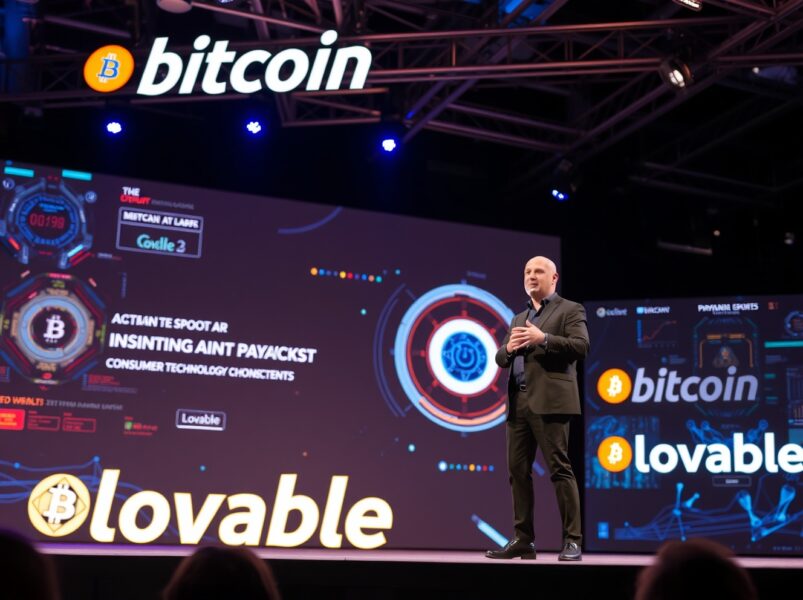
Lovable AI’s Astonishing Rise: Anton Osika Reveals Startup Secrets at Bitcoin World Disrupt 2025

Lovable AI’s Astonishing Rise: Anton Osika Reveals Startup Secrets at Bitcoin World Disrupt 2025

BitcoinWorld Lovable AI’s Astonishing Rise: Anton Osika Reveals Startup Secrets at Bitcoin World Disrupt 2025 Are you ready to witness a phenomenon? The world of technology is abuzz with the incredible rise of Lovable AI, a startup that’s not just breaking records but rewriting the rulebook for rapid growth. Imagine creating powerful apps and websites just by speaking to an AI – that’s the magic Lovable brings to the masses. This groundbreaking approach has propelled the company into the spotlight, making it one of the fastest-growing software firms in history. And now, the visionary behind this sensation, co-founder and CEO Anton Osika, is set to share his invaluable insights on the Disrupt Stage at the highly anticipated Bitcoin World Disrupt 2025. If you’re a founder, investor, or tech enthusiast eager to understand the future of innovation, this is an event you cannot afford to miss. Lovable AI’s Meteoric Ascent: Redefining Software Creation In an era where digital transformation is paramount, Lovable AI has emerged as a true game-changer. Its core premise is deceptively simple yet profoundly impactful: democratize software creation. By enabling anyone to build applications and websites through intuitive AI conversations, Lovable is empowering the vast majority of individuals who lack coding skills to transform their ideas into tangible digital products. This mission has resonated globally, leading to unprecedented momentum. The numbers speak for themselves: Achieved an astonishing $100 million Annual Recurring Revenue (ARR) in less than a year. Successfully raised a $200 million Series A funding round, valuing the company at $1.8 billion, led by industry giant Accel. Is currently fielding unsolicited investor offers, pushing its valuation towards an incredible $4 billion. As industry reports suggest, investors are unequivocally “loving Lovable,” and it’s clear why. This isn’t just about impressive financial metrics; it’s about a company that has tapped into a fundamental need, offering a solution that is both innovative and accessible. The rapid scaling of Lovable AI provides a compelling case study for any entrepreneur aiming for similar exponential growth. The Visionary Behind the Hype: Anton Osika’s Journey to Innovation Every groundbreaking company has a driving force, and for Lovable, that force is co-founder and CEO Anton Osika. His journey is as fascinating as his company’s success. A physicist by training, Osika previously contributed to the cutting-edge research at CERN, the European Organization for Nuclear Research. This deep technical background, combined with his entrepreneurial spirit, has been instrumental in Lovable’s rapid ascent. Before Lovable, he honed his skills as a co-founder of Depict.ai and a Founding Engineer at Sana. Based in Stockholm, Osika has masterfully steered Lovable from a nascent idea to a global phenomenon in record time. His leadership embodies a unique blend of profound technical understanding and a keen, consumer-first vision. At Bitcoin World Disrupt 2025, attendees will have the rare opportunity to hear directly from Osika about what it truly takes to build a brand that not only scales at an incredible pace in a fiercely competitive market but also adeptly manages the intense cultural conversations that inevitably accompany such swift and significant success. His insights will be crucial for anyone looking to understand the dynamics of high-growth tech leadership. Unpacking Consumer Tech Innovation at Bitcoin World Disrupt 2025 The 20th anniversary of Bitcoin World is set to be marked by a truly special event: Bitcoin World Disrupt 2025. From October 27–29, Moscone West in San Francisco will transform into the epicenter of innovation, gathering over 10,000 founders, investors, and tech leaders. It’s the ideal platform to explore the future of consumer tech innovation, and Anton Osika’s presence on the Disrupt Stage is a highlight. His session will delve into how Lovable is not just participating in but actively shaping the next wave of consumer-facing technologies. Why is this session particularly relevant for those interested in the future of consumer experiences? Osika’s discussion will go beyond the superficial, offering a deep dive into the strategies that have allowed Lovable to carve out a unique category in a market long thought to be saturated. Attendees will gain a front-row seat to understanding how to identify unmet consumer needs, leverage advanced AI to meet those needs, and build a product that captivates users globally. The event itself promises a rich tapestry of ideas and networking opportunities: For Founders: Sharpen your pitch and connect with potential investors. For Investors: Discover the next breakout startup poised for massive growth. For Innovators: Claim your spot at the forefront of technological advancements. The insights shared regarding consumer tech innovation at this event will be invaluable for anyone looking to navigate the complexities and capitalize on the opportunities within this dynamic sector. Mastering Startup Growth Strategies: A Blueprint for the Future Lovable’s journey isn’t just another startup success story; it’s a meticulously crafted blueprint for effective startup growth strategies in the modern era. Anton Osika’s experience offers a rare glimpse into the practicalities of scaling a business at breakneck speed while maintaining product integrity and managing external pressures. For entrepreneurs and aspiring tech leaders, his talk will serve as a masterclass in several critical areas: Strategy Focus Key Takeaways from Lovable’s Journey Rapid Scaling How to build infrastructure and teams that support exponential user and revenue growth without compromising quality. Product-Market Fit Identifying a significant, underserved market (the 99% who can’t code) and developing a truly innovative solution (AI-powered app creation). Investor Relations Balancing intense investor interest and pressure with a steadfast focus on product development and long-term vision. Category Creation Carving out an entirely new niche by democratizing complex technologies, rather than competing in existing crowded markets. Understanding these startup growth strategies is essential for anyone aiming to build a resilient and impactful consumer experience. Osika’s session will provide actionable insights into how to replicate elements of Lovable’s success, offering guidance on navigating challenges from product development to market penetration and investor management. Conclusion: Seize the Future of Tech The story of Lovable, under the astute leadership of Anton Osika, is a testament to the power of innovative ideas meeting flawless execution. Their remarkable journey from concept to a multi-billion-dollar valuation in record time is a compelling narrative for anyone interested in the future of technology. By democratizing software creation through Lovable AI, they are not just building a company; they are fostering a new generation of creators. His appearance at Bitcoin World Disrupt 2025 is an unmissable opportunity to gain direct insights from a leader who is truly shaping the landscape of consumer tech innovation. Don’t miss this chance to learn about cutting-edge startup growth strategies and secure your front-row seat to the future. Register now and save up to $668 before Regular Bird rates end on September 26. To learn more about the latest AI market trends, explore our article on key developments shaping AI features. This post Lovable AI’s Astonishing Rise: Anton Osika Reveals Startup Secrets at Bitcoin World Disrupt 2025 first appeared on BitcoinWorld.
Share
Coinstats2025/09/17 23:40