Ostatnie wahania kursu Bitcoina znów podzieliły rynek. Część ekspertów ostrzega przed możliwą głęboką korektą, inni jednak wskazują, że obecne osłabienie to tylko krótkotrwały oddech przed kolejnym ruchem wzrostowym. Choć rynek reaguje emocjonalnie, dane on-chain sugerują, że nie ma powodu do paniki. Czy Bitcoin może zaliczyć 50% spadek? Tradycyjna analiza ostrzega przed ryzykiem Według analityka Bloomberga, […]Ostatnie wahania kursu Bitcoina znów podzieliły rynek. Część ekspertów ostrzega przed możliwą głęboką korektą, inni jednak wskazują, że obecne osłabienie to tylko krótkotrwały oddech przed kolejnym ruchem wzrostowym. Choć rynek reaguje emocjonalnie, dane on-chain sugerują, że nie ma powodu do paniki. Czy Bitcoin może zaliczyć 50% spadek? Tradycyjna analiza ostrzega przed ryzykiem Według analityka Bloomberga, […]

Bitcoin może zaliczyć 50% spadek. Według analityków strach jest jednak przesadzony

2025/11/07 23:40
4 min read

Ostatnie wahania kursu Bitcoina znów podzieliły rynek. Część ekspertów ostrzega przed możliwą głęboką korektą, inni jednak wskazują, że obecne osłabienie to tylko krótkotrwały oddech przed kolejnym ruchem wzrostowym. Choć rynek reaguje emocjonalnie, dane on-chain sugerują, że nie ma powodu do paniki. Czy Bitcoin może zaliczyć 50% spadek?

Tradycyjna analiza ostrzega przed ryzykiem

Według analityka Bloomberga, Mike’a McGlone’a, obecne spadki mogą się jeszcze nie skończyć. W swoim wpisie na platformie X stwierdził, że ruch poniżej 100 000 dolarów może być tylko etapem większej korekty. Analityk stwierdził, że aktualne wydarzenia to możliwy próg zwalniający w kierunku 56 000 dolarów.

McGlone przypomniał, że wcześniejsze wzrosty Bitcoina często kończyły się powrotem w okolice 48-miesięcznej średniej kroczącej, która obecnie znajduje się właśnie w rejonie 56 000 dolarów.

Ta prognoza sugeruje potencjalny spadek nawet o prawie 50% od ostatnich szczytów. Tego typu ostrzeżenia, zwłaszcza gdy pochodzą od uznanych analityków, szybko rozpalają wyobraźnię inwestorów i powodują zwiększoną ostrożność na rynku.

Dane on-chain pokazują łagodniejszy obraz

Z kolei dane z Glassnode i XWIN Research Japan wskazują, że obecna korekta może być już bliska końca. 4 listopada Bitcoin spadł do poziomu 99 000 dolarów, po raz pierwszy od ponad czterech miesięcy schodząc poniżej psychologicznej bariery 100 000 USD. Jednak wkrótce potem odbił do około 101 500 dolarów, jak wynika z danych Coingecko.
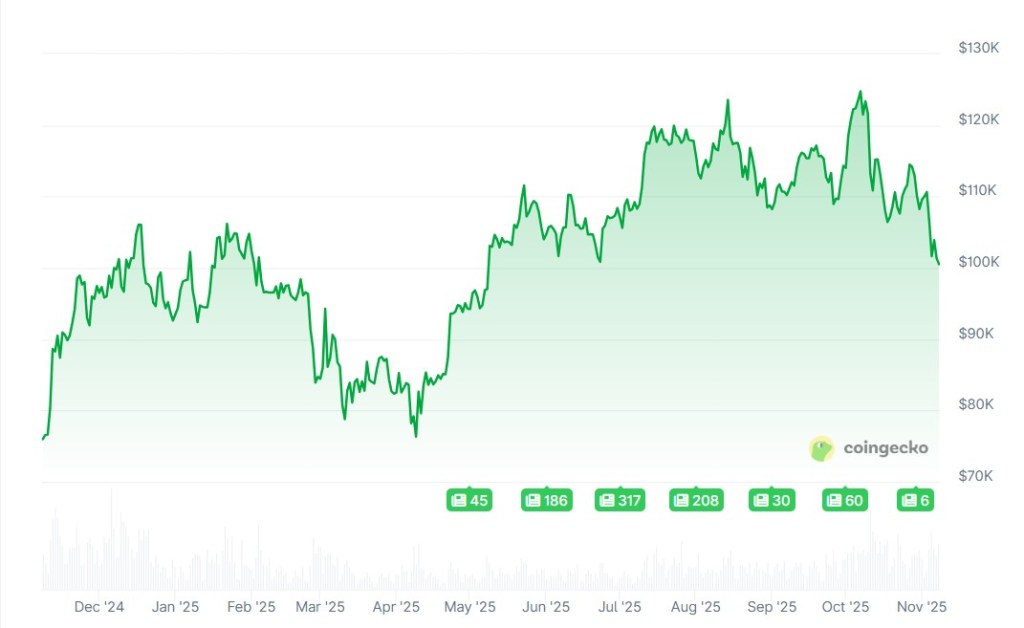
Cena Bitcoina 7 listopada CoinGecko

Kluczowy wskaźnik on-chain, Market Value to Realized Value (MVRV), zniżkował do poziomów, które w przeszłości sygnalizowały lokalne dołki. Glassnode zwrócił uwagę także na Relative Unrealized Loss, który obecnie wynosi 3,1%.

Glassnode dodał również, że straty poniżej progu 5% miały w przeszłości charakter uporządkowanej wyceny, a nie panicznej wyprzedaży.

W praktyce oznacza to, że choć rynek jest nerwowy, struktura korekty nie przypomina scenariusza z lat, w których Bitcoin wchodził w długie bessy.

Długoterminowe prognozy weryfikowane

Nawet najbardziej znane postacie świata inwestycji dostosowują dziś swoje przewidywania. Cathie Wood z ARK Invest obniżyła swoją długoterminową prognozę ceny Bitcoina o 300 000 dolarów. Wcześniej spodziewała się, że do 2030 roku BTC osiągnie poziom 1,5 miliona dolarów, teraz jej szacunki wskazują raczej na 1,2 miliona.

Wood tłumaczyła, że rosnąca popularność stablecoinów na rynkach wschodzących ogranicza częściowo popyt na Bitcoina jako magazyn wartości.

To pokazuje, że nawet długoterminowi optymiści dostrzegają zmianę dynamiki rynku i dostosowują swoje założenia.

Sentymen rynkowy na rozdrożu

Nastroje inwestorów testowane są zarówno przez dane, jak i narrację. Krótkoterminowe wahania cen pozostają duże, ale kluczowe wskaźniki on-chain wciąż utrzymują się w przedziałach, które nie wskazują na ekstremalne napięcie.

Niektórzy analitycy i liderzy funduszy venture wciąż ostrzegają przed możliwymi głębszymi spadkami. Inwestorzy muszą więc ważyć między analizą techniczną, sygnałami z blockchaina a zmieniającymi się trendami w wykorzystaniu Bitcoina i innych cyfrowych aktywów.

Nowe technologie zmieniają krajobraz Bitcoina – nadchodzi Bitcoin Hyper

Właśnie w tym kontekście coraz częściej mówi się o projektach, które mają wzmocnić fundamenty ekosystemu BTC. Jednym z najbardziej obiecujących jest Bitcoin Hyper, czyli pierwsze w historii rozwiązanie warstwy drugiej dla Bitcoina.

Jego celem jest usprawnienie sieci i wprowadzenie funkcji, których Bitcoin do tej pory nie oferował. Chodzi przede wszystkim o błyskawiczne transakcje, wsparcie smart kontraktów, zdecentralizowanych aplikacji czy nawet memecoinów.

Bitcoin Hyper działa równolegle z głównym łańcuchem Bitcoina, korzystając z Solana Virtual Machine i dowodów wiedzy zerowej. Pozwala to na skalowalność i bezpieczeństwo transakcji.

Ogromne zainteresowanie inwestorów

Potencjał projektu dostrzegli już inwestorzy. W przedsprzedaży Bitcoin Hyper zebrano ponad 26 milionów dolarów, a cena tokena $HYPER wynosi obecnie $0,013235. To dowód, że rynek szuka innowacji, które nie tylko zwiększą funkcjonalność Bitcoina, ale też otworzą nowe możliwości dla świata DeFi, NFT i gier blockchainowych.

Token $HYPER służy nie tylko do opłat transakcyjnych, ale też do stakingu i uczestnictwa w zarządzaniu siecią. Co więcej, projekt zarezerwował aż 30% całkowitej podaży na dalszy rozwój, co wskazuje na długofalowe ambicje zespołu.

Dlaczego Bitcoin Hyper może być ważny w okresach korekt

W czasie, gdy część rynku obawia się dalszych spadków, projekty takie jak Bitcoin Hyper mogą odegrać kluczową rolę w dywersyfikacji i zwiększeniu użyteczności Bitcoina. Wprowadzenie warstwy 2 może poprawić przepustowość, obniżyć opłaty transakcyjne. Może uczynić to Bitcoina bardziej konkurencyjnym wobec innych ekosystemów, takich jak Ethereum czy Solana.

Dla inwestorów szukających kryptowaluty do inwestycji, $HYPER może być ciekawą opcją, nie jako alternatywa dla Bitcoina, ale jako jego rozszerzenie, wzmacniające możliwości całej sieci.

Rynek szuka równowagi

Rynek kryptowalut znajduje się w punkcie zwrotnym. Z jednej strony wciąż pojawiają się głosy ostrzegające przed spadkiem BTC nawet o połowę. Z drugiej jednak dane i rozwój technologiczny pokazują, że fundamenty ekosystemu są silniejsze niż kiedykolwiek.

Dziś, gdy coraz więcej osób poszukuje najlepszej giełdy kryptowalut do zakupu aktywów cyfrowych, warto pamiętać, że nie liczy się tylko cena, ale też to, jak dane projekty realnie wpływają na przyszłość technologii blockchain.

Market Opportunity
Mind-AI Logo
Mind-AI Price(MA)
$0.0001482
$0.0001482$0.0001482
-0.53%
USD
Mind-AI (MA) Live Price Chart
Disclaimer: The articles reposted on this site are sourced from public platforms and are provided for informational purposes only. They do not necessarily reflect the views of MEXC. All rights remain with the original authors. If you believe any content infringes on third-party rights, please contact [email protected] for removal. MEXC makes no guarantees regarding the accuracy, completeness, or timeliness of the content and is not responsible for any actions taken based on the information provided. The content does not constitute financial, legal, or other professional advice, nor should it be considered a recommendation or endorsement by MEXC.

You May Also Like

The Role of Blockchain in Building Safer Web3 Gaming Ecosystems

The Role of Blockchain in Building Safer Web3 Gaming Ecosystems

The gaming industry is in the midst of a historic shift, driven by the rise of Web3. Unlike traditional games, where developers and publishers control assets and dictate in-game economies, Web3 gaming empowers players with ownership and influence. Built on blockchain technology, these ecosystems are decentralized by design, enabling true digital asset ownership, transparent economies, and a future where players help shape the games they play. However, as Web3 gaming grows, security becomes a focal point. The range of security concerns, from hacking to asset theft to vulnerabilities in smart contracts, is a significant issue that will undermine or erode trust in this ecosystem, limiting or stopping adoption. Blockchain technology could be used to create security processes around secure, transparent, and fair Web3 gaming ecosystems. We will explore how security is increasing within gaming ecosystems, which challenges are being overcome, and what the future of security looks like. Why is Security Important in Web3 Gaming? Web3 gaming differs from traditional gaming in that players engage with both the game and assets with real value attached. Players own in-game assets that exist as tokens or NFTs (Non-Fungible Tokens), and can trade and sell them. These game assets usually represent significant financial value, meaning security failure could represent real monetary loss. In essence, without security, the promises of owning “something” in Web3, decentralized economies within games, and all that comes with the term “fair” gameplay can easily be eroded by fraud, hacking, and exploitation. This is precisely why the uniqueness of blockchain should be emphasized in securing Web3 gaming. How Blockchain Ensures Security in Web3 Gaming?
  1. Immutable Ownership of Assets Blockchain records can be manipulated by anyone. If a player owns a sword, skin, or plot of land as an NFT, it is verifiably in their ownership, and it cannot be altered or deleted by the developer or even hacked. This has created a proven track record of ownership, providing control back to the players, unlike any centralised gaming platform where assets can be revoked.
  2. Decentralized Infrastructure Blockchain networks also have a distributed architecture where game data is stored in a worldwide network of nodes, making them much less susceptible to centralised points of failure and attacks. This decentralised approach makes it exponentially more difficult to hijack systems or even shut off the game’s economy.
  3. Secure Transactions with Cryptography Whether a player buys an NFT or trades their in-game tokens for other items or tokens, the transactions are enforced by cryptographic algorithms, ensuring secure, verifiable, and irreversible transactions and eliminating the risks of double-spending or fraudulent trades.
  4. Smart Contract Automation Smart contracts automate the enforcement of game rules and players’ economic exchanges for the developer, eliminating the need for intermediaries or middlemen, and trust for the developer. For example, if a player completes a quest that promises a reward, the smart contract will execute and distribute what was promised.
  5. Anti-Cheating and Fair Gameplay The naturally transparent nature of blockchain makes it extremely simple for anyone to examine a specific instance of gameplay and verify the economic outcomes from that play. Furthermore, multi-player games that enforce smart contracts on things like loot sharing or win sharing can automate and measure trustlessness and avoid cheating, manipulations, and fraud by developers.
  6. Cross-Platform Security Many Web3 games feature asset interoperability across platforms. This interoperability is made viable by blockchain, which guarantees ownership is maintained whenever assets transition from one game or marketplace to another, thereby offering protection to players who rely on transfers for security against fraud. Key Security Dangers in Web3 Gaming Although blockchain provides sound first principles of security, the Web3 gaming ecosystem is susceptible to threats. Some of the most serious threats include:

Smart Contract Vulnerabilities: Smart contracts that are poorly written or lack auditing will leave openings for exploitation and thereby result in asset loss. Phishing Attacks: Unintentionally exposing or revealing private keys or signing transactions that are not possible to reverse, under the assumption they were genuine transaction requests. Bridge Hacks: Cross-chain bridges, which allow players to move their assets between their respective blockchains, continually face hacks, requiring vigilance from players and developers. Scams and Rug Pulls: Rug pulls occur when a game project raises money and leaves, leaving player assets worthless. Regulatory Ambiguity: Global regulations remain unclear; risks exist for players and developers alike. While blockchain alone won’t resolve every issue, it remediates the responsibility of the first principles, more so when joined by processes such as auditing, education, and the right governance, which can improve their contribution to the security landscapes in game ecosystems. Real Life Examples of Blockchain Security in Web3 Gaming Axie Infinity (Ronin Hack): The Axie Infinity game and several projects suffered one of the biggest hacks thus far on its Ronin bridge; however, it demonstrated the effectiveness of multi-sig security and the effective utilization of decentralization. The industry benefited through learning and reflection, thus, as projects have implemented changes to reduce the risks of future hacks or misappropriation. Immutable X: This Ethereum scaling solution aims to ensure secure NFT transactions for gaming, allowing players to trade an asset without the burden of exorbitant fees and fears of being a victim of fraud. Enjin: Enjin is providing a trusted infrastructure for Web3 games, offering secure NFT creation and transfer while reiterating that ownership and an asset securely belong to the player. These examples indubitably illustrate that despite challenges to overcome, blockchain remains the foundational layer on which to build more secure Web3 gaming environments. Benefits of Blockchain Security for Players and Developers For Players: Confidence in true ownership of assets Transparency in in-game economies Protection against nefarious trades/scams For Developers: More trust between players and the platform Less reliance on centralized infrastructure Ability to attract wealth and players based on provable fairness By incorporating blockchain security within the mechanics of game design, developers can create and enforce resilient ecosystems where players feel reassured in investing time, money, and ownership within virtual worlds. The Future of Secure Web3 Gaming Ecosystems As the wisdom of blockchain technology and industry knowledge improves, the future for secure Web3 gaming looks bright. New growing trends include: Zero-Knowledge Proofs (ZKPs): A new wave of protocols that enable private transactions and secure smart contracts while managing user privacy with an element of transparency. Decentralized Identity Solutions (DID): Helping players control their identities and decrease account theft risks. AI-Enhanced Security: Identifying irregularities in user interactions by sampling pattern anomalies to avert hacks and fraud by time-stamping critical events. Interoperable Security Standards: Allowing secured and seamless asset transfers across blockchains and games. With these innovations, blockchain will not only secure gaming assets but also enhance the overall trust and longevity of Web3 gaming ecosystems. Conclusion Blockchain is more than a buzzword in Web3; it is the only way to host security, fairness, and transparency. With blockchain, players confirm immutable ownership of digital assets, there is a decentralized infrastructure, and finally, it supports smart contracts to automate code that protects players and developers from the challenges of digital economies. The threats, vulnerabilities, and scams that come from smart contracts still persist, but the industry is maturing with better security practices, cross-chain solutions, and increased formal cryptographic tools. In the coming years, blockchain will remain the base to digital economies and drive Web3 gaming environments that allow players to safely own, trade, and enjoy their digital experiences free from fraud and exploitation. While blockchain and gaming alone entertain, we will usher in an era of secure digital worlds where trust complements innovation. The Role of Blockchain in Building Safer Web3 Gaming Ecosystems was originally published in Coinmonks on Medium, where people are continuing the conversation by highlighting and responding to this story
Share
Medium2025/09/18 14:40
Fintech Is Leveling the Playing Field in Trading, Says Zak Westphal

Fintech Is Leveling the Playing Field in Trading, Says Zak Westphal

The post Fintech Is Leveling the Playing Field in Trading, Says Zak Westphal appeared on BitcoinEthereumNews.com. The trading world was once divided into two groups: those with access to high-powered data and those without.  As you might have guessed, it was the major institutions (like Wall Street) that had a monopoly on the tools, data access, and speed. This left retail traders fighting to keep up. This gap is closing rapidly, and the main reason is the introduction of new technology and platforms entering the fold. Zak Westphal has been at the forefront of this transformation. While Co-Founding StocksToTrade, he has been a big part of empowering everyday traders to gain access to the real-time information and algorithmic systems that have long provided Wall Street with its edge. We spoke with him about how fintech is reshaping the landscape and what it really means for retail traders today. Fintech has changed everything from banking to payments. In your opinion, what has been its greatest impact on the world of trading? For me, it’s all about access. When I began my trading career, institutions had a significant advantage, even more pronounced than it is now. They had direct feeds of data, algorithmic systems, and research teams monitoring information right around the clock. Retail traders, on the other hand, had slower information and pretty basic tools in comparison.  Fintech has substantially changed the game. Today, a retail trader from home can access real-time market data, scan thousands of stocks in mere seconds, and utilize algorithmic tools that were once only available to hedge funds. I can’t think of a time when the access for everyday traders has been as accessible as it is today. That doesn’t mean the advantages are gone, because Wall Street still has resources that individuals simply can’t have. However, there is now an opportunity for everyday traders actually to compete. And that is a…
Share
BitcoinEthereumNews2025/09/18 17:14
SAP Proposes Dividend of €2.50 per Share

SAP Proposes Dividend of €2.50 per Share

WALLDORF, Germany, Feb. 19, 2026 /PRNewswire/ — The Supervisory Board and Executive Board of SAP SE (NYSE: SAP) recommend that shareholders approve a dividend of
Share
AI Journal2026/02/19 15:30
