

The capital game of Circle, the “first stablecoin stock”: old shareholders cash out, Wall Street enters the market, what should retail investors do?
Author: Nancy, PANews
At the critical moment when the US GENIUS stablecoin bill entered the final stage of bargaining, Circle also pressed the fast-forward button for its IPO sprint, trying to ring the Nasdaq bell as the "first stablecoin stock" and will open its first trading day on June 5.
At the intersection of policy signals and market bets, four years after Circle went public, old shareholders were finally able to cash out a large proportion of their shares through the IPO window, earning several times or even dozens of times the returns; at the same time, Circle also took advantage of the policy to increase the issuance scale and pricing range, attracting endorsements from Wall Street giants such as BlackRock and JPMorgan Chase. The underlying logic behind this is not only a gamble on the prospects of the legal stablecoin in the United States, but also a re-evaluation of Circle's global expansion capabilities and the dominant position of the USDC ecosystem.
After more than 11 years, the investment institution is about to exit, and Wall Street "takes over" and subscribes
Against the backdrop of the shelving of the SPAC listing plan in 2022, the turbulent market share of USDC stablecoin, and increasingly stringent global regulation, Circle finally restarted the IPO process, opening a new channel for crypto financial companies to enter the traditional capital market.
According to the prospectus that Circle initially submitted to the US SEC, it plans to issue 24 million Class A common shares, of which the company will issue 9.6 million shares and the remaining 14.4 million shares will be sold by existing shareholders, with a planned pricing range of US$24 to US$26 per share. This structure, in which the proportion of secondary shares of investors far exceeds the company's primary issuance, is extremely rare in technology company IPOs and usually only occurs when founders and early institutions are eager to partially exit at the listing stage or try to reduce the impact of issuance dilution.
However, not long after, Circle raised the IPO issuance scale and price range: the new plan is to issue 32 million shares, of which the company's own issuance ratio has been greatly increased to 24 million shares, the existing shareholders' sales scale has been reduced to 8 million shares, and the pricing range has been raised to US$27 to 28 per share. At the high end, the maximum fundraising amount of this transaction will reach US$896 million, bringing the company's valuation to nearly US$6.2 billion. If potential dilution factors such as employee stock ownership plans, restricted stocks (RSUs) and warrants are taken into account, the fully diluted valuation will be approximately US$7.2 billion.
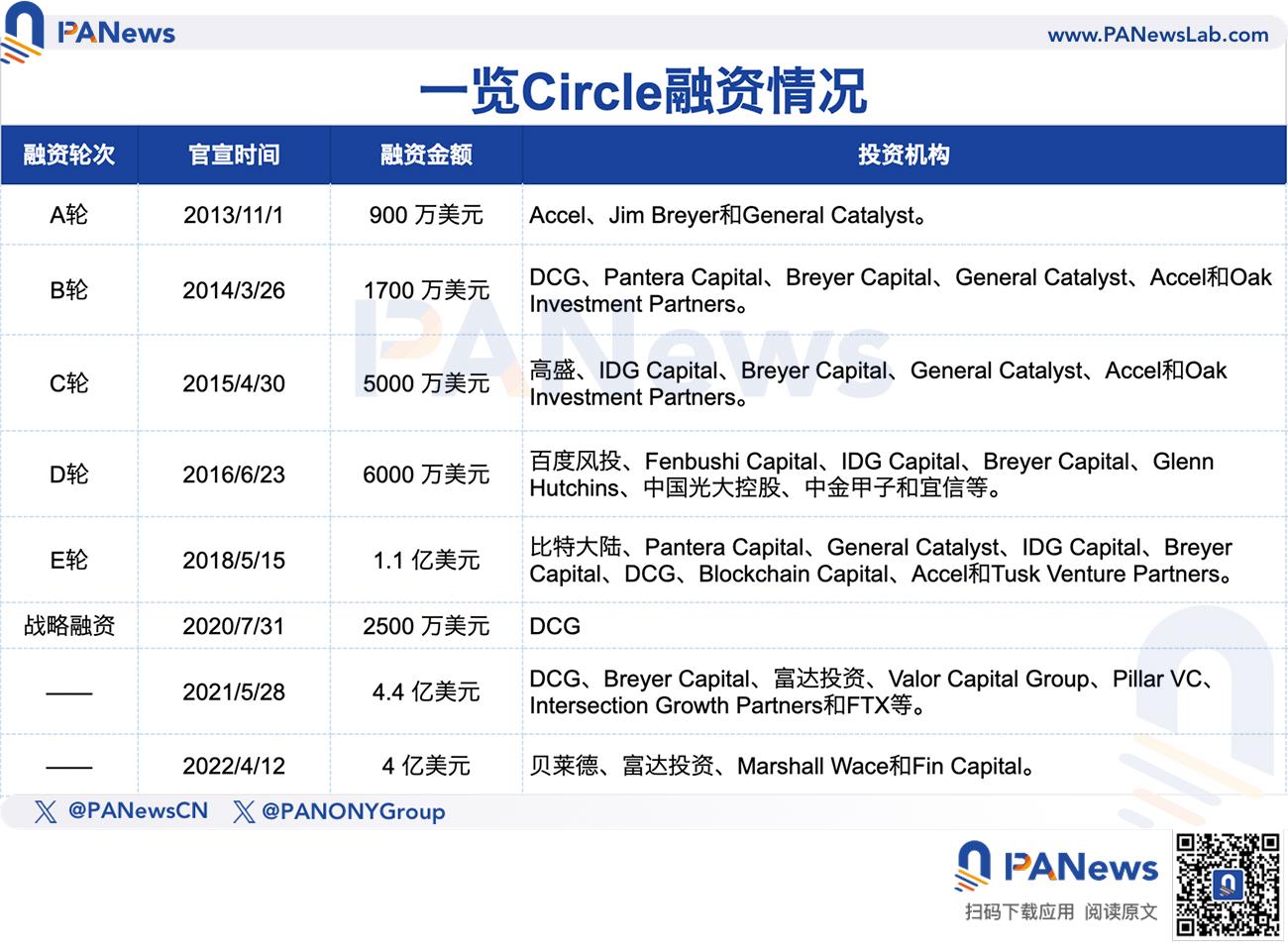
It is worth noting that the list of shareholders participating in the share sale includes not only Circle co-founders Jeremy Allaire and Sean Neville, but also a number of well-known venture capital institutions, including Accel, Breyer Capital, General Catalyst, IDG Capital and Oak Investment Partners. The average shareholding ratio of these institutions is between 8% and 10%. According to the financing time statistics of PANews, the investment time of these institutions can be traced back to 2013, which lasted for more than 11 years.
Compared with the failed SPAC transaction in 2022 (valued at US$9 billion at the time), this IPO returned with a slightly lower valuation, but with a more robust structure and more positive market feedback.
According to Bloomberg, citing people familiar with the matter, the subscription orders for Circle's IPO have exceeded the number of shares available for issuance by dozens of times. For example, ARK Investment Management (founded by Cathie Wood), a technology investment company, has expressed its intention to subscribe to up to $150 million of Circle shares; at the same time, BlackRock, a global asset management giant, also plans to purchase about 10% of the IPO shares. Based on the pricing range, its investment amount is about $86.4 million to $89.6 million.
Pricing strategy may reserve growth potential, growth and concerns coexist
At a critical juncture when the stablecoin track is accelerating compliance evolution and the crypto industry is moving towards mainstreamization, Circle's submission of its IPO prospectus is not only a sprint in the capital market, but also an "arbitrage" of the US regulatory cycle. Once successfully listed, Circle will become the first stablecoin issuer to land on the US stock market, and its symbolic significance is no less than the listing moment of Coinbase that year.
With strong profitability, solid compliance advantages, broad market expansion capabilities, and endorsements from traditional financial giants such as BlackRock, Circle has built a narrative framework for high-quality assets.
On the one hand, according to the prospectus, Circle's total revenue in 2024 will reach US$1.676 billion, a year-on-year increase of approximately 15.6% from US$1.45 billion in 2023. The current stablecoin market is in a period of rapid expansion, but there are only a handful of projects with strong profitability and clear financial data. Circle's revenue growth is undoubtedly a scarce label.
In addition, its core product USDC is already the world's second largest stablecoin, with a current market value of more than $61.4 billion. Although there is still a significant gap between it and USDT in market share, USDC has built a strong cognitive moat in terms of compliance, transparency and regulatory compliance. At the same time, USDC's multi-chain deployment (including Ethereum, Solana, Base and Avalanche, etc.), as well as the continued expansion of multi-dimensional scenarios such as DeFi, payment, and cross-border settlement, also support the gradual recovery of its market value.
It is worth noting that Circle and BlackRock have become close allies, and even temporarily gave up issuing their own stablecoins in order to support USDC. The prospectus disclosed that it is a strategic partner with BlackRock, a global asset management giant. In the new memorandum of understanding (New MOU) signed by Circle and BlackRock in March 2025, it was agreed that BlackRock would be the priority partner for its stablecoin reserves and promised not to issue competitive US dollar payment stablecoins. The two parties agreed that Circle would hand over at least 90% of its US dollar custodial reserves (excluding bank deposits) to BlackRock for management, and BlackRock would not develop or issue its own stablecoins. The agreement is valid for four years. This cooperation not only strengthens USDC's risk resistance from the perspective of liquidity management, but also brings Circle trust endorsement from the traditional financial market.
On the other hand, Circle's valuation strategy has growth potential. The corresponding valuation of Circle's IPO is about US$7.2 billion, with an issue price range of US$27 to US$28 per share. According to its estimated net profit of US$155 million in 2024, the price-to-earnings ratio is about 45.61 to 47.30 times. In the current capital environment where the valuation of the global technology sector is generally high and risk appetite is tightened, Circle's valuation is not exaggerated in the crypto industry, and it can even be said to be rationally priced and quite attractive. You know, for example, Coinbase's price-to-earnings ratio was as high as 300 times in the early days of its listing.
More importantly, Circle rushed into the GENIUS Act window. The timing of Circle's IPO was not accidental, but a precise game of judging the US regulatory cycle. It coincided with the key progress made in the US stablecoin legislation GENIUS, which intends to set a clear regulatory framework for US dollar stablecoins, which means that stablecoin issuers will enter a new stage of "licensing". In other words, the GENIUS Act is a superposition of regulatory arbitrage and market revaluation for Circle, that is, completing compliance endorsement before the bill is officially implemented, and winning the recognition of investors and policymakers through Nasdaq listing.
However, despite Circle's impressive revenue growth, its profit structure is clearly fragile. PANews also pointed out in a previous report that, first of all, the current US Treasury yields that Circle relies on for revenue are essentially pro-cyclical dividends. If the Federal Reserve enters a rate cut cycle, Circle's reserve income ability will experience a systematic decline.
Secondly, Circle's profit margin is structurally squeezed by multiple partners. According to the prospectus, Coinbase, as its core partner, is entitled to up to 50% of the profit share of USDC reserve income. In 2024, Circle paid Coinbase a profit share of up to US$900 million, accounting for more than half of the annual revenue. In addition, Circle's cooperation with Binance also disclosed high incentive costs. In November 2024, Circle paid Binance a one-time advance of US$60.25 million and promised to issue monthly incentives based on its USDC custody balance in the next two years, provided that Binance holds no less than US$1.5 billion in USDC. Although this strategy of relying on the head platform for market share can boost market value, it greatly compresses Circle's actual profit margin.
In general, Circle's IPO application is not only a phased verification of its business model, but also reflects its keen insight into the regulatory environment and financial cycles. However, whether Circle can truly fulfill its expectations of being the "first stablecoin stock" in the future depends on how it can find the best path to balance innovation and compliance in the increasingly complex regulatory framework and financial cycle fluctuations, and continue to optimize its profit structure and steadily promote its global expansion.
You May Also Like
Bitcoin ETFs Outpace Ethereum With $2.9B Weekly Surge

CME Group to launch options on XRP and SOL futures
