The stablecoin market is booming again in 2025, with total market capitalization reaching a new all-time high of $228 billion, according to a report by CryptoQuant. That marks a $33 billion increase so far this year, a 17% rise, driven by renewed crypto trading activity, growing use in payments, and increased regulatory clarity in the United States under President Donald Trump. Source: CryptoQuant . USDT and USDC Lead $33B Market Cap Jump According to the report, Tether (USDT) and Circle’s USDC continue to lead the market. USDT now holds a $155 billion market cap, up $18 billion year-to-date. USDC has gained $17 billion, climbing to a record high of $61 billion, an increase of 39% since January. On centralized exchanges, stablecoin reserves are also surging. The total value of ERC-20 stablecoins held on exchanges has reached $50 billion. Stablecoins are booming again. Market cap hit a record $228B, up $33B (+17%) in 2025. Driven by rising trading activity, growing payment use, and clearer U.S. regulation under Trump. pic.twitter.com/76zKj49UWB — CryptoQuant.com (@cryptoquant_com) June 12, 2025 USDC reserves in particular have grown 1.6 times in 2025 alone, now totaling around $8 billion. This influx supports deeper liquidity for crypto markets. The report also noted that stablecoins are bouncing back in the yield-bearing segment. These are stablecoins that pay interest to holders, often used in DeFi. The value of staked stablecoins has reached $6.9 billion, up 28% since late May. Most of that growth has come from rising demand for sUSDe and sUSDs, which gained $1.23 billion and $700 million in market cap, respectively. A recent report from on-chain data platforms Artemis and Dune shows broader user adoption. According to the report, titled “The State of Stablecoins 2025,” active stablecoin wallets rose from 19.6 million to 30 million over the past year, a 53% increase. The report said the data “suggests wider user engagement” and pointed to stablecoins becoming a key part of digital finance. It also noted that stablecoins are increasingly used in decentralized finance (DeFi), gaming, and NFTs. “Stablecoins have emerged as a bridge between traditional finance and crypto,” it said, “and are becoming a core piece of payment and settlement infrastructure.” This surge in usage is also supported by the rise in real-world payment activity. Data from Artemis shows $94.2 billion in stablecoin transactions were settled between January 2023 and February 2025. Business-to-business (B2B) payments made up the largest chunk, reaching an annual run rate of $36 billion. Card-linked payments using stablecoins crossed $13 billion in volume. Stablecoin Legislation Gains Ground as Tech and Finance Giants Pile In Increased demand has also come alongside progress on the regulatory front. For example, the U.S. Senate advanced the “Guiding and Establishing National Innovation for U.S. Stablecoins Act” or GENIUS Act this week. Backed by President Trump, the bill is designed to create a federal framework for dollar-backed stablecoins. The legislation would require stablecoins to be fully backed by U.S. dollars or highly liquid assets. It would also mandate annual audits for issuers with over $50 billion in market cap, and include requirements for foreign issuers. 🚨 The U.S. Senate Set for Historic Stablecoin Showdown as GENIUS Act nears final vote. #Stablecoins #GeniusAct https://t.co/ZJ59XzuQcn — Cryptonews.com (@cryptonews) June 11, 2025 The Senate voted 68-30 to invoke cloture on the bill , clearing the way for final debate and vote. “This did not happen by accident,” said Senator Tim Scott, one of the bill’s co-sponsors. “To those who said Washington could not act… let’s prove them wrong.” Treasury Secretary Scott Bessent backed the legislation during a Wednesday Senate hearing. He said stablecoins could play a major role in expanding the use of the U.S. dollar globally. “I think $2 trillion is a very reasonable number,” Bessent said, referring to an estimate that the stablecoin market could exceed that level by 2028. “I could see it greatly exceeding that.” 🇺🇸 BREAKING – U.S. Treasury Secretary Bessent: – Stablecoin regulations backed by U.S. Treasuries will expand global USD usage – We could see stablecoin demand exceed $2 TRILLION This is massive for crypto. Regulated stablecoins = institutional trust Institutional trust =… pic.twitter.com/inZh9maAwW — @CryptoELlTES (@CryptooELITES) June 12, 2025 The GENIUS Act appears to be pushing traditional finance further into the stablecoin space. Large U.S. banks, including JPMorgan, Citigroup, Wells Fargo, and Bank of America, are reportedly exploring a joint stablecoin project. Meanwhile, USDC issuer Circle went public earlier this month, with shares jumping 160% on their first day of trading . 🔴 @Circle the company behind the USDC stablecoin, made a dramatic entrance on the NYSE with its shares surging as much as 160% during its trading debut. #Circle #NYSE https://t.co/EJQJ4Yy3m3 — Cryptonews.com (@cryptonews) June 5, 2025 Tech firms are also watching closely. According to Fortune , Apple, Google, Airbnb, and Elon Musk’s X are all exploring stablecoin integrations. Google has already processed two stablecoin payments. 🍎 Apple, X, and Airbnb are in early talks with crypto firms to integrate stablecoin payments. #apple #google #stablecoin https://t.co/gmEbx3i4PN — Cryptonews.com (@cryptonews) June 6, 2025 Airbnb has held talks with Worldpay to cut credit card fees using stablecoins. X is reportedly planning to include stablecoins in its X Money app.The stablecoin market is booming again in 2025, with total market capitalization reaching a new all-time high of $228 billion, according to a report by CryptoQuant. That marks a $33 billion increase so far this year, a 17% rise, driven by renewed crypto trading activity, growing use in payments, and increased regulatory clarity in the United States under President Donald Trump. Source: CryptoQuant . USDT and USDC Lead $33B Market Cap Jump According to the report, Tether (USDT) and Circle’s USDC continue to lead the market. USDT now holds a $155 billion market cap, up $18 billion year-to-date. USDC has gained $17 billion, climbing to a record high of $61 billion, an increase of 39% since January. On centralized exchanges, stablecoin reserves are also surging. The total value of ERC-20 stablecoins held on exchanges has reached $50 billion. Stablecoins are booming again. Market cap hit a record $228B, up $33B (+17%) in 2025. Driven by rising trading activity, growing payment use, and clearer U.S. regulation under Trump. pic.twitter.com/76zKj49UWB — CryptoQuant.com (@cryptoquant_com) June 12, 2025 USDC reserves in particular have grown 1.6 times in 2025 alone, now totaling around $8 billion. This influx supports deeper liquidity for crypto markets. The report also noted that stablecoins are bouncing back in the yield-bearing segment. These are stablecoins that pay interest to holders, often used in DeFi. The value of staked stablecoins has reached $6.9 billion, up 28% since late May. Most of that growth has come from rising demand for sUSDe and sUSDs, which gained $1.23 billion and $700 million in market cap, respectively. A recent report from on-chain data platforms Artemis and Dune shows broader user adoption. According to the report, titled “The State of Stablecoins 2025,” active stablecoin wallets rose from 19.6 million to 30 million over the past year, a 53% increase. The report said the data “suggests wider user engagement” and pointed to stablecoins becoming a key part of digital finance. It also noted that stablecoins are increasingly used in decentralized finance (DeFi), gaming, and NFTs. “Stablecoins have emerged as a bridge between traditional finance and crypto,” it said, “and are becoming a core piece of payment and settlement infrastructure.” This surge in usage is also supported by the rise in real-world payment activity. Data from Artemis shows $94.2 billion in stablecoin transactions were settled between January 2023 and February 2025. Business-to-business (B2B) payments made up the largest chunk, reaching an annual run rate of $36 billion. Card-linked payments using stablecoins crossed $13 billion in volume. Stablecoin Legislation Gains Ground as Tech and Finance Giants Pile In Increased demand has also come alongside progress on the regulatory front. For example, the U.S. Senate advanced the “Guiding and Establishing National Innovation for U.S. Stablecoins Act” or GENIUS Act this week. Backed by President Trump, the bill is designed to create a federal framework for dollar-backed stablecoins. The legislation would require stablecoins to be fully backed by U.S. dollars or highly liquid assets. It would also mandate annual audits for issuers with over $50 billion in market cap, and include requirements for foreign issuers. 🚨 The U.S. Senate Set for Historic Stablecoin Showdown as GENIUS Act nears final vote. #Stablecoins #GeniusAct https://t.co/ZJ59XzuQcn — Cryptonews.com (@cryptonews) June 11, 2025 The Senate voted 68-30 to invoke cloture on the bill , clearing the way for final debate and vote. “This did not happen by accident,” said Senator Tim Scott, one of the bill’s co-sponsors. “To those who said Washington could not act… let’s prove them wrong.” Treasury Secretary Scott Bessent backed the legislation during a Wednesday Senate hearing. He said stablecoins could play a major role in expanding the use of the U.S. dollar globally. “I think $2 trillion is a very reasonable number,” Bessent said, referring to an estimate that the stablecoin market could exceed that level by 2028. “I could see it greatly exceeding that.” 🇺🇸 BREAKING – U.S. Treasury Secretary Bessent: – Stablecoin regulations backed by U.S. Treasuries will expand global USD usage – We could see stablecoin demand exceed $2 TRILLION This is massive for crypto. Regulated stablecoins = institutional trust Institutional trust =… pic.twitter.com/inZh9maAwW — @CryptoELlTES (@CryptooELITES) June 12, 2025 The GENIUS Act appears to be pushing traditional finance further into the stablecoin space. Large U.S. banks, including JPMorgan, Citigroup, Wells Fargo, and Bank of America, are reportedly exploring a joint stablecoin project. Meanwhile, USDC issuer Circle went public earlier this month, with shares jumping 160% on their first day of trading . 🔴 @Circle the company behind the USDC stablecoin, made a dramatic entrance on the NYSE with its shares surging as much as 160% during its trading debut. #Circle #NYSE https://t.co/EJQJ4Yy3m3 — Cryptonews.com (@cryptonews) June 5, 2025 Tech firms are also watching closely. According to Fortune , Apple, Google, Airbnb, and Elon Musk’s X are all exploring stablecoin integrations. Google has already processed two stablecoin payments. 🍎 Apple, X, and Airbnb are in early talks with crypto firms to integrate stablecoin payments. #apple #google #stablecoin https://t.co/gmEbx3i4PN — Cryptonews.com (@cryptonews) June 6, 2025 Airbnb has held talks with Worldpay to cut credit card fees using stablecoins. X is reportedly planning to include stablecoins in its X Money app.

Stablecoin Surge: Market Cap Hits Record $228B in 2025 Amid Trading Boom and Trump-Era Clarity

4 min read

The stablecoin market is booming again in 2025, with total market capitalization reaching a new all-time high of $228 billion, according to a report by CryptoQuant.

That marks a $33 billion increase so far this year, a 17% rise, driven by renewed crypto trading activity, growing use in payments, and increased regulatory clarity in the United States under President Donald Trump.
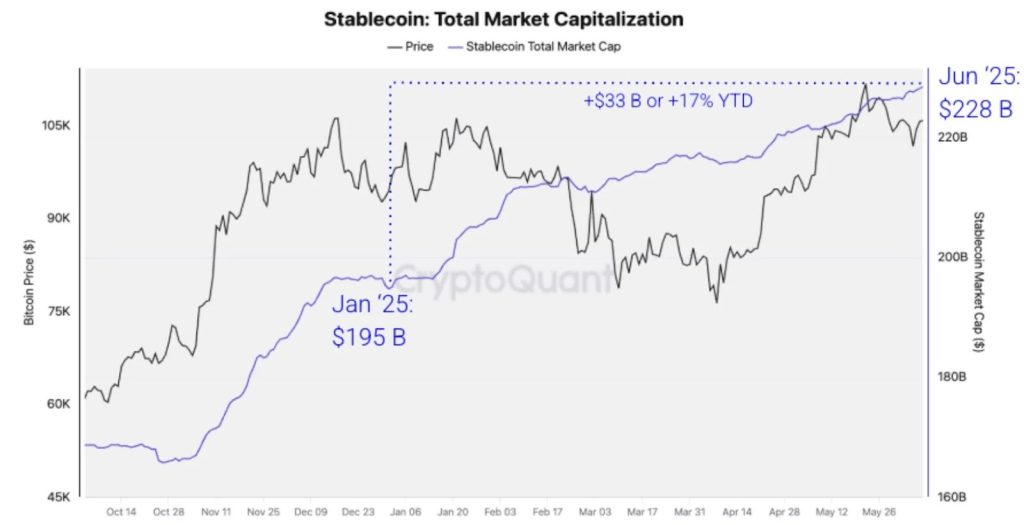
Source: CryptoQuant.

USDT and USDC Lead $33B Market Cap Jump

According to the report, Tether (USDT) and Circle’s USDC continue to lead the market. USDT now holds a $155 billion market cap, up $18 billion year-to-date. USDC has gained $17 billion, climbing to a record high of $61 billion, an increase of 39% since January.

On centralized exchanges, stablecoin reserves are also surging. The total value of ERC-20 stablecoins held on exchanges has reached $50 billion.

USDC reserves in particular have grown 1.6 times in 2025 alone, now totaling around $8 billion. This influx supports deeper liquidity for crypto markets.

The report also noted that stablecoins are bouncing back in the yield-bearing segment. These are stablecoins that pay interest to holders, often used in DeFi. The value of staked stablecoins has reached $6.9 billion, up 28% since late May.

Most of that growth has come from rising demand for sUSDe and sUSDs, which gained $1.23 billion and $700 million in market cap, respectively.

A recent report from on-chain data platforms Artemis and Dune shows broader user adoption. According to the report, titled “The State of Stablecoins 2025,” active stablecoin wallets rose from 19.6 million to 30 million over the past year, a 53% increase.

The report said the data “suggests wider user engagement” and pointed to stablecoins becoming a key part of digital finance. It also noted that stablecoins are increasingly used in decentralized finance (DeFi), gaming, and NFTs.

“Stablecoins have emerged as a bridge between traditional finance and crypto,” it said, “and are becoming a core piece of payment and settlement infrastructure.”

This surge in usage is also supported by the rise in real-world payment activity. Data from Artemis shows $94.2 billion in stablecoin transactions were settled between January 2023 and February 2025.

Business-to-business (B2B) payments made up the largest chunk, reaching an annual run rate of $36 billion. Card-linked payments using stablecoins crossed $13 billion in volume.

Stablecoin Legislation Gains Ground as Tech and Finance Giants Pile In

Increased demand has also come alongside progress on the regulatory front. For example, the U.S. Senate advanced the “Guiding and Establishing National Innovation for U.S. Stablecoins Act” or GENIUS Act this week.

Backed by President Trump, the bill is designed to create a federal framework for dollar-backed stablecoins.

The legislation would require stablecoins to be fully backed by U.S. dollars or highly liquid assets. It would also mandate annual audits for issuers with over $50 billion in market cap, and include requirements for foreign issuers.

The Senate voted 68-30 to invoke cloture on the bill, clearing the way for final debate and vote.

“This did not happen by accident,” said Senator Tim Scott, one of the bill’s co-sponsors. “To those who said Washington could not act… let’s prove them wrong.”

Treasury Secretary Scott Bessent backed the legislation during a Wednesday Senate hearing. He said stablecoins could play a major role in expanding the use of the U.S. dollar globally.

“I think $2 trillion is a very reasonable number,” Bessent said, referring to an estimate that the stablecoin market could exceed that level by 2028. “I could see it greatly exceeding that.”

The GENIUS Act appears to be pushing traditional finance further into the stablecoin space. Large U.S. banks, including JPMorgan, Citigroup, Wells Fargo, and Bank of America, are reportedly exploring a joint stablecoin project.

Meanwhile, USDC issuer Circle went public earlier this month, with shares jumping 160% on their first day of trading.

Tech firms are also watching closely. According to Fortune, Apple, Google, Airbnb, and Elon Musk’s X are all exploring stablecoin integrations. Google has already processed two stablecoin payments.

Airbnb has held talks with Worldpay to cut credit card fees using stablecoins. X is reportedly planning to include stablecoins in its X Money app.

Market Opportunity
Threshold Logo
Threshold Price(T)
$0.00804
$0.00804$0.00804
-1.15%
USD
Threshold (T) Live Price Chart
Disclaimer: The articles reposted on this site are sourced from public platforms and are provided for informational purposes only. They do not necessarily reflect the views of MEXC. All rights remain with the original authors. If you believe any content infringes on third-party rights, please contact [email protected] for removal. MEXC makes no guarantees regarding the accuracy, completeness, or timeliness of the content and is not responsible for any actions taken based on the information provided. The content does not constitute financial, legal, or other professional advice, nor should it be considered a recommendation or endorsement by MEXC.

You May Also Like

Is Doge Losing Steam As Traders Choose Pepeto For The Best Crypto Investment?

Is Doge Losing Steam As Traders Choose Pepeto For The Best Crypto Investment?

The post Is Doge Losing Steam As Traders Choose Pepeto For The Best Crypto Investment? appeared on BitcoinEthereumNews.com. Crypto News 17 September 2025 | 17:39 Is dogecoin really fading? As traders hunt the best crypto to buy now and weigh 2025 picks, Dogecoin (DOGE) still owns the meme coin spotlight, yet upside looks capped, today’s Dogecoin price prediction says as much. Attention is shifting to projects that blend culture with real on-chain tools. Buyers searching “best crypto to buy now” want shipped products, audits, and transparent tokenomics. That frames the true matchup: dogecoin vs. Pepeto. Enter Pepeto (PEPETO), an Ethereum-based memecoin with working rails: PepetoSwap, a zero-fee DEX, plus Pepeto Bridge for smooth cross-chain moves. By fusing story with tools people can use now, and speaking directly to crypto presale 2025 demand, Pepeto puts utility, clarity, and distribution in front. In a market where legacy meme coin leaders risk drifting on sentiment, Pepeto’s execution gives it a real seat in the “best crypto to buy now” debate. First, a quick look at why dogecoin may be losing altitude. Dogecoin Price Prediction: Is Doge Really Fading? Remember when dogecoin made crypto feel simple? In 2013, DOGE turned a meme into money and a loose forum into a movement. A decade on, the nonstop momentum has cooled; the backdrop is different, and the market is far more selective. With DOGE circling ~$0.268, the tape reads bearish-to-neutral for the next few weeks: hold the $0.26 shelf on daily closes and expect choppy range-trading toward $0.29–$0.30 where rallies keep stalling; lose $0.26 decisively and momentum often bleeds into $0.245 with risk of a deeper probe toward $0.22–$0.21; reclaim $0.30 on a clean daily close and the downside bias is likely neutralized, opening room for a squeeze into the low-$0.30s. Source: CoinMarketcap / TradingView Beyond the dogecoin price prediction, DOGE still centers on payments and lacks native smart contracts; ZK-proof verification is proposed,…
Share
BitcoinEthereumNews2025/09/18 00:14
Crucial Fed Rate Cut: October Probability Surges to 94%

Crucial Fed Rate Cut: October Probability Surges to 94%

BitcoinWorld Crucial Fed Rate Cut: October Probability Surges to 94% The financial world is buzzing with a significant development: the probability of a Fed rate cut in October has just seen a dramatic increase. This isn’t just a minor shift; it’s a monumental change that could ripple through global markets, including the dynamic cryptocurrency space. For anyone tracking economic indicators and their impact on investments, this update from the U.S. interest rate futures market is absolutely crucial. What Just Happened? Unpacking the FOMC Statement’s Impact Following the latest Federal Open Market Committee (FOMC) statement, market sentiment has decisively shifted. Before the announcement, the U.S. interest rate futures market had priced in a 71.6% chance of an October rate cut. However, after the statement, this figure surged to an astounding 94%. This jump indicates that traders and analysts are now overwhelmingly confident that the Federal Reserve will lower interest rates next month. Such a high probability suggests a strong consensus emerging from the Fed’s latest communications and economic outlook. A Fed rate cut typically means cheaper borrowing costs for businesses and consumers, which can stimulate economic activity. But what does this really signify for investors, especially those in the digital asset realm? Why is a Fed Rate Cut So Significant for Markets? When the Federal Reserve adjusts interest rates, it sends powerful signals across the entire financial ecosystem. A rate cut generally implies a more accommodative monetary policy, often enacted to boost economic growth or combat deflationary pressures. Impact on Traditional Markets: Stocks: Lower interest rates can make borrowing cheaper for companies, potentially boosting earnings and making stocks more attractive compared to bonds. Bonds: Existing bonds with higher yields might become more valuable, but new bonds will likely offer lower returns. Dollar Strength: A rate cut can weaken the U.S. dollar, making exports cheaper and potentially benefiting multinational corporations. Potential for Cryptocurrency Markets: The cryptocurrency market, while often seen as uncorrelated, can still react significantly to macro-economic shifts. A Fed rate cut could be interpreted as: Increased Risk Appetite: With traditional investments offering lower returns, investors might seek higher-yielding or more volatile assets like cryptocurrencies. Inflation Hedge Narrative: If rate cuts are perceived as a precursor to inflation, assets like Bitcoin, often dubbed “digital gold,” could gain traction as an inflation hedge. Liquidity Influx: A more accommodative monetary environment generally means more liquidity in the financial system, some of which could flow into digital assets. Looking Ahead: What Could This Mean for Your Portfolio? While the 94% probability for a Fed rate cut in October is compelling, it’s essential to consider the nuances. Market probabilities can shift, and the Fed’s ultimate decision will depend on incoming economic data. Actionable Insights: Stay Informed: Continue to monitor economic reports, inflation data, and future Fed statements. Diversify: A diversified portfolio can help mitigate risks associated with sudden market shifts. Assess Risk Tolerance: Understand how a potential rate cut might affect your specific investments and adjust your strategy accordingly. This increased likelihood of a Fed rate cut presents both opportunities and challenges. It underscores the interconnectedness of traditional finance and the emerging digital asset space. Investors should remain vigilant and prepared for potential volatility. The financial landscape is always evolving, and the significant surge in the probability of an October Fed rate cut is a clear signal of impending change. From stimulating economic growth to potentially fueling interest in digital assets, the implications are vast. Staying informed and strategically positioned will be key as we approach this crucial decision point. The market is now almost certain of a rate cut, and understanding its potential ripple effects is paramount for every investor. Frequently Asked Questions (FAQs) Q1: What is the Federal Open Market Committee (FOMC)? A1: The FOMC is the monetary policymaking body of the Federal Reserve System. It sets the federal funds rate, which influences other interest rates and economic conditions. Q2: How does a Fed rate cut impact the U.S. dollar? A2: A rate cut typically makes the U.S. dollar less attractive to foreign investors seeking higher returns, potentially leading to a weakening of the dollar against other currencies. Q3: Why might a Fed rate cut be good for cryptocurrency? A3: Lower interest rates can reduce the appeal of traditional investments, encouraging investors to seek higher returns in alternative assets like cryptocurrencies. It can also be seen as a sign of increased liquidity or potential inflation, benefiting assets like Bitcoin. Q4: Is a 94% probability a guarantee of a rate cut? A4: While a 94% probability is very high, it is not a guarantee. Market probabilities reflect current sentiment and data, but the Federal Reserve’s final decision will depend on all available economic information leading up to their meeting. Q5: What should investors do in response to this news? A5: Investors should stay informed about economic developments, review their portfolio diversification, and assess their risk tolerance. Consider how potential changes in interest rates might affect different asset classes and adjust strategies as needed. Did you find this analysis helpful? Share this article with your network to keep others informed about the potential impact of the upcoming Fed rate cut and its implications for the financial markets! To learn more about the latest crypto market trends, explore our article on key developments shaping Bitcoin price action. This post Crucial Fed Rate Cut: October Probability Surges to 94% first appeared on BitcoinWorld.
Share
Coinstats2025/09/18 02:25
MOEX to Launch $XRP Indices/Futures: $MAXI Adoption Grows

MOEX to Launch $XRP Indices/Futures: $MAXI Adoption Grows

The post MOEX to Launch $XRP Indices/Futures: $MAXI Adoption Grows appeared on BitcoinEthereumNews.com. MOEX to Launch $XRP Indices/Futures: $MAXI Adoption
Share
BitcoinEthereumNews2026/02/04 06:00