Irys, a layer-1 blockchain listed on major exchanges including Coinbase, is under scrutiny after a single entity captured roughly 20% of its airdrop allocation. On November 28, blockchain analytics firm Bubblemaps said it identified about 900 wallets involved in the process. IRYS Slides After 900 Linked Wallets Take $4 Million in Airdrop Tokens According to the firm, these addresses showed no prior on-chain activity. It described the pattern as consistent with coordinated preparation rather than organic network participation. Following the distribution, the cluster network began consolidating the assets. Data shows that roughly 500 of the identified wallets transferred their IRYS allocations to intermediary addresses before routing the funds to Bitget, a centralized exchange. IRYS Token Address Clusters. Source: BubbleMaps The flow of tokens, valued at approximately $4 million, indicates a likely preparation to liquidate the position. Such a move could introduce significant sell-side pressure on the asset’s order book. IRYS price has come under pressure following the disclosures. The token has declined 16% over the past 24 hours and is trading near $0.032 as of press time. Bubblemaps noted that it found no on-chain evidence linking the IRYS team to the wallet cluster. Irys markets itself as an “on-chain AWS” designed for data storage and smart-contract execution. The protocol has raised more than $13 million from venture capital investors and listed its token this week on major exchanges, including Binance and Coinbase. Crypto Needs Stronger Sybil Protection The episode highlights a structural challenge facing crypto projects that rely on airdrops to expand ownership. Indeed, Irys allocated 8% of its total supply to the event. The goal was to distribute tokens to early users and help decentralize the network. Instead, the concentration of tokens in a single cluster shows how airdrops remain vulnerable to actors using large batches of script-generated wallets to capture outsized allocations. When one entity controls 20% of the initial circulating float, market observers say the result is heightened centralization risk and distorted price discovery. Meanwhile, incidents like this point to broader limitations in token distribution practices across permissionless ecosystems. These environments have minimal identity checks and unrestricted network access. This IRYS episode shows how difficult it is to prevent coordinated airdrop capture without stronger filtering, better identity heuristics, or more robust pre-distribution reviews. Without those safeguards, early liquidity events can disproportionately benefit short-term actors. That dynamic can weaken outcomes for long-term holders and overall network stability.Irys, a layer-1 blockchain listed on major exchanges including Coinbase, is under scrutiny after a single entity captured roughly 20% of its airdrop allocation. On November 28, blockchain analytics firm Bubblemaps said it identified about 900 wallets involved in the process. IRYS Slides After 900 Linked Wallets Take $4 Million in Airdrop Tokens According to the firm, these addresses showed no prior on-chain activity. It described the pattern as consistent with coordinated preparation rather than organic network participation. Following the distribution, the cluster network began consolidating the assets. Data shows that roughly 500 of the identified wallets transferred their IRYS allocations to intermediary addresses before routing the funds to Bitget, a centralized exchange. IRYS Token Address Clusters. Source: BubbleMaps The flow of tokens, valued at approximately $4 million, indicates a likely preparation to liquidate the position. Such a move could introduce significant sell-side pressure on the asset’s order book. IRYS price has come under pressure following the disclosures. The token has declined 16% over the past 24 hours and is trading near $0.032 as of press time. Bubblemaps noted that it found no on-chain evidence linking the IRYS team to the wallet cluster. Irys markets itself as an “on-chain AWS” designed for data storage and smart-contract execution. The protocol has raised more than $13 million from venture capital investors and listed its token this week on major exchanges, including Binance and Coinbase. Crypto Needs Stronger Sybil Protection The episode highlights a structural challenge facing crypto projects that rely on airdrops to expand ownership. Indeed, Irys allocated 8% of its total supply to the event. The goal was to distribute tokens to early users and help decentralize the network. Instead, the concentration of tokens in a single cluster shows how airdrops remain vulnerable to actors using large batches of script-generated wallets to capture outsized allocations. When one entity controls 20% of the initial circulating float, market observers say the result is heightened centralization risk and distorted price discovery. Meanwhile, incidents like this point to broader limitations in token distribution practices across permissionless ecosystems. These environments have minimal identity checks and unrestricted network access. This IRYS episode shows how difficult it is to prevent coordinated airdrop capture without stronger filtering, better identity heuristics, or more robust pre-distribution reviews. Without those safeguards, early liquidity events can disproportionately benefit short-term actors. That dynamic can weaken outcomes for long-term holders and overall network stability.

Irys Airdrop Draws Concern After One Entity Captures 20% of Supply

Irys, a layer-1 blockchain listed on major exchanges including Coinbase, is under scrutiny after a single entity captured roughly 20% of its airdrop allocation.

On November 28, blockchain analytics firm Bubblemaps said it identified about 900 wallets involved in the process.

IRYS Slides After 900 Linked Wallets Take $4 Million in Airdrop Tokens

According to the firm, these addresses showed no prior on-chain activity. It described the pattern as consistent with coordinated preparation rather than organic network participation.

Following the distribution, the cluster network began consolidating the assets.

Data shows that roughly 500 of the identified wallets transferred their IRYS allocations to intermediary addresses before routing the funds to Bitget, a centralized exchange.
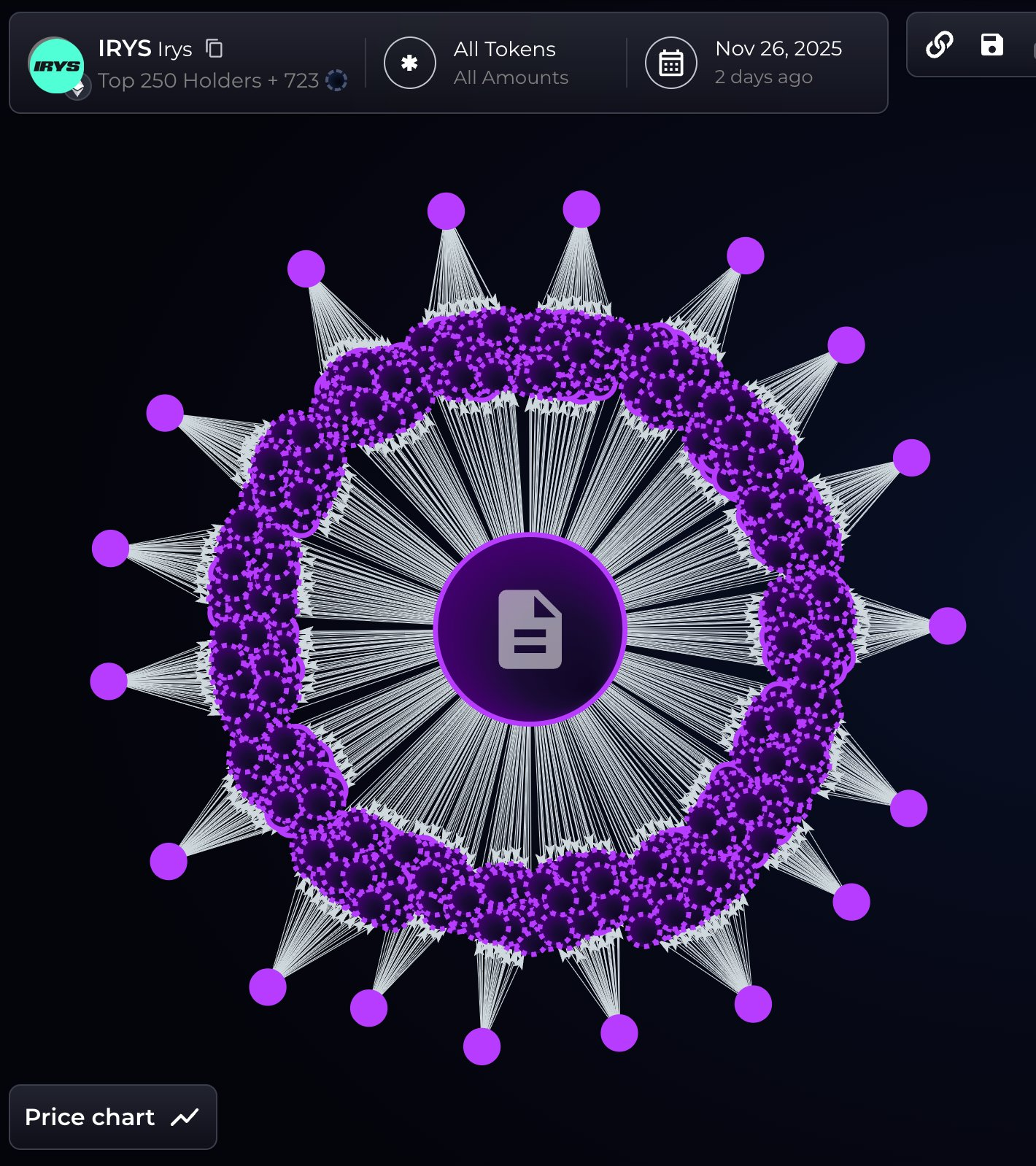
IRYS Token Address Clusters. Source: BubbleMaps

The flow of tokens, valued at approximately $4 million, indicates a likely preparation to liquidate the position. Such a move could introduce significant sell-side pressure on the asset’s order book.

IRYS price has come under pressure following the disclosures. The token has declined 16% over the past 24 hours and is trading near $0.032 as of press time.

Bubblemaps noted that it found no on-chain evidence linking the IRYS team to the wallet cluster.

Irys markets itself as an “on-chain AWS” designed for data storage and smart-contract execution.

The protocol has raised more than $13 million from venture capital investors and listed its token this week on major exchanges, including Binance and Coinbase.

Crypto Needs Stronger Sybil Protection

The episode highlights a structural challenge facing crypto projects that rely on airdrops to expand ownership.

Indeed, Irys allocated 8% of its total supply to the event. The goal was to distribute tokens to early users and help decentralize the network.

Instead, the concentration of tokens in a single cluster shows how airdrops remain vulnerable to actors using large batches of script-generated wallets to capture outsized allocations.

When one entity controls 20% of the initial circulating float, market observers say the result is heightened centralization risk and distorted price discovery.

Meanwhile, incidents like this point to broader limitations in token distribution practices across permissionless ecosystems. These environments have minimal identity checks and unrestricted network access.

This IRYS episode shows how difficult it is to prevent coordinated airdrop capture without stronger filtering, better identity heuristics, or more robust pre-distribution reviews.

Without those safeguards, early liquidity events can disproportionately benefit short-term actors. That dynamic can weaken outcomes for long-term holders and overall network stability.

Market Opportunity
Irys Logo
Irys Price(IRYS)
$0.03366
$0.03366$0.03366
+5.51%
USD
Irys (IRYS) Live Price Chart
Disclaimer: The articles reposted on this site are sourced from public platforms and are provided for informational purposes only. They do not necessarily reflect the views of MEXC. All rights remain with the original authors. If you believe any content infringes on third-party rights, please contact [email protected] for removal. MEXC makes no guarantees regarding the accuracy, completeness, or timeliness of the content and is not responsible for any actions taken based on the information provided. The content does not constitute financial, legal, or other professional advice, nor should it be considered a recommendation or endorsement by MEXC.

You May Also Like

Who’s Building the Next Phase of Artificial Intelligence? 20 Innovators Shaping the AI Industry in 2026

Who’s Building the Next Phase of Artificial Intelligence? 20 Innovators Shaping the AI Industry in 2026

Artificial intelligence, the center of global investing in 2025, is evolving from an experimental phase. After a few volatile years – characterized by rapid model
Share
AI Journal2025/12/19 05:58
Will XRP Price Increase In September 2025?

Will XRP Price Increase In September 2025?

Ripple XRP is a cryptocurrency that primarily focuses on building a decentralised payments network to facilitate low-cost and cross-border transactions. It’s a native digital currency of the Ripple network, which works as a blockchain called the XRP Ledger (XRPL). It utilised a shared, distributed ledger to track account balances and transactions. What Do XRP Charts Reveal? […]
Share
Tronweekly2025/09/18 00:00
CME Group to launch options on XRP and SOL futures

CME Group to launch options on XRP and SOL futures

The post CME Group to launch options on XRP and SOL futures appeared on BitcoinEthereumNews.com. CME Group will offer options based on the derivative markets on Solana (SOL) and XRP. The new markets will open on October 13, after regulatory approval.  CME Group will expand its crypto products with options on the futures markets of Solana (SOL) and XRP. The futures market will start on October 13, after regulatory review and approval.  The options will allow the trading of MicroSol, XRP, and MicroXRP futures, with expiry dates available every business day, monthly, and quarterly. The new products will be added to the existing BTC and ETH options markets. ‘The launch of these options contracts builds on the significant growth and increasing liquidity we have seen across our suite of Solana and XRP futures,’ said Giovanni Vicioso, CME Group Global Head of Cryptocurrency Products. The options contracts will have two main sizes, tracking the futures contracts. The new market will be suitable for sophisticated institutional traders, as well as active individual traders. The addition of options markets singles out XRP and SOL as liquid enough to offer the potential to bet on a market direction.  The options on futures arrive a few months after the launch of SOL futures. Both SOL and XRP had peak volumes in August, though XRP activity has slowed down in September. XRP and SOL options to tap both institutions and active traders Crypto options are one of the indicators of market attitudes, with XRP and SOL receiving a new way to gauge sentiment. The contracts will be supported by the Cumberland team.  ‘As one of the biggest liquidity providers in the ecosystem, the Cumberland team is excited to support CME Group’s continued expansion of crypto offerings,’ said Roman Makarov, Head of Cumberland Options Trading at DRW. ‘The launch of options on Solana and XRP futures is the latest example of the…
Share
BitcoinEthereumNews2025/09/18 00:56