The post Brazil to tax digital assets in foreign exchange transactions appeared on BitcoinEthereumNews.com. Homepage > News > Finance > Brazil to tax digital assets in foreign exchange transactions Brazil is mulling taxing digital assets used in foreign exchange transactions in a proposed new framework, sources have revealed. In South Korea, industry experts warn that the government’s planned digital asset taxation, set to take effect in 2027, could plunge the country into unprecedented financial chaos as both the investors and the taxman are unprepared. Brazil’s new digital asset taxation targets FX transactions Brazil’s financial regulators have proposed amendments to the taxation framework to encompass digital assets used in international payments, sources familiar with the matter tell Reuters. The watchdogs, led by the Banco Central do Brasil, claim that Brazilians have been turning to digital assets to evade the levy charged on FX transactions, known as the financial transaction tax (IOF). In Brazil, digital asset transactions have long been considered investment assets exempt from the IOF tax; holders are only required to pay income tax on their capital gains, but only if they exceed the monthly BRL 30,000 ($5,600) limit. However, two weeks ago, the top bank released new guidance that classifies digital asset transfers in cross-border payments as FX transactions. The guidance, which takes effect in February, also extends to any international payment made using digital assets, including those made via credit or debit cards. The new taxation reflects a shift in the Brazilian digital asset sector from speculation to utility. According to the tax authorities, Brazilians transacted BRL 227 billion ($43 billion) in the first six months of the year, representing a 20% year-over-year increase. Notably, the Latin American nation has pivoted from speculative digital assets to stablecoins. USDT, for instance, accounted for nearly 70% of the $43 billion. The central bank believes investors have turned to dollar-pegged stablecoins as a cost-effective way… The post Brazil to tax digital assets in foreign exchange transactions appeared on BitcoinEthereumNews.com. Homepage > News > Finance > Brazil to tax digital assets in foreign exchange transactions Brazil is mulling taxing digital assets used in foreign exchange transactions in a proposed new framework, sources have revealed. In South Korea, industry experts warn that the government’s planned digital asset taxation, set to take effect in 2027, could plunge the country into unprecedented financial chaos as both the investors and the taxman are unprepared. Brazil’s new digital asset taxation targets FX transactions Brazil’s financial regulators have proposed amendments to the taxation framework to encompass digital assets used in international payments, sources familiar with the matter tell Reuters. The watchdogs, led by the Banco Central do Brasil, claim that Brazilians have been turning to digital assets to evade the levy charged on FX transactions, known as the financial transaction tax (IOF). In Brazil, digital asset transactions have long been considered investment assets exempt from the IOF tax; holders are only required to pay income tax on their capital gains, but only if they exceed the monthly BRL 30,000 ($5,600) limit. However, two weeks ago, the top bank released new guidance that classifies digital asset transfers in cross-border payments as FX transactions. The guidance, which takes effect in February, also extends to any international payment made using digital assets, including those made via credit or debit cards. The new taxation reflects a shift in the Brazilian digital asset sector from speculation to utility. According to the tax authorities, Brazilians transacted BRL 227 billion ($43 billion) in the first six months of the year, representing a 20% year-over-year increase. Notably, the Latin American nation has pivoted from speculative digital assets to stablecoins. USDT, for instance, accounted for nearly 70% of the $43 billion. The central bank believes investors have turned to dollar-pegged stablecoins as a cost-effective way…

Brazil to tax digital assets in foreign exchange transactions

Brazil is mulling taxing digital assets used in foreign exchange transactions in a proposed new framework, sources have revealed.

In South Korea, industry experts warn that the government’s planned digital asset taxation, set to take effect in 2027, could plunge the country into unprecedented financial chaos as both the investors and the taxman are unprepared.

Brazil’s new digital asset taxation targets FX transactions

Brazil’s financial regulators have proposed amendments to the taxation framework to encompass digital assets used in international payments, sources familiar with the matter tell Reuters.

The watchdogs, led by the Banco Central do Brasil, claim that Brazilians have been turning to digital assets to evade the levy charged on FX transactions, known as the financial transaction tax (IOF).

In Brazil, digital asset transactions have long been considered investment assets exempt from the IOF tax; holders are only required to pay income tax on their capital gains, but only if they exceed the monthly BRL 30,000 ($5,600) limit.

However, two weeks ago, the top bank released new guidance that classifies digital asset transfers in cross-border payments as FX transactions. The guidance, which takes effect in February, also extends to any international payment made using digital assets, including those made via credit or debit cards.

The new taxation reflects a shift in the Brazilian digital asset sector from speculation to utility. According to the tax authorities, Brazilians transacted BRL 227 billion ($43 billion) in the first six months of the year, representing a 20% year-over-year increase.

Notably, the Latin American nation has pivoted from speculative digital assets to stablecoins. USDT, for instance, accounted for nearly 70% of the $43 billion. The central bank believes investors have turned to dollar-pegged stablecoins as a cost-effective way to access the U.S. dollar.

The regulator is seeking to plug this gap, ensuring “that the use of stablecoins does not create regulatory arbitrage vis-a-vis the traditional foreign-exchange market,” one unnamed source told Reuters.

Bridging the regulatory gap isn’t the sole driver; other sources suggest that the government is also seeking to increase its tax revenue. One estimate suggests that the country is losing at least $30 billion annually as importers turn to digital assets for cross-border payments.

The new taxation proposal comes amid a commitment by the Brazilian tax agency to implement the Crypto-Asset Reporting Framework (CARF) by July next year.

CARF is a digital asset taxation framework by the Organisation for Economic Co‑operation and Development (OECD) that obliges countries to collect and exchange digital asset tax information. Brazil was among the 50 countries that had expressed intent to implement CARF into local laws by 2027.

With the new announcement, the Receita Federal do Brasil extends its scope of reportable digital asset transactions to include swaps, staking, airdrops, and transfers between wallets. It also extends to offshore VASPs that serve Brazilian investors, which is a localized interpretation of the CARF (OECD’s blanket version doesn’t include this stipulation).

The taxman will also raise the reporting threshold from $5,600 to $6,500.

South Korea’s impending digital asset tax chaos

While Brazil is rolling out a more transparent framework that gives the industry certainty, South Korea could be heading into digital asset taxation chaos in two years.

South Korean legislators first voted for a 20% tax on digital asset income five years ago, and it was set to take effect in January 2022. However, it was postponed to 2025, and later, a faction of legislators lobbied for another two-year extension to 2027.

These delays have been deemed necessary for the tax agency and the digital asset industry to implement the necessary infrastructure. However, experts say that little has been done, and the country could plunge into tax chaos within two years.

“Unresolved issues could spark legal challenges once taxation begins. The deferral period should be used to clarify key definitions and prepare for international data-sharing challenges,” Park Joo-cheol, a researcher at the Korea Institute of Public Finance, told The Korea Times.

Digital asset taxation has become politicized, with President Lee Jae‑myung’s Democratic Party of Korea ascending to power earlier this year on pledges of a tax deferral.

Kim Kab-lae, a researcher at the Korea Capital Market Institute, says these deferrals could become the norm.

“A fourth deferral can no longer be ruled out. If public sentiment begins to support another delay, it could trigger tax resistance strong enough to jeopardize future implementation,” he stated.

Watch: Bitcoin’s Ultimate Use Case Explained

frameborder=”0″ allow=”accelerometer; autoplay; clipboard-write; encrypted-media; gyroscope; picture-in-picture; web-share” referrerpolicy=”strict-origin-when-cross-origin” allowfullscreen>

Source: https://coingeek.com/brazil-to-tax-digital-assets-in-foreign-exchange-transactions/

Market Opportunity
Overtake Logo
Overtake Price(TAKE)
$0.01818
$0.01818$0.01818
+0.11%
USD
Overtake (TAKE) Live Price Chart
Disclaimer: The articles reposted on this site are sourced from public platforms and are provided for informational purposes only. They do not necessarily reflect the views of MEXC. All rights remain with the original authors. If you believe any content infringes on third-party rights, please contact [email protected] for removal. MEXC makes no guarantees regarding the accuracy, completeness, or timeliness of the content and is not responsible for any actions taken based on the information provided. The content does not constitute financial, legal, or other professional advice, nor should it be considered a recommendation or endorsement by MEXC.

You May Also Like

Young Republicans were more proud to be American under Obama than under Trump: data analyst

Young Republicans were more proud to be American under Obama than under Trump: data analyst

CNN data analyst Harry Enten sorts through revealing polls and surveys of American attitudes, looking for shifts, and his latest finding is an indictment of President
Share
Alternet2026/02/10 22:18
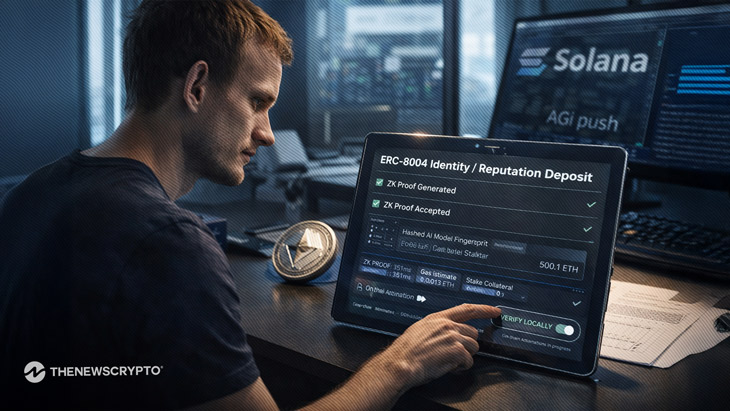
Vitalik Buterin Outlines Ethereum’s AI Framework, Pushes Back Against Solana’s Acceleration Thesis

Vitalik Buterin Outlines Ethereum’s AI Framework, Pushes Back Against Solana’s Acceleration Thesis

Ethereum co-founder Vitalik Buterin has reacted to Solana’s artificial general intelligence acceleration initiative. He did this through the establishment of his
Share
Thenewscrypto2026/02/10 18:40
XRP News Today: XRP Tundra Unveils Two-Token Strategy with 25x Return Potential

XRP News Today: XRP Tundra Unveils Two-Token Strategy with 25x Return Potential

The post XRP News Today: XRP Tundra Unveils Two-Token Strategy with 25x Return Potential appeared on BitcoinEthereumNews.com. XRP remains one of the most closely watched assets in the market, both for its role in cross-border settlement and for its potential within the broader digital asset ecosystem. Yet for long-term holders, one gap has persisted: XRP has never had a native staking system. That limitation has left investors with limited options beyond price appreciation, even as competitors like Ethereum and Solana built extensive staking networks. XRP Tundra’s presale is making news for directly addressing that issue. The project has introduced a two-token strategy designed to provide yield opportunities for XRP holders while embedding exponential upside into presale economics. Analysts covering XRP updates have flagged the model as one of the more innovative token launches of 2025, particularly as it blends utility with transparent launch pricing. A Dual-Token Presale With Defined Launch Values At the center of XRP Tundra’s design is a dual-token model. TUNDRA-S, issued on Solana, functions as the utility and yield-generating token. TUNDRA-X, minted on the XRP Ledger, serves as the governance and reserve layer. Every presale purchase of TUNDRA-S automatically delivers free TUNDRA-X, tying investors into both blockchains in a single allocation. In the current Phase 3, TUNDRA-S is priced at $0.041 with a 17% token bonus included. Free TUNDRA-X is valued for reference at $0.0205. Launch values are already fixed at $2.50 for TUNDRA-S and $1.25 for TUNDRA-X, embedding a built-in 25x return potential for presale participants. For investors who have waited years for XRP-related innovation, this clarity has stood out. Staking Introduces Yield for XRP Holders The presale is not only about token distribution. XRP Tundra introduces staking through Cryo Vaults, where XRP can be locked for periods of 7 to 90 days. Rewards increase with longer commitments, while Frost Keys — NFT multipliers — allow participants to enhance yields or shorten lockups.…
Share
BitcoinEthereumNews2025/09/26 05:31