If Ethereum fails to hold $2,800 and cannot generate bullish volume, the price is likely to rotate toward the $2,200 support level.If Ethereum fails to hold $2,800 and cannot generate bullish volume, the price is likely to rotate toward the $2,200 support level.

Why Ethereum price low-volume bounce risks a correction to $2,220

2025/12/08 21:59
4 min read

Ethereum price lacks conviction as weak volume and failed follow-through increase the risk of a deeper correction toward $2,200 unless buyers step in to defend key support zones.

Summary
  • ETH struggles to reclaim the value area high due to thin bullish volume.
  • Losing $2,800 opens the door to the untapped $2,200 support.
  • Market structure remains range-bound, with downside momentum building.

Ethereum (ETH) price is showing signs of weakness despite its recent bounce, with price action struggling to gain traction above key technical levels. The rally has not been supported by strong bullish volume, raising concerns that the move may lack the momentum needed for sustained continuation.

With the price unable to decisively break above the value area high, Ethereum now faces the possibility of a reversal toward lower support zones. Traders are watching closely as structural signals point toward growing downside risk, particularly if critical support fails to hold.

Ethereum price key technical points

  • Ethereum’s rebound is occurring on low volume, signaling weak buyer participation.
  • Failure to reclaim the value area high increases the risk of a move toward $2,800 support.
  • A breakdown of $2,800 would expose the next support zone at $2,200.
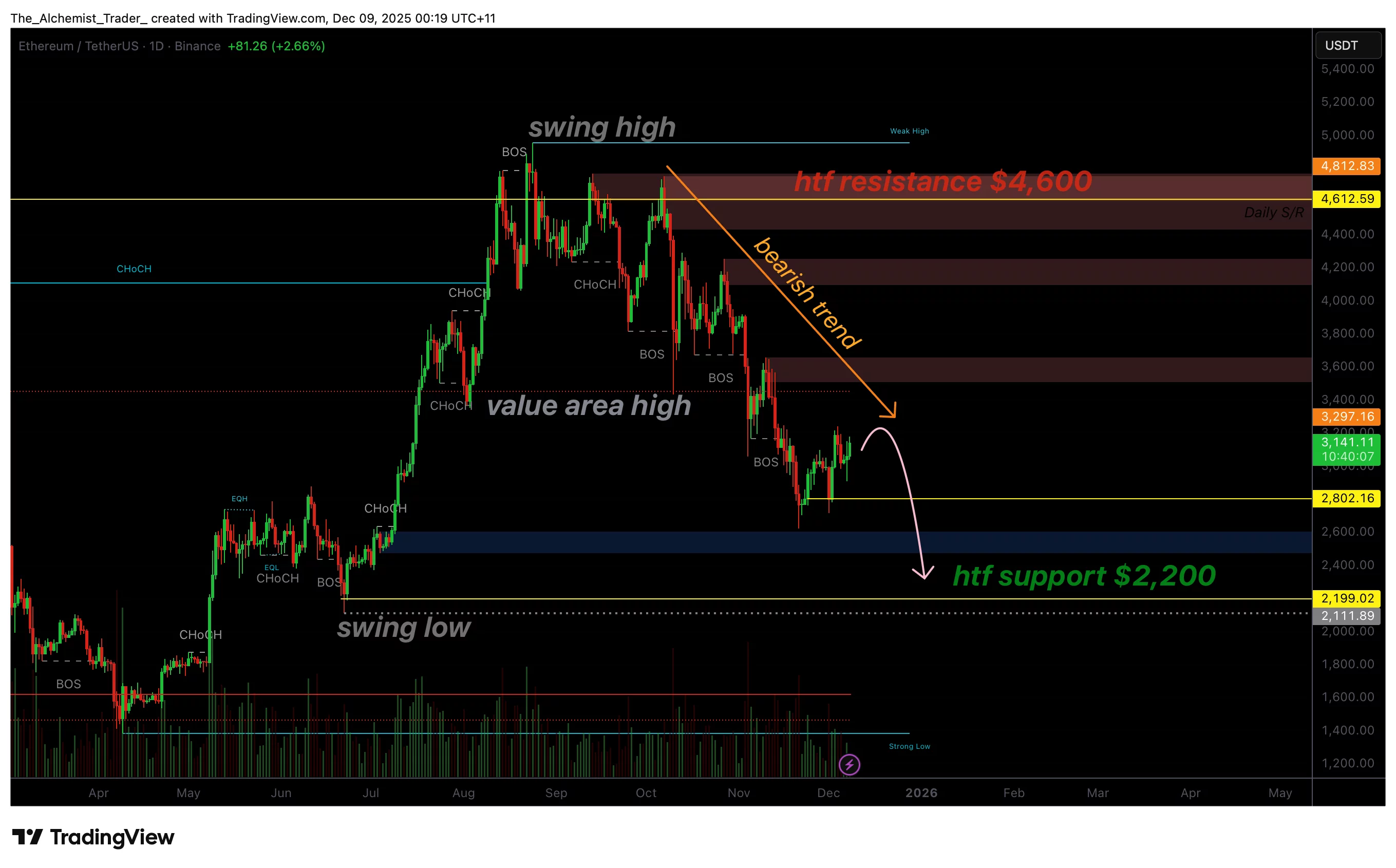
Why Ethereum price low-volume bounce risks a correction to $2,220 - 1

The current bounce on Ethereum has exhibited little strength, struggling to create meaningful follow-through above the value area high. This region serves as an indicator of whether the price can sustain upward expansion or remains confined within its broader range. In Ethereum’s case, the inability to push above this threshold suggests that bullish momentum is lacking.

The weakness is further highlighted by Ethereum ETFs recording over $75 million in outflows with zero inflows, signaling fading institutional appetite as ETH stalls around $3,000. One of the first areas of interest is the $2,800 support level, which has acted as a structural pivot in recent months.

If Ethereum fails to hold $2,800, the probability of a deeper correction increases significantly. Beneath this level lies the $2,200 region, a key support area that has not been revisited since June. This zone contains resting liquidity and represents a natural downside magnet if the market begins to unwind. A sweep of this liquidity could accelerate downward pressure and complete a full rotation within Ethereum’s broader trading range.

It is also important to consider the repeated lack of follow-through in recent bullish attempts. Several countertrend rallies have formed, yet none have managed to break the structure or invalidate the broader downtrend. Each attempt has been met with sell pressure, pushing the price back into the lower half of the range. This series of failed moves further confirms the absence of meaningful buyer commitment.

The long-term structure remains intact within this high-time-frame range, with price oscillating between support and resistance zones for several years. Until Ethereum shows decisive breakout strength, it is likely to continue trading within this larger pattern. This means both rallies and declines are constrained by well-established boundaries, making volume and momentum key indicators for anticipating directional moves.

This broader stagnation mirrors wider market conditions as NFT sales remain modest at $77 million, and Ethereum-based NFTs dropped 13 percent, underscoring the reduced enthusiasm across the ecosystem.

Currently, those indicators lean bearish. With weakening momentum, thin volume on the bounce and no structural break to the upside, Ethereum faces elevated downside risk. A reclaim and close above the value area high would be needed to reverse this short-term bearish bias. Without such confirmation, the path toward $2,200 remains a technical possibility.

What to expect in the coming price action

If Ethereum fails to hold $2,800 and cannot generate bullish volume, the price is likely to rotate toward the $2,200 support level. Only a decisive breakout above the value area high with volume confirmation would negate this bearish scenario.

Market Opportunity
Bullish Degen Logo
Bullish Degen Price(BULLISH)
$0.007341
$0.007341$0.007341
-8.95%
USD
Bullish Degen (BULLISH) Live Price Chart
Disclaimer: The articles reposted on this site are sourced from public platforms and are provided for informational purposes only. They do not necessarily reflect the views of MEXC. All rights remain with the original authors. If you believe any content infringes on third-party rights, please contact [email protected] for removal. MEXC makes no guarantees regarding the accuracy, completeness, or timeliness of the content and is not responsible for any actions taken based on the information provided. The content does not constitute financial, legal, or other professional advice, nor should it be considered a recommendation or endorsement by MEXC.

You May Also Like

Ex-Alipay UK Chief Eva Zhang to Lead Blockscout Into AI-Driven Growth

Ex-Alipay UK Chief Eva Zhang to Lead Blockscout Into AI-Driven Growth

Blockscout, the leading open-source block explorer for EVM chains, has appointed Eva Zhang, former CEO of Alipay UK, as its new chief executive officer.
Share
Blockchainreporter2025/09/18 19:00
Gold price in Malaysia: Rates on February 16

Gold price in Malaysia: Rates on February 16

The post Gold price in Malaysia: Rates on February 16 appeared on BitcoinEthereumNews.com. Gold prices fell in Malaysia on Monday, according to data compiled by
Share
BitcoinEthereumNews2026/02/16 13:21
U.S. Treasury Seeks Public Input on Game-Changing Stablecoin Regulations

U.S. Treasury Seeks Public Input on Game-Changing Stablecoin Regulations

U.S. Treasury invites feedback on groundbreaking stablecoin regulations under GENIUS. Key questions around stablecoin tax treatment and foreign issuer rules. Treasury explores marketing restrictions, oversight balance, and AML enforcement options. The U.S. Treasury Department is now inviting public feedback on the implementation of the groundbreaking GENIUS Act, the first piece of crypto-specific legislation passed in the U.S. this summer. The new law is a milestone in terms of regulation of stablecoins, as the Treasury is aiming to balance the need to innovate and the aim of protecting consumers and monetary stability. According to Treasury officials, the GENIUS Act is designed to stimulate the growth of payment stablecoins while addressing potential risks related to illicit financial activities and maintaining overall economic stability. The department especially shows interest in the acquisition of data that could assist in refining the regulatory guidelines as it proceeds with the writing of its formal proposal. The commenting is active through the October 20 deadline, which gives both opponents and players in the industry time to express their views. One of the most pressing questions under consideration is how the IRS will handle the federal income tax treatment of stablecoins. The GENIUS Act does not directly cover this, and there is room to interpret and make decisions by regulation in the future. Also unclear is when and how foreign issuers can be allowed to offer stablecoins in the U.S., and it does not look like there is a timeline involved in making any changes. Also Read: Ripple Partners with DZ BANK to Launch Institutional Digital Asset Custody Solution Key Areas Under Scrutiny as Treasury Prepares Stablecoin Regulations Several key issues are currently up for discussion as part of the Treasury’s review of the GENIUS Act’s implementation. These include whether stablecoins should have certain marketing limitations, whether it should be at the state or federal level, and how the current anti-money laundering (AML) and sanctions policies will relate to digital assets. Moreover, the Treasury is analyzing how the current regulations, such as the Bank Secrecy Act (BSA), are capable of mitigating the risks of digital assets. This is after it was earlier sought to seek the views of people on the detection of illicit use in the digital asset markets. As the Treasury moves toward finalizing the regulations, it is clear that the department aims to craft a robust and flexible framework that can adapt to the evolving landscape of digital currencies. The outcome will have lasting implications for the future of stablecoin regulation in the U.S., shaping the path forward for both domestic and international players in the crypto space. Also Read: Shiba Inu Faces Major Selling Pressure as 157 Billion SHIB Floods Exchanges! The post U.S. Treasury Seeks Public Input on Game-Changing Stablecoin Regulations appeared first on 36Crypto.
Share
Coinstats2025/09/20 17:22