The post Charles Hoskinson Unveils Cardano’s 2026 Master Plan ⋆ ZyCrypto appeared on BitcoinEthereumNews.com. Advertisement &nbsp &nbsp Cardano founder Charles Hoskinson has shared a detailed vision for the blockchain’s future, signaling that 2026 could become a decisive year for the ecosystem, provided its leadership factions resolve long-standing coordination issues. Speaking during a Dec. 1 livestream, Hoskinson admitted that internal power struggles have slowed Cardano’s momentum but said the platform is finally positioned to accelerate. For years, Input Output (IO) held the dominant role in Cardano’s governance. The company controlled three of the eight genesis keys, giving it the deciding vote over protocol upgrades and ADA reserves. That changed in November 2024 with the implementation of CIP-1694, which burned the genesis keys and shifted governance authority to the broader community. The IOHK founder compared the new system to the legislative and judicial branches of government, though he noted Cardano still lacks a practical executive function. Advertisement &nbsp This executive layer, what Hoskinson called the “Pentad,” consists of IO, Emurgo, the Cardano Foundation, the Midnight Foundation, and Intersect. Coordination between these groups has been strained, he said, warning that without unity, “we’re going to end up with a damn mess.” The Cardano co-founder stressed that cultural alignment is as essential as structure. Only when the five entities operate as a single team can Cardano fully commit to growth. More than a year after the Chang hard fork initiated  Cardano’s governance transformation, Hoskinson believes, has finally arrived. However, significant technical challenges remain, particularly around interoperability. Cardano’s UTXO-based model prevents native support from major cross-chain frameworks like LayerZero, Wormhole, and Chainlink, making the development of custom bridges slow and resource-intensive. This limitation has left the ecosystem without vital pieces of DeFi infrastructure, from widely used stablecoins to robust oracle systems. As Hoskinson put it, “We’re basically an island.” To address these gaps, members of the Pentad… The post Charles Hoskinson Unveils Cardano’s 2026 Master Plan ⋆ ZyCrypto appeared on BitcoinEthereumNews.com. Advertisement &nbsp &nbsp Cardano founder Charles Hoskinson has shared a detailed vision for the blockchain’s future, signaling that 2026 could become a decisive year for the ecosystem, provided its leadership factions resolve long-standing coordination issues. Speaking during a Dec. 1 livestream, Hoskinson admitted that internal power struggles have slowed Cardano’s momentum but said the platform is finally positioned to accelerate. For years, Input Output (IO) held the dominant role in Cardano’s governance. The company controlled three of the eight genesis keys, giving it the deciding vote over protocol upgrades and ADA reserves. That changed in November 2024 with the implementation of CIP-1694, which burned the genesis keys and shifted governance authority to the broader community. The IOHK founder compared the new system to the legislative and judicial branches of government, though he noted Cardano still lacks a practical executive function. Advertisement &nbsp This executive layer, what Hoskinson called the “Pentad,” consists of IO, Emurgo, the Cardano Foundation, the Midnight Foundation, and Intersect. Coordination between these groups has been strained, he said, warning that without unity, “we’re going to end up with a damn mess.” The Cardano co-founder stressed that cultural alignment is as essential as structure. Only when the five entities operate as a single team can Cardano fully commit to growth. More than a year after the Chang hard fork initiated  Cardano’s governance transformation, Hoskinson believes, has finally arrived. However, significant technical challenges remain, particularly around interoperability. Cardano’s UTXO-based model prevents native support from major cross-chain frameworks like LayerZero, Wormhole, and Chainlink, making the development of custom bridges slow and resource-intensive. This limitation has left the ecosystem without vital pieces of DeFi infrastructure, from widely used stablecoins to robust oracle systems. As Hoskinson put it, “We’re basically an island.” To address these gaps, members of the Pentad…

Charles Hoskinson Unveils Cardano’s 2026 Master Plan ⋆ ZyCrypto

Advertisement

Cardano founder Charles Hoskinson has shared a detailed vision for the blockchain’s future, signaling that 2026 could become a decisive year for the ecosystem, provided its leadership factions resolve long-standing coordination issues.

Speaking during a Dec. 1 livestream, Hoskinson admitted that internal power struggles have slowed Cardano’s momentum but said the platform is finally positioned to accelerate.

For years, Input Output (IO) held the dominant role in Cardano’s governance. The company controlled three of the eight genesis keys, giving it the deciding vote over protocol upgrades and ADA reserves.

That changed in November 2024 with the implementation of CIP-1694, which burned the genesis keys and shifted governance authority to the broader community.

The IOHK founder compared the new system to the legislative and judicial branches of government, though he noted Cardano still lacks a practical executive function.

Advertisement


This executive layer, what Hoskinson called the “Pentad,” consists of IO, Emurgo, the Cardano Foundation, the Midnight Foundation, and Intersect. Coordination between these groups has been strained, he said, warning that without unity, “we’re going to end up with a damn mess.”

The Cardano co-founder stressed that cultural alignment is as essential as structure. Only when the five entities operate as a single team can Cardano fully commit to growth.

More than a year after the Chang hard fork initiated 

Cardano’s governance transformation, Hoskinson believes, has finally arrived. However, significant technical challenges remain, particularly around interoperability.

Cardano’s UTXO-based model prevents native support from major cross-chain frameworks like LayerZero, Wormhole, and Chainlink, making the development of custom bridges slow and resource-intensive.

This limitation has left the ecosystem without vital pieces of DeFi infrastructure, from widely used stablecoins to robust oracle systems. As Hoskinson put it, “We’re basically an island.”

To address these gaps, members of the Pentad have proposed allocating 70 million ADA to a strategic integration fund designed to onboard crucial infrastructure partners. The priorities include bridges, analytics tools, wallet upgrades, and top-tier stablecoins.

The urgency is not lost on the community. One supporter called Hoskinson’s breakdown “the single most bullish thing” of the year, praising its clarity, realism, and execution-ready roadmap.

Source: https://zycrypto.com/charles-hoskinson-unveils-cardanos-2026-master-plan/
Market Opportunity
FUTURECOIN Logo
FUTURECOIN Price(FUTURE)
$0.07482
$0.07482$0.07482
0.00%
USD
FUTURECOIN (FUTURE) Live Price Chart
Disclaimer: The articles reposted on this site are sourced from public platforms and are provided for informational purposes only. They do not necessarily reflect the views of MEXC. All rights remain with the original authors. If you believe any content infringes on third-party rights, please contact [email protected] for removal. MEXC makes no guarantees regarding the accuracy, completeness, or timeliness of the content and is not responsible for any actions taken based on the information provided. The content does not constitute financial, legal, or other professional advice, nor should it be considered a recommendation or endorsement by MEXC.

You May Also Like

Hadron Labs Launches Bitcoin Summer on Neutron, Offering 5–10% BTC Yield

Hadron Labs Launches Bitcoin Summer on Neutron, Offering 5–10% BTC Yield

Hadron Labs launches 'Bitcoin Summer' on Neutron, BTC vaults for WBTC, eBTC, solvBTC, uniBTC and USDC. Earn 5–10% BTC via maxBTC, with up to 10x looping.
Share
Blockchainreporter2025/09/18 02:00
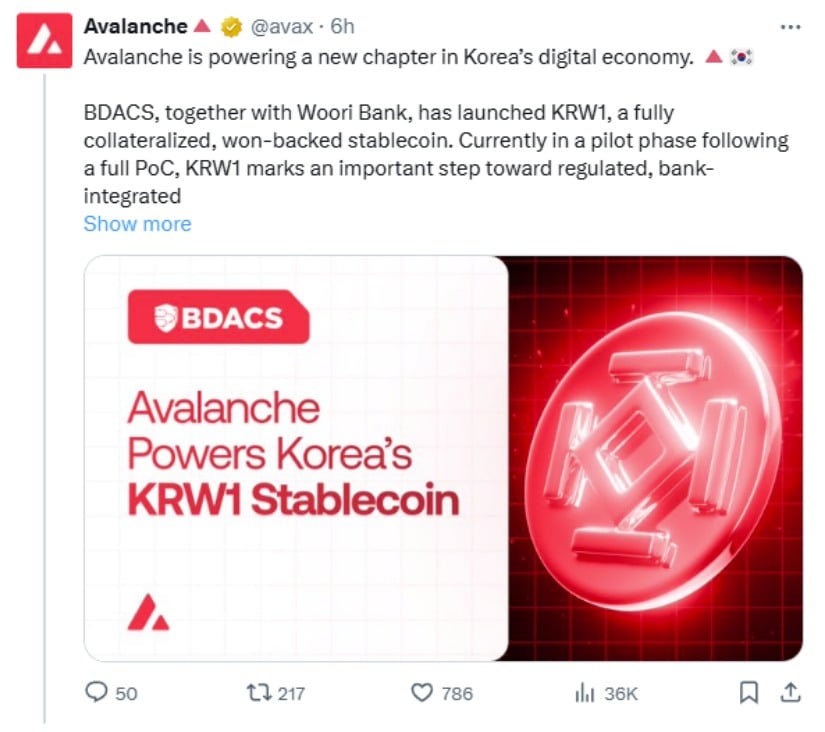
South Korea Launches First Won-Backed Stablecoin KRW1 on Avalanche

South Korea Launches First Won-Backed Stablecoin KRW1 on Avalanche

South Korea made history this week by launching its first Korean won-backed stablecoin.
Share
Brave Newcoin2025/09/19 03:15
Curve Finance votes on revenue-sharing model for CRV holders

Curve Finance votes on revenue-sharing model for CRV holders

The post Curve Finance votes on revenue-sharing model for CRV holders appeared on BitcoinEthereumNews.com. Curve Finance has proposed a new protocol called Yield Basis that would share revenue directly with CRV holders, marking a shift from one-off incentives to sustainable income. Summary Curve Finance has put forward a revenue-sharing protocol to give CRV holders sustainable income beyond emissions and fees. The plan would mint $60M in crvUSD to seed three Bitcoin liquidity pools (WBTC, cbBTC, tBTC), with 35–65% of revenue distributed to veCRV stakers. The DAO vote runs from up to Sept. 24, with the proposal seen as a major step to strengthen CRV tokenomics after past liquidity and governance challenges. Curve Finance founder Michael Egorov has introduced a proposal to give CRV token holders a more direct way to earn income, launching a system called Yield Basis that aims to turn the governance token into a sustainable, yield-bearing asset.  The proposal has been published on the Curve DAO (CRV) governance forum, with voting open until Sept. 24. A new model for CRV rewards Yield Basis is designed to distribute transparent and consistent returns to CRV holders who lock their tokens for veCRV governance rights. Unlike past incentive programs, which relied heavily on airdrops and emissions, the protocol channels income from Bitcoin-focused liquidity pools directly back to token holders. To start, Curve would mint $60 million worth of crvUSD, its over-collateralized stablecoin, with proceeds allocated across three pools — WBTC, cbBTC, and tBTC — each capped at $10 million. 25% of Yield Basis tokens would be reserved for the Curve ecosystem, and between 35% and 65% of Yield Basis’s revenue would be given to veCRV holders. By emphasizing Bitcoin (BTC) liquidity and offering yields without the short-term loss risks associated with automated market makers, the protocol hopes to draw in professional traders and institutions. Context and potential impact on Curve Finance The proposal comes as Curve continues to modify…
Share
BitcoinEthereumNews2025/09/18 14:37