The Pyth Network announced a new reserve strategy. The protocol will convert one-third of its revenue into open-market PYTH token purchases. The Pyth Network, aThe Pyth Network announced a new reserve strategy. The protocol will convert one-third of its revenue into open-market PYTH token purchases. The Pyth Network, a

Pyth DAO to Convert Revenue Into PYTH Reserves

2025/12/14 00:00
3 min read

The Pyth Network announced a new reserve strategy. The protocol will convert one-third of its revenue into open-market PYTH token purchases.

The Pyth Network, a blockchain oracle provider, has unveiled a new reserve strategy. The decentralized autonomous organization (DAO) will convert a portion of the protocol’s revenue into PYTH token purchases.

Pyth said the tokens it purchases in  open market would form the new reserve of the network. One third of the revenue generated by the protocol will be used for these systematic purchases. The goal of the network is to scale at a globally scale. The tactic is overtly aimed at raising revenue and thus purchases of tokens.

The introduction of the PYTH Reserve is a mechanism of structure. It turns the protocol revenue into systematic purchases of PYTH tokens. This directly links the adoption of the product to network value. Pyth emphasized that it has achieved product-market fit. Therefore, the network will now recycle value back into the ecosystem.

Related Reading: Pyth Partners with Revolut to Integrate Digital Banking Data into DeFi | Live Bitcoin News

The PYTH DAO Treasury receives a fraction of the protocol’s revenue. It invests these funds into purchasing PYTH tokens on the open market monthly. This allows transparent mathematical control of the relationship between use and long-term value for the network. More usage means more revenue and more revenue means more tokens purchased.
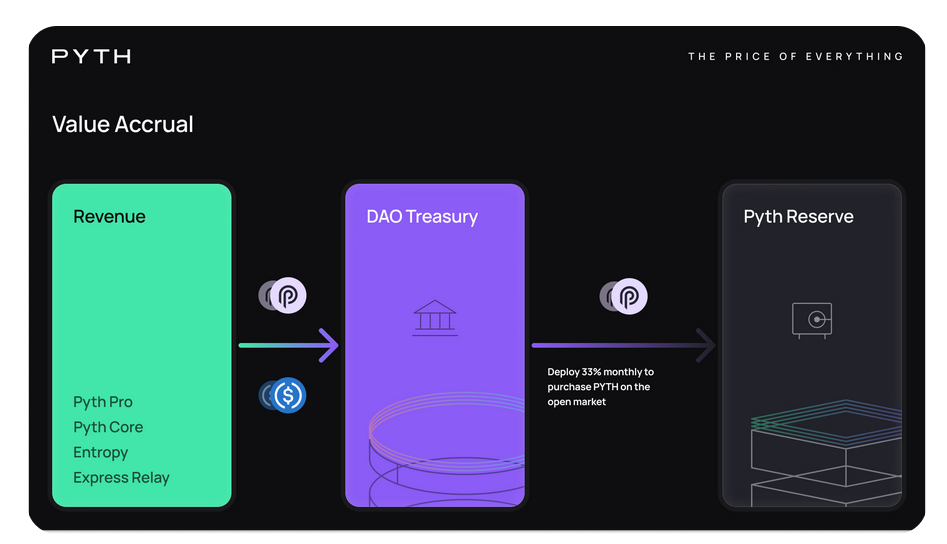
The Pyth Network announced a new reserve strategy. The protocol will convert one-third of its revenue into open-market PYTH token purchases.Source: Pyth Network

First, the DAO announced the initiative on December 12, 2025, confirming monthly treasury buybacks. Moreover, the strategy aims to create consistent and predictable token demand. Meanwhile, the network will scale buybacks alongside revenue growth. Initially, the first month’s buybacks are estimated between $100,000 and $200,000.

Pyth Expands Oracle Revenue Through Institutional Subscriptions

The Pyth Network earns revenue from a number of products and services. These include its standard Pyth Core price feeds on over 100 blockchains. It also includes Pyth Entropy, a random number generation service.

One of the important causes of revenue increase is Pyth Pro. This is a new institutional subscription product. In its first month, Pyth Pro is on its way to achieving an annualized recurring revenue (ARR) of $1M. This proves that the financial institutions are willing to pay for Pyth data.

The network is looking for ambitious growth. It hopes to capture just 1% of an estimated $50 billion market for institutional financial data every year. This would amount to $500 million of revenue per year. As a result of this, there would be significant growth for the PYTH Reserve.

The total supply of PYTH token is 10 billion tokens. Its current circulating quota is about 5.75 billion. The tokens that are not in circulation are subject to a structured cliff vesting schedule. This schedule extends into 2027. This structure fosters long-term commitment on the part of participants. Token holders are involved in the Pyth DAO. They vote on important network parameters such as fees and asset coverage.

The post Pyth DAO to Convert Revenue Into PYTH Reserves appeared first on Live Bitcoin News.

Market Opportunity
Pyth Network Logo
Pyth Network Price(PYTH)
$0.04576
$0.04576$0.04576
-0.34%
USD
Pyth Network (PYTH) Live Price Chart
Disclaimer: The articles reposted on this site are sourced from public platforms and are provided for informational purposes only. They do not necessarily reflect the views of MEXC. All rights remain with the original authors. If you believe any content infringes on third-party rights, please contact [email protected] for removal. MEXC makes no guarantees regarding the accuracy, completeness, or timeliness of the content and is not responsible for any actions taken based on the information provided. The content does not constitute financial, legal, or other professional advice, nor should it be considered a recommendation or endorsement by MEXC.

You May Also Like

And the Big Day Has Arrived: The Anticipated News for XRP and Dogecoin Tomorrow

And the Big Day Has Arrived: The Anticipated News for XRP and Dogecoin Tomorrow

The first-ever ETFs for XRP and Dogecoin are expected to launch in the US tomorrow. Here's what you need to know. Continue Reading: And the Big Day Has Arrived: The Anticipated News for XRP and Dogecoin Tomorrow
Share
Coinstats2025/09/18 04:33
Tokenized Assets Shift From Wrappers to Building Blocks in DeFi

Tokenized Assets Shift From Wrappers to Building Blocks in DeFi

The post Tokenized Assets Shift From Wrappers to Building Blocks in DeFi appeared on BitcoinEthereumNews.com. RWAs are rapidly moving on-chain, unlocking new opportunities for investors and DeFi protocols, according to a new report from Dune and RWAxyz. Tokenized real-world assets (RWAs) are moving beyond digital versions of traditional securities to become key building blocks of decentralized finance (DeFi), according to the 2025 RWA Report from Dune and RWAxyz. The report notes that Treasuries, bonds, credit, and equities are now being used in DeFi as collateral, trading instruments, and yield products. This marks tokenization’s “real breakthrough” – composability, or the ability to combine and reuse assets across different protocols. Projects are already showing how this works in practice. Asset manager Maple Finance’s syrupUSDC, for example, has grown to $2.5 billion, with more than 30% placed in DeFi apps like Spark ($570 million). Centrifuge’s new deJAAA token, a wrapper for Janus Henderson’s AAA CLO fund, is already trading on Aerodrome, Coinbase and other exchanges, with Stellar planned next. Meanwhile, Aave’s Horizon RWA Market now lets institutional users post tokenized Treasuries and CLOs as collateral. This trend underscores a bigger shift: RWAs are no longer just copies of traditional assets; instead, they are becoming core parts of on-chain finance, powering lending, liquidity, and yield, and helping to close the gap between traditional finance (TradFi) and DeFi. “RWAs have crossed the chasm from experimentation to execution,” Sid Powell, CEO of Maple Finance, says in the report. “Our growth to $3.5B AUM reflects a broader shift: traditional financial services are adopting crypto assets while institutions seek exposure to on-chain markets.” Investor demand for higher returns and more diversified options is mainly driving this growth. Tokenized Treasuries proved there is strong demand, with $7.3 billion issued by September 2025 – up 85% year-to-date. The growth was led by BlackRock, WisdomTree, Ondo, and Centrifuge’s JTRSY (Janus Henderson Anemoy Treasury Fund). Spark’s $1…
Share
BitcoinEthereumNews2025/09/18 06:10
SlowMist: ClawHub is increasingly becoming a new target for attackers to poison supply chains.

SlowMist: ClawHub is increasingly becoming a new target for attackers to poison supply chains.

PANews reported on February 9th that, according to SlowMist monitoring, ClawHub, the official plugin center of the open-source AI agent project OpenClaw, is increasingly
Share
PANews2026/02/09 10:51