Former Terraform Labs developer Will Chen argued in a Dec. 13 X thread that the fraud case against Do Kwon was built on a “backwards” theory, days after a courtFormer Terraform Labs developer Will Chen argued in a Dec. 13 X thread that the fraud case against Do Kwon was built on a “backwards” theory, days after a court

Ex-Terra Insider Calls Do Kwon Case ‘Backwards’ In Explosive X Thread

Former Terraform Labs developer Will Chen argued in a Dec. 13 X thread that the fraud case against Do Kwon was built on a “backwards” theory, days after a court sentenced Kwon to 15 years in prison on Friday, Dec. 15.

Chen framed his post as a critique of the legal mechanics, not a character defense. “I wanted Do to fail. I wanted him punished. I thought he was arrogant and reckless and I told him so to his face multiple times,” he wrote. “I’m not here to defend Do Kwon the person. But the legal case is broken.”

Do Kwon Conviction Misframed Terra’s Collapse

He described Judge Engelmayer as “sympathetic” and “extremely methodical,” but argued the guilty plea boxed Kwon into the government’s framing: “Do taking the guilty plea means admitting to the government’s charges as is. There’s no debating afterward.” Chen said he found it “incredibly ironic” that Do Kwon didn’t contest the case.

At the center of Chen’s critique is prosecutors’ theory around Terra’s May 2021 depeg. As Chen summarized it, the government argued that Kwon claimed the algorithm “self-healed” while failing to disclose that Jump Trading stepped in to buy UST and help restore the peg, making his public statements deceptive and therefore fraudulent.

Chen’s rebuttal is that this logic runs in the wrong direction. “Fraud is when you claim your system has safety mechanisms it doesn’t have, and people invest trusting that fake safety, and then they lose money when the danger you hid materializes,” he wrote, contrasting it with the allegation here: “But what the government is alleging is the inverse. Do said ‘no reserves, the algorithm alone handles it’ when he actually did have Jump as a backstop.”

In Chen’s view, that means Do Kwon was “claiming less safety than he actually had,” adding: “If he’d disclosed Jump, investors would have been more confident, not less.” He distilled his conclusion bluntly: “You don’t defraud someone by hiding additional safety mechanisms. The direction is backwards.”

Chen also disputed how prosecutors interpreted a reported private remark attributed to Do Kwon — that Terra “might’ve been fucked without Jump” — as proof Kwon knew the mechanism was broken. “Might’ve been fucked is uncertainty about an unknowable counterfactual,” Chen wrote. “Knew it would have failed is a claim of definite knowledge.”

He argued the only way to truly know the algorithm would not have recovered is to not intervene and watch it die, which he suggests is inconsistent with operating a live financial system. “The algorithm was working during that period,” Chen wrote. “Arbitrage was happening. UST was being burned for LUNA. Jump was also buying. Both things were true.”

Even the non-disclosure itself, Chen argued, could be framed as strategic rather than deceptive. “Algorithmic stablecoins operate in adversarial conditions,” he wrote, suggesting that publicizing the size and nature of defenses can make an attack easier to price. “If attackers know your exact defense capabilities, they can calculate whether an attack is profitable,” Chen said, arguing that “uncertainty about defense resources is itself a defense.”

He compared the idea to “strategic ambiguity” used by central banks and warned that public transparency around reserves can become a tactical disadvantage: “Would disclosing Jump have made Terra more or less secure? Attackers could have calculated exactly how much force was needed to overwhelm the defense.”

Chen then challenged whether the case established investor reliance and causation in a market saturated with information. “Do’s statements were one signal in an incredibly noisy channel,” he wrote, pointing to years of public debate around Terra’s risks, open-source code, and prominent critics. “The risk was described in the original white paper. The code was open source. The potential failure mode was publicly debated for years,” Chen wrote, arguing prosecutors “never established direct causation between Do’s specific statements and investor decisions.”

He also drew a sharp line between the May 2021 episode and the May 2022 collapse, arguing the information environment changed materially in between. “By May 2022, investors knew about backstops,” he wrote, pointing to Luna Foundation Guard’s public launch in January 2022 and the visibility of reserves on-chain. In Chen’s view, that breaks the causal chain: “The May 2021 non-disclosure about Jump is causally disconnected from May 2022 losses because the information environment had completely changed by then.”

One of Chen’s most forceful objections was the scope of losses attributed to Do Kwon. “One thing I can’t get over is the fact that Do signed off on pleading guilty to causing $40 billion in loss,” he wrote. “Market cap decline is not fraud loss.” He offered a simple example to illustrate what he sees as a category error: “If I buy LUNA at $1 and it goes to $100 and then back to zero, my loss is $1. The $99 was paper gains I never realized.” Treating peak-to-trough market cap evaporation as damages, he argued, “sets a terrible legal precedent for the industry.”

While disputing the overarching fraud theory, Chen did not claim Terraform Labs’ messaging was clean across the board. He said “the Chai stuff has more merit as an actual fraud claim,” while arguing the government’s portrayal was still overstated. “That’s not entirely accurate,” he wrote of claims Chai didn’t use Terra, adding that Chai “did use Terra for accounting,” that “Terra wallet was integrated into the app,” and “you could top up Chai with KRT,” while conceding Do Kwon “probably stretched the truth early on” about on-chain payment settlement.

Anchor, Chen wrote, was “harder to defend.” Promoting the roughly 20% yield as sustainable while reserves depleted was “reckless,” and he said Do Kwon knew “the 20% couldn’t last forever without a plan.” Still, Chen argued that even if yield marketing was misleading, the catastrophic losses were driven by the depeg: “If UST had held, people would’ve just earned less interest. They wouldn’t have lost their principal.”

The ex-Terra developer also contrasts Do Kwon to Sam Bankman-Fried: “SBF literally stole customer deposits and used them for other purposes. That’s why SBF victims are being repaid. The money was taken and still exists somewhere. Terra victims can’t be repaid because the value was destroyed in a crash, not stolen and moved to a different account. Treating these situations as equivalent is wrong.”

Chen closed with a broader warning about precedent and builder behavior. “If founder confidence plus project failure equals fraud, we’ve criminalized entrepreneurship,” he wrote, arguing it exposes founders who publicly express optimism about products that later fail. His final framing returned to process: whatever one thinks of Do Kwon personally, Chen argues the plea locked in prosecutors’ narrative without the kind of contested defense that might have narrowed both the theory and the scope of damages.

At press time, LUNC traded at $0.00004080.
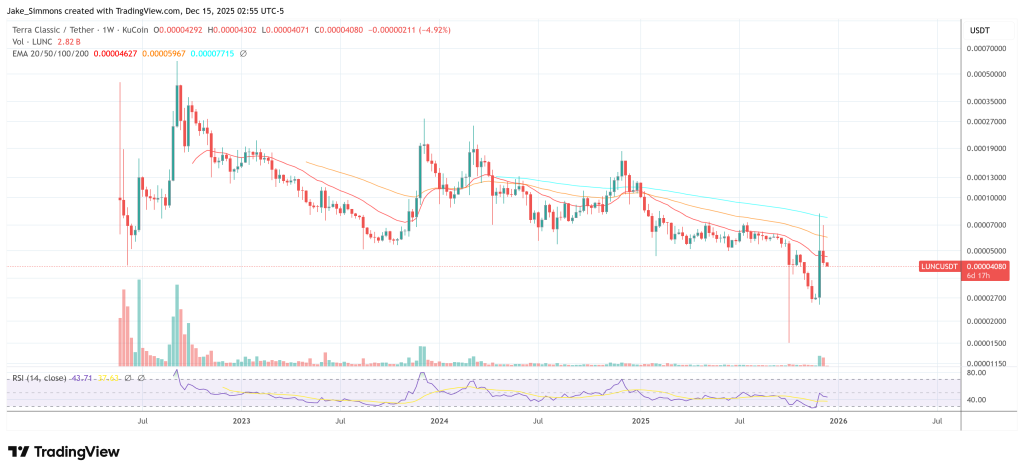
Terra Luna LUNC price chart
Market Opportunity
Terraport Logo
Terraport Price(TERRA)
$0.002726
$0.002726$0.002726
+0.88%
USD
Terraport (TERRA) Live Price Chart
Disclaimer: The articles reposted on this site are sourced from public platforms and are provided for informational purposes only. They do not necessarily reflect the views of MEXC. All rights remain with the original authors. If you believe any content infringes on third-party rights, please contact [email protected] for removal. MEXC makes no guarantees regarding the accuracy, completeness, or timeliness of the content and is not responsible for any actions taken based on the information provided. The content does not constitute financial, legal, or other professional advice, nor should it be considered a recommendation or endorsement by MEXC.

You May Also Like

Bitcoin ETF Investors React to Fed’s Decision
Bitcoin ETF Investors React to Fed’s Decision

The post Bitcoin ETF Investors React to Fed’s Decision appeared on BitcoinEthereumNews.com. In a surprise move, spot Bitcoin ETFs experienced their first significant daily outflows in over a week, following the Federal Reserve’s adjusted policy outlook. This shift reflects the market’s readiness to respond to any hint of change on the regulatory landscape, as well as its sensitivity to central bank cues. Continue Reading:Bitcoin ETF Investors React to Fed’s Decision Source: https://en.bitcoinhaber.net/bitcoin-etf-investors-react-to-feds-decision
Share
BitcoinEthereumNews2025/09/18 18:51
US Senators Introduce SAFE Crypto Act to Target Rising Crypto Scams

US Senators Introduce SAFE Crypto Act to Target Rising Crypto Scams

The post US Senators Introduce SAFE Crypto Act to Target Rising Crypto Scams appeared first on Coinpedia Fintech News Crypto scams are getting faster, smarter and
Share
CoinPedia2025/12/17 18:33
From Idea to App Store: The Complete Guide to Mobile App Development in Saudi Arabia

From Idea to App Store: The Complete Guide to Mobile App Development in Saudi Arabia

Saudi Arabia is at the forefront of digital transformation. With Vision 2030 driving innovation and a rapidly growing population of tech-savvy users, mobile apps have become a core driver of business growth in the Kingdom. From e-commerce and fintech to healthcare, logistics, and on-demand services, Saudi businesses are embracing mobile apps to connect with customers and scale faster. But how do you take a mobile app idea and turn it into a successful launch on the App Store or Google Play? This guide breaks down the complete mobile app development process in Saudi Arabia — step by step. Step 1: Validate Your App Idea for the Saudi Market Before you start building, ask: What problem does my app solve for Saudi users? Is there a cultural or market gap my app can fill? How do local competitors approach the same challenge? For example, apps related to digital payments, e-learning, delivery services, and healthcare are in high demand across Saudi Arabia. Conducting market research and aligning your app idea with local user behavior is critical. Step 2: Plan Features with Local Needs in Mind Your app should start with an MVP (Minimum Viable Product) — a core version that solves the main problem. Later, you can scale with advanced features. In Saudi Arabia, consider adding: Arabic language support (essential for user adoption) Integration with local payment gateways like STC Pay, Mada, or Apple Pay Regulatory compliance (especially for fintech and health apps) Localization for user preferences (Hijri calendar, cultural UI elements) Step 3: Select the Right Development Approach You can choose: Native Apps (Swift for iOS, Kotlin for Android) — Great for scalability and performance. Cross-Platform Apps (Flutter, React Native) — Cost-effective for startups targeting both iOS and Android simultaneously. Hybrid Apps — Suitable for simpler apps with limited features. For Saudi startups and enterprises, cross-platform development is often preferred to reach a wider audience quickly and efficiently. Step 4: Design With a Local Touch The design must balance global usability standards with local cultural relevance. UI (User Interface): Clean, modern visuals that align with Saudi branding. UX (User Experience): Simple navigation, clear Arabic text support, and intuitive flows. Wireframing & Prototyping: Test early with Saudi users to ensure adoption. A user-friendly design is one of the top reasons apps succeed in the Kingdom’s competitive market. Step 5: Develop Your Mobile App Once the design is ready, the coding begins. Saudi app development companies often follow Agile methodology, ensuring flexibility and faster delivery. Front-End Development: Interface and user interactions. Back-End Development: Databases, servers, and APIs. Integration: Secure connections between front-end and back-end. Strong collaboration between developers, designers, and business analysts ensures your app aligns with Saudi market needs. Step 6: Testing Across Devices and Networks Saudi users rely on different devices and network speeds. That’s why rigorous testing is critical: Functionality Testing: Features work as expected. Performance Testing: The app runs smoothly on both 4G and 5G networks. Localization Testing: Arabic text displays correctly, without alignment issues. Security Testing: Data protection compliance with Saudi cybersecurity standards. Step 7: App Store & Google Play Launch in Saudi Arabia To publish your app: Apple App Store (iOS): Requires an Apple Developer account and strict guideline compliance. Google Play Store (Android): Faster approval but still requires detailed app info. You’ll also need metadata in both English and Arabic — titles, descriptions, and screenshots — to maximize visibility among Saudi users. Step 8: Market Your App in Saudi Arabia Launching an app is only the beginning. You need a marketing strategy tailored to the Kingdom: App Store Optimization (ASO): Use Arabic and English keywords. Social Media Campaigns: Leverage platforms like Snapchat, Twitter (X), and Instagram, which are highly popular in Saudi Arabia. Influencer Marketing: Collaborate with Saudi influencers for early traction. Paid Ads: Google Ads and Saudi-focused Facebook/Instagram ads. Partnerships: Collaborate with local businesses to reach a wider audience. Step 9: Gather Feedback and Optimize Once your app is live, monitor: User reviews on app stores Analytics on engagement, retention, and churn rates Suggestions from Saudi users for culturally relevant features Continuous updates and improvements are vital to stay competitive. Step 10: Scale With Advanced Features Once your MVP gains traction, you can expand with advanced features such as: AI and machine learning for personalization Blockchain-based payments for fintech apps AR/VR features for retail and gaming apps IoT integration for smart home and mobility solutions Saudi Arabia’s digital ecosystem is growing rapidly — apps that adapt quickly will thrive. Conclusion Mobile app development in Saudi Arabia is not just about building an app — it’s about aligning with Vision 2030, cultural needs, and user expectations. By following a clear process — from idea validation to launch and beyond — you can transform your concept into a profitable digital product. Whether you’re a startup or an enterprise in Saudi Arabia, the opportunity is massive. With the right strategy, you can move from idea to App Store and create an app that truly resonates with Saudi users. From Idea to App Store: The Complete Guide to Mobile App Development in Saudi Arabia was originally published in Coinmonks on Medium, where people are continuing the conversation by highlighting and responding to this story
Share
Medium2025/09/18 14:46