The post Governance Turmoil Hits DeFi—But Why Is CRV Price Rising and AAVE Price Plunging? appeared first on Coinpedia Fintech News The DeFi space has entered The post Governance Turmoil Hits DeFi—But Why Is CRV Price Rising and AAVE Price Plunging? appeared first on Coinpedia Fintech News The DeFi space has entered

Governance Turmoil Hits DeFi—But Why Is CRV Price Rising and AAVE Price Plunging?
Best DeFi Tokens To Buy In July Before The Bull Market Begins

The post Governance Turmoil Hits DeFi—But Why Is CRV Price Rising and AAVE Price Plunging? appeared first on Coinpedia Fintech News

The DeFi space has entered a crucial phase wherein the two popular platforms are facing governance issues. Curve DAO and Aave, both protocols, have entered an active dispute over the revenue share. As a result, the AAVE price has come under selling pressure, while the CRV price has maintained a substantial ascending trend. In times when the traders are dealing with these tokens differently, the impact on the prices of the cryptos needs to be closely watched. 

Governance stress exists in both, but it’s not the same kind

At first glance, Curve and Aave appear to be facing a similar problem: disagreements between token holders and core contributors. Dig deeper, and the nature of that friction diverges sharply.

In the case of Curve DAO, recent governance debate has focused on developer funding, treasury transparency, and DAO oversight. These discussions are messy but familiar in mature DAOs. Importantly, they do not threaten Curve’s core economic engine—stablecoin liquidity, trading volumes, and fee generation remain intact.

By contrast, Aave is dealing with a governance dispute that touches the most sensitive area possible: revenue ownership and control. Questions around where protocol-linked fees flow, who controls key assets, and how decisions are pushed through governance have raised concerns about alignment between the DAO and the core development entity.

Markets tend to tolerate procedural noise. They react far more aggressively when economic clarity is questioned.

Why Markets Are Treating CRV and AAVE Very Differently

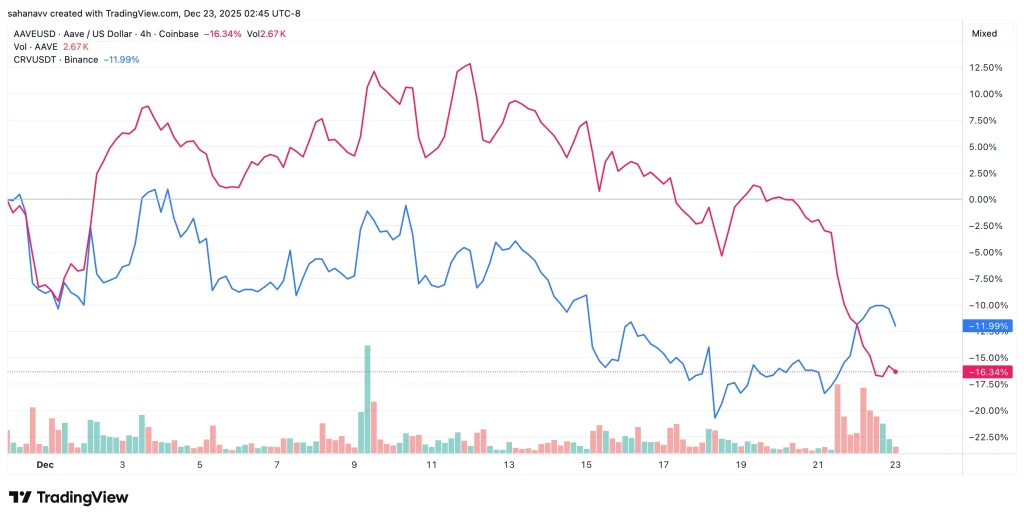
Despite both protocols facing governance tension, traders are reacting to price behavior at key levels, not just headlines. AAVE is trading near $151.44, down 4.79% in the last 24 hours, and price action remains heavy. Each intraday bounce has failed to hold, signaling that sellers are using rallies to exit rather than build positions. This keeps AAVE locked in a short-term distribution phase.
aavecrv price

By contrast, CRV is holding around $0.3688, up a modest 0.9% on the day. While the move is not explosive, the key difference is stability. CRV has avoided sharp sell-offs and is consolidating rather than breaking down, suggesting supply is being absorbed near current levels.

Both tokens are experiencing diverse price action, and hence, it would be interesting to watch how the upcoming price action could unfold.

Bottom Line!

The divergence between AAVE and CRV makes one point clear: markets are no longer reacting to governance headlines alone but to the quality of the risk behind them. Procedural debate is being tolerated, while uncertainty around revenue control is being priced aggressively. Until clarity improves, AAVE is likely to remain under pressure, while CRV’s ability to stabilize will depend on whether governance noise stays contained and protocol activity remains intact.

Market Opportunity
DeFi Logo
DeFi Price(DEFI)
$0.000555
$0.000555$0.000555
-7.80%
USD
DeFi (DEFI) Live Price Chart
Disclaimer: The articles reposted on this site are sourced from public platforms and are provided for informational purposes only. They do not necessarily reflect the views of MEXC. All rights remain with the original authors. If you believe any content infringes on third-party rights, please contact [email protected] for removal. MEXC makes no guarantees regarding the accuracy, completeness, or timeliness of the content and is not responsible for any actions taken based on the information provided. The content does not constitute financial, legal, or other professional advice, nor should it be considered a recommendation or endorsement by MEXC.

You May Also Like

The Channel Factories We’ve Been Waiting For

The Channel Factories We’ve Been Waiting For

The post The Channel Factories We’ve Been Waiting For appeared on BitcoinEthereumNews.com. Visions of future technology are often prescient about the broad strokes while flubbing the details. The tablets in “2001: A Space Odyssey” do indeed look like iPads, but you never see the astronauts paying for subscriptions or wasting hours on Candy Crush.  Channel factories are one vision that arose early in the history of the Lightning Network to address some challenges that Lightning has faced from the beginning. Despite having grown to become Bitcoin’s most successful layer-2 scaling solution, with instant and low-fee payments, Lightning’s scale is limited by its reliance on payment channels. Although Lightning shifts most transactions off-chain, each payment channel still requires an on-chain transaction to open and (usually) another to close. As adoption grows, pressure on the blockchain grows with it. The need for a more scalable approach to managing channels is clear. Channel factories were supposed to meet this need, but where are they? In 2025, subnetworks are emerging that revive the impetus of channel factories with some new details that vastly increase their potential. They are natively interoperable with Lightning and achieve greater scale by allowing a group of participants to open a shared multisig UTXO and create multiple bilateral channels, which reduces the number of on-chain transactions and improves capital efficiency. Achieving greater scale by reducing complexity, Ark and Spark perform the same function as traditional channel factories with new designs and additional capabilities based on shared UTXOs.  Channel Factories 101 Channel factories have been around since the inception of Lightning. A factory is a multiparty contract where multiple users (not just two, as in a Dryja-Poon channel) cooperatively lock funds in a single multisig UTXO. They can open, close and update channels off-chain without updating the blockchain for each operation. Only when participants leave or the factory dissolves is an on-chain transaction…
Share
BitcoinEthereumNews2025/09/18 00:09
Nasdaq-listed iPower reaches $30 million convertible note financing agreement to launch DAT strategy.

Nasdaq-listed iPower reaches $30 million convertible note financing agreement to launch DAT strategy.

PANews reported on December 23 that, according to Globenewswire, Nasdaq-listed e-commerce and supply chain platform iPower announced it has reached a $30 million
Share
PANews2025/12/23 22:19
SelectCam AI Launches Flagship AI-Powered Video Telematics Solutions for Global Fleet Safety

SelectCam AI Launches Flagship AI-Powered Video Telematics Solutions for Global Fleet Safety

SHENZHEN, China–(BUSINESS WIRE)–SelectCam AI, a China-based, product-driven technology company, today announced the launch of its flagship AI video telematics solutions
Share
AI Journal2025/12/23 21:48