The post Solana Co-Founder Sees $1T Stablecoins as Crypto Demand Grows appeared on BitcoinEthereumNews.com. Yakovenko’s $1T stablecoin outlook exceeds JPMorgan’The post Solana Co-Founder Sees $1T Stablecoins as Crypto Demand Grows appeared on BitcoinEthereumNews.com. Yakovenko’s $1T stablecoin outlook exceeds JPMorgan’

Solana Co-Founder Sees $1T Stablecoins as Crypto Demand Grows

  • Yakovenko’s $1T stablecoin outlook exceeds JPMorgan’s 2028 forecast of $500B–$600B.
  • Stablecoin growth remains driven by crypto trading and DeFi, not mainstream payment adoption yet.
  • Solana records rising stablecoin balances, reflecting network usage tied to on-chain dollar flows.

Anatoly Yakovenko, the co-founder of Solana, has outlined a set of projections for 2026 that place stablecoins at the center of several structural shifts underway across digital asset markets. His comments were shared in a public post on X and referenced a future in which the global stablecoin supply exceeds $1 trillion, alongside advances in artificial intelligence and robotics that extend beyond the crypto sector.

Yakovenko’s projection contrasts with other forecasts from traditional financial institutions. JPMorgan Chase & Co. recently estimated that total stablecoin supply could reach between $500 billion and $600 billion by 2028. JPMorgan described current growth as largely tied to crypto-market activity rather than widespread payment adoption.

The bank reported that the stablecoin market has expanded by approximately $100 billion this year, bringing the total supply to about $308 billion. The increase has been led primarily by Tether’s USDT and Circle’s USDC. Analysts noted that derivatives platforms alone added around $20 billion in stablecoin balances, coinciding with higher perpetual futures trading volumes.

Use Cases Remain Concentrated in Crypto Markets

JPMorgan’s analysis highlighted that most stablecoin demand remains driven by their role as cash equivalents or collateral within the crypto ecosystem. These assets support trading, lending, and borrowing across decentralized finance and derivatives markets. 

The report also highlighted that broader payment adoption does not necessarily imply a proportional increase in total stablecoin supply. Higher transaction velocity, enabled by deeper integration into financial systems, could allow existing supply to circulate more efficiently. 

At the same time, banks and payment networks are developing tokenized deposits and related blockchain-based products. In contrast, central banks continue exploring digital currencies that may compete with privately issued stablecoins.

Solana Activity Reflects Network-Level Growth

Against this backdrop, Solana has emerged as one of the networks recording huge growth in stablecoin usage. Low transaction costs and fast settlement times have supported increased issuance and transfers on the blockchain. Data from the past year shows that stablecoin balances on Solana have reached record levels, reflecting its role in facilitating on-chain dollar movement.

Related: Solana-based Synthetic Stablecoin USX Depegs; Is It a UST 2.0?

Disclaimer: The information presented in this article is for informational and educational purposes only. The article does not constitute financial advice or advice of any kind. Coin Edition is not responsible for any losses incurred as a result of the utilization of content, products, or services mentioned. Readers are advised to exercise caution before taking any action related to the company.

Source: https://coinedition.com/solana-co-founder-sees-1t-stablecoins-as-crypto-demand-grows/
Market Opportunity
DeFi Logo
DeFi Price(DEFI)
$0.000335
$0.000335$0.000335
+5.34%
USD
DeFi (DEFI) Live Price Chart
Disclaimer: The articles reposted on this site are sourced from public platforms and are provided for informational purposes only. They do not necessarily reflect the views of MEXC. All rights remain with the original authors. If you believe any content infringes on third-party rights, please contact [email protected] for removal. MEXC makes no guarantees regarding the accuracy, completeness, or timeliness of the content and is not responsible for any actions taken based on the information provided. The content does not constitute financial, legal, or other professional advice, nor should it be considered a recommendation or endorsement by MEXC.

You May Also Like

Pippin (PIPPIN) Price Prediction 2026–2030: Can PIPPIN Hit $0.70 Soon?

Pippin (PIPPIN) Price Prediction 2026–2030: Can PIPPIN Hit $0.70 Soon?

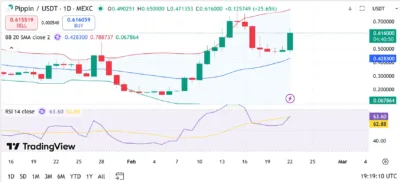
PIPPIN has surged sharply on the daily timeframe, printing a powerful bullish candle with over 25% gains. RSI is holding above 60, signaling strengthening momentum
Share
Coinstats2026/02/23 04:29
Will Cardano Reach $10 by 2030? Analysts Break Down ADA’s Growth Cycles

Will Cardano Reach $10 by 2030? Analysts Break Down ADA’s Growth Cycles

The post Will Cardano Reach $10 by 2030? Analysts Break Down ADA’s Growth Cycles appeared first on Coinpedia Fintech News Cardano (ADA) is trading at $0.9024 with a market cap of $32.91 billion. Experts say ADA has the potential to climb much higher, with some placing long-term targets as high as $10. The token continues to benefit from stronger visibility, rising liquidity, and increasing inflows from both institutional and retail markets. Can Cardano Hit $10 …
Share
CoinPedia2025/09/18 17:19
Crypto whale loses $6M to sneaky phishing scheme targeting staked Ethereum

Crypto whale loses $6M to sneaky phishing scheme targeting staked Ethereum

The post Crypto whale loses $6M to sneaky phishing scheme targeting staked Ethereum appeared on BitcoinEthereumNews.com. A crypto whale lost more than $6 million in staked Ethereum (stETH) and Aave-wrapped Bitcoin (aEthWBTC) after approving malicious signatures in a phishing scheme on Sept. 18, according to blockchain security firm Scam Sniffer. According to the firm, the attackers disguised their move as a routine wallet confirmation through “Permit” signatures, which tricked the victim into authorizing fund transfers without triggering obvious red flags. Yu Xian, founder of blockchain security company SlowMist, noted that the victim did not recognize the danger because the transaction required no gas fees. He wrote: “From the victim’s perspective, he just clicked a few times to confirm the wallet’s pop-up signature requests, didn’t spend a single penny of gas, and $6.28 million was gone.” How Permit exploits work Permit approvals were originally designed to simplify token transfers. Instead of submitting an on-chain approval and paying fees, a user can sign an off-chain message authorizing a spender. That efficiency, however, has created a new attack surface for malicious players. Once a user signs such a permit, attackers can combine two functions—Permit and TransferFrom—to drain assets directly. Because the authorization takes place off-chain, wallet dashboards show no unusual activity until the funds move. As a result, the assets are gone when the approval executes on-chain, and tokens are redirected to the attacker’s wallet. This loophole has made permit exploits increasingly attractive for malicious actors, who can siphon millions without needing complex hacks or high-cost gas wars. Phishing losses The latest theft highlights a wider trend of escalating phishing campaigns. Scam Sniffer reported that in August alone, attackers stole $12.17 million from more than 15,200 victims. That figure represented a 72% jump in losses compared with July. According to the firm, the most significant share of August’s damages came from three large accounts that accounted for nearly half…
Share
BitcoinEthereumNews2025/09/19 02:31