The crypto market is slightly lower today, with total market capitalisation slipping by 0.5% over the past 24 hours to $3.04 trillion, remaining just above the $The crypto market is slightly lower today, with total market capitalisation slipping by 0.5% over the past 24 hours to $3.04 trillion, remaining just above the $

Why Is Crypto Down Today? – December 29, 2025

2025/12/29 22:48
7 min read

The crypto market is slightly lower today, with total market capitalisation slipping by 0.5% over the past 24 hours to $3.04 trillion, remaining just above the $3 trillion level. Despite the mild pullback, trading activity remains elevated, with 24-hour volume at $116.18 billion.

TLDR:

  • The crypto market cap slipped 0.5% over the past 24 hours to $3.04 trillion;
  • Most top assets traded lower, with BTC down 0.5% to $87,337;
  • Onchain data shows continued aggressive ETH accumulation by large players;
  • Bitwise CIO Matt Hougan expects a decade-long Bitcoin uptrend with lower volatility;
  • Technicals show BTC holding key support at $85,000–$86,000;
  • The Crypto Fear and Greed Index holding at 30 in the fear zone;
  • US Bitcoin spot ETFs saw $275.88 million in net outflows;
  • US Ethereum spot ETFs recorded $38.7 million in outflows;
  • Nasdaq-listed ALT5 Sigma came under scrutiny after reports that its newly appointed auditor lacks an active license.

Crypto Winners & Losers

At the time of writing, most top assets are trading in the red, reflecting cautious sentiment across the market.

Bitcoin (BTC) is down 0.5% on the day, currently trading at $87,337, while its weekly performance shows a steeper 3.1% decline. Bitcoin’s market cap stands at $1.74 trillion, with more than $44.7 billion traded in the past 24 hours.
Ethereum (ETH) is also lower, slipping 0.2% in the last 24 hours to $2,931, extending its seven-day loss to nearly 4%. ETH recorded close to $25 billion in daily trading volume, maintaining its position as the second-largest crypto asset by market cap at $354 billion.

Among the rest of the top 10, BNB (BNB) declined 0.6% to $850, while XRP (XRP) edged down 0.1% to $1.86.

Solana (SOL) fell 0.5% to $123.81, continuing a broader weekly downtrend of 2.6%. Dogecoin (DOGE) posted the steepest weekly loss in this group, down 7.3%, despite only a modest 0.4% dip over the past day.

Tron (TRX) limited losses to 1% in the past 24 hours, trading at $0.281, making it one of the more resilient large-cap tokens today.

On the upside, select altcoins outperformed the broader market. TokenFi surged 66.4%, while ZEROBASE climbed 68.2% over the past 24 hours. The White Whale also posted strong gains, rising 57.1%.

Trending tokens include Neiro, Bitcoin, and OVERTAKE, with OVERTAKE standing out after jumping more than 31% on the day.

Meanwhile, Trend Research withdrew 20,850 ETH, worth $63.28 million, from Binance on Sunday and immediately borrowed an additional $40 million in USDT through the lending protocol Aave, which indicates continued aggressive accumulation as Ethereum trades near $3,000.

The institutional arm of Easy Come Easy Go now controls 601,074 ETH valued at $1.83 billion across five addresses, having borrowed a total of $958 million in stablecoins to fund purchases at an average price of roughly $3,265 per token.

Bitwise CIO Sees Bitcoin Entering a Decade of Steady Gains

Bitcoin is likely to trend higher over the next decade, but without the sharp, cycle-driven rallies that defined earlier bull markets, according to Bitwise CIO Matt Hougan.

Speaking on CNBC, Hougan said Bitcoin is entering a prolonged period of “strong but unspectacular” returns, marked by lower volatility and more gradual price appreciation.

Despite recent weakness, Hougan remains bullish on 2026, arguing that steady institutional demand is helping stabilize the market.

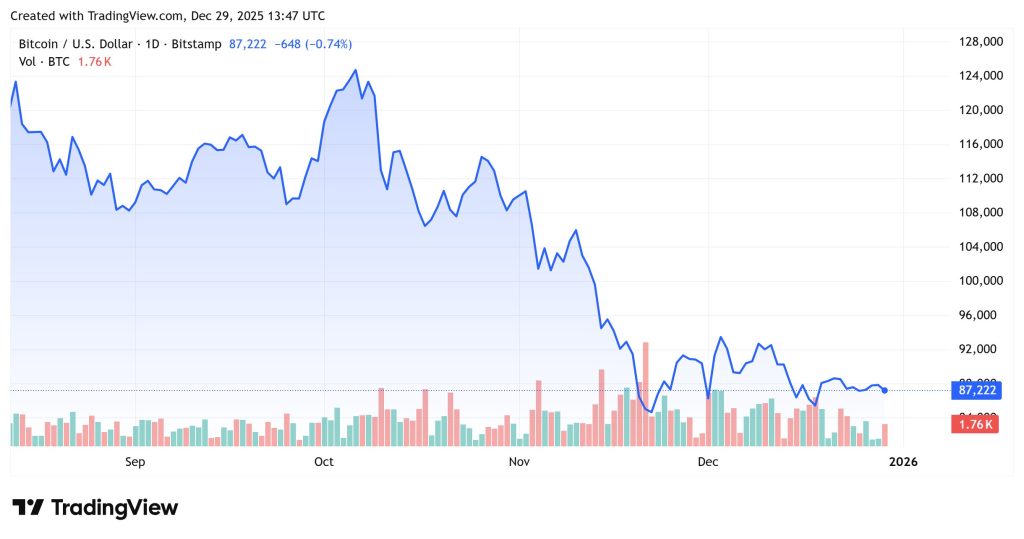
Bitcoin has pulled back roughly 30% from its October peak near $125,100 and is trading around $87,800, reviving debate over whether the current cycle has already topped. Some analysts point to similarities with past cycle peaks, raising concerns about further downside.

Hougan acknowledged retail selling pressure but said long-term institutional buyers have limited the drawdown compared with past cycles, when losses often exceeded 60%.

Others remain more optimistic. Strategy CEO Phong Le has argued that Bitcoin’s underlying fundamentals held up throughout 2025 despite weaker prices, while Bitwise chief investment officer Matt Hougan said earlier this year that he expects 2026 to be an “up year” for the asset.

According to Linh Tran, market analyst at XS.com, Bitcoin’s recent price action underscores the market’s sensitivity to monetary policy expectations rather than headline economic data.

Levels & Events to Watch Next

At the time of writing on Monday, Bitcoin is trading near $87,220, down around 0.7% on the day. The recent price action shows BTC extending a broader downtrend that began after the October peak near $125,000, with sellers maintaining control through November and December.

Over the past several weeks, Bitcoin has consistently printed lower highs, while support around the $85,000–$86,000 zone has held multiple times.

A decisive break below this range could expose BTC to a deeper pullback toward $81,000, with a psychological risk of slipping below $80,000 if selling accelerates. On the upside, bulls would need to reclaim $92,000 to signal short-term relief, with stronger resistance waiting near $98,000 and then $103,000.

Ethereum is following a similar structure, currently trading around $2,926, down roughly 0.8% over the past 24 hours. The chart shows ETH breaking sharply lower in early November before entering a choppy consolidation phase below the $3,200 level.

During the recent sessions, ETH has struggled to hold momentum above $3,000, turning that zone into near-term resistance. As long as price remains below it, downside risks persist. A drop below $2,800 could open the door toward $2,650, a level that previously acted as support during the November selloff. Further weakness may bring $2,500 into focus.

On the recovery side, a sustained move back above $3,100 would be the first sign of renewed strength, potentially setting up a push toward $3,400 and then $3,650.

Meanwhile, crypto market sentiment remains subdued, with the Crypto Fear and Greed Index holding at 30, firmly in the fear zone, according to the latest data.

The reading shows little change from recent days, indicating that traders remain cautious as prices struggle to regain momentum. Risk appetite appears limited, with investors hesitant to increase exposure amid ongoing volatility.

US Bitcoin spot ETFs ended the latest session in the red, with net outflows of $275.88 million on Dec. 26, according to the data shown. Cumulative net inflows still stand at $56.62 billion, while total net assets across US BTC spot ETFs remain elevated at $113.53 billion, equivalent to roughly 6.5% of Bitcoin’s total market capitalization.

Outflows were concentrated among the largest products. BlackRock’s IBIT led the declines, recording $192.61 million in net outflows on the day. Fidelity’s FBTC followed with $74.38 million leaving the fund, while Grayscale’s GBTC saw more modest outflows of $8.89 million.

US spot Ethereum ETFs also recorded net outflows of $38.7 million on Dec. 26. The pullback was driven by two funds. BlackRock’s ETHA led the declines with $22.12 million in outflows, followed by Grayscale’s ETHE, which saw $16.58 million leave the fund. The remaining ETH ETFs posted flat flows, with no products recording inflows during the session.

Cumulative net inflows stand at $12.34 billion, while total net assets across US ETH ETFs amount to $17.73 billion, representing just over 5% of Ethereum’s total market capitalisation.

Meanwhile, Nasdaq-listed ALT5 Sigma is facing renewed scrutiny after a report found that the company’s newly appointed auditor is currently barred from performing audits due to an expired license.

According to the Financial Times, ALT5 Sigma moved to replace its previous auditor this month after failing to file its third-quarter financial results by the required deadline.

Disclaimer: The articles reposted on this site are sourced from public platforms and are provided for informational purposes only. They do not necessarily reflect the views of MEXC. All rights remain with the original authors. If you believe any content infringes on third-party rights, please contact [email protected] for removal. MEXC makes no guarantees regarding the accuracy, completeness, or timeliness of the content and is not responsible for any actions taken based on the information provided. The content does not constitute financial, legal, or other professional advice, nor should it be considered a recommendation or endorsement by MEXC.

You May Also Like

Crucial Fed Rate Cut: October Probability Surges to 94%

Crucial Fed Rate Cut: October Probability Surges to 94%

BitcoinWorld Crucial Fed Rate Cut: October Probability Surges to 94% The financial world is buzzing with a significant development: the probability of a Fed rate cut in October has just seen a dramatic increase. This isn’t just a minor shift; it’s a monumental change that could ripple through global markets, including the dynamic cryptocurrency space. For anyone tracking economic indicators and their impact on investments, this update from the U.S. interest rate futures market is absolutely crucial. What Just Happened? Unpacking the FOMC Statement’s Impact Following the latest Federal Open Market Committee (FOMC) statement, market sentiment has decisively shifted. Before the announcement, the U.S. interest rate futures market had priced in a 71.6% chance of an October rate cut. However, after the statement, this figure surged to an astounding 94%. This jump indicates that traders and analysts are now overwhelmingly confident that the Federal Reserve will lower interest rates next month. Such a high probability suggests a strong consensus emerging from the Fed’s latest communications and economic outlook. A Fed rate cut typically means cheaper borrowing costs for businesses and consumers, which can stimulate economic activity. But what does this really signify for investors, especially those in the digital asset realm? Why is a Fed Rate Cut So Significant for Markets? When the Federal Reserve adjusts interest rates, it sends powerful signals across the entire financial ecosystem. A rate cut generally implies a more accommodative monetary policy, often enacted to boost economic growth or combat deflationary pressures. Impact on Traditional Markets: Stocks: Lower interest rates can make borrowing cheaper for companies, potentially boosting earnings and making stocks more attractive compared to bonds. Bonds: Existing bonds with higher yields might become more valuable, but new bonds will likely offer lower returns. Dollar Strength: A rate cut can weaken the U.S. dollar, making exports cheaper and potentially benefiting multinational corporations. Potential for Cryptocurrency Markets: The cryptocurrency market, while often seen as uncorrelated, can still react significantly to macro-economic shifts. A Fed rate cut could be interpreted as: Increased Risk Appetite: With traditional investments offering lower returns, investors might seek higher-yielding or more volatile assets like cryptocurrencies. Inflation Hedge Narrative: If rate cuts are perceived as a precursor to inflation, assets like Bitcoin, often dubbed “digital gold,” could gain traction as an inflation hedge. Liquidity Influx: A more accommodative monetary environment generally means more liquidity in the financial system, some of which could flow into digital assets. Looking Ahead: What Could This Mean for Your Portfolio? While the 94% probability for a Fed rate cut in October is compelling, it’s essential to consider the nuances. Market probabilities can shift, and the Fed’s ultimate decision will depend on incoming economic data. Actionable Insights: Stay Informed: Continue to monitor economic reports, inflation data, and future Fed statements. Diversify: A diversified portfolio can help mitigate risks associated with sudden market shifts. Assess Risk Tolerance: Understand how a potential rate cut might affect your specific investments and adjust your strategy accordingly. This increased likelihood of a Fed rate cut presents both opportunities and challenges. It underscores the interconnectedness of traditional finance and the emerging digital asset space. Investors should remain vigilant and prepared for potential volatility. The financial landscape is always evolving, and the significant surge in the probability of an October Fed rate cut is a clear signal of impending change. From stimulating economic growth to potentially fueling interest in digital assets, the implications are vast. Staying informed and strategically positioned will be key as we approach this crucial decision point. The market is now almost certain of a rate cut, and understanding its potential ripple effects is paramount for every investor. Frequently Asked Questions (FAQs) Q1: What is the Federal Open Market Committee (FOMC)? A1: The FOMC is the monetary policymaking body of the Federal Reserve System. It sets the federal funds rate, which influences other interest rates and economic conditions. Q2: How does a Fed rate cut impact the U.S. dollar? A2: A rate cut typically makes the U.S. dollar less attractive to foreign investors seeking higher returns, potentially leading to a weakening of the dollar against other currencies. Q3: Why might a Fed rate cut be good for cryptocurrency? A3: Lower interest rates can reduce the appeal of traditional investments, encouraging investors to seek higher returns in alternative assets like cryptocurrencies. It can also be seen as a sign of increased liquidity or potential inflation, benefiting assets like Bitcoin. Q4: Is a 94% probability a guarantee of a rate cut? A4: While a 94% probability is very high, it is not a guarantee. Market probabilities reflect current sentiment and data, but the Federal Reserve’s final decision will depend on all available economic information leading up to their meeting. Q5: What should investors do in response to this news? A5: Investors should stay informed about economic developments, review their portfolio diversification, and assess their risk tolerance. Consider how potential changes in interest rates might affect different asset classes and adjust strategies as needed. Did you find this analysis helpful? Share this article with your network to keep others informed about the potential impact of the upcoming Fed rate cut and its implications for the financial markets! To learn more about the latest crypto market trends, explore our article on key developments shaping Bitcoin price action. This post Crucial Fed Rate Cut: October Probability Surges to 94% first appeared on BitcoinWorld.
Share
Coinstats2025/09/18 02:25
Vitalik Buterin Selling Ethereum 'Faster,' Says On-Chain Tracking Firm As Second-Largest Crypto Plunges Over 5%

Vitalik Buterin Selling Ethereum 'Faster,' Says On-Chain Tracking Firm As Second-Largest Crypto Plunges Over 5%

Vitalik Buterin offloaded millions worth of Ethereum (CRYPTO: ETH) over the past couple of days, coinciding with a significant drop in the cryptocurrency’s priceread
Share
Coinstats2026/02/23 12:46
VeChain (VET) Daily Market Analysis 23 February 2026

VeChain (VET) Daily Market Analysis 23 February 2026

VeChain faces price pressure despite major ecosystem upgrades – here's the latest: • VET price down 10.80% over 7 days, underperforming global crypto market (16
Share
Coinstats2026/02/23 12:47