A fierce winter storm that swept much of the US over the weekend forced large parts of the Bitcoin mining fleet to cut power, leaving the network much weaker forA fierce winter storm that swept much of the US over the weekend forced large parts of the Bitcoin mining fleet to cut power, leaving the network much weaker for

US Storm Smashes Bitcoin Mining Power, Sending Hash Rates Tumbling

2026/01/27 19:30
3 min read

A fierce winter storm that swept much of the US over the weekend forced large parts of the Bitcoin mining fleet to cut power, leaving the network much weaker for a short time.

Reports say power outages and extreme weather pushed some operators to pause or slow their rigs so local grids could breathe. The result was a dramatic, though temporary, fall in the total mining power securing the blockchain.

Miners Adjust Power Use

According to mining operators on the ground, the pause was intentional. Many farms turned down machines to reduce strain on regional utilities when demand spiked and generation dropped.

Abundant Mines, a crypto mining firm headquartered in Oregon, said roughly 40% of global mining capacity went offline in a 24-hour window. That kind of quick scaling back is possible because miners can shut down and restart hardware rapidly, which in some regions acts like a big, flexible electrical load that can be trimmed when needed.

Hashrate Drop And Quick Recovery

Based on reports from mining trackers, network hashrate fell sharply starting Friday and hit a low not seen in seven months by Sunday, dropping to about 663 EH/s. Within a day or so, as crews worked and weather systems moved on, the figure climbed back toward 854 EH/s.

Hashrate Index estimates the US supplies nearly 38% of worldwide mining power, so disruptions in the country show up fast in global totals.
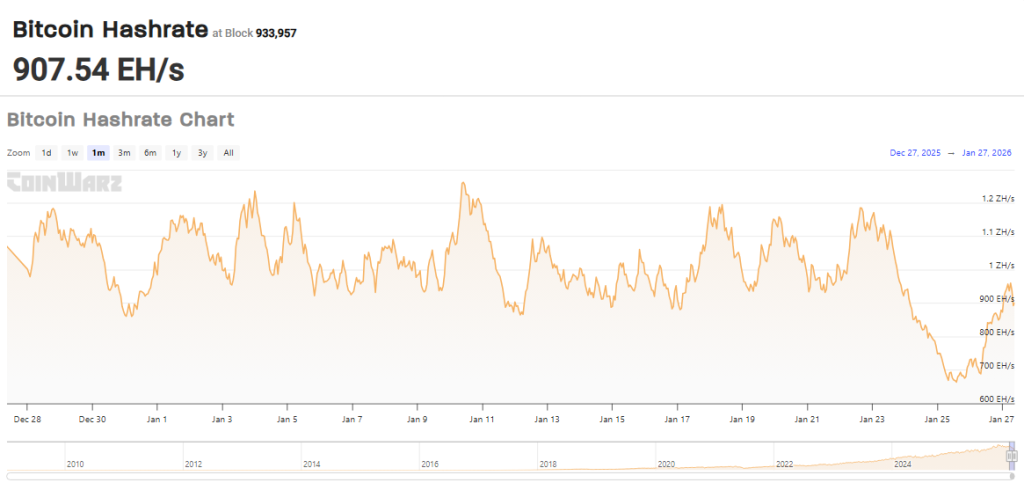
A federal Energy Information Administration report noted there are more than 130 dedicated crypto mining sites across the US, meaning storms that affect broad regions can hit mining supply in a big way.

Bitcoin Price Action

Price moved with the headlines but not in a straight line. Based on reports, Bitcoin traded around $88,300 through the volatility, with swings linked to both weather and wider geopolitical strains.

The market had earlier seen lifts up near $96,000 during episodes of geopolitical tension, while other stretches brought softer prices as macro risks grew.

Traders watched carefully; the temporary hashrate dip raised questions about short-term miner revenue, yet it did not trigger a major crash in market value.

Big Miners Felt The Impact

Analytics firms noted output from some big US miners fell sharply. Marathon Digital’s daily production was down from 45 coins to seven in one day, and IREN moved from 18 to six, data compiled by market trackers showed.

CryptoQuant flagged slower daily digs from several major operators as the storm hit. In Texas, reports say miners worked with grid managers to help balance supply and demand, using their machines to soak up extra power when available and to step back when the grid was under strain.

Featured image from Pexels, chart from TradingView

Disclaimer: The articles reposted on this site are sourced from public platforms and are provided for informational purposes only. They do not necessarily reflect the views of MEXC. All rights remain with the original authors. If you believe any content infringes on third-party rights, please contact [email protected] for removal. MEXC makes no guarantees regarding the accuracy, completeness, or timeliness of the content and is not responsible for any actions taken based on the information provided. The content does not constitute financial, legal, or other professional advice, nor should it be considered a recommendation or endorsement by MEXC.

You May Also Like

And the Big Day Has Arrived: The Anticipated News for XRP and Dogecoin Tomorrow

And the Big Day Has Arrived: The Anticipated News for XRP and Dogecoin Tomorrow

The first-ever ETFs for XRP and Dogecoin are expected to launch in the US tomorrow. Here's what you need to know. Continue Reading: And the Big Day Has Arrived: The Anticipated News for XRP and Dogecoin Tomorrow
Share
Coinstats2025/09/18 04:33
Tokenized Assets Shift From Wrappers to Building Blocks in DeFi

Tokenized Assets Shift From Wrappers to Building Blocks in DeFi

The post Tokenized Assets Shift From Wrappers to Building Blocks in DeFi appeared on BitcoinEthereumNews.com. RWAs are rapidly moving on-chain, unlocking new opportunities for investors and DeFi protocols, according to a new report from Dune and RWAxyz. Tokenized real-world assets (RWAs) are moving beyond digital versions of traditional securities to become key building blocks of decentralized finance (DeFi), according to the 2025 RWA Report from Dune and RWAxyz. The report notes that Treasuries, bonds, credit, and equities are now being used in DeFi as collateral, trading instruments, and yield products. This marks tokenization’s “real breakthrough” – composability, or the ability to combine and reuse assets across different protocols. Projects are already showing how this works in practice. Asset manager Maple Finance’s syrupUSDC, for example, has grown to $2.5 billion, with more than 30% placed in DeFi apps like Spark ($570 million). Centrifuge’s new deJAAA token, a wrapper for Janus Henderson’s AAA CLO fund, is already trading on Aerodrome, Coinbase and other exchanges, with Stellar planned next. Meanwhile, Aave’s Horizon RWA Market now lets institutional users post tokenized Treasuries and CLOs as collateral. This trend underscores a bigger shift: RWAs are no longer just copies of traditional assets; instead, they are becoming core parts of on-chain finance, powering lending, liquidity, and yield, and helping to close the gap between traditional finance (TradFi) and DeFi. “RWAs have crossed the chasm from experimentation to execution,” Sid Powell, CEO of Maple Finance, says in the report. “Our growth to $3.5B AUM reflects a broader shift: traditional financial services are adopting crypto assets while institutions seek exposure to on-chain markets.” Investor demand for higher returns and more diversified options is mainly driving this growth. Tokenized Treasuries proved there is strong demand, with $7.3 billion issued by September 2025 – up 85% year-to-date. The growth was led by BlackRock, WisdomTree, Ondo, and Centrifuge’s JTRSY (Janus Henderson Anemoy Treasury Fund). Spark’s $1…
Share
BitcoinEthereumNews2025/09/18 06:10
SlowMist: ClawHub is increasingly becoming a new target for attackers to poison supply chains.

SlowMist: ClawHub is increasingly becoming a new target for attackers to poison supply chains.

PANews reported on February 9th that, according to SlowMist monitoring, ClawHub, the official plugin center of the open-source AI agent project OpenClaw, is increasingly
Share
PANews2026/02/09 10:51