Bitcoin Erases $85B in 4 Hours as Crypto Faces $500M Liquidations
The leading cryptocurrency, Bitcoin BTC $83 897 24h volatility: 6.3% Market cap: $1.68 T Vol. 24h: $64.87 B , has just erased more than $85 billion of its market capitalization in less than four hours, facing more than $200 million in liquidations in the same period, post US market opening.
By the time of this writing, BTC was trading at $84,437, down 5.83% in the last 24 hours, according to CoinMarketCap on Jan. 29. With that, Bitcoin saw its nearly $1.70 trillion capitalization losing approximately $85 billion in a sudden crash that affected the entire crypto market.
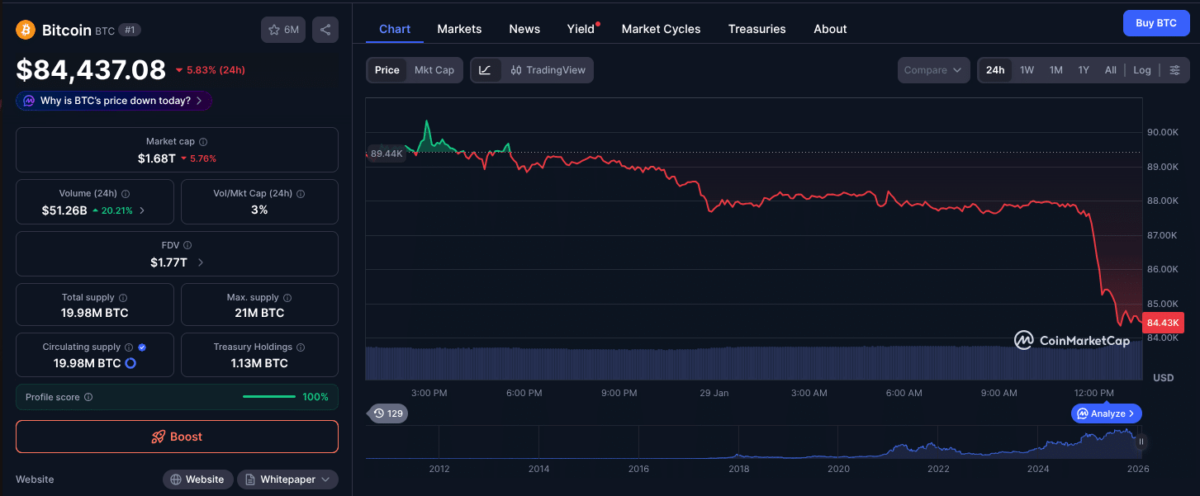
Bitcoin (BTC) market data and price as of January 29, 2026 | Source: CoinMarketCap
Bitcoin’s 24-hour exchange volume raised by 20% to $51 billion, representing 3% of its market cap. The crash started just a few minutes after the United States stock market opened in the red on Jan. 29. Both the S&P 500, the US dollar index, gold, silver, and other leading assets are trading at losses intraday.
Nevertheless, a drop to this price region was already expected by prominent analysts like CrypNuevo. The analyst has been warning of this possibility for over a month, arguing that BTC would need to revisit a price range between $80,000 and $84,000 before it was ready to seek new highs above $100,000.
Crypto Traders Face $500M Liquidations in 4 Hours
Notably, this aggressive price drop caused a new cascade of liquidations, most from long positions, in a short time frame (four hours), according to CoinGlass data.
Overall, $500 million were erased from leveraged trading positions in the past four hours of this writing—$471 million of which were from longs.
Bitcoin alone saw $206 million in four-hour liquidations, $202 million of that coming from long positions.
In a higher time frame, more than 200,000 crypto traders saw more than $800 million in liquidations in the last 24 hours. The single largest liquidation happened in the BTC-USD pair on Hyperliquid, at a nominal value of $31 million. It was a long position.
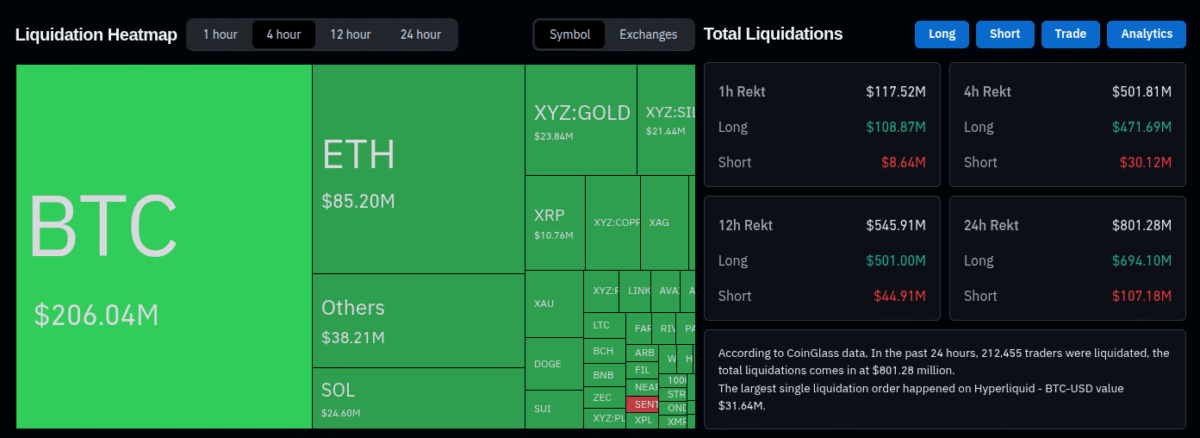
Liquidation heatmap and total liquidations (4-hour), as of January 29, 2026 | Source: CoinGlass
Interestingly, these numbers, while terrifying, are nowhere close to the $19.35 billion liquidations crypto faced on Oct. 10.
Bitcoin and other cryptocurrencies could now be ready to rebound after erasing these liquidation clusters to the downside—accumulated since late 2025. However, this could only happen if macroeconomics and geopolitical affairs contribute to risk-on liquidity, which is highly uncertain at this point.
On that note, JPMorgan explained that BTC is not acting as a hedge to the falling US dollar, unlike precious metals like gold, silver, and copper that saw expressive rallies this week.
nextThe post Bitcoin Erases $85B in 4 Hours as Crypto Faces $500M Liquidations appeared first on Coinspeaker.
You May Also Like

YZi Labs Binance Deposit: A $6.63M Signal That Could Shake the ID Token Market

BitGo wins BaFIN nod to offer regulated crypto trading in Europe
BitGo’s move creates further competition in a burgeoning European crypto market that is expected to generate $26 billion revenue this year, according to one estimate. BitGo, a digital asset infrastructure company with more than $100 billion in assets under custody, has received an extension of its license from Germany’s Federal Financial Supervisory Authority (BaFin), enabling it to offer crypto services to European investors. The company said its local subsidiary, BitGo Europe, can now provide custody, staking, transfer, and trading services. Institutional clients will also have access to an over-the-counter (OTC) trading desk and multiple liquidity venues.The extension builds on BitGo’s previous Markets-in-Crypto-Assets (MiCA) license, also issued by BaFIN, and adds trading to the existing custody, transfer and staking services. BitGo acquired its initial MiCA license in May 2025, which allowed it to offer certain services to traditional institutions and crypto native companies in the European Union.Read more