Ethereum has slipped below the $3,000 level, extending a period of fragile price action as the broader crypto market remains cautious. While spot prices continueEthereum has slipped below the $3,000 level, extending a period of fragile price action as the broader crypto market remains cautious. While spot prices continue

Bitmine Stakes Additional 250,912 Ethereum Worth $745M – 61% Is Now Staked

2026/01/30 12:00
4 min read

Ethereum has slipped below the $3,000 level, extending a period of fragile price action as the broader crypto market remains cautious. While spot prices continue to struggle with overhead resistance, on-chain data points to a notable divergence between market sentiment and long-term positioning. According to data from Arkham, Bitmine has staked an additional 250,912 ETH—worth roughly $745 million—over the past 18 hours, adding to an already substantial locked position.

This move brings renewed attention to the behavior of large, well-capitalized players during periods of price weakness. Staking activity of this magnitude suggests that some participants are prioritizing yield generation and long-term exposure over short-term price fluctuations. Rather than distributing holdings into market rallies, these entities are choosing to remove supply from circulation, tightening liquid availability while accepting reduced flexibility.

The contrast is notable. Ethereum’s price is trading below a key psychological threshold, yet capital continues to flow into staking contracts at scale. This dynamic highlights the growing structural role of Ethereum’s proof-of-stake model, where investment decisions are increasingly driven by network participation and cash-flow–like returns, not only price appreciation.

As Ethereum consolidates below $3,000, the key question is whether sustained staking demand can offset weak spot momentum, or if price will need to stabilize further before confidence returns across the broader market.

Large-Scale Staking Tightens Liquid Ethereum Supply

According to data from Arkham, Bitmine has now staked a total of 2,582,963 ETH, valued at approximately $7.67 billion. This represents about 61% of its total Ethereum holdings, a level that underscores how aggressively large holders are committing capital to long-term network participation rather than maintaining liquid exposure.

Bimtine Ethereum Transfers | Source: Arkham

This behavior is particularly notable given the current market context. Ethereum remains below the $3,000 level, volatility is elevated, and leverage metrics suggest fragile positioning among short-term traders. Despite this, Bitmine’s decision to stake a majority of its ETH indicates a clear preference for yield generation and balance-sheet efficiency over tactical trading. Staking effectively removes ETH from active circulation, tightening the available supply and capping sell-side pressure from these large wallets.

At the same time, Ethereum balances held on exchanges have continued to trend lower, reinforcing the picture of constrained liquid supply. While declining exchange balances do not guarantee upward price movement, they do suggest that fewer coins are readily available to meet sudden sell demand. In this environment, price action becomes more sensitive to marginal flows, particularly during periods of stress or renewed demand.

The combination of large-scale staking and shrinking exchange reserves points to a market where long-term holders are locking in exposure. Even as short-term sentiment remains cautious. Whether this structural tightening of supply translates into price support will depend on broader risk conditions and the return of sustained spot demand.

ETH Consolidates Below Key Moving Averages

Ethereum’s price action reflects a market caught between weakening momentum and an attempt to stabilize after a prolonged correction. On the daily chart, ETH is trading near the $2,900–$3,000 zone, a level that has acted as both psychological support and a pivot area in recent weeks. The rejection from higher levels earlier in the quarter confirmed a clear sequence of lower highs, keeping the broader structure tilted to the downside.
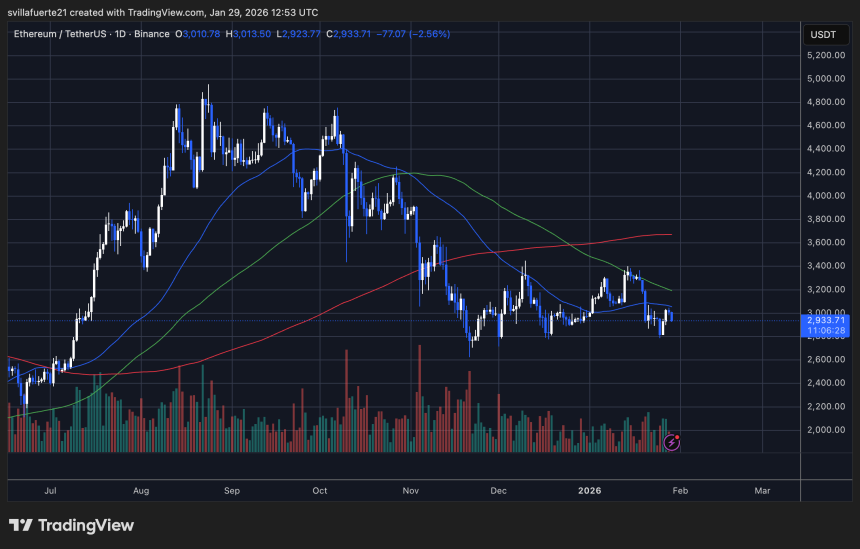
ETH testing critical demand | Source: ETHUSDT chart on TradingView

From a trend perspective, ETH remains below its key moving averages. The 50-day average has rolled over and sits above the price. Reinforcing short-term bearish pressure, while the 100-day average continues to slope downward. Acting as dynamic resistance near the $3,200–$3,300 area.

The 200-day moving average is still rising but flattening. Is positioned higher and signals that long-term trend support has not yet been reclaimed. Until ETH can close decisively above the 50- and 100-day averages, upside attempts are likely to remain corrective rather than impulsive.

Volume dynamics add context to this consolidation. Selling pressure during the latest pullback was notable but not extreme, suggesting distribution rather than panic. Since then, volume has contracted, consistent with a market entering a compression phase. This points to indecision rather than aggressive accumulation.

Overall, ETH is consolidating below major resistance while holding a fragile support band near $2,800–$2,900. A sustained loss of this zone would expose downside risk. While any recovery requires a reclaim of key moving averages to shift the structure toward stabilization.

Featured image from ChatGPT, chart from TradingView.com 

Disclaimer: The articles reposted on this site are sourced from public platforms and are provided for informational purposes only. They do not necessarily reflect the views of MEXC. All rights remain with the original authors. If you believe any content infringes on third-party rights, please contact [email protected] for removal. MEXC makes no guarantees regarding the accuracy, completeness, or timeliness of the content and is not responsible for any actions taken based on the information provided. The content does not constitute financial, legal, or other professional advice, nor should it be considered a recommendation or endorsement by MEXC.

You May Also Like

Shibarium May No Longer Turbocharge Shiba Inu Price Rally, Here’s Reason

Shibarium May No Longer Turbocharge Shiba Inu Price Rally, Here’s Reason

The post Shibarium May No Longer Turbocharge Shiba Inu Price Rally, Here’s Reason appeared on BitcoinEthereumNews.com. Shibarium, the layer-2 blockchain of the Shiba Inu (SHIB) ecosystem, is battling to stay active. Shibarium has slipped from hitting transaction milestones to struggling to record any transactions on its platform, a development that could severely impact SHIB. Shibarium transactions crash from millions to near zero As per Shibariumscan data, the total daily transactions on Shibarium as of Sept. 16 stood at 11,600. This volume of transactions reflects how low the transaction count has dropped for the L2, whose daily average ranged between 3.5 million and 4 million last month. However, in the last week of August, daily transaction volume on Shibarium lost momentum, slipping from 1.3 million to 9,590 as of Aug. 28. This pattern has lingered for much of September, with the highest peak so far being on Sept. 5, when it posted 1.26 million transactions. The low user engagement has greatly affected the transaction count in recent days. In addition, the security breach over the weekend by malicious attackers on Shibarium has probably worsened issues. Although developer Kaal Dhairya reassured the community that the attack to steal millions of BONE tokens was successfully prevented, users’ confidence appears shaken. This has also impacted the price outlook for Shiba Inu, the ecosystem’s native token. Following reports of the malicious attack on Shibarium, SHIB dipped immediately into the red zone. Unlike on previous occasions where investors accumulated on the dip, market participants did not flock to Shiba Inu. Shiba Inu price struggles, can burn mechanism help? With the current near-zero crash in transaction volume for Shibarium, SHIB’s price cannot depend on it to support a rally. It might take a while to rebuild user confidence and for transactions to pick up again. In the meantime, Shiba Inu might have to rely on other means to boost prices from its low levels. This…
Share
BitcoinEthereumNews2025/09/18 07:57
👨🏿‍🚀TechCabal Daily – When banks go cashless

👨🏿‍🚀TechCabal Daily – When banks go cashless

In today's edition: South Africa's biggest banks are going cashless || Onafriq and PAPSS pilot Naira wallet transfers from Nigeria to Ghana || South Africa just
Share
Techcabal2026/02/04 14:02
Wormhole launches reserve tying protocol revenue to token

Wormhole launches reserve tying protocol revenue to token

The post Wormhole launches reserve tying protocol revenue to token appeared on BitcoinEthereumNews.com. Wormhole is changing how its W token works by creating a new reserve designed to hold value for the long term. Announced on Wednesday, the Wormhole Reserve will collect onchain and offchain revenues and other value generated across the protocol and its applications (including Portal) and accumulate them into W, locking the tokens within the reserve. The reserve is part of a broader update called W 2.0. Other changes include a 4% targeted base yield for tokenholders who stake and take part in governance. While staking rewards will vary, Wormhole said active users of ecosystem apps can earn boosted yields through features like Portal Earn. The team stressed that no new tokens are being minted; rewards come from existing supply and protocol revenues, keeping the cap fixed at 10 billion. Wormhole is also overhauling its token release schedule. Instead of releasing large amounts of W at once under the old “cliff” model, the network will shift to steady, bi-weekly unlocks starting October 3, 2025. The aim is to avoid sharp periods of selling pressure and create a more predictable environment for investors. Lockups for some groups, including validators and investors, will extend an additional six months, until October 2028. Core contributor tokens remain under longer contractual time locks. Wormhole launched in 2020 as a cross-chain bridge and now connects more than 40 blockchains. The W token powers governance and staking, with a capped supply of 10 billion. By redirecting fees and revenues into the new reserve, Wormhole is betting that its token can maintain value as demand for moving assets and data between chains grows. This is a developing story. This article was generated with the assistance of AI and reviewed by editor Jeffrey Albus before publication. Get the news in your inbox. Explore Blockworks newsletters: Source: https://blockworks.co/news/wormhole-launches-reserve
Share
BitcoinEthereumNews2025/09/18 01:55