

Hyperliquid Vs HFDX: Traders Debate The Best Perp DEX For 2026
Decentralized perpetual trading is entering a more competitive phase. What was once a narrow field of experimental platforms has grown into a crowded landscape where execution quality, liquidity depth, and risk management matter more than novelty. As market participation accelerates, traders are beginning to compare leading perp DEXs not just on performance, but on how they behave under pressure.
The discussion leading to 2026 is more and more centered on two highly divergent directions. Hyperliquid has grown fast and performed well in the market, whereas HFDX is a non-custodial and decentralized trading protocol that is structured around on-chain perpetual futures and structured yield strategies built around real protocol activity. The comparison of the two is a wider debate on what traders will eventually lay emphasis on with the on-chain derivatives coming to maturity.
Hyperliquid’s Momentum and Market-Led Appeal
 Hyperliquid’s Momentum and Market-Led Appeal
Source: TradingView
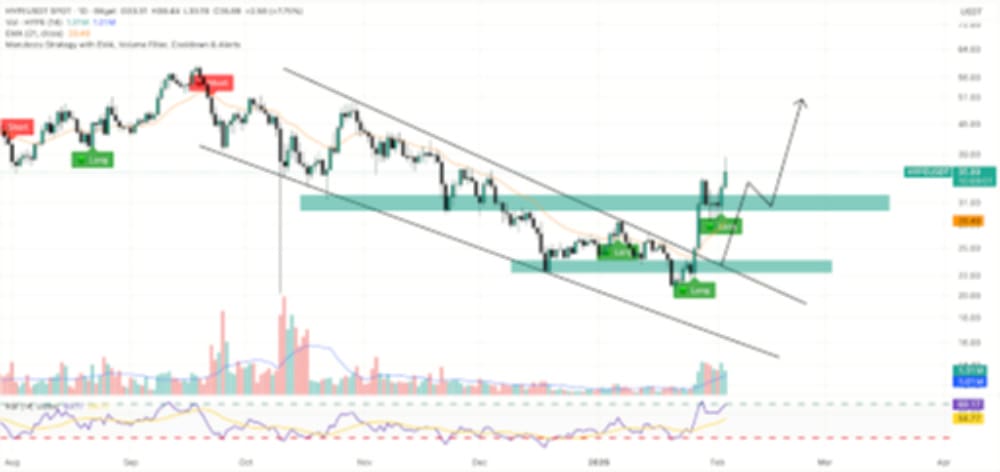
Hyperliquid has emerged as an outstanding project in challenging times for the rest of the crypto market. As most of the assets faltered, HYPE has recorded a 42-percent gain in the last 30 days and attracted more traders who are interested in relative strength. The amount of on-chain activity and trading volume on Hyperliquid has soared in the past few weeks, which further proves that the exchange is a fast-moving derivatives venue.
Trading volumes for HYPE reached roughly $1 billion over 24 hours, representing around 10% of the asset’s circulating market cap. At the platform level, Hyperliquid now holds an estimated 26% share of the derivatives market, with daily volumes around $8.2 billion. These figures suggest that Hyperliquid has successfully attracted both speculative traders and short-term liquidity during a volatile market phase.
Price action has played a key role in this narrative. Recent buy signals delivered gains of roughly 35% within a week, pushing HYPE toward session highs near $38. The momentum has allowed some traders to look at a direction of $50 in case it continues, but technical indicators like the Relative Strength Index are becoming overbought. This increases the possibility of a pullback, and possible retracement areas could be at a minimum of 31 and possibly even 28, and then onwards to higher levels.
Despite its strength, Hyperliquid remains exposed to broader market risk. Even assets that outperform during downturns can be affected by sudden waves of selling, especially in leveraged environments.
How HFDX Approaches the Perp DEX Question Differently
While Hyperliquid’s story is closely tied to momentum and market share, HFDX presents a contrasting model focused on infrastructure and system behavior. Rather than competing through rapid expansion or price-driven narratives, HFDX emphasizes non-custodial execution, pooled liquidity, and transparent risk enforcement.
HFDX is designed to operate entirely on-chain, allowing users to trade perpetual futures or participate in structured liquidity strategies without giving up custody of their assets. As participation increases, this approach becomes less about speed and more about how reliably the system handles volume, volatility, and capital allocation.
Several structural differences shape how traders evaluate HFDX relative to faster-moving competitors:
- Pooled liquidity execution enables trades to settle against shared protocol liquidity, supporting more consistent pricing as volume fluctuates.
- Non-custodial design ensures users retain control of funds regardless of market conditions or platform stress.
- Economics tied to real usage align protocol sustainability with trading fees and borrowing costs rather than token-driven incentives.
- Smart contract risk enforcement provides predictable leverage and liquidation behavior that remains transparent to all participants.
- Clear separation of trading and liquidity roles reduces internal strain as participation grows across different user types.
This framework appeals to traders and capital allocators who evaluate perp DEXs based on durability rather than short-term performance.
What the Hyperliquid vs HFDX Debate Signals for 2026
The comparison between Hyperliquid and HFDX highlights two distinct paths within decentralized derivatives. One emphasizes rapid growth, market dominance, and price momentum. The other focuses on infrastructure quality, risk clarity, and long-term system behavior.
Towards the year 2026, we can expect more picky traders. Momentum will not always be favored by market conditions and stressful times are more likely to demonstrate flaws in the performance and risk management. Under such circumstances, the discussion could turn into one about which platform will expand the most as time passes to which one will be reliable when things become unstable.
Hyperliquid’s recent performance shows how quickly on-chain participation can concentrate around strong narratives. HFDX’s approach reflects a quieter bet on structure and transparency. Together, they illustrate the evolving criteria traders are using to define what the best perp DEX will look like in the next phase of the market.
Make Your Money Work Smarter And Unlock A Wealth Of Opportunities With HFDX Today!
Website: https://hfdx.xyz/
Telegram: https://t.me/HFDXTrading
X: https://x.com/HfdxProtocol
You May Also Like

SHIB Price Prediction: Mixed Signals Point to $0.0000085 Target by February End

Fed rate decision September 2025
