Make-it Capital Edition #54
The World of Cryptocurrencies
The cryptocurrency market has experienced a sharp decline throughout January 2026, with total market capitalization dropping by $356 billion. Bitcoin (BTC) has fallen from highs near $96,000 to below $80,000, while Ethereum (ETH) and other major altcoins have generally seen even steeper declines. This downturn is not isolated to crypto but reflects broader financial market pressures, though the crypto market is amplified by its high volatility and leverage. Market sentiment has shifted to “fear,” with whales selling and retail investors attempting to buy the dips amid ongoing concerns about manipulation from past events like the October 2025 meltdown or as it is also known the 10/10 crash.
This cascade effect — where dips trigger forced selling — results from thin liquidity and over-leveraged positions, rather than a fundamental loss of faith in crypto. While these factors suggest near-term pain, some analysts view this as a healthy consolidation and reset for the bull market, with potential for recovery if liquidity returns or negotiations ease trade and geopolitical tensions. Regulatory developments could also help reduce manipulation and restore faith if passed.
Talking about regulations, the CLARITY Act, also known as the Responsible Financial Innovation Act (RFIA) (there are two versions of what is essentially the same bill), is intended to provide clear guidance to the digital assets and financial industries. It defines which assets are considered ancillary or network assets — regulated by the Commodity Futures Trading Commission (CFTC) and which are classified as tokenized securities — regulated by the Securities and Exchange Commission (SEC). The overall health of the cryptocurrency markets depends significantly on the passage of this bill. If enacted, it will be very bullish for the industry.
However, Coinbase CEO Brian Armstrong withdrew his support for the bill following the proposed Senate markup. Armstrong stated that he would “rather have no bill than a bad bill.” The main issue between Coinbase and the current Senate-endorsed proposal is the yield on stablecoins. Coinbase currently offers exchange members a 3.5% yield on their USDC stablecoin holdings. It also provides opportunities to earn higher yields by lending USDC on DeFi applications. In comparison, incumbent banks offer much less. According to Bankrate, the average yield for a U.S. savings account is 0.62%, with checking accounts offering even less.
This stark difference helps explain why traditional banks are strongly opposed to new market entrants like Coinbase paying out competitive and fair yields. The fight is far from over, and the passage of the CLARITY Act in Q1 2026 now appears uncertain. If the bill does not regain momentum before the summer, midterm elections will become senators’ primary focus, not passing crypto legislation.
Still, failure to pass the CLARITY Act is hardly the end of the industry. On the contrary, not passing the Act could still produce the industry’s desired outcome. Given the current administration’s pro-crypto stance, it may simply take more time to map out the rules of the road. This is a Goliath (incumbent banks) versus David (nascent crypto industry) situation, with significant political support for David. The most probable outcome is some sort of Trump-like deal. Talking of Donald, the Trump administration is also planning to host a meeting between the banking and crypto industries on February 2 to try to get the CLARITY Act passed. Reports suggest there will be a push to allow yield on stablecoins, which is presumably why Fidelity recently announced plans to launch its own stablecoin. Also, the SEC and CFTC signaled they are ready to provide crypto guidance even if regulations are not passed.
Be that all as it may, the digitization of assets is now unstoppable. This becomes indisputably clear when we analyze Wall Street’s actions rather than its words.
For starters, the Bank of New York Mellon (BNY) — the world’s largest custodial bank and the first in history to surpass $50 trillion in assets under custody — has taken its initial step toward moving operations onchain with the launch of tokenized client deposits. BNY now offers onchain, mirrored representations of client deposit balances on its Digital Assets platform, marking the bank’s first move toward blockchain-based bank money. The system will run on BNY’s private, permissioned blockchain. Balances will also continue to be recorded on traditional systems to maintain regulatory and reporting integrity. Carolyn Weinberg, BNY’s Chief Product and Innovation Officer, highlighted the potential of digital deposits, stating they will enable clients to “operate with greater speed across collateral, margin, and payments, within a framework built for scale, resilience, and regulatory alignment.” BNY’s launch closely follows J.P. Morgan’s deposit token rollout, marking the latest development in the bank-led race to modernize cash absent of a EU-favored CBDC (Central Bank Digital Currency).
In fact, J.P. Morgan’s digital asset arm, Kinexys, will deploy its JPM Coin (JPMD) on Canton, marking the digital dollar’s second expansion onto a permissionless network after its launch on Coinbase’s Base in November 2025. JPM Coin represents U.S. dollar deposits held at J.P. Morgan, allowing institutional clients to send and receive dollars 24/7 using blockchain-based rails.
Moreover, Nasdaq filed an SEC rule change to allow trading and settlement of tokenized Nasdaq-listed equities and ETPs. This filing includes blockchain settlement and identical voting and dividend rights as those already provided with traditional equities.
Just one week earlier, the New York Stock Exchange (NYSE) revealed plans to develop a tokenized securities trading and onchain settlement platform. The goal is 24/7 trading, fractional shares, and near-instant settlement.
In the rapidly developing world of tokenized real-world assets (RWA), a distinction is made between Distributed Asset Value (DAV) and Represented Asset Value (RAV). Both are metrics used to categorize and measure the total value of tokenized assets — such as bonds, treasuries, real estate, or other RWAs brought on-chain via blockchain — based on their transferability and mobility. These terms originate from a framework introduced in late 2025 to clarify distinctions in how tokenized assets function in decentralized finance (DeFi) and traditional finance integration.
DAVs are tokenized RWAs with fully transferable tokens that can be moved to external wallets outside the issuing platform. Holders can transfer them peer-to-peer, store them in personal wallets, or use them with other protocols. Even if restrictions like whitelists or eligibility checks apply, the core feature is on-chain mobility, with the blockchain serving primarily as a distribution layer. The total value of DAVs increased by 16% to nearly $25 billion in January 2026.
RAVs, on the other hand, are tokenized RWAs whose tokens are not transferable outside the issuing platform or between wallets. Ownership and record-keeping remain centralized or restricted — often for regulatory, design, or compliance reasons — even though the asset is tokenized on a blockchain to provide benefits such as improved reconciliation, transparency, or operational efficiency. In this case, the blockchain functions more as a shared ledger for representation, auditing, and tracking, rather than for free distribution. The total value of RAVs surged by 42% to nearly $380 billion in January alone.
In essence, DAVs capture the more “decentralized” side of tokenization (true on-chain ownership and movement), while RAVs cover the “represented” side (tokenization for efficiency without full decentralization of control). This distinction helps analyze the maturity and potential of the RWA market: DAVs enable broader innovation in DeFi, while RAVs focus on bridging traditional finance with blockchain transparency.
An excellent exmple of DAVs is tokenized gold which has recently taken off. The two biggest players, Tether (XAUT) and Paxos (PAXG), have had their products on the market for about six years now. However, only in the last eight months has their market cap increased from $1.4 billion to $5.5 billion, rising much more rapidly than the underlying asset, gold, itself. Why the sudden appreciation by the market? CoinBureau points out that investors seem to have recognized the difference in their risk position governed by ‘intermediary dependence’ when investing in gold ETFs versus tokenized gold.
In fact, there is evidence that much of the world’s gold trade operates on a fractional reserve system. Most gold ETF issuers issue shares against gold collateralized in bullion banks (HSBC, JP Morgan, etc.). These bullion banks use delta-neutral hedges to sustain paper demand far above the pool of physical gold in their custody. In principle, this hedging strategy assumes that futures can substitute for physical delivery.
In a rally driven by physical demand though, there is a real threat that these hedges could collapse, causing market stress and bankruptcies. Additionally, there is growing concern about the credibility of these bullion banks due to their limited transparency around their gold reserves. This makes ETFs and traditional paper gold products riskier than their physical counterparts — especially as the number of intermediaries in these financial products increases.
This is where tokenized gold sets itself apart. Most tokenized gold issuers claim to maintain vaults where every token issued is backed 1:1 with physical gold (gold held by dedicated custodians, segregated from common pools, and registered in the name of the issuer). The best part is that the two biggest issuers, Tether and Paxos, offer transparency measures allowing institutional clients to verify the individual serial numbers of the gold bars backing their tokenized representations. It seems Investors’ trust in legacy fractional reserve systems is crumbling rapidly.
Depite all these undeniably positive developments, January saw outflows from the major spot ETFs. BTC ETFs decreased by -$1.61 billion marking January as the third consecutive month of outflows, while ETH ETFs lost -$353 million — also the third month of continuing outflows, though with a tendency toward smaller losses. I guess “small progress is still progress”.
The World of Commodities
Commodities had a strong start to the year, driven mainly by a weaker US dollar, severe weather, and rising geopolitical tensions. “Gold is the money of kings; silver is the money of gentlemen; barter is the money of peasants — but debt is the money of slaves.”
Gold futures experienced one of their most severe single-day price declines, closing down about -11.4%, or -$600, on January 30. In historical context, the most extreme daily percentage drops date back to the volatile post-1970s era, particularly around the 1980 peak, when gold hit approximately $850/oz before crashing amid the fallout from the Hunt brothers’ silver squeeze coupled with high interest rates. The record single-day percentage drop is often cited as -13.2% on January 22, 1980. Gold’s volatility spikes during parabolic rallies followed by corrections, as seen in 1980 and 2025–2026. Despite the plunge, gold remains strongly positive over longer periods, with massive gains in 2025 (+65%) and still significantly up year-to-date in early 2026 (+9%).
Gold’s rise has caught the attention of noted technology investor Cathie Wood, who says the precious metal is the real ongoing market bubble — not artificial intelligence. Wood’s remarks came on January 29 as gold surged to a new all-time high above $5,600 (one day before the barbarous relic’s monstrous decline), while reaching a new record percentage of the U.S. M2 money supply. “Odds are high that the gold price is heading for a fall,” Wood posted on X. “While parabolic moves often take asset prices higher than most investors would think possible, these out-of-this-world spikes tend to occur at the end of a cycle. In our view, the bubble today is not in AI, but in gold.”
Silver fared even worse than gold, with COMEX silver futures settling down approximately -31% on the last trading day of January, closing at around $78.53 per ounce. As with gold, this was not the worst single daily drop in prices, although it came close. The silver market’s most violent single-day percentage declines also occurred during the Hunt Brothers’ attempt to corner the market in late 1979 to early 1980, which ended in a spectacular crash where individual days saw declines larger than -33% amid the forced liquidation of massive leveraged positions. These 1980 events remain the benchmark for silver’s worst volatility, with the January 30, 2026 drop now being described as the “worst since 1980” or the “biggest in 46 years.” However, even after the plunge, silver price are still up nearly +12% in 2026 after having risen about +145% in 2025. Silver has reached the number three spot among assets by market cap, behind the undisputed leader, gold, and the king of AI hardware, NVIDIA, but ahead of Alphabet (Google), Apple, Microsoft, and Amazon.
Copper, meanwhile, keeps hitting its own new highs for a simple reason: Supply does not meet demand creating price pressure. Robert Friedland, the American-Canadian billionaire financier and entrepreneur, widely regarded as one of the most influential and dynamic figures in the global mining industry, recently said at the 2025 Energy Business Summit hosted by the University of Southern California (USC) Marshall School of Business that one cannot own enough copper. “We’re consuming 30 million tonnes of copper a year, only 4 million tonnes of which is recycled. That means to maintain 3% GDP growth, we have to mine the same amount of copper in the next 18 years as we mined in the last 10,000 years combined. This is without any new electrification, without data centers, without solar and wind, and without the greening of the world economy. You people have no idea whatsoever what we’re facing.”
The top three commodities in January 2026 were Indium (+68%), Lithium (+35%), followed by Uranium (+22%). The bottom three start with Cocoa (-31%), followed by Potatoes (-25%) and Tea (-12%).
The Rest …
Optimism in the 1990s was so pervasive that in 1997 Wired magazine proclaimed, “We’re facing 25 years of prosperity, freedom, and a better environment for the whole world.” Since then, the S&P 500 has risen by 810%, and if you had reinvested dividends, by 1,390%. Global poverty rates have dropped dramatically and longevity has increased. So why has the optimism of the 1990s given way to a widespread sense of fear?
According to OECD figures, the US Consumer Confidence Index, which reached an all-time high in 2000, has just hit 84.5, its lowest reading since 2014. A December 2025 report by the Pew Research Center shows that trust in government has fallen from 77% in 1964, to 54% in 2001, and just 17% at the end of 2025 — close to an all-time low. Fear now seems omnipresent. Is this due to AI slowly but surely replacing humans, increasing geopolitical tensions, inflationary pressures, out-of-control government spending, or all of these factors combined, perhaps even fueled by people with a certain agenda? In any case, this fear has driven precious metals, particularly gold and silver, to astounding heights albeit being capped for the time being. In any case, according to FRED, for the first time since 1996, the value of gold held by non-US central banks ($4.6 trillion) exceeds the value of US Treasurys they hold ($3.9 trillion).
The Fed announced on December 12, 2025, that it will begin making reserve management purchases (RMPs) of approximately $40 billion in Treasury bills each month. This is simply economic jargon for the third round of quantitative easing (QE3). QE1 was initiated in response to the housing crisis in 2008, while QE2 helped the US economy survive the COVID lockdowns in 2020. Both QEs were emergency responses to extraordinary events. Today, there is no mortgage crisis, and no global pandemic.
Thus, it appears the aim of QE3 is not to fight a crisis, but to prevent one. When the Fed buys Treasury bills, it intentionally pushes interest rates lower, reducing the interest due on total government debt (currently $970 billion per year on a total of $38 trillion in debt). As a consequence, however, inflation will remain above the Fed’s 2% target, and the US dollar will continue to lose purchasing power against other currencies and assets. The US currency has lost about 10% in value as measured by the US Dollar Index. This supports exporters but hurts imports, ultimately leading to higher inflation.
Perhaps the US economy can grow out of this dilemma through repatriation efforts and AI-driven productivity improvements. It might be achieved, as real GDP grew at annualized rates of 3.8% in Q2 and 4.3% in Q3, and 5.4% as published by the Atlanta Fed’s GDPNow model on January 26. As mentioned below, some industry insiders expect GDP growth to even reach 7.3%. The key factor appears to be labor productivity.
Labor productivity, typically measured as output per hour worked, reflects how efficiently labor is used in the production process. Although growth in labor input has slowed, real GDP has continued to expand, indicating a significant increase in output per hour. In other words, a larger portion of recent GDP growth seems to be driven by productivity gains rather than by labor force expansion.
As noted by Citrini Research, it is quite possible that 2026 will see steady or even rising unemployment despite strong GDP growth. A weakening labor market alongside growing GDP and a rising stock market is not unprecedented — this dynamic occurred in 1992, 1975, and 1958. Perhaps most notably, the years following World War II saw a surplus of labor as GIs returned to an economy that had learned to do more with less, with wartime technology repurposed from armaments production to everyday industrial and consumer uses. Tomorrow’s wartime technology may very well be the current repatriation efforts executed by AI-guided robots.
In closing, the top three major stock markets in local currency in January 2026 were Venezuela (+61%), followed by Turkey (+23%), and Bulgaria (+20%). The bottom three start with Lebanon (-13%), followed by India’s BSE Sensex (-6%), and Indonesia (-5%).
MAKE-IT CAPITAL FUND (the Fund)
- As a unique hedge fund for a comprehensive blockchain / cryptocurrency portfolio, the Fund allows investors to participate in the full spectrum of distributed ledger / crypto assets with just one investment.
- The Fund aims to reduce inherent risk and volatility without compromising performance by applying its proprietary 5-pillar strategy.
- The Fund is operated by Make-It Singapore and managed by Make-It New Zealand.
- The Fund is fully transparent and always trades at the exact NAV.
We misread the tea leaves somewhat this month; otherwise, we would have increased our short hedges. Overall, the Make It Fund lost about 6.6% for the month. Certainly not ideal. However, considering Bitcoin’s 10% loss and Ethereum’s 19% decline, it’s a bit more bearable.
We remain fully convinced that crypto will usher in a thoroughly overhauled financial system built on transparency, fairness, and equal access for everyone. Pullbacks have been common in our journey; however, they have always presented buying opportunities if we focus on the big picture. Winston Churchill put it well: “A pessimist sees the difficulty in every opportunity; an optimist sees the opportunity in every difficulty.”
Staying with the big picture meme, on a recent Moonshots podcast with Peter Diamandis, Cathie Wood of ARK Invest fame said that every technological revolution has been accompanied by a step-function increase in GDP growth. From the 1500s to the 1900s, global GDP growth stalled at 0.6% because no truly revolutionary technology entered the markets. With the introduction of railways, the telephone, electricity, and internal combustion engines, global GDP growth increased fivefold to 3% per year from 1900 until 2025. However, with the advent of AI, robotics, energy storage, blockchain technology, and multiomic sequencing, reinforced by their exponential convergence, ARK Invest is projecting another 2.5x increase to 7.3% global GDP growth, compared to the 3.1% forecast by the IMF. In Cathie’s view, this 7%+ growth is still conservative. In any case, it is “nothing that anyone living today has seen before.”
Cathie further predicted that the new financial system will be built on blockchain technology and digital assets, growing into a $28 trillion market by 2030. She stated that this growth will be primarily driven by increasing Bitcoin adoption. “Bitcoin is maturing as the leader of a new institutional asset class,” noting that Bitcoin exchange-traded funds and corporate Bitcoin holders increased their share of Bitcoin’s total supply from 8.7% to 12% in 2025.
Growth is also expected from increased adoption of decentralized finance, stablecoins, and RWAs, with top smart contract chains like Ethereum and Solana expected to benefit most. In the report, ARK also stated that these smart contract platforms could grow at a 54% CAGR to $6 trillion by 2030.
A link to the discussed ARK Invest report “Big Ideas 2026” is provided below; it offers a thorough examination of what the future may hold for many investment classes over the next five years.
Thank you for your time and attention.
Sincerely,
Philipp L.P. von Gottberg
Here is the promised link to the ARK Invest report Big Ideas 2026 (you might have to register with an email address and a name to access it):
https://www.ark-invest.com/big-ideas-2026
THE WORLD AS WE SAW IT IN JANUARY 2026 was originally published in Coinmonks on Medium, where people are continuing the conversation by highlighting and responding to this story.
You May Also Like

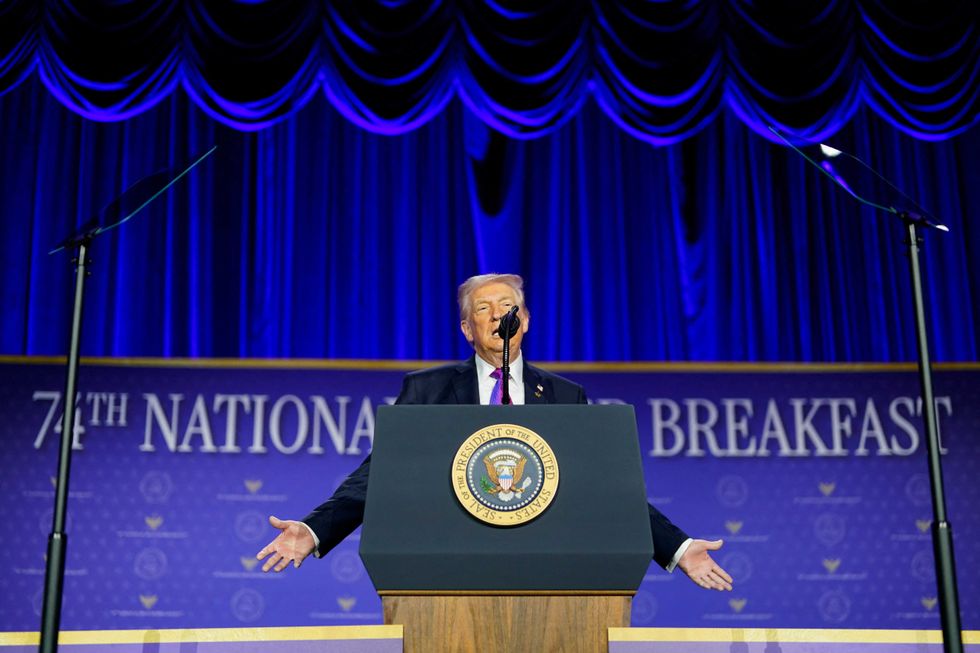
Trump roasts Mike Johnson for saying grace at prayer event: 'Excuse me, it's lunch!'

Where Can You Turn $1,000 Into $5,000 This Week? Experts Point Towards Remittix As The Best Option