Xinbi, the Chinese-language crypto platform tied to scams, pig butchering rings, and cybercrime, has still processed $17.9 billion worth of transactions even afterXinbi, the Chinese-language crypto platform tied to scams, pig butchering rings, and cybercrime, has still processed $17.9 billion worth of transactions even after

Telegram bans groups while Xinbi pushes users to SafeW

2026/02/09 23:24
4 min read

Xinbi, the Chinese-language crypto platform tied to scams, pig butchering rings, and cybercrime, has still processed $17.9 billion worth of transactions even after getting kicked off Telegram and being targeted by U.S. regulators.

TRM Labs tracked the numbers and confirmed the wallets linked to Xinbi took in $8.9 billion in crypto so far. The service is now operating mostly on SafeW, a lesser-known messaging app, with a connected wallet system called XinbiPay.

Both were rolled out after Telegram started deleting the group’s channels. The people running Xinbi didn’t disappear; they doubled down. After Telegram banned it in May 2025, the group came right back using the same usernames and channels.
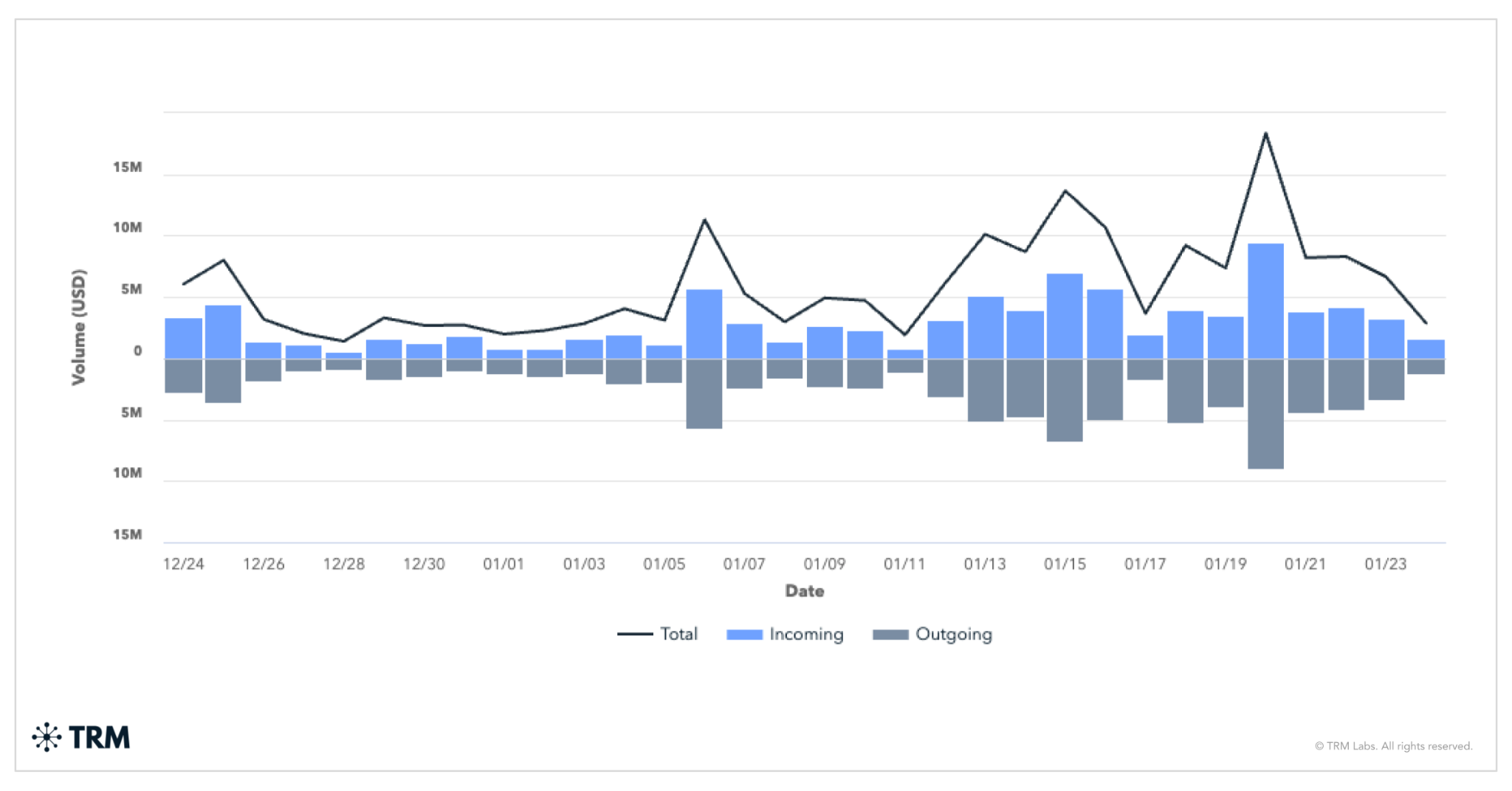
China XinbiNewly established XinbiPay Wallet service hot wallet inflow and outflow since December 24, 2025. Source: TRM Labs

At the same time, they started pushing users to download SafeW and use XinbiPay, which also goes by NewPay. Traffic started to drop in December, but by January, users were sending large volumes through the new system.

The arrest of Chen Zhi, the head of Prince Group, and the collapse of Tudou Guarantee in January 2026 made users nervous. That’s when most people started jumping to SafeW, because by then, Xinbi already had everything in place.

Xinbi is believed to be based around the Golden Triangle, where Myanmar, Thailand, and Laos meet. It’s long been used by fraud networks to wash money and cash out stolen crypto.

Telegram bans groups while Xinbi pushes users to SafeW

Telegram used to be the core of the Chinese-speaking guarantee service world. Since around 2019, groups like Huione, Haowang, and Tudou have been using bots, escrow features, and built-in wallets to handle anonymous crypto deals inside chat windows.
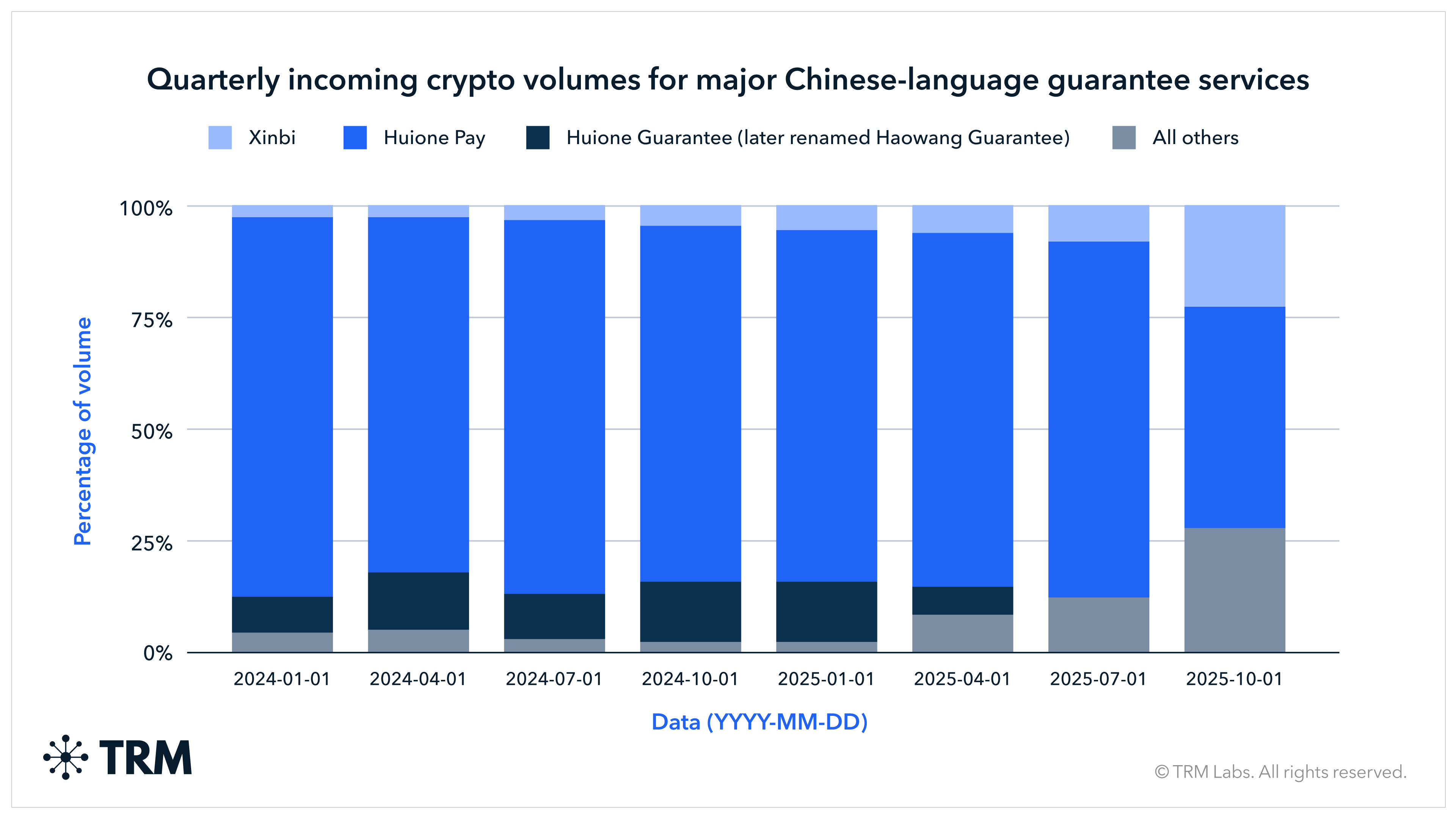
China's crypto marketplace Xinbi posts $17.9 billion in volume even after regulatory actionsSource: TRM Labs

Xinbi joined that list in 2022 and quickly became like the top channel for criminals to swap funds without identity checks, according to TRM Labs.

But that all changed in May 2025 when FinCEN called Huione and Haowang the primary money laundering risks. The U.S. Treasury then used Section 311 to cut them off from the global financial system. Soon after, Telegram deleted huge clusters of channels, including ones tied to Xinbi.

Huione and Haowang tried to move to ChatMe, but barely anyone followed. Users complained about delays, vanished admins, and stuck funds. Both platforms eventually shut down, according to TRM, but Xinbi handled it differently, in that it actually never told users to leave Telegram right away.

Instead, it slowly introduced SafeW and XinbiPay while keeping the old channels active.

Xinbi absorbs users while rivals shut down

From May to December 2025, Xinbi’s inflows nearly doubled, even after Telegram kicked it off. Meanwhile, Haowang and Huione saw their activity drop almost 100 percent. Tudou lost about 74 percent. These numbers came straight from TRM Labs’ on-chain tracking. Xinbi didn’t just avoid collapse. It took advantage of the chaos and pulled in more users.

That growth happened because Xinbi’s system is built to handle volume fast. Anyone offering shady services needs to send a security deposit to the admin team, sometimes as high as tens of thousands of USDT, depending on what they’re selling.

Once approved, they get a private channel. Deals are done in shared chat rooms with an admin acting as escrow. If something goes wrong, the admin uses the vendor’s deposit to settle it.

Once crypto lands inside XinbiPay, TRM Labs said it becomes a pain to trace, because the wallets are managed by the platform, not individuals.

TRM says investigators have to study the movement patterns inside the system. They watch for areas where large amounts of crypto gather, or where it exits the system.

Since 2022, Xinbi has handled at least $16.4 billion in transactions. Some of its listings included stolen data, fake IDs, deepfake tools, and money laundering services. Xinbi even claimed it was registered with FinCEN in the U.S. and FINTRAC in Canada. That gave it a fake sense of credibility, even though it was being used by fraud groups.

The smartest crypto minds already read our newsletter. Want in? Join them.

Market Opportunity
Union Logo
Union Price(U)
$0.001516
$0.001516$0.001516
+4.04%
USD
Union (U) Live Price Chart
Disclaimer: The articles reposted on this site are sourced from public platforms and are provided for informational purposes only. They do not necessarily reflect the views of MEXC. All rights remain with the original authors. If you believe any content infringes on third-party rights, please contact [email protected] for removal. MEXC makes no guarantees regarding the accuracy, completeness, or timeliness of the content and is not responsible for any actions taken based on the information provided. The content does not constitute financial, legal, or other professional advice, nor should it be considered a recommendation or endorsement by MEXC.

You May Also Like

Aave V4 roadmap signals end of multichain sprawl

Aave V4 roadmap signals end of multichain sprawl

The post Aave V4 roadmap signals end of multichain sprawl appeared on BitcoinEthereumNews.com. Aave Labs has released its official launch roadmap for V4, laying out the final steps ahead of the major upgrade’s Q4 mainnet launch.  Alongside new architectural and security improvements, the roadmap introduces a fundamental shift in how user balances are tracked and highlights a strategic pullback from economically underperforming deployments across layer-2 and alternative layer-1 networks. The V4 release moves away from aTokens’ rebasing-style mechanics toward ERC-4626-style share accounting, a change that promises cleaner integrations, easier tax treatment, and better compatibility with downstream DeFi infrastructure.  In a recent technical development update, Aave Labs confirmed that “tokenization is to remain optional and built using ERC 4626 vaults,” and that internal accounting will eliminate the use of exchange rates or scaled balances. The goal is to “further improve the overall reliability of the protocol.” ERC-4626 is a widely adopted Ethereum standard that expresses user deposits as shares of a vault rather than balances that grow over time. In Aave V3, aTokens accrue interest by increasing a user’s balance directly — behavior that resembles rebasing tokens and often confuses integrations and portfolio accounting tools.  By contrast, ERC-4626 tracks yield through a rising price-per-share metric, leaving token balances unchanged. The result is more predictable behavior for integrators, auditors and tax software, as well as a clearer cost basis for users. The roadmap also outlines a series of release milestones, including a formal codebase publication, a public testnet launch with a redesigned interface, and the completion of a multi-layered security review involving formal verification and manual audits. Aave Labs said the roadmap reflects the protocol’s “final stages of review, testing, and deployment,” and that additional documentation and launch preparation materials will be released in the coming weeks. But the most pointed strategic shift comes not from the codebase, but from Aave’s own governance forums. “Aave…
Share
BitcoinEthereumNews2025/09/18 07:40
Wormhole Token Surges After Tokenomics Reset and W Reserve Launch
Wormhole Token Surges After Tokenomics Reset and W Reserve Launch

Wormhole, a leading interoperability protocol that enables asset transfers across multiple blockchains, has announced significant updates to its native tokenomics. These changes include the introduction of a token reserve and enhanced incentives for stakers, which could influence the protocol’s governance structure, as voting power is tied to the stake of Wormhole tokens. In a recent [...]
Share
Crypto Breaking News2025/09/18 03:18
Grayscale’s Multi-Crypto Exchange-Traded Product Gets SEC Approval

Grayscale’s Multi-Crypto Exchange-Traded Product Gets SEC Approval

Grayscale’s multi-crypto ETP receives SEC approval, offering new investment opportunities. SEC’s new crypto ETF standards could lead to dozens of launches. GDLC fund includes Bitcoin, Ether, XRP, Solana, and Cardano exposure. The U.S. Securities and Exchange Commission (SEC) has officially approved Grayscale’s Digital Large Cap Fund (GDLC), marking a significant development for the cryptocurrency industry. This fund will become the first multi-crypto asset exchange-traded product (ETP) available on the market, providing investors exposure to five prominent cryptocurrencies-Bitcoin, Ether, XRP, Solana, and Cardano. According to Grayscale’s CEO, Peter Mintzberg, the approval signals a significant milestone for both the company and the broader crypto industry. He has thanked the SEC Crypto Task Force for working hard on providing the much-needed regulatory clarity to the sector. This accreditation comes after it was previously delayed earlier in the year, as the SEC had put off the conversion of GDLC on the over-the-counter fund to a tradable ETF on NYSE Arca in the communal view of seeking additional examination. Grayscale Digital Large Cap Fund $GDLC was just approved for trading along with the Generic Listing Standards. The Grayscale team is working expeditiously to bring the FIRST multi #crypto asset ETP to market with Bitcoin, Ethereum, XRP, Solana, and Cardano#BTC #ETH $XRP $SOL… — Peter Mintzberg (@PeterMintzberg) September 17, 2025 The latest update on Grayscale’s website shows that GDLC has a net asset value of $57.7 per share and that its assets under management exceed $915 million. Multi-crypto investment is a much-needed diversification of an already fast-expanding digital asset market. Also Read: The Secret Behind $RLUSD’s Success: Building a Stablecoin for the Global Economy The SEC’s Accelerated Approval Process and Broader Impact on Crypto ETFs In addition to approving Grayscale’s fund, the SEC also introduced a new development for crypto ETF issuers. The agency approved, on an accelerated basis, the generic listing standards for cryptocurrency ETFs. This action should make the approval process less challenging, which will result in the introduction of a large number of new crypto ETFs, most of which may track such assets as XRP, Solana, and even Dogecoin. SEC Chairman Paul Atkins pointed out that these revised listing standards would enhance investor access to digital assets and innovation in the capital markets. Eric Balchunas, a senior ETF analyst at Bloomberg, says that the introduction of these standards will lead to the introduction of more than 100 crypto ETFs next year. This approval is in line with the SEC’s larger endeavors to simplify the regulations surrounding cryptocurrencies and related products, which may result in new opportunities for investors in the digital asset sector. It highlights a growing recognition of crypto’s place within traditional financial markets and could pave the way for a more robust crypto ETF market in the future. Also Read: Bitcoin, Ethereum and Solana Make Major Moves: Top Crypto Trends You Can’t Miss The post Grayscale’s Multi-Crypto Exchange-Traded Product Gets SEC Approval appeared first on 36Crypto.
Share
Coinstats2025/09/18 15:29