

This Kenyan startup promises school pickups digital paper trail
On school mornings across Kenyan cities, transport handovers happen fast and mostly on trust, yet when something goes wrong, schools often lack verifiable records of who arrived, when, and through which entry point, a gap that creates risk for pupils, parents, and administrators and turns routine logistics into a safeguarding and accountability problem.
Many school transport routines still rely on paper registers, phone calls between drivers and teachers, and scattered text messages, even as the new Traffic (School Transport) Rules, 2025, and National Transport and Safety Authority (NTSA) notices require proper records and reporting.
Meanwhile, GPS‑based school‑bus apps and communication platforms raise questions under the Data Protection Act 2019 about children’s location data and consent. For most schools, the practical need is not a full‑day trace of a child’s movements but a reliable, auditable record of key handover moments where legal duty of care changes.
TerraGO, a Kenyan school operations startup, built its system around logging these predefined handover actions rather than continuously following children. The platform focuses on creating time- and place-based records tied to specific school-defined touchpoints rather than producing a stream of location data.
Each logged action answers a narrow question: did a registered band or tag interact with an approved reader at a known location within an expected time window? This gives schools a way to confirm that a pupil passed through a set checkpoint without building a full movement history.
The hardware in the child’s bag or on their wrist
Children carry a wearable in the form of a wristband or bag tag that uses near field communication (NFC), while schools install readers at bus doors, gates, and key entrances. Once students arrive in school, a tap on one of these readers creates a record linked to that device, that location, and that moment.
According to co-founder Collins Muriuki, schools decide where those readers sit, whether at the bus step, the main gate, or reception, and the system treats each tap as a discrete entry in the school’s transport and arrival log.
“NFC tap confirmations at school-defined touchpoints,” Muriuki said.
How a school morning plays out
A typical bus journey starts with a child tapping the reader as they board, which logs the boarding event. During the trip, the school can activate a temporary link that shows the bus route to both the school and the parent. The journey also includes a map tied to the vehicle rather than an individual child, which expires when the journey ends.
On arrival, the child taps again when getting off the bus and once more at the gate or entrance, and each of these actions can trigger a notification if the school and parent have chosen to receive them, while children who walk or arrive by car tap at the entrance to create a single arrival record.
The system stays focused on those taps, so if a registered band interacts with a known reader in the expected time band, the platform can report that the pupil was present at that point, without relying on a phone in the child’s pocket or a chain of GPS signals.
What parents see and what they do not
Parents can view confirmations for arrival and pickup events, and turn notifications on or off.
Live map visibility appears only during an active bus trip and ends when the route ends, with no replay of past journeys and no scrollable route history inside the app.
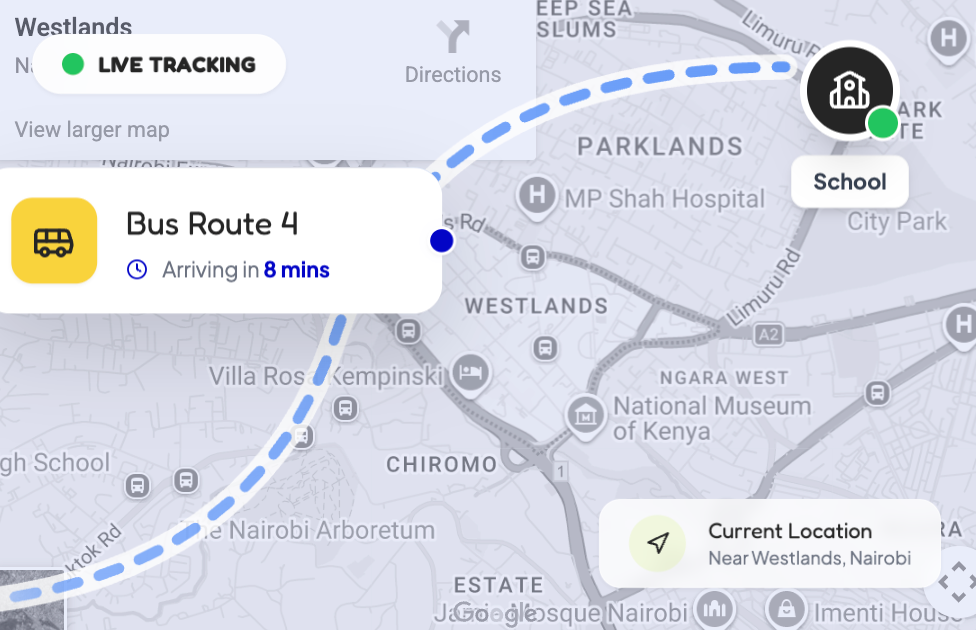 Image: Terra GO
Outside those time-bound journeys, the parent view centres on event records rather than maps, which keeps the focus on handovers rather than continuous tracking.
Pickup without biometrics
At pickup, parents generate a short term code and name the adult allowed to collect the child, then share that code with the guardian, and at the gate a staff member checks the string and sees either a match with the child’s details and expected adult or a warning if the code has expired, is presented by an unlisted person, or appears at an unusual time.
Codes reset daily and cannot be reused, and the system avoids facial recognition or fingerprint scans, relying instead on these time-limited digital passes.
How schools use the dashboard
Inside the school, administrators see a morning view that compares expected and confirmed arrivals by route and class, helping them spot pupils who boarded a bus but have not yet checked in at the gate, those who are late, and flagged exceptions.
Staff open individual records when the dashboard signals an issue, and alerts go out only when set conditions match, such as the right band, reader, and time window, while unclear or partial data does not trigger a message.
Data scope and control
The system’s records depend on physical taps at registered readers, not on continuous location feeds. Schools control their operational data, while parents see only records tied to their own child. Access to past data is time-limited and linked to specific uses, such as reviews.
The company says it does not sell child data, Muriuki insisted, and that access to live and historical records inside its systems is logged and restricted by role.
“Even internally, Terra staff cannot casually explore a child’s historical data. Access is tightly controlled and logged,” Muriuki said.
The process of onboarding a school
Bringing a school onto the platform starts by mapping its classes, routes, gates, and policies, then importing student, guardian, and transport details into that structure. After that, staff run test scenarios such as mock bus runs and trial pickups before any live use.
Rollout then takes place in stages, by route, grade, or entry point, which allows staff to adjust processes in smaller groups rather than changing everything at once.
How much does the product cost?
The product has a wearable and a subscription. Each child uses a Terra GO band, an IP68-rated wrist device, which the company claims can last for one year without recharging. The band costs KES 2,500 ($19).
Parents pay KES 500 ($4) monthly for the software, which covers alerts, live bus trip location, safe zone notifications, pickup codes, a shared guardian circle, and 30 days of logs. The annual plan costs KES 5,000 ($40).
You May Also Like

Finary Secures €25M Funding to Enhance Crypto Integration

Stronger Euro seen as disinflationary but manageable – Nomura
