Upexi reported a steep fourth-quarter loss as falling crypto prices weighed heavily on its digital asset reserves. The Solana-focused treasury firm posted an approximateUpexi reported a steep fourth-quarter loss as falling crypto prices weighed heavily on its digital asset reserves. The Solana-focused treasury firm posted an approximate

Upexi Doubles Down on Solana Despite $179M Quarterly Loss as SOL Holds $78 Support

2026/02/12 05:21
3 min read

Upexi reported a steep fourth-quarter loss as falling crypto prices weighed heavily on its digital asset reserves. The Solana-focused treasury firm posted an approximate $179 million net loss for Q4 2025. 

Consequently, the decline reflected the sharp pullback in Solana’s market value during the period. However, management signaled no retreat from its core strategy. Instead, executives reinforced their commitment to expanding Solana holdings despite short-term volatility.

Upexi Doubles Down on Solana Despite $179M Quarterly Loss as SOL Holds $78 Support

Treasury Strategy Expands Despite Market Pressure

According to the press release, Upexi increased its Solana reserves by 106,000 tokens during the quarter. It ended 2025 holding more than 2 million SOL. Significantly, the company has staked roughly 95% of its holdings to generate yield. At a current market price near $80, those holdings reflect a drawdown of about 57%.

Nevertheless, leadership continues to pursue disciplined accumulation. CFO Andrew Norstrud said the company will grow its holdings per share through capital management and staking returns. 

Additionally, Upexi completed a $36 million Solana-backed convertible note after the quarter closed. It also raised $7.4 million through a registered direct offering. Hence, total cash climbed from $1.6 million to nearly $9.7 million following capital raises.

Operationally, revenue reached $8.1 million, more than double last year’s $4 million. Moreover, staking contributed over $5 million of that total. Gross profit rose 126% year over year to $6.7 million. 

The treasury segment, launched in 2025, drove much of that growth. Besides expanding reserves, Upexi launched a $50 million share repurchase plan and bought back about 416,000 shares.

CEO Allan Marshall emphasized long-term conviction. He stated, “Our conviction in the long-term opportunity for Solana and our strategy remains stronger than ever despite the challenging market environment over the last several months dynamics which we view as cyclical, not structural.”

SOL Tests Critical Support at $78

Meanwhile, Solana trades near $79 after a recent slide. The token fell 3.77% in 24 hours and nearly 14% over the week. Market capitalization stands above $45 billion with a circulating supply of 570 million SOL.

Technically, Solana remains in a clear downtrend since its October peak near $240. It lost the $160 and $120 support zones earlier. Now, attention shifts to the $78 level. According to ALTS GEMS Alert, $SOL sits on a massive floor at $78. 

Bulls must defend this zone to prevent further downside. Consequently, a breakdown could expose $62 and possibly $50. However, a rebound above $90 and later $120 could restore momentum toward $160.

Market Opportunity
Solana Logo
Solana Price(SOL)
$80.77
$80.77$80.77
+1.31%
USD
Solana (SOL) Live Price Chart
Disclaimer: The articles reposted on this site are sourced from public platforms and are provided for informational purposes only. They do not necessarily reflect the views of MEXC. All rights remain with the original authors. If you believe any content infringes on third-party rights, please contact [email protected] for removal. MEXC makes no guarantees regarding the accuracy, completeness, or timeliness of the content and is not responsible for any actions taken based on the information provided. The content does not constitute financial, legal, or other professional advice, nor should it be considered a recommendation or endorsement by MEXC.

You May Also Like

UK and US Seal $42 Billion Tech Pact Driving AI and Energy Future
UK and US Seal $42 Billion Tech Pact Driving AI and Energy Future

The post UK and US Seal $42 Billion Tech Pact Driving AI and Energy Future appeared on BitcoinEthereumNews.com. Key Highlights Microsoft and Google pledge billions as part of UK US tech partnership Nvidia to deploy 120,000 GPUs with British firm Nscale in Project Stargate Deal positions UK as an innovation hub rivaling global tech powers UK and US Seal $42 Billion Tech Pact Driving AI and Energy Future The UK and the US have signed a “Technological Prosperity Agreement” that paves the way for joint projects in artificial intelligence, quantum computing, and nuclear energy, according to Reuters. Donald Trump and King Charles review the guard of honour at Windsor Castle, 17 September 2025. Image: Kirsty Wigglesworth/Reuters The agreement was unveiled ahead of U.S. President Donald Trump’s second state visit to the UK, marking a historic moment in transatlantic technology cooperation. Billions Flow Into the UK Tech Sector As part of the deal, major American corporations pledged to invest $42 billion in the UK. Microsoft leads with a $30 billion investment to expand cloud and AI infrastructure, including the construction of a new supercomputer in Loughton. Nvidia will deploy 120,000 GPUs, including up to 60,000 Grace Blackwell Ultra chips—in partnership with the British company Nscale as part of Project Stargate. Google is contributing $6.8 billion to build a data center in Waltham Cross and expand DeepMind research. Other companies are joining as well. CoreWeave announced a $3.4 billion investment in data centers, while Salesforce, Scale AI, BlackRock, Oracle, and AWS confirmed additional investments ranging from hundreds of millions to several billion dollars. UK Positions Itself as a Global Innovation Hub British Prime Minister Keir Starmer said the deal could impact millions of lives across the Atlantic. He stressed that the UK aims to position itself as an investment hub with lighter regulations than the European Union. Nvidia spokesman David Hogan noted the significance of the agreement, saying it would…
Share
BitcoinEthereumNews2025/09/18 02:22
Trump caves on his own snubs as retaliation ploy against Dem governors backfires

Trump caves on his own snubs as retaliation ploy against Dem governors backfires

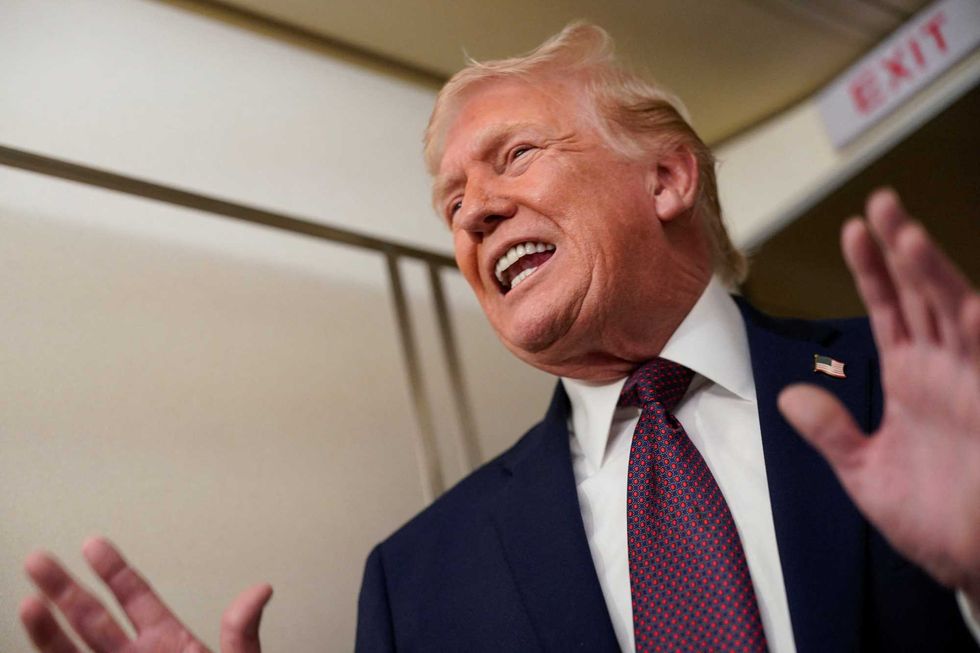
President Donald Trump on Wednesday walked back a snub he gave to two Democratic Governors. Last week, Trump notably did not invite Democratic governors Wes Moore
Share
Rawstory2026/02/12 10:29
Bitcoin devs cheer block reconstruction stats, ignore security budget concerns

Bitcoin devs cheer block reconstruction stats, ignore security budget concerns

The post Bitcoin devs cheer block reconstruction stats, ignore security budget concerns appeared on BitcoinEthereumNews.com. This morning, Bitcoin Core developers celebrated improved block reconstruction statistics for node operators while conveniently ignoring the reason for these statistics — the downward trend in fees for Bitcoin’s security budget. Reacting with heart emojis and thumbs up to a green chart showing over 80% “successful compact block reconstructions without any requested transactions,” they conveniently omitted red trend lines of the fees that Bitcoin users pay for mining security which powered those green statistics. Block reconstructions occur when a node requests additional information about transactions within a compact block. Although compact blocks allow nodes to quickly relay valid bundles of transactions across the internet, the more frequently that nodes can reconstruct without extra, cumbersome transaction requests from their peers is a positive trend. Because so many nodes switched over in August to relay transactions bidding 0.1 sat/vB across their mempools, nodes now have to request less transaction data to reconstruct blocks containing sub-1 sat/vB transactions. After nodes switched over in August to accept and relay pending transactions bidding less than 1 sat/vB, disparate mempools became harmonized as most nodes had a better view of which transactions would likely join upcoming blocks. As a result, block reconstruction times improved, as nodes needed less information about these sub-1 sat/vB transactions. In July, several miners admitted that user demand for Bitcoin blockspace had persisted at such a low that they were willing to accept transaction fees of just 0.1 satoshi per virtual byte — 90% lower than their prior 1 sat/vB minimum. With so many blocks partially empty, they succumbed to the temptation to accept at least something — even 1 billionth of one bitcoin (BTC) — rather than $0 to fill up some of the excess blockspace. Read more: Bitcoin’s transaction fees have fallen to a multi-year low Green stats for block reconstruction after transaction fees crash After…
Share
BitcoinEthereumNews2025/09/18 04:07