This article explores challenges and innovations in medical image retrieval, focusing on dataset imbalance, organ size and shape biases, and recall accuracy interpretation. It highlights a novel application of ColBERT-inspired re-ranking, demonstrating its feasibility in refining CBIR results by incorporating context such as user behavior and medical relevance. While no strong link was found between anatomical region size and retrieval recall, the study opens new pathways for improving image retrieval systems, balancing computational costs, and enhancing real-world usability.This article explores challenges and innovations in medical image retrieval, focusing on dataset imbalance, organ size and shape biases, and recall accuracy interpretation. It highlights a novel application of ColBERT-inspired re-ranking, demonstrating its feasibility in refining CBIR results by incorporating context such as user behavior and medical relevance. While no strong link was found between anatomical region size and retrieval recall, the study opens new pathways for improving image retrieval systems, balancing computational costs, and enhancing real-world usability.

How Dataset Imbalances Shape Medical Image Retrieval Accuracy

3 min read

Abstract and 1. Introduction

  1. Materials and Methods

    2.1 Vector Database and Indexing

    2.2 Feature Extractors

    2.3 Dataset and Pre-processing

    2.4 Search and Retrieval

    2.5 Re-ranking retrieval and evaluation

  2. Evaluation and 3.1 Search and Retrieval

    3.2 Re-ranking

  3. Discussion

    4.1 Dataset and 4.2 Re-ranking

    4.3 Embeddings

    4.4 Volume-based, Region-based and Localized Retrieval and 4.5 Localization-ratio

  4. Conclusion, Acknowledgement, and References

4 Discussion

4.1 Dataset

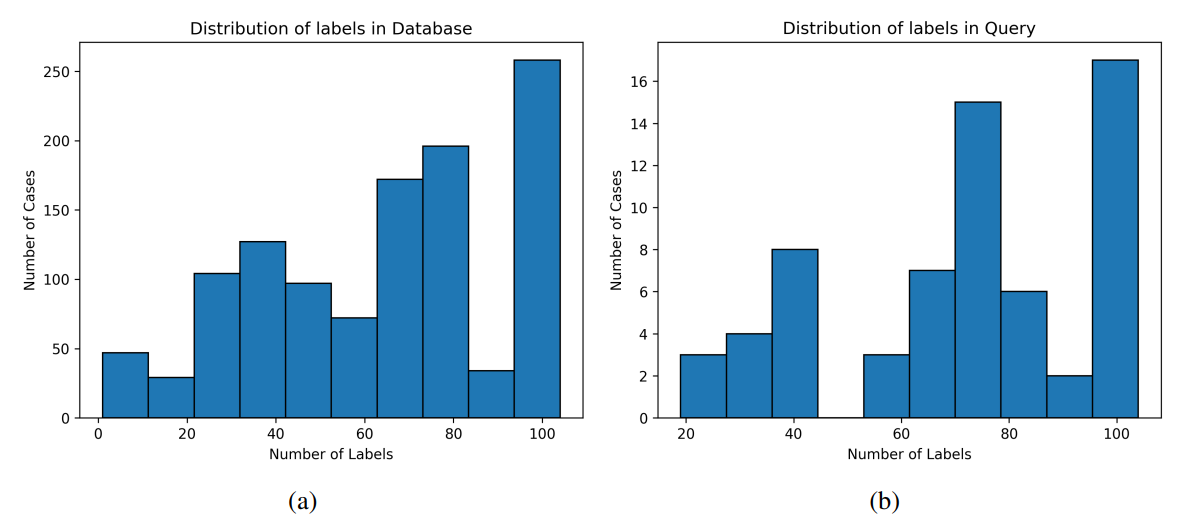
As depicted in Figure 6, the labels inside the database and query subset (derived from TS train and test set, respectively) are not balanced. This should resemble a pattern as can be observed in future real-world scenarios of image retrieval. At the same time, this imbalance should be kept in mind when reading and interpreting recall values from the provided result tables.

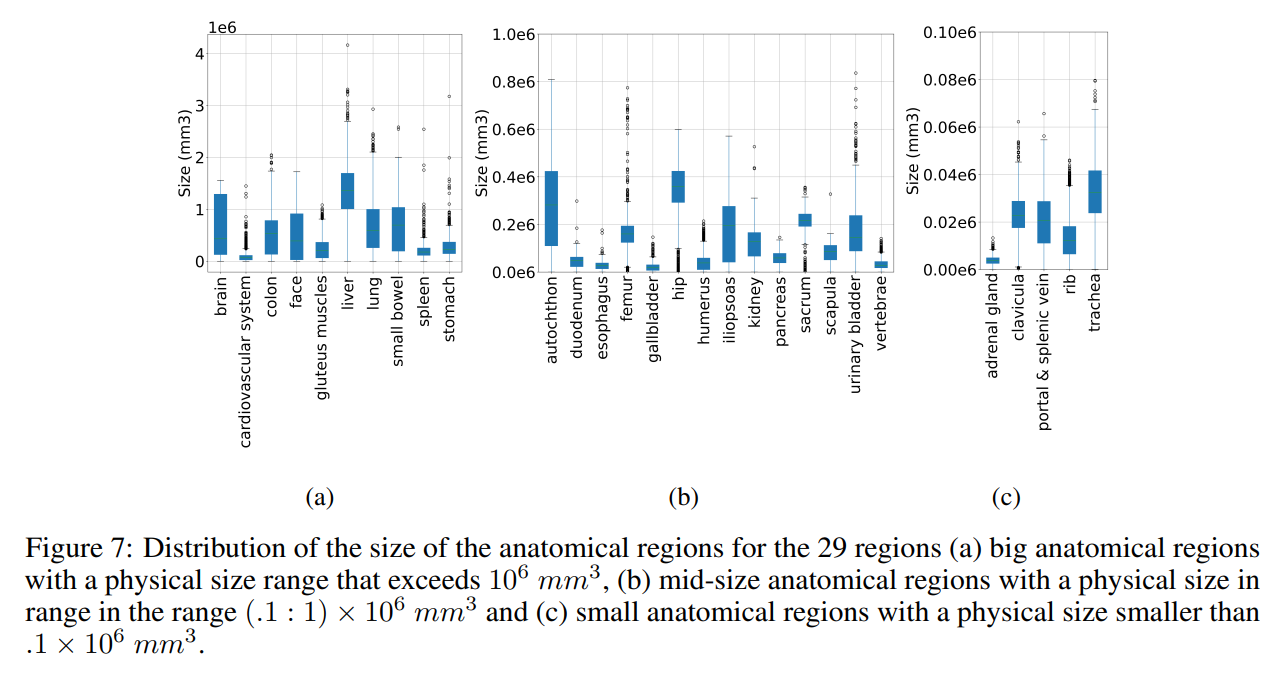
\ Additionally, it is worth noting that the size and shape of organs can impact the probability of correctly predicting a given label by chance. For example, smaller organs can be less likely to collect "by-chance" true positive predictions compared to larger organs. Similarly, organs with elongated shapes aligned with the slice-wise sampling direction can increase the likelihood of "by-chance" hits. A volume and shape-adjusted representation of recall values does not seem reasonable and thus has not been performed in this work. However, organ volume as shown in Figure 7 and Figure 8 should be considered while interpreting result tables.

\ Figure 9 and Figure 10 present an overview of mean recall for each of the retrieval methods (all models) versus the mean anatomical region size for 29 and 104 classes, respectively. There is no pattern suggesting any correlation between the size of the anatomical region and the average retrieval recall.

\ Figure 6: Distribution of the classes in database (a) and query (b) volumes.
\

4.2 Re-ranking

For the first time, we could successfully adopt and show the feasibility of ColBERT-inspired re-ranking for an image retrieval task. In theory, this shows that CBIR results can be made subject to context-aware re-ranking. This is very important as it provides a conceptual entry point to use the information of a future retrieval solution in the real world. Concretely, observations such as user behavior on a graphical user interface, and temporal or medical relevance can be "factored in" to adjust the search results. Further research will study the advantages and disadvantages of ColBERT-inspired re-ranking. In future works, further insights into balancing computational costs in the context of latency-accuracy trade-offs will be shared.

\

:::info Authors:

(1) Farnaz Khun Jush, Bayer AG, Berlin, Germany ([email protected]);

(2) Steffen Vogler, Bayer AG, Berlin, Germany ([email protected]);

(3) Tuan Truong, Bayer AG, Berlin, Germany ([email protected]);

(4) Matthias Lenga, Bayer AG, Berlin, Germany ([email protected]).

:::


:::info This paper is available on arxiv under CC BY 4.0 DEED license.

:::

\

Market Opportunity
RealLink Logo
RealLink Price(REAL)
$0.04714
$0.04714$0.04714
-6.48%
USD
RealLink (REAL) Live Price Chart
Disclaimer: The articles reposted on this site are sourced from public platforms and are provided for informational purposes only. They do not necessarily reflect the views of MEXC. All rights remain with the original authors. If you believe any content infringes on third-party rights, please contact [email protected] for removal. MEXC makes no guarantees regarding the accuracy, completeness, or timeliness of the content and is not responsible for any actions taken based on the information provided. The content does not constitute financial, legal, or other professional advice, nor should it be considered a recommendation or endorsement by MEXC.

You May Also Like

Woman shot 5 times by DHS to stare down Trump at State of the Union address

Woman shot 5 times by DHS to stare down Trump at State of the Union address

A House Democrat has invited Marimar Martinez to attend President Donald Trump's State of the Union address in Washington, D.C., after she was shot by Customs and
Share
Rawstory2026/02/06 03:36
What is Play-to-Earn Gaming? Unlocking New Possibilities

What is Play-to-Earn Gaming? Unlocking New Possibilities

The post What is Play-to-Earn Gaming? Unlocking New Possibilities appeared on BitcoinEthereumNews.com. The Play-to-Earn (P2E) model is playing a key role in the advancement of the crypto industry. Users are able to earn crypto by playing games and get involved with global communities of gamers, creators, and developers. In this article, we’ll explore the functionalities of P2E gaming, its core features, potential risks, benefits, legal issues, and highlight some of the most impactful games shaping the Web3 gaming frontier.  What is Play-to-Earn Gaming? As its name implies, you gain rewards for playing the game. Players in Play-to-Earn games get involved with blockchain networks and can receive crypto assets or NFTs as prizes. The assets you acquire can be sold, traded or kept as an investment to see if their value rises. In Axie Infinity, players gathered and combated Axies, which are fantastical creatures. The game gave players SLP, a coin that works the same as money and could be traded for fiat currencies or other coins. Due to its success, it has grown into a more advanced and eco-friendly economy on current gaming platforms. How P2E Works? Most P2E gaming relies on Ethereum and Layer 2 networks, including Immutable, Ronin, and Base. Users are given both tokens and NFTs for accomplishing various game goals, such as: Completing missions or winning battles Trading or crafting in-game items Participating in tournaments or community events Staking assets or voting in DAOs The main difference between P2E games and traditional ones is that players can truly own what they earn in the game. Weapons, land, avatars, and resources on the Web3 game are tokenized, enabling you to trade or transfer them elsewhere. For example, users in Decentraland are able to purchase virtual land as NFTs, set up experiences and earn money from events or the services they provide. They are different from other items since they…
Share
BitcoinEthereumNews2025/09/19 21:33
DBS Partners With Franklin Templeton and Ripple for Tokenized Lending Platform

DBS Partners With Franklin Templeton and Ripple for Tokenized Lending Platform

TLDR DBS Digital Exchange, Franklin Templeton, and Ripple signed a memorandum of understanding to launch tokenized trading and lending services on the XRP Ledger DBS will list Franklin Templeton’s sgBENJI token alongside Ripple’s RLUSD stablecoin, allowing real-time swaps for institutional investors The partnership enables portfolio rebalancing and yield generation during volatile market conditions through tokenized [...] The post DBS Partners With Franklin Templeton and Ripple for Tokenized Lending Platform appeared first on CoinCentral.
Share
Coincentral2025/09/18 17:06