Bloomberg Intelligence exchange-traded fund (ETF) analyst James Seyffart has compiled a comprehensive roster of dozens of crypto ETF proposals now parked at the U.S. Securities and Exchange Commission (SEC), spanning Nasdaq, NYSE Arca, and Cboe and covering products tied to bitcoin, ethereum, and a wide slate of altcoins. Issuers Crowd SEC Docket With Crypto ETF […]Bloomberg Intelligence exchange-traded fund (ETF) analyst James Seyffart has compiled a comprehensive roster of dozens of crypto ETF proposals now parked at the U.S. Securities and Exchange Commission (SEC), spanning Nasdaq, NYSE Arca, and Cboe and covering products tied to bitcoin, ethereum, and a wide slate of altcoins. Issuers Crowd SEC Docket With Crypto ETF […]

Dozens of Crypto ETFs Sit in SEC Queue, Bloomberg’s Seyffart Shows

5 min read

Bloomberg Intelligence exchange-traded fund (ETF) analyst James Seyffart has compiled a comprehensive roster of dozens of crypto ETF proposals now parked at the U.S. Securities and Exchange Commission (SEC), spanning Nasdaq, NYSE Arca, and Cboe and covering products tied to bitcoin, ethereum, and a wide slate of altcoins.

Issuers Crowd SEC Docket With Crypto ETF Filings: James Seyffart

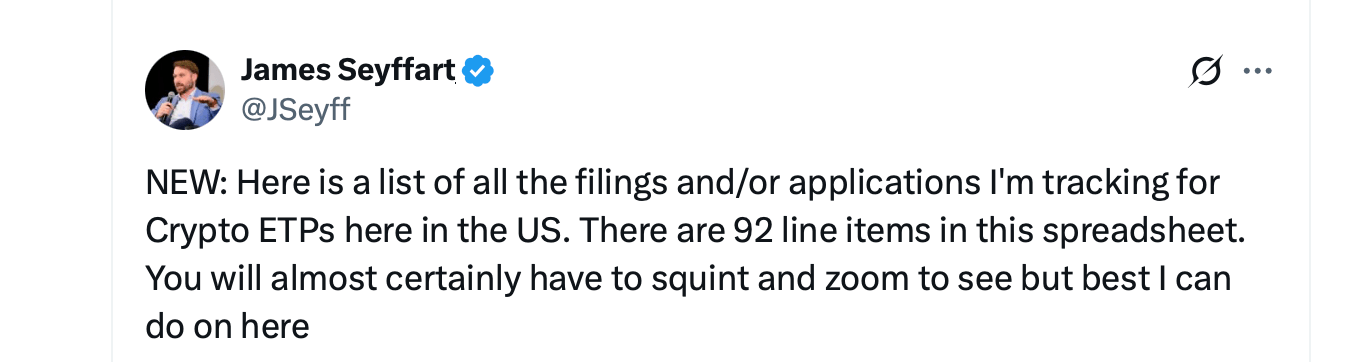
Seyffart‘s image shared on X opens with multi-asset baskets and dual-coin funds. Hashdex seeks to list two “Nasdaq Crypto Index” products on Nasdaq—both baskets combining bitcoin and ethereum—while Franklin Templeton and Bitwise have parallel bitcoin-and-ethereum baskets aiming to list on NYSE Arca/Cboe as shown in Seyffart’s table. Grayscale’s Digital Large Cap conversion (GDLC) is also queued as a basket conversion. These headline filings signal that plain-vanilla, diversified crypto exposure remains a core part of the pipeline alongside the single-asset wave.
Dozens of Crypto ETFs Sit in SEC Queue, Bloomberg’s Seyffart Shows

Single-asset conversions and spot proposals dominate the middle of Seyffart’s chart. Grayscale has conversion filings for litecoin, solana, XRP, avalanche, hedera, and polkadot trusts, mirroring its current lineup, with Seyffart’s image showing NYSE Arca or Cboe as the proposed venues. Canary appears repeatedly as a placeholder filer across several single-asset spot concepts (including LTC, SOL, XRP, HBAR, and SUI), illustrating the breadth of “shell” registrations that keep optionality open while sponsors finalize partners and service providers. Coinshares, Franklin Templeton, Fidelity, Invesco and Galaxy, Vaneck, 21shares, and Wisdomtree each appear with their own SOL or XRP spot ETFs slated for Nasdaq, NYSE Arca, or Cboe.

The SOL and XRP tranche is the largest cluster. Vaneck’s Solana Trust, 21shares’ Core Solana ETF, Bitwise’s Solana ETF, Franklin Templeton’s Solana ETF, Fidelity’s Solana ETF, and the Invesco/Galaxy Solana ETF are all present; on the XRP side, the roster includes conversions and spot ETFs from Grayscale, Bitwise, 21shares, Coinshares, Franklin Templeton, and Wisdomtree, plus Canary placeholder entries. Seyffart’s image shows solana and XRP as the most frequently targeted altcoins among the 92 applications.

Beyond those two altcoins, there are also filings tied to cardano, avalanche, polkadot, and hedera. Grayscale’s Cardano Trust conversion appears, and a Vaneck Avalanche product is listed alongside a Grayscale Avalanche conversion; Bitwise has dedicated DOGE and Aptos entries, and the table notes a 21shares Polkadot ETF as well. These single-asset spot filings sit next to “American-made crypto basket” concepts and a Kraneshares “CF Large Cap Crypto” basket, reflecting a mix of index and single-coin approaches.

The list also captures ethereum (ETH)-specific structures. Alongside traditional spot ETH (and previously approved Ether ETFs), the sheet shows an “Ethereum ETF Options (ETHA)” concept and an “ethereum staking” wrapper from 21shares/Cboe and a parallel staking-enabled approach from Grayscale on NYSE Arca, indicating issuers are testing SEC tolerance for yield-bearing constructs within the ETF format. Final-decision dates in the table extend into October, with earlier deadlines delayed, consistent with recent coverage of the SEC’s review cadence.

Several entries on the image relate to conversions of existing over-the-counter (OTC) products. Osprey’s OBTC conversion appears on the sheet, alongside Grayscale’s conversions noted above, positioning those issuers to move long-standing trusts into the 1933/1934 Act ETF chassis pending exchange rule approvals (19b-4s) where required. The chart’s legend reminds readers that 1940 Act funds (derivatives-based) do not need 19b-4 approvals; that’s why many leveraged or inverse products in the lower half show no exchange rule filing.

Newcomer filings tied to Truth/Yorkville appear repeatedly: “Truth Social Bitcoin ETF” and a “Crypto Blue Chip ETF,” plus “Crypto ETP generic listing standards” stubs, all assigned to NYSE Arca or Cboe in the image. Those indicate an attempt to pre-clear templated rules for broader crypto ETP listing—an approach exchanges have used in other asset classes to streamline approvals after the first product clears.

The derivatives and levered cohort is quite extensive and mostly in the 1940 Act lane. Proshares appears with a set of solana ( SOL) and XRP futures-based ETFs including “Short Solana,” “-2X Solana,” “2X Solana,” “-2X XRP” and “2X XRP.” Teucrium adds “2X XRP” and “-2X XRP,” and Tuttle Capital floods the bottom block with “2X” funds tied to XRP, SOL, TRUMP, DOGE, MELANIA, BNB, BONK, ADA, LINK, and DOT. The sheet marks these as 1940 Act filings (no 19b-4), and one green date shows the SEC has already signed off on a 2X SOL product earlier this year.

REX-OSPREY’s shelf covers “ ETH + Staking,” BTC, SOL, XRP, BONK, DOGE and a TRUMP-themed product, all in the derivatives bucket. Separately, Bitwise shows Chainlink and NEAR proposals, a standalone Aptos ETF, and a Polkadot entry, while Vaneck’s column includes BNB and a SOL product (plus Avalanche). 21shares adds SUI and ONDO besides its SOL and XRP filings. The repeated presence of Coinbase-centric or “digital asset” baskets—Kraneshares “Coinbase 50 Index,” Coinshares “Digital Asset ETF,” and Canary’s “AXL” entry—rounds out the breadth.

The right-hand columns of Seyffart’s table track prospectus dates, 19b-4 submission dates, and first/second/third/final decision deadlines. Many entries show red dates denoting delays; a legend notes that green dates reflect approvals and yellow cells denote items in limbo. The overall count—92—has been cited across industry coverage in recent months and reflects a notable expansion from filings filed last year.

Read at face value, the slate suggests three parallel paths: continued maturation of spot products (beyond bitcoin and ethereum), conversion of legacy trusts into ETFs, and a broad, derivatives-based layer designed to give registered access to more niche exposures. Whether many of the single-asset altcoin funds ultimately list will hinge on exchange surveillance-sharing, custody arrangements, and the SEC’s comfort with market quality—issues that have guided recent deferrals and fueled staggered timelines across the table.

If approved in meaningful numbers, these filings would extend the ETF market beyond bitcoin and ethereum into a menu that includes solana, XRP, cardano, avalanche, hedera, polkadot, chainlink, NEAR, aptos, sui, BNB, and more, across Nasdaq, NYSE Arca, and Cboe.

Market Opportunity
Nowchain Logo
Nowchain Price(NOW)
$0.0006961
$0.0006961$0.0006961
-0.69%
USD
Nowchain (NOW) Live Price Chart
Disclaimer: The articles reposted on this site are sourced from public platforms and are provided for informational purposes only. They do not necessarily reflect the views of MEXC. All rights remain with the original authors. If you believe any content infringes on third-party rights, please contact [email protected] for removal. MEXC makes no guarantees regarding the accuracy, completeness, or timeliness of the content and is not responsible for any actions taken based on the information provided. The content does not constitute financial, legal, or other professional advice, nor should it be considered a recommendation or endorsement by MEXC.

You May Also Like

The Role of Blockchain in Building Safer Web3 Gaming Ecosystems

The Role of Blockchain in Building Safer Web3 Gaming Ecosystems

The gaming industry is in the midst of a historic shift, driven by the rise of Web3. Unlike traditional games, where developers and publishers control assets and dictate in-game economies, Web3 gaming empowers players with ownership and influence. Built on blockchain technology, these ecosystems are decentralized by design, enabling true digital asset ownership, transparent economies, and a future where players help shape the games they play. However, as Web3 gaming grows, security becomes a focal point. The range of security concerns, from hacking to asset theft to vulnerabilities in smart contracts, is a significant issue that will undermine or erode trust in this ecosystem, limiting or stopping adoption. Blockchain technology could be used to create security processes around secure, transparent, and fair Web3 gaming ecosystems. We will explore how security is increasing within gaming ecosystems, which challenges are being overcome, and what the future of security looks like. Why is Security Important in Web3 Gaming? Web3 gaming differs from traditional gaming in that players engage with both the game and assets with real value attached. Players own in-game assets that exist as tokens or NFTs (Non-Fungible Tokens), and can trade and sell them. These game assets usually represent significant financial value, meaning security failure could represent real monetary loss. In essence, without security, the promises of owning “something” in Web3, decentralized economies within games, and all that comes with the term “fair” gameplay can easily be eroded by fraud, hacking, and exploitation. This is precisely why the uniqueness of blockchain should be emphasized in securing Web3 gaming. How Blockchain Ensures Security in Web3 Gaming?
  1. Immutable Ownership of Assets Blockchain records can be manipulated by anyone. If a player owns a sword, skin, or plot of land as an NFT, it is verifiably in their ownership, and it cannot be altered or deleted by the developer or even hacked. This has created a proven track record of ownership, providing control back to the players, unlike any centralised gaming platform where assets can be revoked.
  2. Decentralized Infrastructure Blockchain networks also have a distributed architecture where game data is stored in a worldwide network of nodes, making them much less susceptible to centralised points of failure and attacks. This decentralised approach makes it exponentially more difficult to hijack systems or even shut off the game’s economy.
  3. Secure Transactions with Cryptography Whether a player buys an NFT or trades their in-game tokens for other items or tokens, the transactions are enforced by cryptographic algorithms, ensuring secure, verifiable, and irreversible transactions and eliminating the risks of double-spending or fraudulent trades.
  4. Smart Contract Automation Smart contracts automate the enforcement of game rules and players’ economic exchanges for the developer, eliminating the need for intermediaries or middlemen, and trust for the developer. For example, if a player completes a quest that promises a reward, the smart contract will execute and distribute what was promised.
  5. Anti-Cheating and Fair Gameplay The naturally transparent nature of blockchain makes it extremely simple for anyone to examine a specific instance of gameplay and verify the economic outcomes from that play. Furthermore, multi-player games that enforce smart contracts on things like loot sharing or win sharing can automate and measure trustlessness and avoid cheating, manipulations, and fraud by developers.
  6. Cross-Platform Security Many Web3 games feature asset interoperability across platforms. This interoperability is made viable by blockchain, which guarantees ownership is maintained whenever assets transition from one game or marketplace to another, thereby offering protection to players who rely on transfers for security against fraud. Key Security Dangers in Web3 Gaming Although blockchain provides sound first principles of security, the Web3 gaming ecosystem is susceptible to threats. Some of the most serious threats include:
Smart Contract Vulnerabilities: Smart contracts that are poorly written or lack auditing will leave openings for exploitation and thereby result in asset loss. Phishing Attacks: Unintentionally exposing or revealing private keys or signing transactions that are not possible to reverse, under the assumption they were genuine transaction requests. Bridge Hacks: Cross-chain bridges, which allow players to move their assets between their respective blockchains, continually face hacks, requiring vigilance from players and developers. Scams and Rug Pulls: Rug pulls occur when a game project raises money and leaves, leaving player assets worthless. Regulatory Ambiguity: Global regulations remain unclear; risks exist for players and developers alike. While blockchain alone won’t resolve every issue, it remediates the responsibility of the first principles, more so when joined by processes such as auditing, education, and the right governance, which can improve their contribution to the security landscapes in game ecosystems. Real Life Examples of Blockchain Security in Web3 Gaming Axie Infinity (Ronin Hack): The Axie Infinity game and several projects suffered one of the biggest hacks thus far on its Ronin bridge; however, it demonstrated the effectiveness of multi-sig security and the effective utilization of decentralization. The industry benefited through learning and reflection, thus, as projects have implemented changes to reduce the risks of future hacks or misappropriation. Immutable X: This Ethereum scaling solution aims to ensure secure NFT transactions for gaming, allowing players to trade an asset without the burden of exorbitant fees and fears of being a victim of fraud. Enjin: Enjin is providing a trusted infrastructure for Web3 games, offering secure NFT creation and transfer while reiterating that ownership and an asset securely belong to the player. These examples indubitably illustrate that despite challenges to overcome, blockchain remains the foundational layer on which to build more secure Web3 gaming environments. Benefits of Blockchain Security for Players and Developers For Players: Confidence in true ownership of assets Transparency in in-game economies Protection against nefarious trades/scams For Developers: More trust between players and the platform Less reliance on centralized infrastructure Ability to attract wealth and players based on provable fairness By incorporating blockchain security within the mechanics of game design, developers can create and enforce resilient ecosystems where players feel reassured in investing time, money, and ownership within virtual worlds. The Future of Secure Web3 Gaming Ecosystems As the wisdom of blockchain technology and industry knowledge improves, the future for secure Web3 gaming looks bright. New growing trends include: Zero-Knowledge Proofs (ZKPs): A new wave of protocols that enable private transactions and secure smart contracts while managing user privacy with an element of transparency. Decentralized Identity Solutions (DID): Helping players control their identities and decrease account theft risks. AI-Enhanced Security: Identifying irregularities in user interactions by sampling pattern anomalies to avert hacks and fraud by time-stamping critical events. Interoperable Security Standards: Allowing secured and seamless asset transfers across blockchains and games. With these innovations, blockchain will not only secure gaming assets but also enhance the overall trust and longevity of Web3 gaming ecosystems. Conclusion Blockchain is more than a buzzword in Web3; it is the only way to host security, fairness, and transparency. With blockchain, players confirm immutable ownership of digital assets, there is a decentralized infrastructure, and finally, it supports smart contracts to automate code that protects players and developers from the challenges of digital economies. The threats, vulnerabilities, and scams that come from smart contracts still persist, but the industry is maturing with better security practices, cross-chain solutions, and increased formal cryptographic tools. In the coming years, blockchain will remain the base to digital economies and drive Web3 gaming environments that allow players to safely own, trade, and enjoy their digital experiences free from fraud and exploitation. While blockchain and gaming alone entertain, we will usher in an era of secure digital worlds where trust complements innovation. The Role of Blockchain in Building Safer Web3 Gaming Ecosystems was originally published in Coinmonks on Medium, where people are continuing the conversation by highlighting and responding to this story
Share
Medium2025/09/18 14:40
Vitalik Buterin Challenges Ethereum’s Layer 2 Paradigm

Vitalik Buterin Challenges Ethereum’s Layer 2 Paradigm

Vitalik Buterin challenges the role of layer 2 solutions in Ethereum's ecosystem. Layer 2's slow progress and Ethereum’s L1 scaling impact future strategies.
Share
Coinstats2026/02/04 04:08
USAA Names Dan Griffiths Chief Information Officer to Drive Secure, Simplified Digital Member Experiences

USAA Names Dan Griffiths Chief Information Officer to Drive Secure, Simplified Digital Member Experiences

SAN ANTONIO–(BUSINESS WIRE)–USAA today announced the appointment of Dan Griffiths as Chief Information Officer, effective February 5, 2026. A proven financial‑services
Share
AI Journal2026/02/04 04:15