

Kaspa (KAS) Leads Bitcoin, Monero, and Others as Favorite Proof Of Work Crypto

A new on chain poll has started to attract attention across the Proof of Work crypto community. The vote asks a simple question. Which Proof of Work cryptocurrency stands out as the favorite among participants today? Early results show Kaspa (KAS) taking the lead over several well known names such as Bitcoin and Monero.
The poll appears on Hoosat Vote, a decentralized governance platform built for the Hoosat Network. Crypto analyst observers have pointed to the vote as an interesting snapshot of community preference inside the Proof of Work ecosystem. The poll remains active and will continue collecting responses until March 31, which means the current standings may still change before the final result appears.
The poll runs on Hoosat Vote, a decentralized voting system launched in late 2025 for the Hoosat Network (HTN). Hoosat Vote records each poll and vote directly on a GhostDAG-based blockchain. This structure removes the need for centralized polling tools that store results outside the blockchain environment.
Hoosat Vote allows users to create community questions and record responses in a transparent way. Votes become permanent blockchain entries, which creates a verifiable history of community decisions and sentiment. The system operates with fast confirmation speeds and low network costs. These features make the platform suitable for frequent community governance activities.
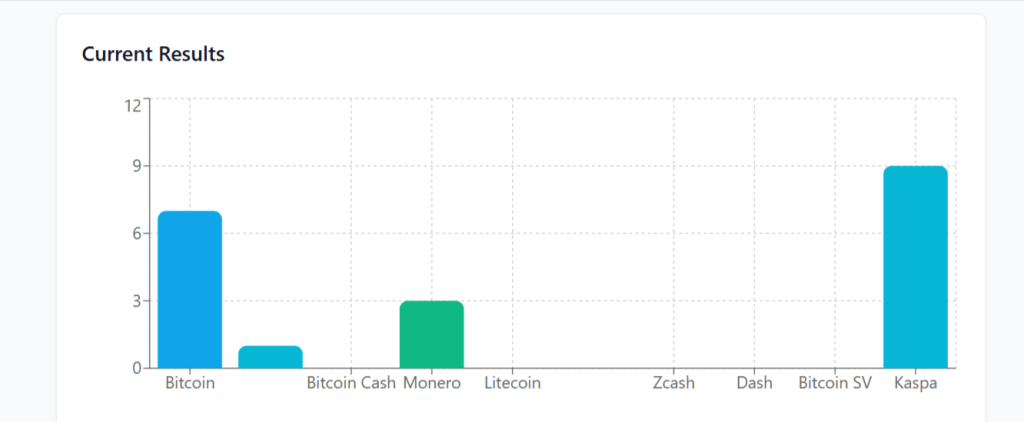
The current poll asks users to select their favorite Proof of Work crypto among several well known assets. Options include Bitcoin, Dogecoin, Bitcoin Cash, Monero, Litecoin, Ethereum Classic, Zcash, Dash, Bitcoin SV, and Kaspa.
 Source: Hoosat Vote
Early Voting Results Show Kaspa (KAS) Leading The Proof Of Work Poll
The results displayed in the poll interface reveal an early advantage for Kaspa (KAS). The latest snapshot shows Kaspa holding 9 votes, which represents about 45% of the total responses recorded so far.
Bitcoin follows in second place with 7 votes, which equals 35% of the poll. Monero holds the third position with 3 votes, representing 15% of the total responses. Dogecoin currently sits behind the top three with 1 vote.
Several other Proof of Work assets such as Litecoin, Zcash, Dash, Bitcoin Cash, Ethereum Classic, and Bitcoin SV have not yet recorded votes in this poll snapshot.
A visual chart of the results reinforces this ranking. Kaspa appears clearly ahead of the other candidates in the current stage of voting. Bitcoin remains the closest competitor based on the latest numbers.
Kaspa Popularity Reflects Interest In New Proof Of Work Architecture
Kaspa has gained attention inside Proof of Work circles because of its unique blockchain design. The network uses a GhostDAG protocol, which allows blocks to exist in parallel rather than following a single chain structure. This design allows faster confirmation speeds without abandoning the Proof of Work model.
The Kaspa network therefore combines traditional mining security with higher throughput than older Proof of Work chains. Supporters believe this structure could keep the network competitive as blockchain infrastructure evolves.
Read Also: Top Analyst Reveals Bitcoin (BTC) Roadmap and Key Price Levels For the Next 2 Years
Bitcoin and Monero continue to represent established pillars of the Proof of Work ecosystem. Kaspa, however, represents a newer generation of networks that attempt to expand the capabilities of the mining model.
The Hoosat Vote poll remains open for another 16 days, which means the ranking may still evolve as more users participate. The final outcome will become clear once voting closes on March 31. Until then, the poll offers an interesting view into which Proof of Work projects attract attention among early participants in this on chain governance experiment.
Subscribe to our YouTube channel for daily crypto updates, market insights, and expert analysis.
The post Kaspa (KAS) Leads Bitcoin, Monero, and Others as Favorite Proof Of Work Crypto appeared first on CaptainAltcoin.
You May Also Like

And the Big Day Has Arrived: The Anticipated News for XRP and Dogecoin Tomorrow

Swiss Franc Intervention: Critical Analysis of SNB’s 2025 Policy and Safe-Haven Resilience
