Sub-Saharan Africa is quietly becoming one of the hottest crypto frontiers. The latest Chainalysis 2025 report shows that the region […] The post Sub-Saharan Africa Named Third-Fastest Crypto Adoption in Report – Can $HYPER Ride the Wave? appeared first on Coindoo.Sub-Saharan Africa is quietly becoming one of the hottest crypto frontiers. The latest Chainalysis 2025 report shows that the region […] The post Sub-Saharan Africa Named Third-Fastest Crypto Adoption in Report – Can $HYPER Ride the Wave? appeared first on Coindoo.

Sub-Saharan Africa Named Third-Fastest Crypto Adoption in Report – Can $HYPER Ride the Wave?

2025/09/12 00:32
5 min read

Sub-Saharan Africa is quietly becoming one of the hottest crypto frontiers.

The latest Chainalysis 2025 report shows that the region is now the third-fastest growing market for crypto adoption, with $205B in value received between July 2024 and June 2025 – a 50% jump year-on-year.

Unlike many regions where speculation dominates, activity here is split between grassroots retail use (with over 8% of transfers under $10K) and institutional flows, like multi-million stablecoin settlements powering trade.

That mix makes the continent a proving ground for crypto’s ‘real-world use’ story, and why scaling solutions like Bitcoin Hyper ($HYPER) are catching attention.

Retail Adoption & Economic Pressures

The clearest sign of sub-Saharan Africa’s retail-driven growth came in March 2025, when the region posted nearly $25B in on-chain volume in a single month.
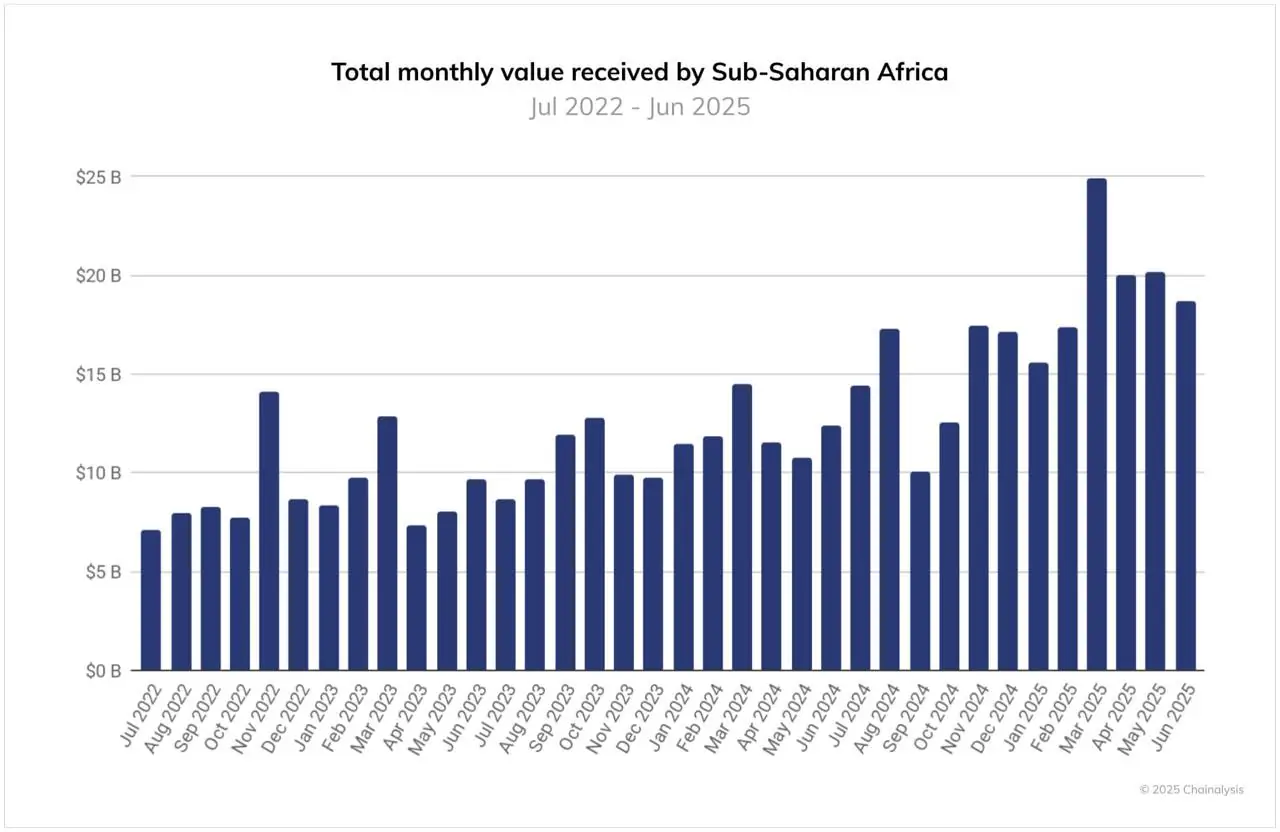
Bar chart of monthly on-chain volume in sub-Saharan Africa.Source: Chainalysis Report

That spike stood out globally, as other regions were cooling off. The trigger was Nigeria’s sharp currency devaluation, which forced people to look for alternatives.

Such shocks typically push crypto volumes higher in two ways: more citizens move towards digital assets to hedge against inflation; and the same amount of fiat buys less crypto, making nominal values surge.

Retail adoption is also visible in the transfer data. In sub-Saharan Africa, more than 8% of all crypto transactions were under $10K, compared to 6% across the rest of the world. This suggests that everyday use is a bigger factor here than speculative trading.

We must also consider the context: a region where many adults remain unbanked, but mobile money is already a part of daily life. For many Africans, crypto is a tool for payments, remittances, and savings when local currencies simply don’t hold up.

Institutional Flows & Regional Leaders

On the institutional side, Nigeria continues to dominate sub-Saharan Africa’s crypto flows. Between July 2024 and June 2025, the country received $92.1B+ in value, nearly triple South Africa’s intake.
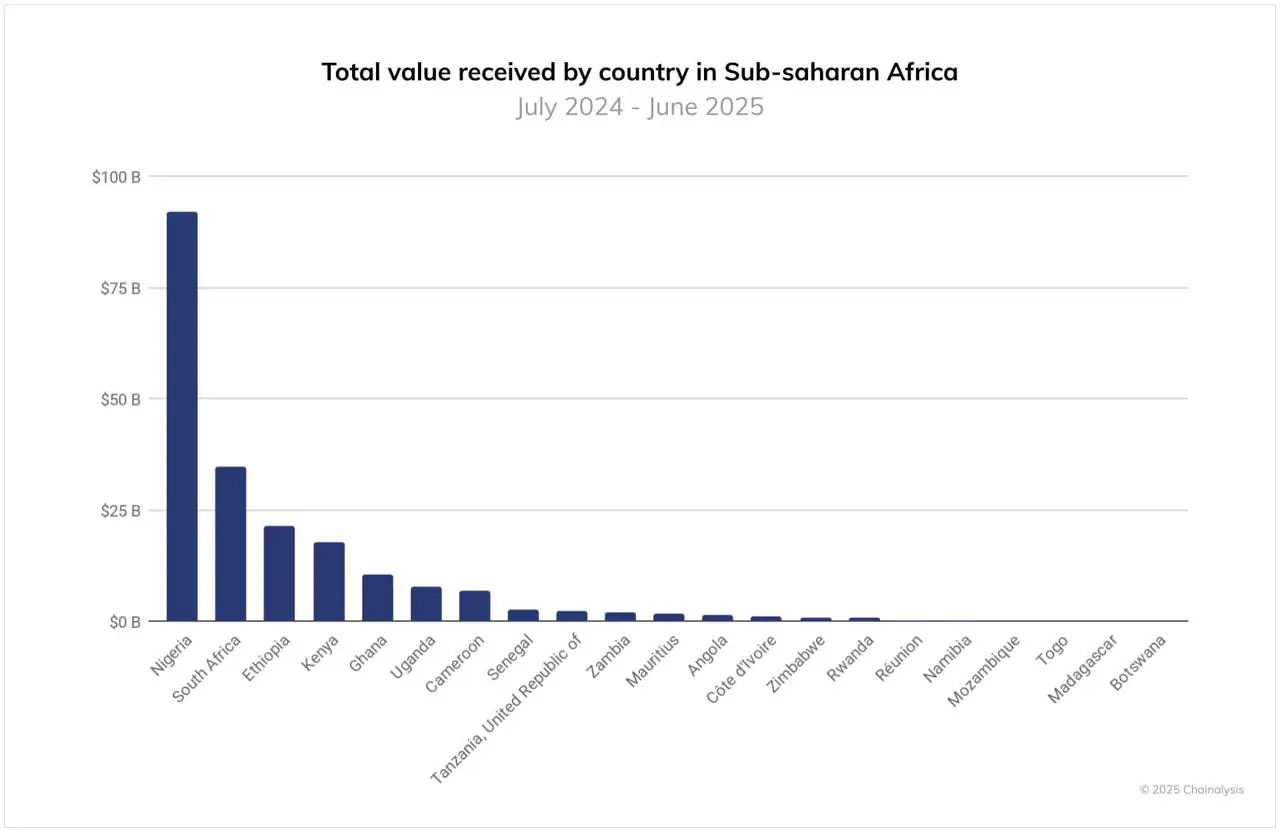
Bar chart of total value received by countries across ub-Saharan Africa.Source: Chainalysis Report

Inflationary pressures and tight access to US dollars have pushed both retail and businesses toward $BTC and $USDT, with stablecoins in particular acting as a lifeline for dollar exposure.

South Africa, meanwhile, is carving out a different kind of leadership. According to the Chainanalysis report, South Africa’s advanced regulatory framework has already licensed hundreds of virtual asset service providers, giving institutions the certainty to engage.

Local banks, including Absa, are now piloting custody solutions and even exploring stablecoin issuance on an institutional level, shifting from it being an experimental tool to a mainstream financial product.

Cross-border flows tell another part of the story. Multi-million dollar stablecoin transfers now facilitate trade between Africa, the Middle East, and Asia, with energy and merchant payments leading the way.

Taken together, the region is building adoption from both ends – retail users on one side, and institutional rails on the other.

Bitcoin’s Influential Role

Bitcoin remains the dominant entry point into crypto across sub-Saharan Africa. In Nigeria, 89% of fiat purchases go into $BTC, while in South Africa the figure stands at 74%. Both are far higher than the 51% share seen in $USD markets.
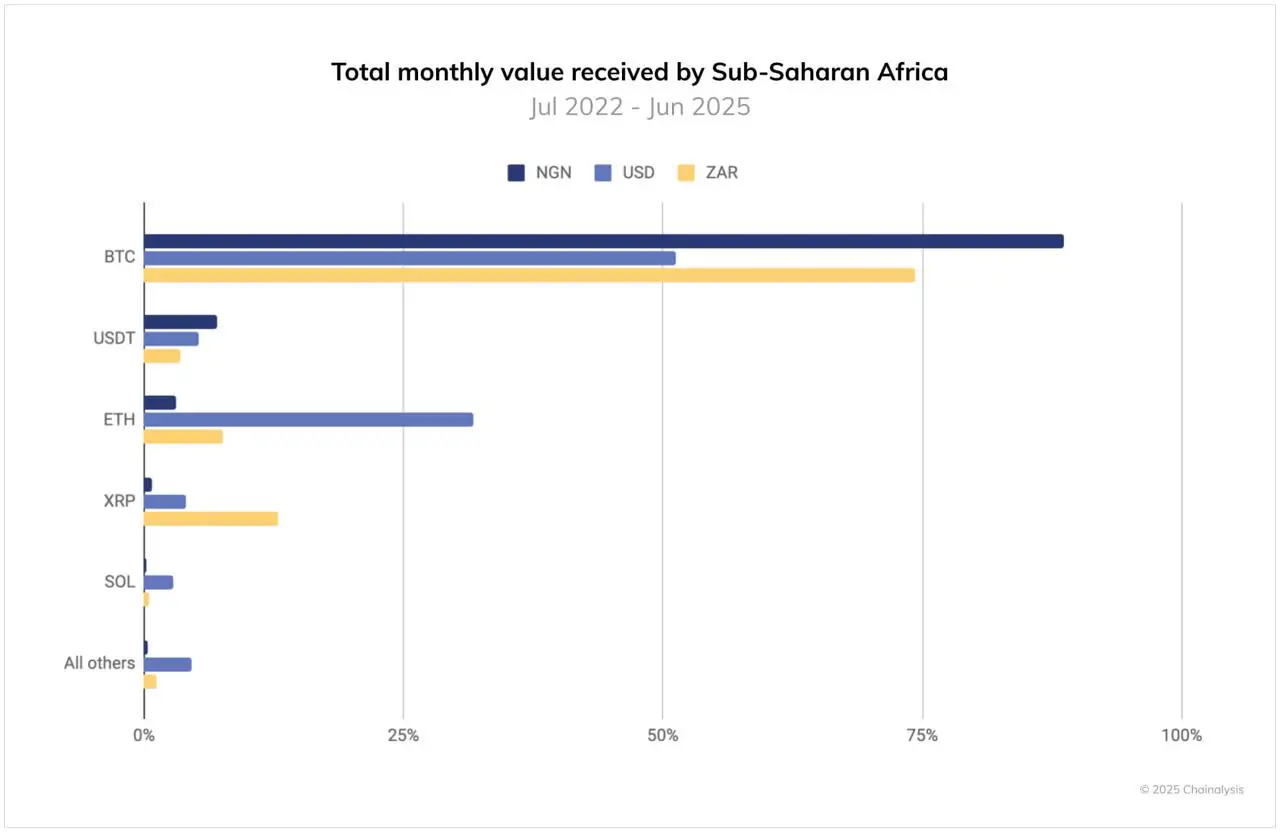
Bar chart of total value received by crypto assets in sub-Saharan Africa.Source: Chainalysis Report

The reasons are clear: in economies where inflation bites and dollar access is restricted, Bitcoin functions as both a hedge and a ‘digital dollar’ substitute. Stablecoins also play a key role, with $USDT making up 7% of purchases in Nigeria, compared to just 5% in US markets.

This dual purpose of Bitcoin being ‘digital gold’ and a practical financial tool underlines why adoption is so prevalent in the region. Yet $BTC’s biggest drawback remains speed and cost. That’s where scaling solutions like Bitcoin Hyper ($HYPER) aim to step in.

Bitcoin Hyper ($HYPER) – Bitcoin’s Execution Layer

Bitcoin Hyper ($HYPER) is positioning itself as an innovative Bitcoin Layer-2 ecosystem that integrates the Solana Virtual Machine.

The project aims to give Bitcoin what it has always lacked: speed, low fees, and real programmability. On Hyper, $BTC can be bridged in, transacted instantly at near-zero cost, and settled back to Bitcoin’s base chain with zero-knowledge proofs.
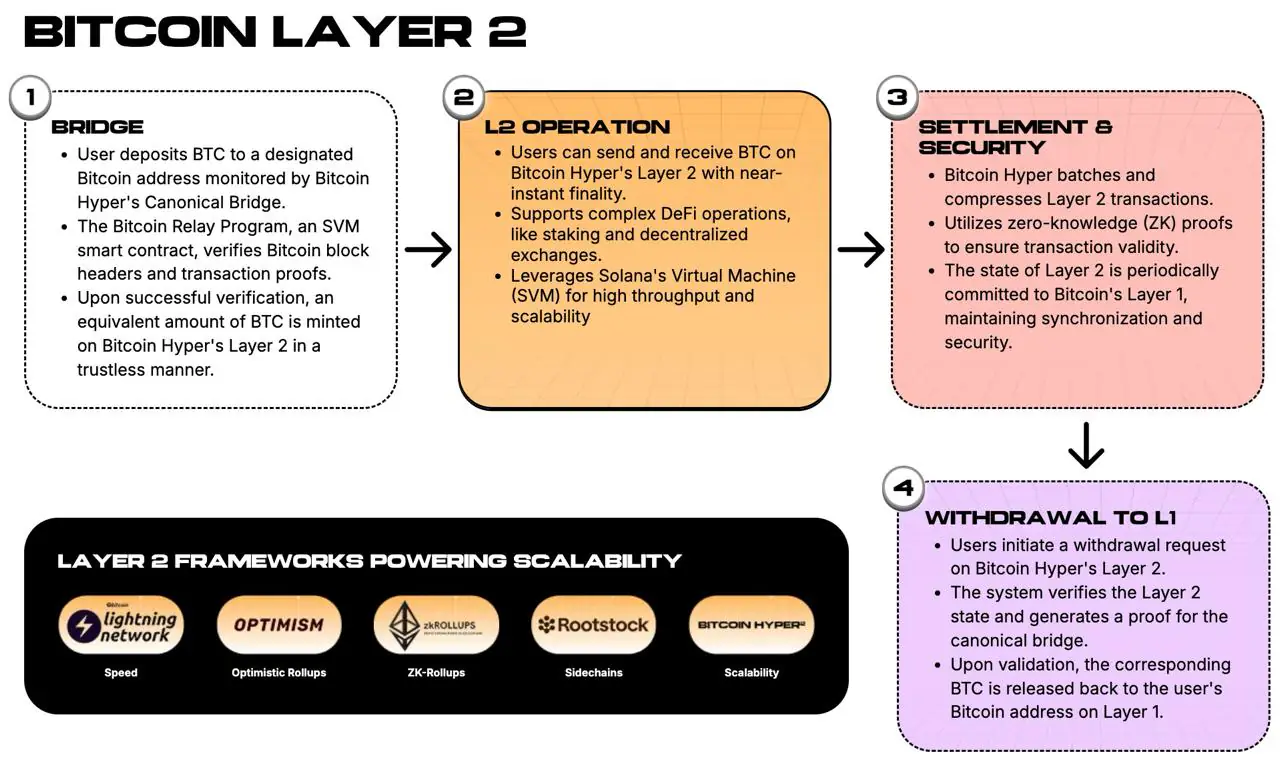
Bitcoin Hyper ($HYPER) Layer-2 framework for powering scalability.

It promises interoperability with Ethereum and Solana, making Bitcoin part of a broader multi-chain ecosystem. Bitcoin Hyper turns $BTC from static ‘digital gold’ into an execution layer where DeFi apps, meme coins, NFTs, and payments can actually run.

That unlocks the use cases already visible in sub-Saharan Africa (fast transfers, dollar substitutes, cross-border trade) but without today’s $BTC bottlenecks.

The $HYPER presale has gained a lot of investor attention, raising $15M+, with tokens priced at $0.012895 and staking yields hovering around 74% APY.

If Bitcoin is already functioning as money in places like Lagos and Cape Town, $HYPER could become the app store layered on top of it.

Remember, this article is not financial advice. Please do your own research before committing any capital.


This publication is sponsored. Coindoo does not endorse or assume responsibility for the content, accuracy, quality, advertising, products, or any other materials on this page. Readers are encouraged to conduct their own research before engaging in any cryptocurrency-related actions. Coindoo will not be liable, directly or indirectly, for any damages or losses resulting from the use of or reliance on any content, goods, or services mentioned. Always do your

The post Sub-Saharan Africa Named Third-Fastest Crypto Adoption in Report – Can $HYPER Ride the Wave? appeared first on Coindoo.

Market Opportunity
Hyperlane Logo
Hyperlane Price(HYPER)
$0.09491
$0.09491$0.09491
-2.19%
USD
Hyperlane (HYPER) Live Price Chart
Disclaimer: The articles reposted on this site are sourced from public platforms and are provided for informational purposes only. They do not necessarily reflect the views of MEXC. All rights remain with the original authors. If you believe any content infringes on third-party rights, please contact [email protected] for removal. MEXC makes no guarantees regarding the accuracy, completeness, or timeliness of the content and is not responsible for any actions taken based on the information provided. The content does not constitute financial, legal, or other professional advice, nor should it be considered a recommendation or endorsement by MEXC.

You May Also Like

Unprecedented Surge: Gold Price Hits Astounding New Record High

Unprecedented Surge: Gold Price Hits Astounding New Record High

BitcoinWorld Unprecedented Surge: Gold Price Hits Astounding New Record High While the world often buzzes with the latest movements in Bitcoin and altcoins, a traditional asset has quietly but powerfully commanded attention: gold. This week, the gold price has once again made headlines, touching an astounding new record high of $3,704 per ounce. This significant milestone reminds investors, both traditional and those deep in the crypto space, of gold’s enduring appeal as a store of value and a hedge against uncertainty. What’s Driving the Record Gold Price Surge? The recent ascent of the gold price to unprecedented levels is not a random event. Several powerful macroeconomic forces are converging, creating a perfect storm for the precious metal. Geopolitical Tensions: Escalating conflicts and global instability often drive investors towards safe-haven assets. Gold, with its long history of retaining value during crises, becomes a preferred choice. Inflation Concerns: Persistent inflation in major economies erodes the purchasing power of fiat currencies. Consequently, investors seek assets like gold that historically maintain their value against rising prices. Central Bank Policies: Many central banks globally are accumulating gold at a significant pace. This institutional demand provides a strong underlying support for the gold price. Furthermore, expectations around interest rate cuts in the future also make non-yielding assets like gold more attractive. These factors collectively paint a picture of a cautious market, where investors are looking for stability amidst a turbulent economic landscape. Understanding Gold’s Appeal in Today’s Market For centuries, gold has held a unique position in the financial world. Its latest record-breaking performance reinforces its status as a critical component of a diversified portfolio. Gold offers a tangible asset that is not subject to the same digital vulnerabilities or regulatory shifts that can impact cryptocurrencies. While digital assets offer exciting growth potential, gold provides a foundational stability that appeals to a broad spectrum of investors. Moreover, the finite supply of gold, much like Bitcoin’s capped supply, contributes to its perceived value. The current market environment, characterized by economic uncertainty and fluctuating currency values, only amplifies gold’s intrinsic benefits. It serves as a reliable hedge when other asset classes, including stocks and sometimes even crypto, face downward pressure. How Does This Record Gold Price Impact Investors? A soaring gold price naturally raises questions for investors. For those who already hold gold, this represents a significant validation of their investment strategy. For others, it might spark renewed interest in this ancient asset. Benefits for Investors: Portfolio Diversification: Gold often moves independently of other asset classes, offering crucial diversification benefits. Wealth Preservation: It acts as a robust store of value, protecting wealth against inflation and economic downturns. Liquidity: Gold markets are highly liquid, allowing for relatively easy buying and selling. Challenges and Considerations: Opportunity Cost: Investing in gold means capital is not allocated to potentially higher-growth assets like equities or certain cryptocurrencies. Volatility: While often seen as stable, gold prices can still experience significant fluctuations, as evidenced by its rapid ascent. Considering the current financial climate, understanding gold’s role can help refine your overall investment approach. Looking Ahead: The Future of the Gold Price What does the future hold for the gold price? While no one can predict market movements with absolute certainty, current trends and expert analyses offer some insights. Continued geopolitical instability and persistent inflationary pressures could sustain demand for gold. Furthermore, if global central banks continue their gold acquisition spree, this could provide a floor for prices. However, a significant easing of inflation or a de-escalation of global conflicts might reduce some of the immediate upward pressure. Investors should remain vigilant, observing global economic indicators and geopolitical developments closely. The ongoing dialogue between traditional finance and the emerging digital asset space also plays a role. As more investors become comfortable with both gold and cryptocurrencies, a nuanced understanding of how these assets complement each other will be crucial for navigating future market cycles. The recent surge in the gold price to a new record high of $3,704 per ounce underscores its enduring significance in the global financial landscape. It serves as a powerful reminder of gold’s role as a safe haven asset, a hedge against inflation, and a vital component for portfolio diversification. While digital assets continue to innovate and capture headlines, gold’s consistent performance during times of uncertainty highlights its timeless value. Whether you are a seasoned investor or new to the market, understanding the drivers behind gold’s ascent is crucial for making informed financial decisions in an ever-evolving world. Frequently Asked Questions (FAQs) Q1: What does a record-high gold price signify for the broader economy? A record-high gold price often indicates underlying economic uncertainty, inflation concerns, and geopolitical instability. Investors tend to flock to gold as a safe haven when they lose confidence in traditional currencies or other asset classes. Q2: How does gold compare to cryptocurrencies as a safe-haven asset? Both gold and some cryptocurrencies (like Bitcoin) are often considered safe havens. Gold has a centuries-long history of retaining value during crises, offering tangibility. Cryptocurrencies, while newer, offer decentralization and can be less susceptible to traditional financial system failures, but they also carry higher volatility and regulatory risks. Q3: Should I invest in gold now that its price is at a record high? Investing at a record high requires careful consideration. While the price might continue to climb due to ongoing market conditions, there’s also a risk of a correction. It’s crucial to assess your personal financial goals, risk tolerance, and consider diversifying your portfolio rather than putting all your capital into a single asset. Q4: What are the main factors that influence the gold price? The gold price is primarily influenced by global economic uncertainty, inflation rates, interest rate policies by central banks, the strength of the U.S. dollar, and geopolitical tensions. Demand from jewelers and industrial uses also play a role, but investment and central bank demand are often the biggest drivers. Q5: Is gold still a good hedge against inflation? Historically, gold has proven to be an effective hedge against inflation. When the purchasing power of fiat currencies declines, gold tends to hold its value or even increase, making it an attractive asset for preserving wealth during inflationary periods. To learn more about the latest crypto market trends, explore our article on key developments shaping Bitcoin’s price action. This post Unprecedented Surge: Gold Price Hits Astounding New Record High first appeared on BitcoinWorld.
Share
Coinstats2025/09/18 02:30
Transforming intelligent agents into economic agents: A panoramic scan of the ERC-8004 ecosystem players.

Transforming intelligent agents into economic agents: A panoramic scan of the ERC-8004 ecosystem players.

Written by: KarenZ, Foresight News From everyday tasks to professional scenarios, AI agents are permeating our lives. An era of "agent economy" where intelligent
Share
PANews2026/02/10 13:04
Why This Crypto Downturn Signals A Hopeful New Era Of Stability

Why This Crypto Downturn Signals A Hopeful New Era Of Stability

The post Why This Crypto Downturn Signals A Hopeful New Era Of Stability appeared on BitcoinEthereumNews.com. Chainlink Founder Reveals: Why This Crypto Downturn
Share
BitcoinEthereumNews2026/02/10 13:43