By Maggie Hsu Compiled by: TechFlow How do you measure the success and growth of a crypto protocol or product? In Web2, marketers have a variety of strategies for measuring success. In crypto, however, marketing strategies are still being developed, particularly across Layer 1, Layer 2, and protocols. Some metrics aren't yet available, some are less relevant, and many require rethinking for blockchain-specific metrics. I’ve spoken with many growth and marketing leaders, and they all have different dashboards. This is normal because the definition of growth for an L1 or L2 is different than for a DeFi protocol, wallet, or game. Let’s explore these differences more broadly: The growth of both L1 and L2 is closely tied to the user and developer communities. We can measure success by looking at Monthly Active Addresses (MAAs) for L1 and L2, as well as the number of applications people are building on them. Growth in MAAs while not significantly increasing applications could simply indicate the presence of a few popular or less popular apps; ideally, both should grow in lockstep. In this scenario, the Chief Marketing Officer (CMO) becomes more of a marketing engine for the community, in addition to promoting the protocol itself. The fundamental growth metrics for a protocol are user numbers, transaction volume, and Total Value Locked (TVL)—the total value of assets deposited in the protocol's smart contracts—or Total Value Secured (TVS)—the total value of assets secured by the protocol. While TVL is a controversial metric, it can provide a general understanding of a protocol's growth when combined with the other metrics discussed below. One founder shared that they also calculate a "cost of capital" for "active TVL," which is the ratio between the amount of rewards they need to provide to achieve a certain amount of locked value and the resulting fees or locked value. Growth in infrastructure and other software-as-a-service (SaaS) businesses is often tied to the growth of individual products. For example, developer platform Alchemy focuses on customer and revenue growth within each product line, similar to what we see in traditional SaaS companies. More specifically, focusing on the percentage of recurring revenue retained by existing customers, or gross revenue retention rate (GRR), indicates that a product is sticky and has a stable customer base, which is crucial for measuring recurring revenue. Net revenue retention rate (NRR) also accounts for upsells and reflects the ability to increase revenue from the existing customer base. Wallet and Games growth also looks more traditional (similar to the SaaS example above), but here it focuses on measuring overall usage and revenue using the following metrics: Daily Active Addresses (DAA), the number of unique addresses active on the network each day Daily Transacting Users (DTU), which is the number of unique addresses conducting revenue-generating transactions on the network (a subset of DAAs) Average revenue per user (ARPU), the revenue generated from a user or customer during a specific period However, if a token is involved, then token price and holder distribution will be affected, but even these metrics depend on your goals. For example, do you want a large number of small token holders, or a small number of whales? This depends on the category, stage, and strategy of your product or service, and you need to choose the appropriate measurement metrics. So, how do you build a company-specific metrics dashboard? Here are some potential metrics suggestions, along with their placement in the marketing funnel to provide further insights. Ultimately, you need to decide what to measure, how to weigh the importance of each metric, and how to act on the data... Core indicators: What matters? Metrics like Customer Acquisition Cost (CAC), Customer Lifetime Value (LTV), and Average Revenue Per User (ARPU) are core to understanding the success and efficiency of your customer acquisition efforts (we’ll define these metrics below). While these concepts are widely accepted in traditional SaaS, they require some adjustments in the crypto space, as “customer” often refers to a “wallet,” and the form of value creation differs. Below, we’ll redefine these metrics and explore their unique nuances in the crypto space. Customer Acquisition Cost (CAC) Customer acquisition cost (CAC) is the total cost of acquiring a customer and can be measured in a few different ways: Broadly speaking, blended customer acquisition cost (CAC) is calculated by dividing your total customer acquisition costs by the total number of new customers. It tells you the average price you paid for each new customer across all channels—including not only acquisition costs but also organic growth costs (which can make it difficult to see which specific growth strategies are driving results). Paid CAC, on the other hand, focuses solely on customers acquired through paid marketing. Too often, teams invest in paid marketing without measuring its effectiveness. Paid CAC reflects the cost of acquiring these customers and whether a particular marketing campaign is truly effective. This is particularly important to measure in the cryptocurrency space, as we've seen early on that many teams get distracted by paid rewards and fail to understand what their product actually does. What counts as “costs”? When calculating CAC, costs may include advertising spend, sponsorships, development of marketing collateral, quest token incentives (on platforms like Galaxe, Layer3, or Coinbase Quests), and airdrops to target wallets. Who counts as a “customer”? In this context, “customer” could mean a “user” or a “developer”; for example, a brand new wallet transacting on a protocol could be considered a customer of that protocol. Lifetime Value (LTV) and Average Revenue Per User (ARPU) Lifetime Value (LTV) represents the present value of a customer's future net profits over the life of the relationship. LTV essentially measures the return a customer gets after becoming a customer, including the amount they spend on your product. LTV itself is a complex calculation and concept. In the cryptocurrency world, it doesn't always translate directly, as "users" aren't always like traditional "customers." For example, they might be anonymous wallets, or a single user might hold multiple wallets. Therefore, LTV might reflect a single wallet's contribution to the total value locked (TVL), which refers to the total USD value of assets held in the protocol's smart contracts, as we've already discussed. For DeFi protocols, TVL can provide a snapshot of the “current total assets,” while LTV can help answer “the value of a specific wallet to the protocol over its lifetime.” LTV:CAC ratio Customer lifetime value (LTV) is often used to assess the initial customer acquisition cost (CAC) and the "value" of that customer over time. The LTV:CAC ratio provides insight into the cost-effectiveness of acquiring new customers by comparing the value they bring to the table with the cost of acquiring them. For traditional SaaS products, a 3:1 ratio is considered reasonable because it means that the value you create from a customer is three times the cost of acquiring the customer, and the remaining profit can be reinvested in growth. In the cryptocurrency space, we have not yet established such a benchmark. In the cryptocurrency space, other acquisition incentives, such as airdrops or points, also need to be considered when evaluating LTV:CAC ratios, as they can be misleading. Ideally, these incentives help attract users to the product and help them get started, but when users like the product enough, it can continue to grow even without the incentives—in which case CAC will decrease and LTV will increase, improving the LTV:CAC ratio. Here’s a quick summary of the key metrics we outlined in the article and how they apply to our thinking in the crypto space: Taken together, these metrics provide a foundation for measuring how effectively your growth marketing efforts are engaging users at different stages of the marketing funnel, while also accounting for the cost of those efforts. Analyzing the Growth Funnel in the Crypto Field After identifying the core metrics, the next step is to map them to the marketing funnel from top to bottom. It’s important to note that while the crypto growth marketing funnel differs from the traditional Web2 funnel, the differences primarily stem from crypto-specific marketing strategies, behavioral characteristics, and unique opportunities at each stage, such as on-chain activity, token incentives, and community-driven dynamics. Next, we’ll explore each stage of the funnel, analyzing key strategies and metrics, and how they differ in crypto and Web2… Awareness/Lead Generation Whether it’s traditional channels or cryptocurrency, the first stage of the marketing funnel is to increase brand awareness. Even in the cryptocurrency field, increasing brand awareness is a prerequisite for everything that follows. At this stage, you'll also begin measuring customer acquisition cost (CAC). "Reach" (the number of unique individuals who see your content) should also be a core metric. Reach is particularly important when evaluating the success of mass marketing channels like press, media, and public relations. The challenge at this stage is distinguishing short-term spikes in attention from truly "sticky" interest: Are users simply curious, or are they genuinely interested in using the product? Beyond core acquisition metrics, the channels you use to find new users each have their own advantages, risks, and unique nuances to the crypto landscape: Key Opinion Leaders (KOLs) and Influencers Paying a random influencer or KOL with a large audience may seem like a reliable way to generate awareness, but it often fails to generate meaningful engagement, especially when the influencer has no authentic connection to the project and their audience doesn’t resonate with it. However, there's value in partnering with influencers who align with the project's philosophy and can share their excitement in a credible way. Consider "micro-influencers"—more niche, targeted voices whose audiences trust them—or even local influencers, such as experts within your team who have already established a strong personal presence. Claire Kart, CMO of Aztec, a privacy-focused L2 company, is a prime example. She not only works internally with influencers but also actively seeks out emerging influencers, connects with them organically, and brings them into the Aztec ecosystem. advertise Advertising in the crypto space faces a host of challenges. For example, due to vague and ever-changing policies regarding crypto advertising, many crypto companies are unable to run ad campaigns on traditional platforms like Google or Meta. Furthermore, the crypto community is wary of traditional advertising, as similar ad formats are sometimes exploited by scammers to direct users to malicious websites. Crypto marketers have had more success promoting specific apps on X (formerly Twitter), LinkedIn, Reddit, TikTok, or the Apple App Store. They can also consider alternatives such as Brave browser ads, Spindl ads within the Coinbase/Base app, or MiniApps and sponsored posts on Farcaster, or even optimize for prompts and incorporate them into AI search answers. Referral and affiliate marketing The concept behind referral programs is the same as traditional marketing: when someone signs up through your referral, you earn a reward. The difference in cryptocurrency is that rewards can be sent instantly and verified directly on-chain, aligning incentives and making the entire process smoother. Projects like Blackbird demonstrate how on-chain referrals can develop into compounding network effects through ongoing loyalty programs and community engagement, rather than just a one-time customer acquisition campaign. Word-of-mouth is one of the most powerful growth drivers in crypto: for consumer-facing products, adoption is often driven by referrals, where users recommend a product to other users because they enjoy the experience and find it valuable. For infrastructure projects, referrals often come from existing customers and developers. Measuring word-of-mouth growth can be done by simply tracking the Net Promoter Score (NPS) or by directly surveying new users after they sign up or complete an onboarding session to see if they were referred and by whom. In this sense, referrals are like an inverted, bottom-up marketing funnel: users don’t just stay at the conversion stage, but instead reintroduce new potential users to the top of the funnel. Early users become evangelists, bringing more people into the network (and potentially being rewarded for their contributions), thus keeping the growth flywheel spinning. A note on accuracy: Accurately measuring growth from real users/customers versus bots is a problem across industries, particularly in social media. Cryptocurrencies offer unique identity primitives, such as "proof of humanness" via World ID or zero-knowledge proofs (via zkPassport), that can distinguish real users from bots or airdrop scammers. Growth teams can leverage these primitives not only to build Sybil resistance against community growth mechanisms like airdrops, but also to better understand real users and help plan product retention. The power of the growing network Finally, one of the unique growth drivers of cryptocurrency is its token, which is often the best way to attract users, developers, and liquidity to markets that traditionally struggle to overcome cold start issues. However, this isn't just about speculation: more importantly, when a token's price rises, it can attract new users who want to participate in a particular movement or development. Developers also take notice, as a rising price signals an active community and genuine demand, making the platform more attractive. Consideration/Interest The next stage in the traditional marketing funnel is consideration, which is when a potential customer becomes actively interested in a product and is evaluating and comparing it to other products. In the cryptocurrency space, this is particularly important, as every decision—from purchasing tokens to ordering a hardware wallet—typically requires significant education, as cryptocurrency remains a relatively new (and often complex) industry for both users and developers. Providing users with the right information to help them make decisions and weigh competing products or platforms can have a huge impact. This is why companies from Coinbase to Alchemy are investing in educational content for both consumers and developers. Effective educational content goes beyond detailing a product’s features and benefits, and also covers how the product works (e.g., security, custody, community and treasury governance, token economics, etc.). Developers may need in-depth technical documentation and tutorials, while consumers often require explanatory content (e.g., before transferring real funds between wallets or blockchains). User education via email during key processes (such as product registration or purchase), in-product prompts and tooltips, interactive onboarding, and product trials or “testnet” setups to demonstrate and experience features before committing to transferring assets are all standard tools. Companies are also starting to optimize their educational content to fit large language models (LLMs) so that when someone asks a question, the company’s content can be retrieved. Successful teams measure interest not only through clicks or downloads, but also through intermediate actions users take, such as joining a wallet's waitlist or adding a small deposit to test functionality, to demonstrate trust and intent. However, understanding the success of these efforts depends on the channels chosen, as each channel has its own set of metrics. Ultimately, however, you need to map these metrics to some kind of conversion, as we'll cover below. conversion Conversion is the stage in the marketing funnel where users complete their desired behavior. At this stage, users have been attracted, engaged, and informed, ultimately taking the action you want them to take. As a metric, "conversion rate" is a broad term: in traditional marketing, it might refer to the number of customers who purchased a product, users who signed up for a demo, or people who requested to speak with a sales team. In crypto, conversions can also include wallet downloads, token purchases, or even code deployments on a platform. The specifics of what constitutes a conversion depend on your product and goals, but accurately defining conversion metrics is crucial for developing the best measurement methods. Tracking conversions across marketing channels (e.g., wallet downloads driven by offline events) is crucial. Understanding which sources drive results can help teams optimize budget allocation, messaging, and more. Accurately measuring conversions also relies on attribution mechanisms, which are particularly complex in the crypto space, especially since the user journey between traditional websites, social networks, and on-chain behavior (for example, from off-chain to on-chain behavior or vice versa) is difficult to accurately track. Web tracking tools like Google Tag Manager can track website conversions, while new tools for wallet users like Addressable can bridge the gap between off-chain advertising and on-chain behavior, allowing teams to track on-chain behavior from websites or Web2 ads. However, the user journey is often not linear; for example, a user may first see a post on X, attend an offline event, and then make their first transaction. While attribution in the crypto space has historically been difficult, improved analytical tools are enabling teams to gain a more comprehensive understanding of growth. While many people maintain multiple wallets, advancements in analytical technology are enabling the ability to match multiple wallets to a single user, allowing on-chain activity to be linked to specific users. As privacy regulations (e.g., GDPR, cookie restrictions, etc.) make Web2 attribution more difficult, the transparency of on-chain data offers advantages while also protecting user identities. Post-conversion engagement In traditional marketing funnels, the engagement/interest stage typically measures product interactions before purchase. These interactions are how users gain a better understanding of the product and brand, and are a crucial stage in converting initial interest into loyal engagement. In the crypto marketing funnel, post-conversion user engagement is equally important, encompassing both online and offline, on-chain and off-chain behavior. This not only provides insights into how to retain users, but also how to maintain the overall health of the community, regardless of where users are located. For example, online engagement (which we also cover in our social media guide) can include metrics like: Engagement on Discord or other forums/chat platforms Activity on X (formerly Twitter) Sentiment analysis on social channels User participation in governance or voting While many crypto marketers still rely on traditional social listening tools, these traditional methods need to be adapted for the crypto sector. For example, sentiment tracking can provide a directional understanding of community sentiment toward a project, but it shouldn't be the sole basis for decision-making. Sentiment tracking can help teams identify active contributors and key influencers and assess the effectiveness of messaging. However, the crypto community is fragmented across multiple platforms, and the quality and depth of metrics vary. A small number of highly active accounts can have an outsized influence, resulting in a high level of data noise. In addition to sentiment tracking tools, some teams use other social media monitoring tools (such as Fedica) to track and reward user engagement. For example, they can identify contributors who amplify content, create memes, participate in discussions, and generally inject energy into the community. However, it's important to note that incentivized campaigns are susceptible to manipulation: certain incentives may attract those who prioritize rewards over the project itself, potentially leading to short-term community activity but lack of sustainability in the long term. Crypto marketing can still achieve meaningful organic growth through unincentivized or non-paid methods. For example, this can be achieved through a strategy that interweaves different types of content. Eco, a stablecoin liquidity layer, employed an organic content strategy based on the "4-1-1 principle": publishing four educational pieces of content about its market opportunity; one piece of "soft sell" content (e.g., a third-party endorsement); and one piece of "hard sell" content (e.g., "Use our product"); and repeating this cycle every few hours for seven days. Through this organic publishing strategy alone, combined with leveraging major product announcements and co-marketing campaigns, Eco increased its total monthly impressions by nearly 600%. Offline engagement (such as attending conferences or events) also plays a key role in helping users engage through deeper connections. Traditionally, these activities have been measured by collecting email addresses to expand mailing lists (e.g., by scanning attendee QR codes). More sophisticated tools include tagging giveaways with NFC chips (e.g., through IYK) and running campaigns to encourage users to click or scan them. Online platforms (such as Discord or Towns) provide dedicated spaces for ongoing interaction and relationship building. Teams can track the number of user interactions (posts, likes, replies) over a period of time and analyze the quality and sentiment of these interactions. Retention Retention answers a key question: "Who's staying?" Retention can be measured as the percentage of users who complete an on-chain action after a set period of time, or more broadly, as a measure of ongoing user activity. Retention is calculated by dividing the number of existing users at the end of a given period by the number of users at the beginning of that period. If you're measuring mailing list subscribers or wallet downloads, retention isn't tracking initial signups, but rather users who remain active over time. Common retention metrics include returning users or daily active addresses over time. In the cryptocurrency space, retention metrics must account for the tension between "long-term" and "short-term" behavior, given the powerful token mechanics and behaviors involved. For example, a surge in airdrop users at launch might look like growth, but once the rewards cease, many will leave. This is why it's important to define your "ideal" user and measure retention relative to that group, rather than just the raw total number of users. This is also why it's important to measure product metrics—both intrinsic to the product itself and organic interest in it—so as to avoid confusing what's working with what's not, especially if your product hasn't yet achieved product-market fit. Otherwise, you might think you've found product-market fit when you haven't; that is, people's interest isn't in your product, but in the rewards. Retention naturally drives customer lifetime value (LTV) as well, as the longer users stay, the more they spend or transact. This not only increases their LTV but also leads to a more desirable LTV:CAC ratio. Churn Churn is the opposite of retention and measures how many users are lost during their lifetime and when. Churn rate is calculated by dividing the number of users who churned at the end of a time period by the total number of users at the beginning of that period and expressing it as a percentage. In crypto, an alternative metric for churn (although it doesn't map perfectly to traditional churn metrics) is the percentage of wallets that become inactive after a certain period of time. For example, users may sign up for a wallet through a marketing campaign or cycle, but then never use it again. Some of these users may re-engage at some point in the future, but the key to calculating churn is identifying active, frequently engaged, and returning users, rather than "dormant" users who have only performed a single on-chain action. Tools like Safary can monitor user interactions with decentralized applications (dApps) and help identify friction points that lead to user churn, such as high transaction fees, a complex user experience, or the need to complete multiple onboarding steps. For example, when Solana released its Seeker phone, some users requested a pre-funded wallet (similar to the earlier Saga phone) to reduce initial friction. The need to manually top up funds before making transactions could slow adoption. While Solana has transitioned to dApp rewards after users receive the phone, reducing friction in the onboarding process remains crucial. To mitigate churn, leverage funnel tracking and user cohort targeting platforms that support crypto-specific user engagement (such as Absolute Labs' Wallet Relationship Management). These tools allow teams to create custom user segments and re-engage them through Web2 channels and crypto-native strategies like targeted airdrops. Furthermore, direct messaging to wallets via secure decentralized messaging tools like XMTP can provide timely, personalized reminders to encourage users to return and continue engaging. Wallet share Another way to track churn and retention is to look at "wallet share": the proportion of total spending in a category that customers allocate to your product or service. In the crypto space, this concept can be applied very intuitively. By analyzing the composition of wallets, teams can see the types of assets held, the amount, and the direction of activity. If users stop interacting with your protocol, on-chain data can reveal whether they are switching to competitors. Of course, as protocol products and services become more complex, the reasons for user migration can become more difficult to determine. But if you observe user behavior shifting toward a competitor or another product with unique features, this can reveal important information. Similarly, if many of your token holders also hold tokens from a related project, this could present opportunities for joint marketing—for example, partnering with that project to host a joint event or giving away your tokens to its token holders. General analytics tools like Dune, a crypto data hub, enable this type of analysis, while more specialized platforms can provide deeper insights into specific tokens. Since most users have multiple wallets, it's also important to link them to a single end-user identity; on-chain analytics tools like Nansen can provide wallet tags across multiple chains, enabling more accurate wallet share analysis. Growth measurement in the crypto space isn't about simply replicating Web2 approaches. Instead, it's about adapting effective strategies, discarding ineffective ones, and building a new framework around the unique advantages of blockchain. Given the diversity of crypto products, from L1 to gaming, each team's growth dashboard will be different. But data doesn’t tell the whole story. Ultimately, quantitative metrics are only part of the story: there’s no substitute for a deep understanding of your audience and users through qualitative insights. The conversations within your community (whether they’re discussions about your project or simple memes and vibes), the energy felt at events, and even a gut feeling about what’s working and what’s not, all play an important role in guiding your growth strategy. In the early stages, the actions of a few core users may be more valuable than those of the rest. These qualitative signals are often the earliest signs of product-market fit. The best crypto growth strategies are a balance of data and intuition, combining short-term tactics to spark excitement with long-term strategies to build a stronger community.By Maggie Hsu Compiled by: TechFlow How do you measure the success and growth of a crypto protocol or product? In Web2, marketers have a variety of strategies for measuring success. In crypto, however, marketing strategies are still being developed, particularly across Layer 1, Layer 2, and protocols. Some metrics aren't yet available, some are less relevant, and many require rethinking for blockchain-specific metrics. I’ve spoken with many growth and marketing leaders, and they all have different dashboards. This is normal because the definition of growth for an L1 or L2 is different than for a DeFi protocol, wallet, or game. Let’s explore these differences more broadly: The growth of both L1 and L2 is closely tied to the user and developer communities. We can measure success by looking at Monthly Active Addresses (MAAs) for L1 and L2, as well as the number of applications people are building on them. Growth in MAAs while not significantly increasing applications could simply indicate the presence of a few popular or less popular apps; ideally, both should grow in lockstep. In this scenario, the Chief Marketing Officer (CMO) becomes more of a marketing engine for the community, in addition to promoting the protocol itself. The fundamental growth metrics for a protocol are user numbers, transaction volume, and Total Value Locked (TVL)—the total value of assets deposited in the protocol's smart contracts—or Total Value Secured (TVS)—the total value of assets secured by the protocol. While TVL is a controversial metric, it can provide a general understanding of a protocol's growth when combined with the other metrics discussed below. One founder shared that they also calculate a "cost of capital" for "active TVL," which is the ratio between the amount of rewards they need to provide to achieve a certain amount of locked value and the resulting fees or locked value. Growth in infrastructure and other software-as-a-service (SaaS) businesses is often tied to the growth of individual products. For example, developer platform Alchemy focuses on customer and revenue growth within each product line, similar to what we see in traditional SaaS companies. More specifically, focusing on the percentage of recurring revenue retained by existing customers, or gross revenue retention rate (GRR), indicates that a product is sticky and has a stable customer base, which is crucial for measuring recurring revenue. Net revenue retention rate (NRR) also accounts for upsells and reflects the ability to increase revenue from the existing customer base. Wallet and Games growth also looks more traditional (similar to the SaaS example above), but here it focuses on measuring overall usage and revenue using the following metrics: Daily Active Addresses (DAA), the number of unique addresses active on the network each day Daily Transacting Users (DTU), which is the number of unique addresses conducting revenue-generating transactions on the network (a subset of DAAs) Average revenue per user (ARPU), the revenue generated from a user or customer during a specific period However, if a token is involved, then token price and holder distribution will be affected, but even these metrics depend on your goals. For example, do you want a large number of small token holders, or a small number of whales? This depends on the category, stage, and strategy of your product or service, and you need to choose the appropriate measurement metrics. So, how do you build a company-specific metrics dashboard? Here are some potential metrics suggestions, along with their placement in the marketing funnel to provide further insights. Ultimately, you need to decide what to measure, how to weigh the importance of each metric, and how to act on the data... Core indicators: What matters? Metrics like Customer Acquisition Cost (CAC), Customer Lifetime Value (LTV), and Average Revenue Per User (ARPU) are core to understanding the success and efficiency of your customer acquisition efforts (we’ll define these metrics below). While these concepts are widely accepted in traditional SaaS, they require some adjustments in the crypto space, as “customer” often refers to a “wallet,” and the form of value creation differs. Below, we’ll redefine these metrics and explore their unique nuances in the crypto space. Customer Acquisition Cost (CAC) Customer acquisition cost (CAC) is the total cost of acquiring a customer and can be measured in a few different ways: Broadly speaking, blended customer acquisition cost (CAC) is calculated by dividing your total customer acquisition costs by the total number of new customers. It tells you the average price you paid for each new customer across all channels—including not only acquisition costs but also organic growth costs (which can make it difficult to see which specific growth strategies are driving results). Paid CAC, on the other hand, focuses solely on customers acquired through paid marketing. Too often, teams invest in paid marketing without measuring its effectiveness. Paid CAC reflects the cost of acquiring these customers and whether a particular marketing campaign is truly effective. This is particularly important to measure in the cryptocurrency space, as we've seen early on that many teams get distracted by paid rewards and fail to understand what their product actually does. What counts as “costs”? When calculating CAC, costs may include advertising spend, sponsorships, development of marketing collateral, quest token incentives (on platforms like Galaxe, Layer3, or Coinbase Quests), and airdrops to target wallets. Who counts as a “customer”? In this context, “customer” could mean a “user” or a “developer”; for example, a brand new wallet transacting on a protocol could be considered a customer of that protocol. Lifetime Value (LTV) and Average Revenue Per User (ARPU) Lifetime Value (LTV) represents the present value of a customer's future net profits over the life of the relationship. LTV essentially measures the return a customer gets after becoming a customer, including the amount they spend on your product. LTV itself is a complex calculation and concept. In the cryptocurrency world, it doesn't always translate directly, as "users" aren't always like traditional "customers." For example, they might be anonymous wallets, or a single user might hold multiple wallets. Therefore, LTV might reflect a single wallet's contribution to the total value locked (TVL), which refers to the total USD value of assets held in the protocol's smart contracts, as we've already discussed. For DeFi protocols, TVL can provide a snapshot of the “current total assets,” while LTV can help answer “the value of a specific wallet to the protocol over its lifetime.” LTV:CAC ratio Customer lifetime value (LTV) is often used to assess the initial customer acquisition cost (CAC) and the "value" of that customer over time. The LTV:CAC ratio provides insight into the cost-effectiveness of acquiring new customers by comparing the value they bring to the table with the cost of acquiring them. For traditional SaaS products, a 3:1 ratio is considered reasonable because it means that the value you create from a customer is three times the cost of acquiring the customer, and the remaining profit can be reinvested in growth. In the cryptocurrency space, we have not yet established such a benchmark. In the cryptocurrency space, other acquisition incentives, such as airdrops or points, also need to be considered when evaluating LTV:CAC ratios, as they can be misleading. Ideally, these incentives help attract users to the product and help them get started, but when users like the product enough, it can continue to grow even without the incentives—in which case CAC will decrease and LTV will increase, improving the LTV:CAC ratio. Here’s a quick summary of the key metrics we outlined in the article and how they apply to our thinking in the crypto space: Taken together, these metrics provide a foundation for measuring how effectively your growth marketing efforts are engaging users at different stages of the marketing funnel, while also accounting for the cost of those efforts. Analyzing the Growth Funnel in the Crypto Field After identifying the core metrics, the next step is to map them to the marketing funnel from top to bottom. It’s important to note that while the crypto growth marketing funnel differs from the traditional Web2 funnel, the differences primarily stem from crypto-specific marketing strategies, behavioral characteristics, and unique opportunities at each stage, such as on-chain activity, token incentives, and community-driven dynamics. Next, we’ll explore each stage of the funnel, analyzing key strategies and metrics, and how they differ in crypto and Web2… Awareness/Lead Generation Whether it’s traditional channels or cryptocurrency, the first stage of the marketing funnel is to increase brand awareness. Even in the cryptocurrency field, increasing brand awareness is a prerequisite for everything that follows. At this stage, you'll also begin measuring customer acquisition cost (CAC). "Reach" (the number of unique individuals who see your content) should also be a core metric. Reach is particularly important when evaluating the success of mass marketing channels like press, media, and public relations. The challenge at this stage is distinguishing short-term spikes in attention from truly "sticky" interest: Are users simply curious, or are they genuinely interested in using the product? Beyond core acquisition metrics, the channels you use to find new users each have their own advantages, risks, and unique nuances to the crypto landscape: Key Opinion Leaders (KOLs) and Influencers Paying a random influencer or KOL with a large audience may seem like a reliable way to generate awareness, but it often fails to generate meaningful engagement, especially when the influencer has no authentic connection to the project and their audience doesn’t resonate with it. However, there's value in partnering with influencers who align with the project's philosophy and can share their excitement in a credible way. Consider "micro-influencers"—more niche, targeted voices whose audiences trust them—or even local influencers, such as experts within your team who have already established a strong personal presence. Claire Kart, CMO of Aztec, a privacy-focused L2 company, is a prime example. She not only works internally with influencers but also actively seeks out emerging influencers, connects with them organically, and brings them into the Aztec ecosystem. advertise Advertising in the crypto space faces a host of challenges. For example, due to vague and ever-changing policies regarding crypto advertising, many crypto companies are unable to run ad campaigns on traditional platforms like Google or Meta. Furthermore, the crypto community is wary of traditional advertising, as similar ad formats are sometimes exploited by scammers to direct users to malicious websites. Crypto marketers have had more success promoting specific apps on X (formerly Twitter), LinkedIn, Reddit, TikTok, or the Apple App Store. They can also consider alternatives such as Brave browser ads, Spindl ads within the Coinbase/Base app, or MiniApps and sponsored posts on Farcaster, or even optimize for prompts and incorporate them into AI search answers. Referral and affiliate marketing The concept behind referral programs is the same as traditional marketing: when someone signs up through your referral, you earn a reward. The difference in cryptocurrency is that rewards can be sent instantly and verified directly on-chain, aligning incentives and making the entire process smoother. Projects like Blackbird demonstrate how on-chain referrals can develop into compounding network effects through ongoing loyalty programs and community engagement, rather than just a one-time customer acquisition campaign. Word-of-mouth is one of the most powerful growth drivers in crypto: for consumer-facing products, adoption is often driven by referrals, where users recommend a product to other users because they enjoy the experience and find it valuable. For infrastructure projects, referrals often come from existing customers and developers. Measuring word-of-mouth growth can be done by simply tracking the Net Promoter Score (NPS) or by directly surveying new users after they sign up or complete an onboarding session to see if they were referred and by whom. In this sense, referrals are like an inverted, bottom-up marketing funnel: users don’t just stay at the conversion stage, but instead reintroduce new potential users to the top of the funnel. Early users become evangelists, bringing more people into the network (and potentially being rewarded for their contributions), thus keeping the growth flywheel spinning. A note on accuracy: Accurately measuring growth from real users/customers versus bots is a problem across industries, particularly in social media. Cryptocurrencies offer unique identity primitives, such as "proof of humanness" via World ID or zero-knowledge proofs (via zkPassport), that can distinguish real users from bots or airdrop scammers. Growth teams can leverage these primitives not only to build Sybil resistance against community growth mechanisms like airdrops, but also to better understand real users and help plan product retention. The power of the growing network Finally, one of the unique growth drivers of cryptocurrency is its token, which is often the best way to attract users, developers, and liquidity to markets that traditionally struggle to overcome cold start issues. However, this isn't just about speculation: more importantly, when a token's price rises, it can attract new users who want to participate in a particular movement or development. Developers also take notice, as a rising price signals an active community and genuine demand, making the platform more attractive. Consideration/Interest The next stage in the traditional marketing funnel is consideration, which is when a potential customer becomes actively interested in a product and is evaluating and comparing it to other products. In the cryptocurrency space, this is particularly important, as every decision—from purchasing tokens to ordering a hardware wallet—typically requires significant education, as cryptocurrency remains a relatively new (and often complex) industry for both users and developers. Providing users with the right information to help them make decisions and weigh competing products or platforms can have a huge impact. This is why companies from Coinbase to Alchemy are investing in educational content for both consumers and developers. Effective educational content goes beyond detailing a product’s features and benefits, and also covers how the product works (e.g., security, custody, community and treasury governance, token economics, etc.). Developers may need in-depth technical documentation and tutorials, while consumers often require explanatory content (e.g., before transferring real funds between wallets or blockchains). User education via email during key processes (such as product registration or purchase), in-product prompts and tooltips, interactive onboarding, and product trials or “testnet” setups to demonstrate and experience features before committing to transferring assets are all standard tools. Companies are also starting to optimize their educational content to fit large language models (LLMs) so that when someone asks a question, the company’s content can be retrieved. Successful teams measure interest not only through clicks or downloads, but also through intermediate actions users take, such as joining a wallet's waitlist or adding a small deposit to test functionality, to demonstrate trust and intent. However, understanding the success of these efforts depends on the channels chosen, as each channel has its own set of metrics. Ultimately, however, you need to map these metrics to some kind of conversion, as we'll cover below. conversion Conversion is the stage in the marketing funnel where users complete their desired behavior. At this stage, users have been attracted, engaged, and informed, ultimately taking the action you want them to take. As a metric, "conversion rate" is a broad term: in traditional marketing, it might refer to the number of customers who purchased a product, users who signed up for a demo, or people who requested to speak with a sales team. In crypto, conversions can also include wallet downloads, token purchases, or even code deployments on a platform. The specifics of what constitutes a conversion depend on your product and goals, but accurately defining conversion metrics is crucial for developing the best measurement methods. Tracking conversions across marketing channels (e.g., wallet downloads driven by offline events) is crucial. Understanding which sources drive results can help teams optimize budget allocation, messaging, and more. Accurately measuring conversions also relies on attribution mechanisms, which are particularly complex in the crypto space, especially since the user journey between traditional websites, social networks, and on-chain behavior (for example, from off-chain to on-chain behavior or vice versa) is difficult to accurately track. Web tracking tools like Google Tag Manager can track website conversions, while new tools for wallet users like Addressable can bridge the gap between off-chain advertising and on-chain behavior, allowing teams to track on-chain behavior from websites or Web2 ads. However, the user journey is often not linear; for example, a user may first see a post on X, attend an offline event, and then make their first transaction. While attribution in the crypto space has historically been difficult, improved analytical tools are enabling teams to gain a more comprehensive understanding of growth. While many people maintain multiple wallets, advancements in analytical technology are enabling the ability to match multiple wallets to a single user, allowing on-chain activity to be linked to specific users. As privacy regulations (e.g., GDPR, cookie restrictions, etc.) make Web2 attribution more difficult, the transparency of on-chain data offers advantages while also protecting user identities. Post-conversion engagement In traditional marketing funnels, the engagement/interest stage typically measures product interactions before purchase. These interactions are how users gain a better understanding of the product and brand, and are a crucial stage in converting initial interest into loyal engagement. In the crypto marketing funnel, post-conversion user engagement is equally important, encompassing both online and offline, on-chain and off-chain behavior. This not only provides insights into how to retain users, but also how to maintain the overall health of the community, regardless of where users are located. For example, online engagement (which we also cover in our social media guide) can include metrics like: Engagement on Discord or other forums/chat platforms Activity on X (formerly Twitter) Sentiment analysis on social channels User participation in governance or voting While many crypto marketers still rely on traditional social listening tools, these traditional methods need to be adapted for the crypto sector. For example, sentiment tracking can provide a directional understanding of community sentiment toward a project, but it shouldn't be the sole basis for decision-making. Sentiment tracking can help teams identify active contributors and key influencers and assess the effectiveness of messaging. However, the crypto community is fragmented across multiple platforms, and the quality and depth of metrics vary. A small number of highly active accounts can have an outsized influence, resulting in a high level of data noise. In addition to sentiment tracking tools, some teams use other social media monitoring tools (such as Fedica) to track and reward user engagement. For example, they can identify contributors who amplify content, create memes, participate in discussions, and generally inject energy into the community. However, it's important to note that incentivized campaigns are susceptible to manipulation: certain incentives may attract those who prioritize rewards over the project itself, potentially leading to short-term community activity but lack of sustainability in the long term. Crypto marketing can still achieve meaningful organic growth through unincentivized or non-paid methods. For example, this can be achieved through a strategy that interweaves different types of content. Eco, a stablecoin liquidity layer, employed an organic content strategy based on the "4-1-1 principle": publishing four educational pieces of content about its market opportunity; one piece of "soft sell" content (e.g., a third-party endorsement); and one piece of "hard sell" content (e.g., "Use our product"); and repeating this cycle every few hours for seven days. Through this organic publishing strategy alone, combined with leveraging major product announcements and co-marketing campaigns, Eco increased its total monthly impressions by nearly 600%. Offline engagement (such as attending conferences or events) also plays a key role in helping users engage through deeper connections. Traditionally, these activities have been measured by collecting email addresses to expand mailing lists (e.g., by scanning attendee QR codes). More sophisticated tools include tagging giveaways with NFC chips (e.g., through IYK) and running campaigns to encourage users to click or scan them. Online platforms (such as Discord or Towns) provide dedicated spaces for ongoing interaction and relationship building. Teams can track the number of user interactions (posts, likes, replies) over a period of time and analyze the quality and sentiment of these interactions. Retention Retention answers a key question: "Who's staying?" Retention can be measured as the percentage of users who complete an on-chain action after a set period of time, or more broadly, as a measure of ongoing user activity. Retention is calculated by dividing the number of existing users at the end of a given period by the number of users at the beginning of that period. If you're measuring mailing list subscribers or wallet downloads, retention isn't tracking initial signups, but rather users who remain active over time. Common retention metrics include returning users or daily active addresses over time. In the cryptocurrency space, retention metrics must account for the tension between "long-term" and "short-term" behavior, given the powerful token mechanics and behaviors involved. For example, a surge in airdrop users at launch might look like growth, but once the rewards cease, many will leave. This is why it's important to define your "ideal" user and measure retention relative to that group, rather than just the raw total number of users. This is also why it's important to measure product metrics—both intrinsic to the product itself and organic interest in it—so as to avoid confusing what's working with what's not, especially if your product hasn't yet achieved product-market fit. Otherwise, you might think you've found product-market fit when you haven't; that is, people's interest isn't in your product, but in the rewards. Retention naturally drives customer lifetime value (LTV) as well, as the longer users stay, the more they spend or transact. This not only increases their LTV but also leads to a more desirable LTV:CAC ratio. Churn Churn is the opposite of retention and measures how many users are lost during their lifetime and when. Churn rate is calculated by dividing the number of users who churned at the end of a time period by the total number of users at the beginning of that period and expressing it as a percentage. In crypto, an alternative metric for churn (although it doesn't map perfectly to traditional churn metrics) is the percentage of wallets that become inactive after a certain period of time. For example, users may sign up for a wallet through a marketing campaign or cycle, but then never use it again. Some of these users may re-engage at some point in the future, but the key to calculating churn is identifying active, frequently engaged, and returning users, rather than "dormant" users who have only performed a single on-chain action. Tools like Safary can monitor user interactions with decentralized applications (dApps) and help identify friction points that lead to user churn, such as high transaction fees, a complex user experience, or the need to complete multiple onboarding steps. For example, when Solana released its Seeker phone, some users requested a pre-funded wallet (similar to the earlier Saga phone) to reduce initial friction. The need to manually top up funds before making transactions could slow adoption. While Solana has transitioned to dApp rewards after users receive the phone, reducing friction in the onboarding process remains crucial. To mitigate churn, leverage funnel tracking and user cohort targeting platforms that support crypto-specific user engagement (such as Absolute Labs' Wallet Relationship Management). These tools allow teams to create custom user segments and re-engage them through Web2 channels and crypto-native strategies like targeted airdrops. Furthermore, direct messaging to wallets via secure decentralized messaging tools like XMTP can provide timely, personalized reminders to encourage users to return and continue engaging. Wallet share Another way to track churn and retention is to look at "wallet share": the proportion of total spending in a category that customers allocate to your product or service. In the crypto space, this concept can be applied very intuitively. By analyzing the composition of wallets, teams can see the types of assets held, the amount, and the direction of activity. If users stop interacting with your protocol, on-chain data can reveal whether they are switching to competitors. Of course, as protocol products and services become more complex, the reasons for user migration can become more difficult to determine. But if you observe user behavior shifting toward a competitor or another product with unique features, this can reveal important information. Similarly, if many of your token holders also hold tokens from a related project, this could present opportunities for joint marketing—for example, partnering with that project to host a joint event or giving away your tokens to its token holders. General analytics tools like Dune, a crypto data hub, enable this type of analysis, while more specialized platforms can provide deeper insights into specific tokens. Since most users have multiple wallets, it's also important to link them to a single end-user identity; on-chain analytics tools like Nansen can provide wallet tags across multiple chains, enabling more accurate wallet share analysis. Growth measurement in the crypto space isn't about simply replicating Web2 approaches. Instead, it's about adapting effective strategies, discarding ineffective ones, and building a new framework around the unique advantages of blockchain. Given the diversity of crypto products, from L1 to gaming, each team's growth dashboard will be different. But data doesn’t tell the whole story. Ultimately, quantitative metrics are only part of the story: there’s no substitute for a deep understanding of your audience and users through qualitative insights. The conversations within your community (whether they’re discussions about your project or simple memes and vibes), the energy felt at events, and even a gut feeling about what’s working and what’s not, all play an important role in guiding your growth strategy. In the early stages, the actions of a few core users may be more valuable than those of the rest. These qualitative signals are often the earliest signs of product-market fit. The best crypto growth strategies are a balance of data and intuition, combining short-term tactics to spark excitement with long-term strategies to build a stronger community.

a16z: What new, unique metrics do crypto projects need?

2025/09/17 09:00
22 min read

By Maggie Hsu

Compiled by: TechFlow

How do you measure the success and growth of a crypto protocol or product? In Web2, marketers have a variety of strategies for measuring success. In crypto, however, marketing strategies are still being developed, particularly across Layer 1, Layer 2, and protocols. Some metrics aren't yet available, some are less relevant, and many require rethinking for blockchain-specific metrics.

I’ve spoken with many growth and marketing leaders, and they all have different dashboards. This is normal because the definition of growth for an L1 or L2 is different than for a DeFi protocol, wallet, or game. Let’s explore these differences more broadly:

The growth of both L1 and L2 is closely tied to the user and developer communities. We can measure success by looking at Monthly Active Addresses (MAAs) for L1 and L2, as well as the number of applications people are building on them. Growth in MAAs while not significantly increasing applications could simply indicate the presence of a few popular or less popular apps; ideally, both should grow in lockstep. In this scenario, the Chief Marketing Officer (CMO) becomes more of a marketing engine for the community, in addition to promoting the protocol itself.

The fundamental growth metrics for a protocol are user numbers, transaction volume, and Total Value Locked (TVL)—the total value of assets deposited in the protocol's smart contracts—or Total Value Secured (TVS)—the total value of assets secured by the protocol. While TVL is a controversial metric, it can provide a general understanding of a protocol's growth when combined with the other metrics discussed below. One founder shared that they also calculate a "cost of capital" for "active TVL," which is the ratio between the amount of rewards they need to provide to achieve a certain amount of locked value and the resulting fees or locked value.

Growth in infrastructure and other software-as-a-service (SaaS) businesses is often tied to the growth of individual products. For example, developer platform Alchemy focuses on customer and revenue growth within each product line, similar to what we see in traditional SaaS companies. More specifically, focusing on the percentage of recurring revenue retained by existing customers, or gross revenue retention rate (GRR), indicates that a product is sticky and has a stable customer base, which is crucial for measuring recurring revenue. Net revenue retention rate (NRR) also accounts for upsells and reflects the ability to increase revenue from the existing customer base.

Wallet and Games growth also looks more traditional (similar to the SaaS example above), but here it focuses on measuring overall usage and revenue using the following metrics:

  • Daily Active Addresses (DAA), the number of unique addresses active on the network each day
  • Daily Transacting Users (DTU), which is the number of unique addresses conducting revenue-generating transactions on the network (a subset of DAAs)
  • Average revenue per user (ARPU), the revenue generated from a user or customer during a specific period

However, if a token is involved, then token price and holder distribution will be affected, but even these metrics depend on your goals. For example, do you want a large number of small token holders, or a small number of whales? This depends on the category, stage, and strategy of your product or service, and you need to choose the appropriate measurement metrics.

So, how do you build a company-specific metrics dashboard? Here are some potential metrics suggestions, along with their placement in the marketing funnel to provide further insights. Ultimately, you need to decide what to measure, how to weigh the importance of each metric, and how to act on the data...

Core indicators: What matters?

Metrics like Customer Acquisition Cost (CAC), Customer Lifetime Value (LTV), and Average Revenue Per User (ARPU) are core to understanding the success and efficiency of your customer acquisition efforts (we’ll define these metrics below).

While these concepts are widely accepted in traditional SaaS, they require some adjustments in the crypto space, as “customer” often refers to a “wallet,” and the form of value creation differs. Below, we’ll redefine these metrics and explore their unique nuances in the crypto space.

Customer Acquisition Cost (CAC)

Customer acquisition cost (CAC) is the total cost of acquiring a customer and can be measured in a few different ways:

Broadly speaking, blended customer acquisition cost (CAC) is calculated by dividing your total customer acquisition costs by the total number of new customers. It tells you the average price you paid for each new customer across all channels—including not only acquisition costs but also organic growth costs (which can make it difficult to see which specific growth strategies are driving results).

Paid CAC, on the other hand, focuses solely on customers acquired through paid marketing. Too often, teams invest in paid marketing without measuring its effectiveness. Paid CAC reflects the cost of acquiring these customers and whether a particular marketing campaign is truly effective. This is particularly important to measure in the cryptocurrency space, as we've seen early on that many teams get distracted by paid rewards and fail to understand what their product actually does.

What counts as “costs”? When calculating CAC, costs may include advertising spend, sponsorships, development of marketing collateral, quest token incentives (on platforms like Galaxe, Layer3, or Coinbase Quests), and airdrops to target wallets.

Who counts as a “customer”? In this context, “customer” could mean a “user” or a “developer”; for example, a brand new wallet transacting on a protocol could be considered a customer of that protocol.

Lifetime Value (LTV) and Average Revenue Per User (ARPU)

Lifetime Value (LTV) represents the present value of a customer's future net profits over the life of the relationship. LTV essentially measures the return a customer gets after becoming a customer, including the amount they spend on your product.

LTV itself is a complex calculation and concept. In the cryptocurrency world, it doesn't always translate directly, as "users" aren't always like traditional "customers." For example, they might be anonymous wallets, or a single user might hold multiple wallets. Therefore, LTV might reflect a single wallet's contribution to the total value locked (TVL), which refers to the total USD value of assets held in the protocol's smart contracts, as we've already discussed.

For DeFi protocols, TVL can provide a snapshot of the “current total assets,” while LTV can help answer “the value of a specific wallet to the protocol over its lifetime.”

LTV:CAC ratio

Customer lifetime value (LTV) is often used to assess the initial customer acquisition cost (CAC) and the "value" of that customer over time. The LTV:CAC ratio provides insight into the cost-effectiveness of acquiring new customers by comparing the value they bring to the table with the cost of acquiring them.

For traditional SaaS products, a 3:1 ratio is considered reasonable because it means that the value you create from a customer is three times the cost of acquiring the customer, and the remaining profit can be reinvested in growth. In the cryptocurrency space, we have not yet established such a benchmark.

In the cryptocurrency space, other acquisition incentives, such as airdrops or points, also need to be considered when evaluating LTV:CAC ratios, as they can be misleading. Ideally, these incentives help attract users to the product and help them get started, but when users like the product enough, it can continue to grow even without the incentives—in which case CAC will decrease and LTV will increase, improving the LTV:CAC ratio.

Here’s a quick summary of the key metrics we outlined in the article and how they apply to our thinking in the crypto space:
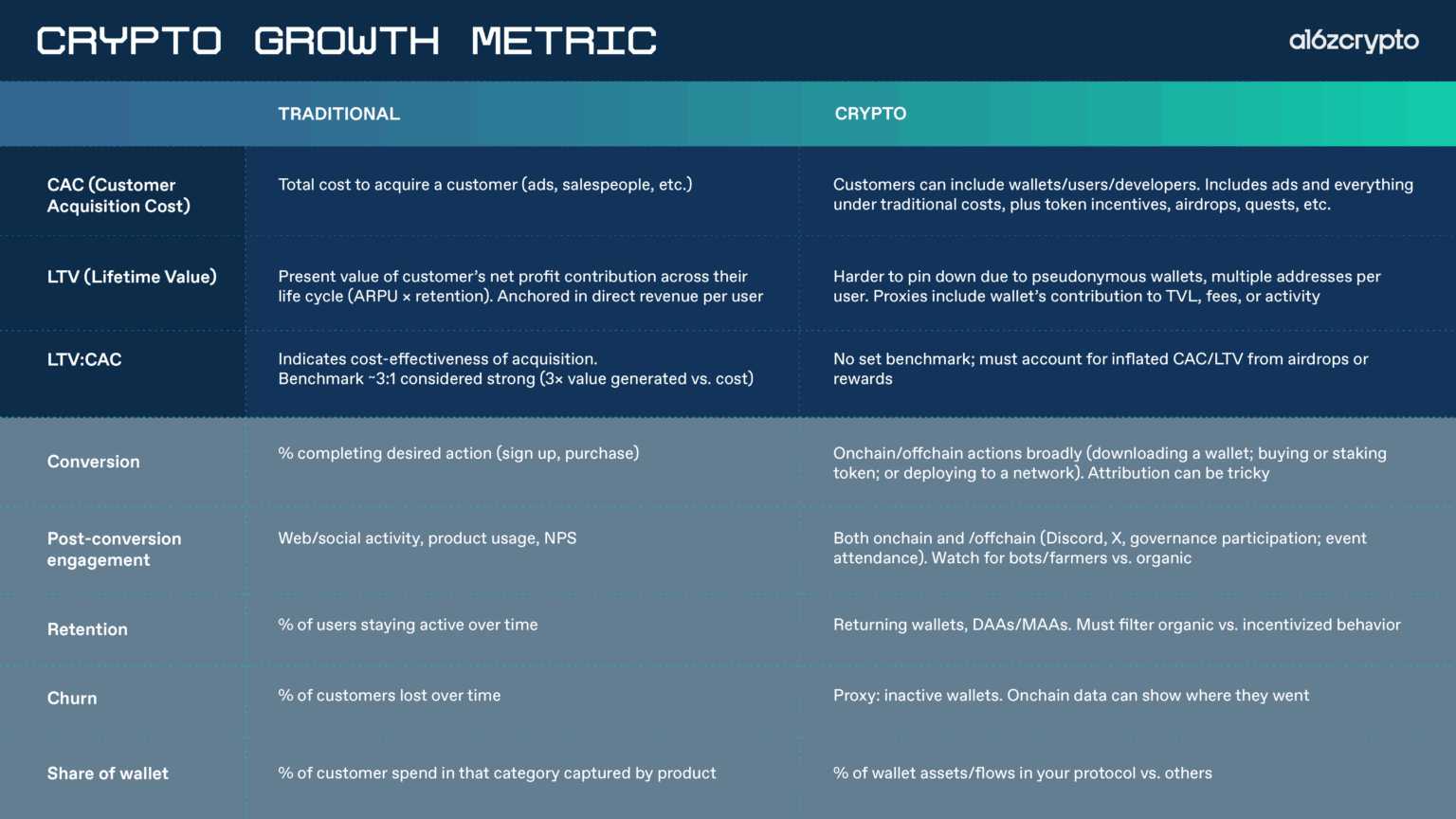
Taken together, these metrics provide a foundation for measuring how effectively your growth marketing efforts are engaging users at different stages of the marketing funnel, while also accounting for the cost of those efforts.

Analyzing the Growth Funnel in the Crypto Field

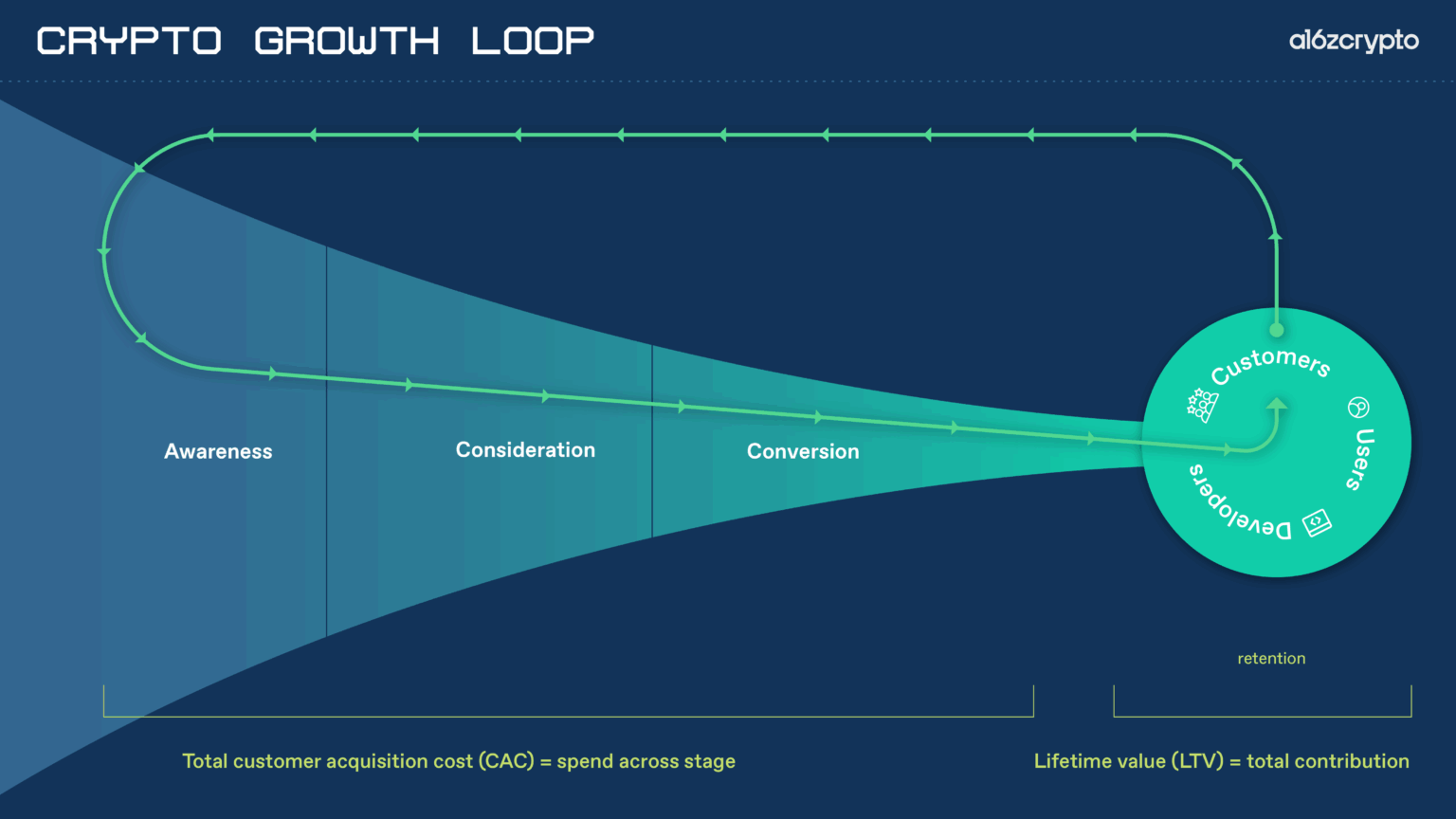
After identifying the core metrics, the next step is to map them to the marketing funnel from top to bottom. It’s important to note that while the crypto growth marketing funnel differs from the traditional Web2 funnel, the differences primarily stem from crypto-specific marketing strategies, behavioral characteristics, and unique opportunities at each stage, such as on-chain activity, token incentives, and community-driven dynamics.

Next, we’ll explore each stage of the funnel, analyzing key strategies and metrics, and how they differ in crypto and Web2…
Awareness/Lead Generation

Whether it’s traditional channels or cryptocurrency, the first stage of the marketing funnel is to increase brand awareness. Even in the cryptocurrency field, increasing brand awareness is a prerequisite for everything that follows.

At this stage, you'll also begin measuring customer acquisition cost (CAC). "Reach" (the number of unique individuals who see your content) should also be a core metric. Reach is particularly important when evaluating the success of mass marketing channels like press, media, and public relations. The challenge at this stage is distinguishing short-term spikes in attention from truly "sticky" interest: Are users simply curious, or are they genuinely interested in using the product?

Beyond core acquisition metrics, the channels you use to find new users each have their own advantages, risks, and unique nuances to the crypto landscape:

Key Opinion Leaders (KOLs) and Influencers

Paying a random influencer or KOL with a large audience may seem like a reliable way to generate awareness, but it often fails to generate meaningful engagement, especially when the influencer has no authentic connection to the project and their audience doesn’t resonate with it.

However, there's value in partnering with influencers who align with the project's philosophy and can share their excitement in a credible way. Consider "micro-influencers"—more niche, targeted voices whose audiences trust them—or even local influencers, such as experts within your team who have already established a strong personal presence. Claire Kart, CMO of Aztec, a privacy-focused L2 company, is a prime example. She not only works internally with influencers but also actively seeks out emerging influencers, connects with them organically, and brings them into the Aztec ecosystem.

advertise

Advertising in the crypto space faces a host of challenges. For example, due to vague and ever-changing policies regarding crypto advertising, many crypto companies are unable to run ad campaigns on traditional platforms like Google or Meta. Furthermore, the crypto community is wary of traditional advertising, as similar ad formats are sometimes exploited by scammers to direct users to malicious websites.

Crypto marketers have had more success promoting specific apps on X (formerly Twitter), LinkedIn, Reddit, TikTok, or the Apple App Store. They can also consider alternatives such as Brave browser ads, Spindl ads within the Coinbase/Base app, or MiniApps and sponsored posts on Farcaster, or even optimize for prompts and incorporate them into AI search answers.

Referral and affiliate marketing

The concept behind referral programs is the same as traditional marketing: when someone signs up through your referral, you earn a reward. The difference in cryptocurrency is that rewards can be sent instantly and verified directly on-chain, aligning incentives and making the entire process smoother. Projects like Blackbird demonstrate how on-chain referrals can develop into compounding network effects through ongoing loyalty programs and community engagement, rather than just a one-time customer acquisition campaign.

Word-of-mouth is one of the most powerful growth drivers in crypto: for consumer-facing products, adoption is often driven by referrals, where users recommend a product to other users because they enjoy the experience and find it valuable. For infrastructure projects, referrals often come from existing customers and developers.

Measuring word-of-mouth growth can be done by simply tracking the Net Promoter Score (NPS) or by directly surveying new users after they sign up or complete an onboarding session to see if they were referred and by whom.

In this sense, referrals are like an inverted, bottom-up marketing funnel: users don’t just stay at the conversion stage, but instead reintroduce new potential users to the top of the funnel. Early users become evangelists, bringing more people into the network (and potentially being rewarded for their contributions), thus keeping the growth flywheel spinning.

A note on accuracy: Accurately measuring growth from real users/customers versus bots is a problem across industries, particularly in social media. Cryptocurrencies offer unique identity primitives, such as "proof of humanness" via World ID or zero-knowledge proofs (via zkPassport), that can distinguish real users from bots or airdrop scammers. Growth teams can leverage these primitives not only to build Sybil resistance against community growth mechanisms like airdrops, but also to better understand real users and help plan product retention.

The power of the growing network

Finally, one of the unique growth drivers of cryptocurrency is its token, which is often the best way to attract users, developers, and liquidity to markets that traditionally struggle to overcome cold start issues. However, this isn't just about speculation: more importantly, when a token's price rises, it can attract new users who want to participate in a particular movement or development. Developers also take notice, as a rising price signals an active community and genuine demand, making the platform more attractive.

Consideration/Interest

The next stage in the traditional marketing funnel is consideration, which is when a potential customer becomes actively interested in a product and is evaluating and comparing it to other products.

In the cryptocurrency space, this is particularly important, as every decision—from purchasing tokens to ordering a hardware wallet—typically requires significant education, as cryptocurrency remains a relatively new (and often complex) industry for both users and developers. Providing users with the right information to help them make decisions and weigh competing products or platforms can have a huge impact. This is why companies from Coinbase to Alchemy are investing in educational content for both consumers and developers.

Effective educational content goes beyond detailing a product’s features and benefits, and also covers how the product works (e.g., security, custody, community and treasury governance, token economics, etc.). Developers may need in-depth technical documentation and tutorials, while consumers often require explanatory content (e.g., before transferring real funds between wallets or blockchains).

User education via email during key processes (such as product registration or purchase), in-product prompts and tooltips, interactive onboarding, and product trials or “testnet” setups to demonstrate and experience features before committing to transferring assets are all standard tools. Companies are also starting to optimize their educational content to fit large language models (LLMs) so that when someone asks a question, the company’s content can be retrieved.

Successful teams measure interest not only through clicks or downloads, but also through intermediate actions users take, such as joining a wallet's waitlist or adding a small deposit to test functionality, to demonstrate trust and intent. However, understanding the success of these efforts depends on the channels chosen, as each channel has its own set of metrics. Ultimately, however, you need to map these metrics to some kind of conversion, as we'll cover below.

conversion

Conversion is the stage in the marketing funnel where users complete their desired behavior. At this stage, users have been attracted, engaged, and informed, ultimately taking the action you want them to take.

As a metric, "conversion rate" is a broad term: in traditional marketing, it might refer to the number of customers who purchased a product, users who signed up for a demo, or people who requested to speak with a sales team. In crypto, conversions can also include wallet downloads, token purchases, or even code deployments on a platform. The specifics of what constitutes a conversion depend on your product and goals, but accurately defining conversion metrics is crucial for developing the best measurement methods.

Tracking conversions across marketing channels (e.g., wallet downloads driven by offline events) is crucial. Understanding which sources drive results can help teams optimize budget allocation, messaging, and more.

Accurately measuring conversions also relies on attribution mechanisms, which are particularly complex in the crypto space, especially since the user journey between traditional websites, social networks, and on-chain behavior (for example, from off-chain to on-chain behavior or vice versa) is difficult to accurately track.

Web tracking tools like Google Tag Manager can track website conversions, while new tools for wallet users like Addressable can bridge the gap between off-chain advertising and on-chain behavior, allowing teams to track on-chain behavior from websites or Web2 ads. However, the user journey is often not linear; for example, a user may first see a post on X, attend an offline event, and then make their first transaction.

While attribution in the crypto space has historically been difficult, improved analytical tools are enabling teams to gain a more comprehensive understanding of growth. While many people maintain multiple wallets, advancements in analytical technology are enabling the ability to match multiple wallets to a single user, allowing on-chain activity to be linked to specific users. As privacy regulations (e.g., GDPR, cookie restrictions, etc.) make Web2 attribution more difficult, the transparency of on-chain data offers advantages while also protecting user identities.

Post-conversion engagement

In traditional marketing funnels, the engagement/interest stage typically measures product interactions before purchase. These interactions are how users gain a better understanding of the product and brand, and are a crucial stage in converting initial interest into loyal engagement.

In the crypto marketing funnel, post-conversion user engagement is equally important, encompassing both online and offline, on-chain and off-chain behavior. This not only provides insights into how to retain users, but also how to maintain the overall health of the community, regardless of where users are located.

For example, online engagement (which we also cover in our social media guide) can include metrics like:

  • Engagement on Discord or other forums/chat platforms
  • Activity on X (formerly Twitter)
  • Sentiment analysis on social channels
  • User participation in governance or voting

While many crypto marketers still rely on traditional social listening tools, these traditional methods need to be adapted for the crypto sector. For example, sentiment tracking can provide a directional understanding of community sentiment toward a project, but it shouldn't be the sole basis for decision-making. Sentiment tracking can help teams identify active contributors and key influencers and assess the effectiveness of messaging. However, the crypto community is fragmented across multiple platforms, and the quality and depth of metrics vary. A small number of highly active accounts can have an outsized influence, resulting in a high level of data noise.

In addition to sentiment tracking tools, some teams use other social media monitoring tools (such as Fedica) to track and reward user engagement. For example, they can identify contributors who amplify content, create memes, participate in discussions, and generally inject energy into the community. However, it's important to note that incentivized campaigns are susceptible to manipulation: certain incentives may attract those who prioritize rewards over the project itself, potentially leading to short-term community activity but lack of sustainability in the long term.

Crypto marketing can still achieve meaningful organic growth through unincentivized or non-paid methods. For example, this can be achieved through a strategy that interweaves different types of content. Eco, a stablecoin liquidity layer, employed an organic content strategy based on the "4-1-1 principle": publishing four educational pieces of content about its market opportunity; one piece of "soft sell" content (e.g., a third-party endorsement); and one piece of "hard sell" content (e.g., "Use our product"); and repeating this cycle every few hours for seven days. Through this organic publishing strategy alone, combined with leveraging major product announcements and co-marketing campaigns, Eco increased its total monthly impressions by nearly 600%.

Offline engagement (such as attending conferences or events) also plays a key role in helping users engage through deeper connections. Traditionally, these activities have been measured by collecting email addresses to expand mailing lists (e.g., by scanning attendee QR codes). More sophisticated tools include tagging giveaways with NFC chips (e.g., through IYK) and running campaigns to encourage users to click or scan them. Online platforms (such as Discord or Towns) provide dedicated spaces for ongoing interaction and relationship building. Teams can track the number of user interactions (posts, likes, replies) over a period of time and analyze the quality and sentiment of these interactions.

Retention

Retention answers a key question: "Who's staying?" Retention can be measured as the percentage of users who complete an on-chain action after a set period of time, or more broadly, as a measure of ongoing user activity. Retention is calculated by dividing the number of existing users at the end of a given period by the number of users at the beginning of that period. If you're measuring mailing list subscribers or wallet downloads, retention isn't tracking initial signups, but rather users who remain active over time. Common retention metrics include returning users or daily active addresses over time.

In the cryptocurrency space, retention metrics must account for the tension between "long-term" and "short-term" behavior, given the powerful token mechanics and behaviors involved. For example, a surge in airdrop users at launch might look like growth, but once the rewards cease, many will leave. This is why it's important to define your "ideal" user and measure retention relative to that group, rather than just the raw total number of users. This is also why it's important to measure product metrics—both intrinsic to the product itself and organic interest in it—so as to avoid confusing what's working with what's not, especially if your product hasn't yet achieved product-market fit. Otherwise, you might think you've found product-market fit when you haven't; that is, people's interest isn't in your product, but in the rewards.

Retention naturally drives customer lifetime value (LTV) as well, as the longer users stay, the more they spend or transact. This not only increases their LTV but also leads to a more desirable LTV:CAC ratio.

Churn

Churn is the opposite of retention and measures how many users are lost during their lifetime and when. Churn rate is calculated by dividing the number of users who churned at the end of a time period by the total number of users at the beginning of that period and expressing it as a percentage. In crypto, an alternative metric for churn (although it doesn't map perfectly to traditional churn metrics) is the percentage of wallets that become inactive after a certain period of time. For example, users may sign up for a wallet through a marketing campaign or cycle, but then never use it again. Some of these users may re-engage at some point in the future, but the key to calculating churn is identifying active, frequently engaged, and returning users, rather than "dormant" users who have only performed a single on-chain action.

Tools like Safary can monitor user interactions with decentralized applications (dApps) and help identify friction points that lead to user churn, such as high transaction fees, a complex user experience, or the need to complete multiple onboarding steps. For example, when Solana released its Seeker phone, some users requested a pre-funded wallet (similar to the earlier Saga phone) to reduce initial friction. The need to manually top up funds before making transactions could slow adoption. While Solana has transitioned to dApp rewards after users receive the phone, reducing friction in the onboarding process remains crucial.

To mitigate churn, leverage funnel tracking and user cohort targeting platforms that support crypto-specific user engagement (such as Absolute Labs' Wallet Relationship Management). These tools allow teams to create custom user segments and re-engage them through Web2 channels and crypto-native strategies like targeted airdrops. Furthermore, direct messaging to wallets via secure decentralized messaging tools like XMTP can provide timely, personalized reminders to encourage users to return and continue engaging.

Wallet share

Another way to track churn and retention is to look at "wallet share": the proportion of total spending in a category that customers allocate to your product or service. In the crypto space, this concept can be applied very intuitively. By analyzing the composition of wallets, teams can see the types of assets held, the amount, and the direction of activity. If users stop interacting with your protocol, on-chain data can reveal whether they are switching to competitors. Of course, as protocol products and services become more complex, the reasons for user migration can become more difficult to determine. But if you observe user behavior shifting toward a competitor or another product with unique features, this can reveal important information.

Similarly, if many of your token holders also hold tokens from a related project, this could present opportunities for joint marketing—for example, partnering with that project to host a joint event or giving away your tokens to its token holders. General analytics tools like Dune, a crypto data hub, enable this type of analysis, while more specialized platforms can provide deeper insights into specific tokens. Since most users have multiple wallets, it's also important to link them to a single end-user identity; on-chain analytics tools like Nansen can provide wallet tags across multiple chains, enabling more accurate wallet share analysis.

Growth measurement in the crypto space isn't about simply replicating Web2 approaches. Instead, it's about adapting effective strategies, discarding ineffective ones, and building a new framework around the unique advantages of blockchain. Given the diversity of crypto products, from L1 to gaming, each team's growth dashboard will be different.

But data doesn’t tell the whole story. Ultimately, quantitative metrics are only part of the story: there’s no substitute for a deep understanding of your audience and users through qualitative insights. The conversations within your community (whether they’re discussions about your project or simple memes and vibes), the energy felt at events, and even a gut feeling about what’s working and what’s not, all play an important role in guiding your growth strategy. In the early stages, the actions of a few core users may be more valuable than those of the rest. These qualitative signals are often the earliest signs of product-market fit. The best crypto growth strategies are a balance of data and intuition, combining short-term tactics to spark excitement with long-term strategies to build a stronger community.

Market Opportunity
LETSTOP Logo
LETSTOP Price(STOP)
$0.0184
$0.0184$0.0184
+1.48%
USD
LETSTOP (STOP) Live Price Chart
Disclaimer: The articles reposted on this site are sourced from public platforms and are provided for informational purposes only. They do not necessarily reflect the views of MEXC. All rights remain with the original authors. If you believe any content infringes on third-party rights, please contact [email protected] for removal. MEXC makes no guarantees regarding the accuracy, completeness, or timeliness of the content and is not responsible for any actions taken based on the information provided. The content does not constitute financial, legal, or other professional advice, nor should it be considered a recommendation or endorsement by MEXC.

You May Also Like

Next Couple of Months Will Be Wild for XRP: Wealth Manager

Next Couple of Months Will Be Wild for XRP: Wealth Manager

Wealth manager Nate Geraci has reiterated his view that the coming months will be "wild" for XRP. This comes as the XRP community braces for another major milestone in the ETF space.Visit Website
Share
The Crypto Basic2025/09/18 17:09
Top 5 Cryptocurrency Data APIs: Comprehensive Comparison (2025)

Top 5 Cryptocurrency Data APIs: Comprehensive Comparison (2025)

Photo by Pierre Borthiry - Peiobty on Unsplash Cryptocurrency APIs are essential tools for developers building apps (e.g. trading bots, portfolio trackers) and for analysts conducting market research. These APIs provide programmatic access to historical price data, real-time market quotes, and even on-chain metrics from blockchain networks. Choosing the right API means finding a balance between data coverage, update speed, reliability, and cost. In this article, we compare five of the most popular crypto data API providers — EODHD, CoinMarketCap, CoinGecko, CryptoCompare, and Glassnode — focusing on their features, data types (historical, real-time, on-chain), rate limits, documentation, and pricing plans. We also highlight where EODHD’s crypto API stands out in this competitive landscape. Overview of the Top 5 Crypto Data API Providers
  1. EODHD (End-of-Day Historical Data) — All-in-One Multi-Asset Data EODHD is a versatile financial data provider covering stocks, forex, and cryptocurrencies. It offers an unmatched data coverage with up to 30 years of historical data across the global For crypto, EODHD supports thousands of coins and trading pairs (2,600+ crypto pairs against USD) and provides multiple data types under one service. Key features include:
Historical Price Data: Daily OHLCV (open-high-low-close-volume) for crypto assets, with records for major coins going back to 2009 eodhd.com (essentially as far back as Bitcoin’s history). This extensive archive facilitates long-term backtesting. Real-Time Market Data: Live crypto price quotes via REST API and WebSocket. EODHD’s “Live” plan delivers real-time (typically streaming) updates with high rate limits (up to 1,000 requests/minute on paid plans) Developers can also use bulk API endpoints to On-Chain & Fundamental Data: While not an on-chain analytics platform per se, EODHD provides crypto fundamental metrics such as market cap (actual and diluted), circulating/total/max supply, all-time high/low, and links to each project’s whitepaper, block explorer These fundamentals give context beyond price, though advanced on-chain metrics (e.g. active addresses) are not included. Additional Features: EODHD stands out for its ease of use and support tools. API responses are clean JSON by default (with an option for CSV), and the service offers no-code solutions like Excel and Google Sheets add-ons to fetch crypto data without programming Comprehensive documentation and an “API Academy” with examples help users get started EODHD also provides 24/7 live customer support, reflecting its 7+ years of reliable service Pricing & Limits: EODHD’s pricing is very competitive for the value. It has a free plan (registration required) which allows 20 API calls per day for trying out basic Paid plans start at $19.99/month for end-of-day and live crypto data, allowing up to 100,000 calls per day— a generous limit that far exceeds most competitors at that price. The next tier ($29.99/mo) adds real-time WebSocket streaming, and the top All-in-One plan ($99.99/mo) unlocks everything (historical, intraday, real-time, fundamentals, news, etc.) All paid plans come with high throughput (up to 1,000 requests/min) Enterprise or commercial licenses are available for custom needs, and students can even get 50% discounts for educational Overall, EODHD offers an excellent price-to-performance ratio, giving developers extensive crypto (and cross-asset) data for a fraction of the cost of some single-purpose crypto APIs. 2. CoinMarketCap — Industry-Standard Market Data CoinMarketCap (CMC) is one of the most well-known cryptocurrency data aggregators. It provides information on over 10,000 digital assets and aggregates data from hundreds of CMC’s API is a go-to choice for current market prices, rankings, and exchange statistics. Key features include: Real-Time Quotes & Global Metrics: The API offers real-time price quotes, market capitalization, trading volume, and rankings for thousands of cryptocurrencies. It also provides global market metrics like total market cap, total volume, Bitcoin dominance, etc., updated (CMC’s data updates roughly every 1–2 minutes by default; true streaming is not yet available via their API.) Historical Data: Paid tiers unlock access to historical price data. CMC has data going back to 2013 for many assets, and enterprise plans provide all historical OHLCV data since 2013.The API endpoints include daily and even intraday historical quotes, but note that the free tier does not include historical price retrieval(free users get only latest data). Exchange and Market Endpoints: CoinMarketCap’s API covers exchange-level data (e.g. exchange listings, trading pair metadata, liquidity scores) and derivative market data (futures, options prices) on higher plans. This is useful for monitoring exchange performance and volumes across both centralized and decentralized exchanges. However, on-chain analytics are not CMC’s focus — the API doesn’t provide blockchain metrics like address counts or transaction rates. Developer Support: CMC provides comprehensive documentation and a straightforward RESTful JSON API . The endpoints are well-documented with examples, and categories include latest listings, historical quotes, metadata/info (project details), exchange stats, and The service is known for its reliability and is used by major companies (Yahoo Finance, for example, uses CoinMarketCap’s data feeds in its crypto Pricing & Limits: CoinMarketCap offers a free Basic plan with 10,000 credits per month (approximately 333 calls/day) and access to 11 core endpoint. The free tier is suitable for simple apps that only need current market data on a limited number of assets. To get historical data or higher frequency updates, you must upgrade. The Hobbyist plan starts at around $29/month (paid annually) and offers a higher monthly call allowance (e.g. ~50,000 calls/month) and more endpoints. Mid-tier plans like Startup ($79/mo) and Standard ($199/mo) increase the rate limits and data access — e.g., more historical data and additional endpoints like derivatives or exchange listings. For example, Standard and above allow intraday historical quotes and more frequent updates. Professional/Enterprise plans ($699/mo and up, or custom) provide the highest limits (up to millions of calls per month), full historical datasets, and SLA . Rate limits on CMC are enforced via a credit system; different endpoints consume different credits, and higher plans simply grant more credits per month. In summary, CoinMarketCap’s API is very robust but can become expensive for extensive data needs — it targets enterprise use cases with its upper tiers. Smaller developers often stick to the free or Hobbyist plan for basic data (while accepting the lack of historical data in those tiers) 3. CoinGecko — Broad Coverage & Community Focus CoinGecko is another hugely popular cryptocurrency data provider known for its broad coverage and developer-friendly approach. CoinGecko’s API is often praised for having a useful free offering and covering not just standard market data but also categories like DeFi, NFTs, and community metrics. Notable features: Wide Asset Coverage: CoinGecko tracks over 13,000 cryptocurrencies (including many small-cap and emerging tokens). It also includes data on NFT collections and decentralized finance (DeFi) tokens and protocols. This makes it one of the most comprehensive datasets for the crypto market. If an asset is trading on a major exchange or DEX, CoinGecko likely has it listed. Market Data and Beyond: The API provides real-time price data, market caps, volumes, and historical charts for all these assets. Historical data can be retrieved in the form of market charts (typically with daily or hourly granularity depending on the time range). Additionally, CoinGecko offers endpoints for exchange data, trading pairs, categories (sectors), indices, and even asset contract info (mapping contract addresses to CoinGecko listings). They also expose developer and social metrics for each coin — e.g. GitHub repo stats (forks, stars, commits) and social media stats (Twitter followers, Reddit subscribers) This is valuable for analysts who want to gauge community interest or development activity alongside price. No WebSockets — REST Only: CoinGecko’s API is purely REST-based; there is no built-in WebSocket streaming. Data updates for price endpoints are cached at intervals (typically every 1–5 minutes for free users, and up to every 30 seconds for Pro users). So while you can get near-real-time data by polling, ultra-low-latency needs (like high-frequency trading) are better served by other providers or exchange-specific APIs. Documentation & Use: The API is very straightforward to use — in fact, for the free tier no API key was required historically (though recently CoinGecko introduced an optional “Demo” key for better tracking). A simple GET request to an endpoint like /simple/price returns current prices. CoinGecko’s documentation is clear, and they even highlight popular endpoints and provide examples. Because of its simplicity and generous free limits, CoinGecko’s API has been integrated into countless projects and tutorials. Pricing & Limits: CoinGecko operates a freemium model. The free tier (now referred to as the “Demo” plan) allows about 10–30 calls per minute (the exact rate is dynamic based on system load) In practical terms, that’s roughly up to 1,800 calls/hour if usage is maxed out — very sufficient for small applications. The free API gives access to most endpoints and data (including historical market charts) but with lower priority and slower update frequency. For higher needs, CoinGecko offers paid plans: Analyst, Lite, and Pro. For example, the Analyst plan (~$129/mo) offers 500,000 calls per month at 500 calls/minute rate limit, the Pro plan (~$499/mo) offers 2,000,000 calls/mo at the same rate, and an Enterprise plan (~$999/mo and up) can be tailored for even larger volumes. Paid plans also use a separate pro API endpoint with faster data updates (prices cached every 30 seconds) and come with commercial usage rights and support SLA Notably, CoinGecko’s free plan is one of the best among crypto APIs in terms of data offered for $0, but if you need heavy usage or guaranteed uptime, the cost can ramp up — at the high end, large enterprise users might negotiate custom plans beyond the listed Pro tier.
  1. CryptoCompare — Full Market Data + More CryptoCompare is a long-standing crypto data provider that offers a rich set of market data and analytics. It not only provides price data but also aggregates news, social sentiment, and even some on-chain data, making it a comprehensive source for crypto market Key features of CryptoCompare’s API include:
Market Data & Exchange Coverage: CryptoCompare covers 5,700+ coins and 260,000+ trading pairs across a wide array of exchanges. It collects trade data from more than 170 exchanges (both centralized and some decentralized) to produce its aggregate indices (known as CCCAGG prices). The API provides real-time price quotes, order book snapshots, trade history, and OHLCV candlesticks at various intervals. For advanced users, CryptoCompare can supply tick-level trade data and order book data for deep analysis (these are available via their WebSocket or extended API endpoints). Historical Data: CryptoCompare is strong in historical coverage. It offers historical daily data for many coins and historical intraday (minute) data as well. By default, all subscription plans include at least 7 days of minute-level history and full daily history; enterprise clients can get up to 1 year of minute-by-minute historical data (and raw trade data) for backtesting. This is valuable for quantitative researchers who require detailed price series. On-Chain Metrics and Other Data: In addition to market prices, CryptoCompare has expanded into on-chain metrics and alternative data. The API can provide certain blockchain statistics (they mention “blockchain metrics” and address data in their offerings)— for example, network transaction counts or wallet addresses for major chains. While it’s not as extensive as a dedicated on-chain provider, this allows blending on-chain indicators (like transaction volumes) with price data for analysis. CryptoCompare also integrates news feeds and social sentiment: the API has endpoints for the latest news articles and community sentiment analysis, which can help gauge market Reliability and Performance: CryptoCompare’s infrastructure is built for high performance. They claim support for up to 40,000 API calls per second bursts and hundreds of trades per second This makes it suitable for real-time applications and dashboards that need frequent updates. Their data is normalized through a proprietary algorithm to filter out bad data (e.g., outlier prices or exchange anomalies), aiming to deliver clean and consistent price indices (CCCAGG). The API itself is well-documented, and client libraries exist for languages like Python. Pricing & Limits: CryptoCompare historically offered a free public API (with IP-based limiting), but now uses an API key model with tiered plans. Personal/free use is still allowed — you can register for a free API key for non-commercial projects and get a decent allowance (exact call limits aren’t explicitly published, but users report free tiers on the order of a few thousand calls per day). For commercial or heavy use, their plans start around $80/month for a basic package and go up to ~$200/month for advanced packages. These plans might offer on the order of 100k to a few hundred thousand calls per month, plus higher data resolution. All plans grant access to ~60+ endpoints and features like full historical data download for daily/hourly (minute data beyond 7 days is enterprise-only). Enterprise solutions are available for customers needing custom data feeds, unlimited usage, white-label solutions, or bespoke datasets (pricing for these is via negotiation). In summary, CryptoCompare provides a very rich dataset and is priced in a mid-range: not as cheap as community resources, but more affordable than some institutional-grade providers. Its value is especially high if you need a mix of price, news, and basic on-chain data in one
  1. Glassnode — On-Chain Analytics Leader Glassnode is the premier platform for on-chain metrics and blockchain analytics. Unlike the other APIs in this list, Glassnode’s focus is less on real-time market prices and more on the fundamental health and usage of blockchain networks. It provides a wealth of on-chain data that is invaluable for crypto analysts and long-term investors. Key aspects of Glassnode’s API:

Extensive On-Chain Metrics: Glassnode offers over 800 on-chain metrics spanning multiple major blockchains (Bitcoin, Ethereum, Litecoin, and many others, as well as key ERC-20 tokens). This includes metrics like active addresses, transaction counts, transaction volumes, mining hash rates, exchange inflows/outflows, UTXO distributions, HODLer stats, realized cap, SOPR and much more. If you need to peer ino what’s happening inside a blockchain (not just its price on exchanges), Glassnode is the go-to source. For example, one can query the number of active Bitcoin addresses, the amount of BTC held by long-term holders vs. short-term, or Ethereum gas usage trends Market & Derivatives Data: In addition to pure on-chain data, Glassnode also incorporates off-chain market data for context. They provide spot price data for major assets (often used in tandem with metrics in their charts), and even some derivatives metrics (futures open interest, funding rates, etc. for major exchanges) at higher . This means Glassnode can be a one-stop shop for an analyst who wants to correlate on-chain activity with price movements or derivative market trends. Data Resolutions and API Access: The API allows retrieval of metrics at various time resolutions. Free users can typically access metrics at a daily resolution (one data point per day) and usually with a delayed timeframe (e.g. yesterday’s data). Paid tiers unlock higher frequency data — the mid-tier (Advanced) gives up to hourly data, and the top tier (Professional) can go down to 10-minute intervals for certain metrics This granularity is useful for near-real-time monitoring of on-chain events. It’s important to note that Glassnode’s API is primarily used for pulling time-series data of specific metrics (e.g., get the 24h moving average of active addresses, daily, over the last 5 years). The API is well-documented with a metric catalog detailing every metric and its available history and access tier. Analyst Tools: Glassnode provides an entire platform (Glassnode Studio) for visualizing these metrics with charts and alerts. While that’s beyond the API itself, it’s worth noting that many analysts use the web interface for research and the API for programmatic access when building models. Glassnode has become an industry standard for on-chain analysis — many research reports and crypto funds cite Glassnode metrics for insights on network adoption, investor behavior, and market cycles. Pricing & Limits: Glassnode’s offerings are tiered more by data access level than raw call counts. They have a Standard (Free) tier, an Advanced (Tier 2) paid tier, and a Professional (Tier 3) tier. The Free tier allows access to Basic metrics (Tier 1 metrics) at daily resolution, which covers a lot of fundamental data for major chains but not the more complex or derived metrics. The Advanced plan (around $29–$49 per month depending on promotions) unlocks Essential metrics (Tier 2) and provides up to hourly . The Professional plan (around $79 per month for individuals) gives access to all metrics (including Premium Tier 3 metrics) and finer resolution (10-min updates). However, there’s a catch: API access is only officially included for Professional/Enterprise users and may require a special add-on or enterprise . In practice, Glassnode does offer a free API but it is limited (e.g., you can query basic metrics via REST with a free API key, but many endpoints will return only if you have the right subscription). Enterprise clients who need programmatic access to extensive history or want to ingest Glassnode data into trading models can arrange custom packages (cost can run into the hundreds or thousands of dollars monthly for institutional licenses, which may include SLAs, custom metrics, or priority support). For the purpose of our comparison, Glassnode’s free option is great for community analysts to explore a subset of data, but serious use of their API requires the paid tiers. Glassnode is best suited for analysts and institutional users who heavily value on-chain rather than developers who just need straightforward price feeds. The table below summarizes the data coverage and features of these five API providers side-by-side: Ready to build with crypto data that just works? If you want reliable crypto prices + multi-asset coverage (stocks, FX, ETFs) + generous limits without piecing together 3–4 vendors, EODHD is the pragmatic pick. Why EODHD wins for most teams All-in-one: crypto + equities + FX under one API (consistent JSON/CSV). Great value: up to 100k calls/day from ~$19.99/mo — perfect for MVPs and production apps. Fast start: clean docs, code samples, Excel/Sheets add-ins, and bulk endpoints. Scale-ready: real-time REST & WebSocket, historical OHLCV, fundamentals, news. What you can ship this week Real-time crypto dashboards and alerts Backtests using years of OHLCV data Cross-asset analytics (BTC vs. S&P 500, ETH vs. USD) Spreadsheet models that refresh automatically 👉 Start for free with EODHD — grab your API key and make your first request in minutes.Try EODHD now (free tier available) and upgrade when you need more throughput. Top 5 Cryptocurrency Data APIs: Comprehensive Comparison (2025) was originally published in Coinmonks on Medium, where people are continuing the conversation by highlighting and responding to this story
Share
Medium2025/09/26 21:29
XRP Price Outlook As Peter Brandt Predicts BTC Price Might Crash to $42k

XRP Price Outlook As Peter Brandt Predicts BTC Price Might Crash to $42k

The post XRP Price Outlook As Peter Brandt Predicts BTC Price Might Crash to $42k appeared on BitcoinEthereumNews.com. XRP price led cryptocurrency losses on Friday
Share
BitcoinEthereumNews2026/02/06 19:06