Morgan Stanley: S&P 500 Has Hit Bottom—Here’s What Comes Next
Key Takeaways
- Morgan Stanley’s Michael Wilson believes the S&P 500 has reached its floor and won’t fall to fresh lows
- A “barbell” investment approach is advised: combining cyclical stocks with premium growth names including the Magnificent 7
- According to Serena Tang at Morgan Stanley, oil has emerged as the dominant factor influencing market dynamics
- Strategists map out three potential oil trajectories: de-escalation ($80–$90), sustained pressure ($100–$110), or critical disruption ($150+)
- A 10-year Treasury yield reaching 4.50% represents a crucial warning threshold for stock valuations
Morgan Stanley is signaling to market participants that the S&P 500 has likely seen its darkest days — provided oil prices don’t experience additional dramatic escalation.
In remarks delivered Monday, strategist Michael Wilson expressed confidence that the S&P 500 won’t establish significant new troughs. His analysis suggests the index is establishing a foundation, presenting opportunities for investors to increase positions in select equities.
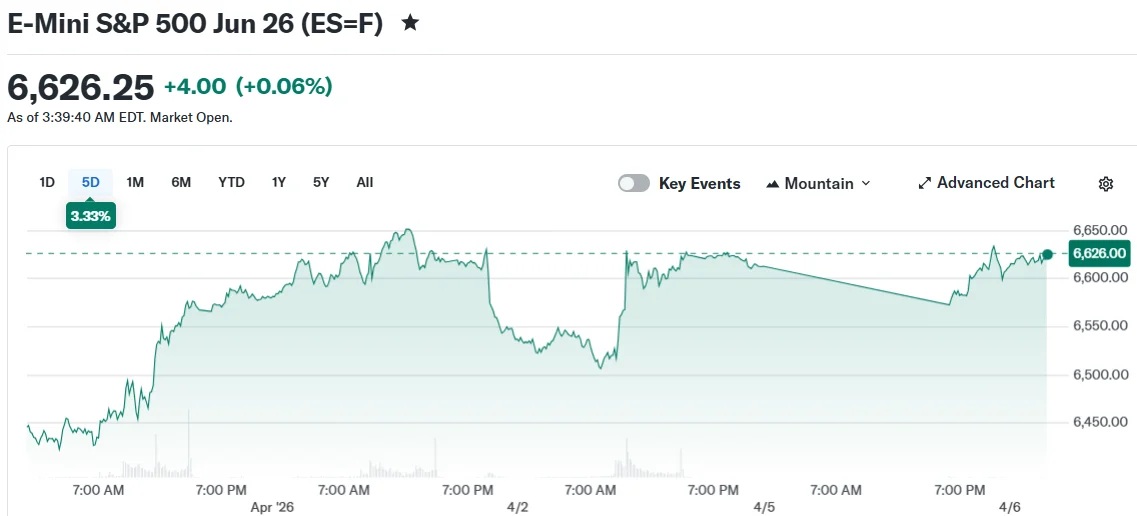 E-Mini S&P 500 Jun 26 (ES=F)
Wilson highlighted the index’s rebound from critical support zones he had identified several weeks prior, specifically the 6,300–6,500 territory.
The forward price-to-earnings ratio for the S&P 500 has contracted by 18% from its zenith during the last six months. Wilson noted that such significant valuation compression typically occurs only during economic recessions or aggressive Federal Reserve tightening periods — neither scenario aligns with Morgan Stanley’s primary forecast.
Morgan Stanley’s Current Investment Blueprint
Wilson advocates for a dual-track investment strategy. One component focuses on cyclical industries including Financials, Consumer Discretionary, and short-cycle Industrial sectors. The complementary element emphasizes high-quality growth companies, particularly the hyperscaler technology firms.
The Magnificent 7 currently commands approximately 24x forward earnings — comparable to Consumer Staples at 22x — while delivering earnings growth exceeding three times that of defensive sectors. Wilson emphasized the group sits at the 2nd percentile of its historical valuation spectrum since 2023.
He identified the 4.50% mark on 10-year Treasury yields as a critical juncture. Historical patterns show that breaching this threshold typically creates headwinds for equity valuations.
Fundamental economic indicators are beginning to validate the recovery narrative. The March ISM Manufacturing PMI registered 52.7, surpassing analyst expectations, while U.S. hotel revenue per available room climbed 8% during the preceding six-month period.
Crude Oil Has Become the Market’s Command Center
In separate commentary, Morgan Stanley’s Chief Cross-Asset Strategist Serena Tang characterized oil as the predominant force in financial markets — influencing investor interpretation of growth trajectories, inflation dynamics, monetary policy decisions, and risk appetite.
Tang presented three distinct scenarios. Under a de-escalation framework, oil prices normalize within the $80–$90 per barrel band. This environment favors equity outperformance, declining bond yields, and cyclical sector leadership. She characterizes this as a “classic risk-on environment.”
Should oil maintain the $100–$110 range, markets can digest the pressure, albeit with increased volatility. The S&P 500 would likely experience wide-ranging fluctuations, companies with robust balance sheets would distinguish themselves, and credit markets would face mounting pressure.
In the most extreme scenario — oil surpassing $150 — Tang indicates investors would pivot to recession-oriented positioning, gravitating toward government bonds, cash holdings, and defensive sectors.
Tang observed that during oil shocks, equities and bonds can decline simultaneously, undermining the traditional diversification benefits of 60/40 portfolio construction. During the past month, equity valuations declined approximately 15% measured by forward price-to-earnings multiples.
The post Morgan Stanley: S&P 500 Has Hit Bottom—Here’s What Comes Next appeared first on Blockonomi.


Ayrıca Şunları da Beğenebilirsiniz

This bot turned $16 into $16,000 trading for only 5 minutes

China Orders Jack Dorsey’s Bitchat Pulled from Apple App Store