

Inside Bitcoin Whales: Calm LTH vs Aggressive STH Dynamics
- LTH whales accumulate steadily and remain calm, providing long-term market stability despite short-term fluctuations.
- STH whales act aggressively, often repositioning during pullbacks, adding volatility and short-term pressure to Bitcoin markets.
The debate over whale behavior in the Bitcoin market has resurfaced after on-chain analyst Carmelo Aleman on CryptoQuant revealed a striking difference between two large groups: Long-Term Holder (LTH) Whales and Short-Term Holder (STH) Whales.
Both types hold more than 1,000 BTC, but their reactions to the market are strikingly different.
LTH Whales are known to be calm players, unaffected by price fluctuations, especially when declines are still moderate. They are more often associated with strategic accumulation, holding assets for more than 155 days, and tend to suppress selling pressure.
In contrast, STH Whales are aggressive, exploiting corrections to increase holdings while lowering average costs. This pattern does indeed liven up the market, but it also increases short-term volatility.
Calm vs. Aggressive Dynamics in the Bitcoin Market
On-chain data shows a clear difference. Currently, STH whales are recorded at a Realized Price of around $111,299 with holdings of 1.0705 million BTC. This figure indicates that many of them entered the market at a high price level.
In contrast, LTH whales are in a much safer position, with a Realized Price of only $41,887 and holdings of around 3.72 million BTC. This difference in cost basis explains why STH whales are more reactive: they don’t want to bear the brunt of price volatility for too long.
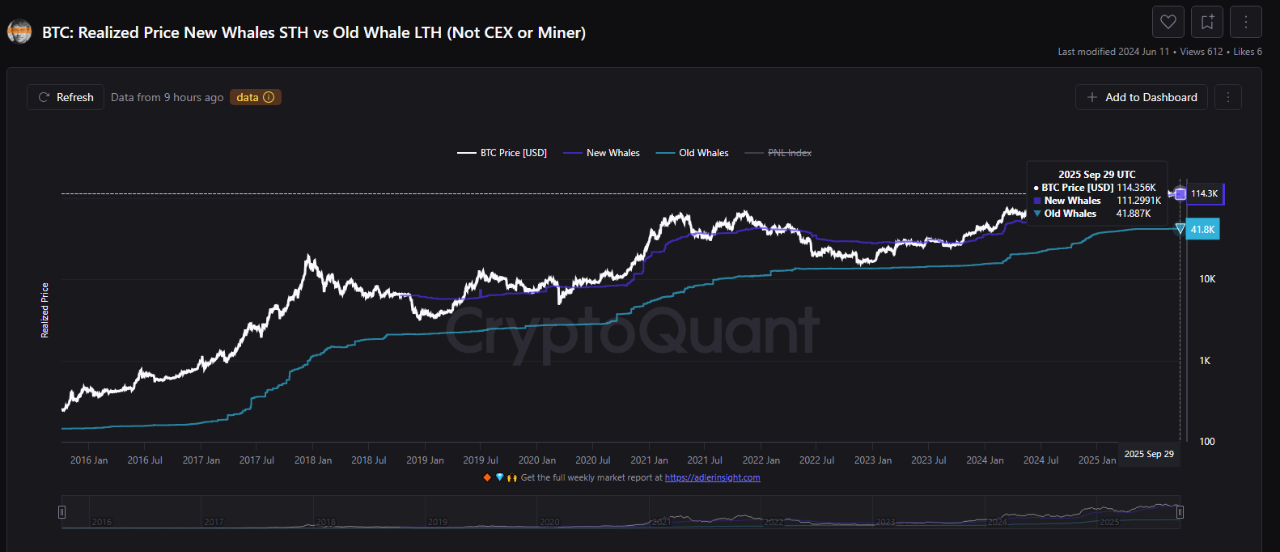 Source: CryptoQuant
Interestingly, STH whales often come from institutions, companies, or new players who enter Bitcoin with high expectations. Once the price corrects, they take aggressive action.
However, every time a wallet holds past 155 days, their status changes to LTH. The problem is, waves of new players continue to arrive, so the aggressive cycle repeats itself, creating almost endless short-term pressure.
On the other hand, the LTH whale pattern actually helps stabilize the market. With a long-term accumulation strategy, the available supply in the market becomes more limited.
We previously highlighted this through the MVRV ratio indicator, which showed the Bitcoin market was in balance: no signs of panic, but also no excessive euphoria. Reduced selling from LTHs also contributed to maintaining strong market conditions.
Market Signals Show Resilience Despite Short-Term Moves
Looking at the latest price movement, BTC is trading at about $114,181. In the last four hours, it has slightly increased by 0.33%, while in 24 hours, it has been almost flat with a correction of 0.02%.
Over the last 7 days, BTC has actually strengthened by 2.04%. These figures further confirm that despite the buying and selling from STHs, the market remains quite resilient.
Furthermore, a long-term perspective is also beginning to emerge. Deutsche Bank estimates that by 2030, Bitcoin could share a place with gold on central bank balance sheets.
However, analysts emphasize that the role of the US dollar will not be replaced. This projection shows that digital assets are gaining increasing recognition in the traditional financial world, although their status is more of a complement, not a replacement.
However, what’s interesting to note is the contrast in behavior between these two whale groups. STH’s aggressive activity often triggers sharp short-term movements, while LTH’s consistent accumulation serves as a price support.
The combination of these two makes the Bitcoin market always dynamic, with its rhythms changing in a matter of days.
]]>Ayrıca Şunları da Beğenebilirsiniz

Exploring the Future of the Internet with ‘web3 with a16z’

Unstoppable: Why No Public Company Can Ever Catch MicroStrategy’s Massive Bitcoin Holdings
