Key Takeaways: Canary Capital has filed an S-1 amendment with the U.S. SEC for its Spot Litecoin ETF, revealing the official ticker LTCC and a 0.95% annual sponsor fee. Bloomberg The post Canary Capital Finalizes Spot Litecoin ETF Filing with 0.95% Fee, Ticker LTCC appeared first on CryptoNinjas.Key Takeaways: Canary Capital has filed an S-1 amendment with the U.S. SEC for its Spot Litecoin ETF, revealing the official ticker LTCC and a 0.95% annual sponsor fee. Bloomberg The post Canary Capital Finalizes Spot Litecoin ETF Filing with 0.95% Fee, Ticker LTCC appeared first on CryptoNinjas.

Canary Capital Finalizes Spot Litecoin ETF Filing with 0.95% Fee, Ticker LTCC

Key Takeaways:

  • Canary Capital has filed an S-1 amendment with the U.S. SEC for its Spot Litecoin ETF, revealing the official ticker LTCC and a 0.95% annual sponsor fee.
  • Bloomberg analysts say this update marks the “last step before go-time,” signaling near-term approval once the SEC resumes full operations.
  • The move positions Litecoin (LTC) as the next major altcoin poised for institutional ETF access, following the success of Bitcoin and Ethereum spot products.

The most recent regulatory filing by Canary Capital is an indicator of a conclusive move to introduce the first U.S. spot Litecoin ETF. Although the government shutdown has caused the SEC reviews to slow, industry observers feel that approval may come fairly quickly as the activities resume normalcy and this may be the next stage towards altcoin acceptance.

Read More: Litecoin Whale Buys $100M LTC, DNSBTC Offers Free Cloud Mining With $60 Starting Bonus
canary-capital

Canary’s Updated Filing: What’s New

Final Ticker and Fee Structure

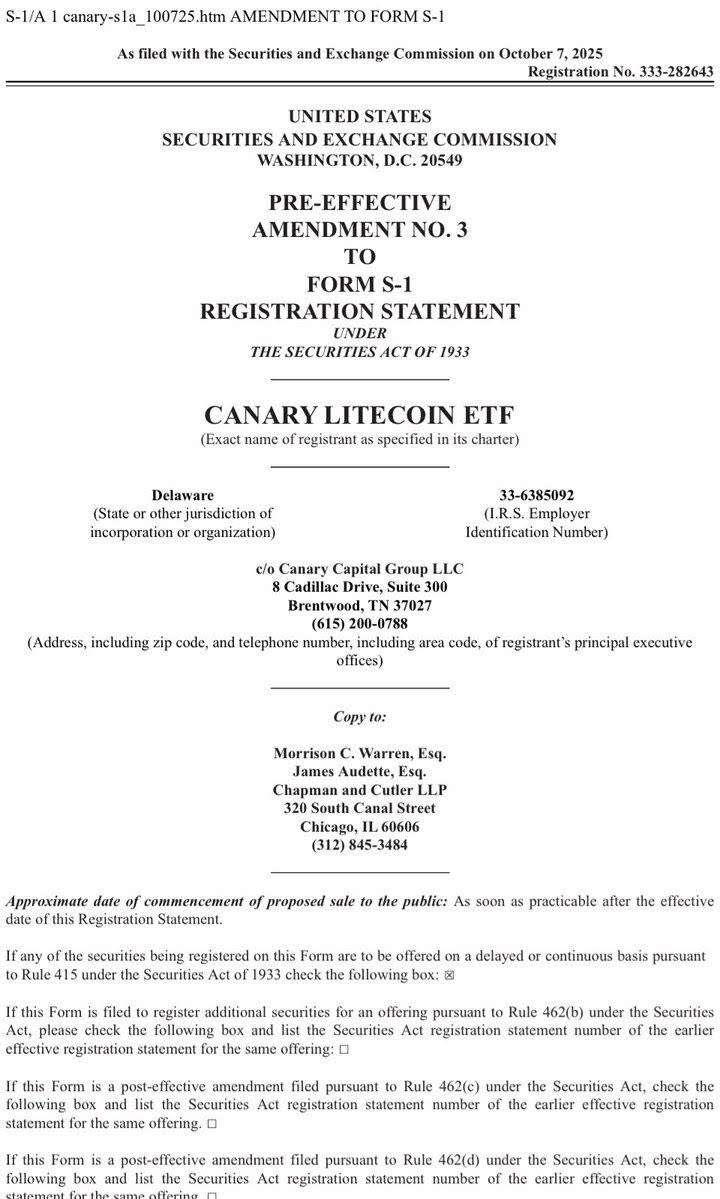
On October 7, Canary Capital submitted its amended S-1 registration statement for the Spot Litecoin ETF. The document revealed that the fund will trade under the ticker LTCC and charge investors a 0.95% sponsor fee.

The rate is higher than the 0.20–0.50% range typical for spot Bitcoin ETFs, but analysts describe it as “standard” for first-generation products in emerging sectors. The slightly elevated cost reflects the added complexity of custody, valuation, and liquidity management for altcoins like Litecoin, which do not yet have the same institutional infrastructure as Bitcoin.

Read More: SEC Pushes Final Decision on Solana ETFs to October 16 After Maximum 60-Day Extension
canary-litecoin-etf

What the S-1 Amendment Means

An S-1 amendment typically represents the final stage before a spot ETF can launch. These filings usually disclose finalized tickers, custodians, and fees – the last technical details before SEC clearance. Bloomberg ETF analysts Eric Balchunas and James Seyffart described Canary’s move as “the goal line moment,” indicating the paperwork appears ready for approval.

Once cleared, LTCC would become the first U.S. spot ETF tracking Litecoin, a major milestone that could expand institutional access to one of the longest-standing digital assets in the market.

Market Context and Institutional Impact

Why Litecoin Matters

Often referred to as the “silver to Bitcoin’s gold,” Litecoin is one of the oldest and most decentralized cryptocurrencies. Its regulatory classification as a commodity confirmed in past CFTC statements, gives it a clearer compliance path than many newer altcoins. That clarity helps explain why Canary chose LTC as its first non-Bitcoin, non-Ethereum ETF product.

Diversified exposure to crypto has been gaining traction among institutional investors. Following record inflows in Bitcoin spot ETFs earlier this year, the market has shifted to more ordinate altcoins that have strong networks and open on-chain data. An ETF in Litecoin would enable legacy investors to be exposed to the prices without having to actually handle the asset, carry wallets or even deal with exchange risks.

Custody and Valuation

The filing by Canary describes a clear-cut framework: Canary ETF will be holding real Litecoin held in custody by regulated providers like Coinbase Custody Trust and BitGo, and daily net asset value (NAV) will be calculated using various exchanges at around 4 p.m. ET. This data aggregation ensures more accurate market representation and reduces the influence of any single exchange’s volatility.

The structure mirrors that of spot Bitcoin ETFs, which helped legitimize crypto exposure in institutional portfolios by adding traditional safeguards such as independent auditing and transparent pricing mechanisms.

Regulatory and Political Environment

SEC Delays Amid Government Shutdown

The amended filings arrive during a period of U.S. government shutdown, which has slowed the SEC’s ability to process ETF applications. Under emergency operating rules, the agency retains only essential staff, delaying reviews of non-critical items, including digital asset ETFs.

The SEC had initially faced an early-October decision deadline for Canary’s Litecoin ETF but missed it due to limited staffing. Analysts believe that once the government resumes normal operations, approvals could proceed quickly since all necessary documentation now appears complete.

A Shift in ETF Oversight

Regulatory frameworks created by the SEC in the recent time simplified the approval process of crypto ETFs through the focus on S-1 registration forms instead of the time-consuming 19b-4 rule amendments. The change can cut the waiting time by up to 240 days to a minimum of 75 days without any additional political upheavals.

Such a rush of acceleration would be crucial to Canary and other companies that are struggling to introduce altcoin ETFs. The company has also submitted preliminary applications to register XRP and Solana spot ETFs, indicating that the firm has a desire to end up as a leader in the altcoin ETF market, when regulatory circumstances are put under control.

The post Canary Capital Finalizes Spot Litecoin ETF Filing with 0.95% Fee, Ticker LTCC appeared first on CryptoNinjas.

Piyasa Fırsatı
1 Logosu
1 Fiyatı(1)
$0.006206
$0.006206$0.006206
+28.43%
USD
1 (1) Canlı Fiyat Grafiği
Sorumluluk Reddi: Bu sitede yeniden yayınlanan makaleler, halka açık platformlardan alınmıştır ve yalnızca bilgilendirme amaçlıdır. MEXC'nin görüşlerini yansıtmayabilir. Tüm hakları telif sahiplerine aittir. Herhangi bir içeriğin üçüncü taraf haklarını ihlal ettiğini düşünüyorsanız, kaldırılması için lütfen [email protected] ile iletişime geçin. MEXC, içeriğin doğruluğu, eksiksizliği veya güncelliği konusunda hiçbir garanti vermez ve sağlanan bilgilere dayalı olarak alınan herhangi bir eylemden sorumlu değildir. İçerik, finansal, yasal veya diğer profesyonel tavsiye niteliğinde değildir ve MEXC tarafından bir tavsiye veya onay olarak değerlendirilmemelidir.

Ayrıca Şunları da Beğenebilirsiniz

Bitcoin ETF Investors React to Fed’s Decision
Bitcoin ETF Investors React to Fed’s Decision

The post Bitcoin ETF Investors React to Fed’s Decision appeared on BitcoinEthereumNews.com. In a surprise move, spot Bitcoin ETFs experienced their first significant daily outflows in over a week, following the Federal Reserve’s adjusted policy outlook. This shift reflects the market’s readiness to respond to any hint of change on the regulatory landscape, as well as its sensitivity to central bank cues. Continue Reading:Bitcoin ETF Investors React to Fed’s Decision Source: https://en.bitcoinhaber.net/bitcoin-etf-investors-react-to-feds-decision
Paylaş
BitcoinEthereumNews2025/09/18 18:51
US Senators Introduce SAFE Crypto Act to Target Rising Crypto Scams

US Senators Introduce SAFE Crypto Act to Target Rising Crypto Scams

The post US Senators Introduce SAFE Crypto Act to Target Rising Crypto Scams appeared first on Coinpedia Fintech News Crypto scams are getting faster, smarter and
Paylaş
CoinPedia2025/12/17 18:33
From Idea to App Store: The Complete Guide to Mobile App Development in Saudi Arabia

From Idea to App Store: The Complete Guide to Mobile App Development in Saudi Arabia

Saudi Arabia is at the forefront of digital transformation. With Vision 2030 driving innovation and a rapidly growing population of tech-savvy users, mobile apps have become a core driver of business growth in the Kingdom. From e-commerce and fintech to healthcare, logistics, and on-demand services, Saudi businesses are embracing mobile apps to connect with customers and scale faster. But how do you take a mobile app idea and turn it into a successful launch on the App Store or Google Play? This guide breaks down the complete mobile app development process in Saudi Arabia — step by step. Step 1: Validate Your App Idea for the Saudi Market Before you start building, ask: What problem does my app solve for Saudi users? Is there a cultural or market gap my app can fill? How do local competitors approach the same challenge? For example, apps related to digital payments, e-learning, delivery services, and healthcare are in high demand across Saudi Arabia. Conducting market research and aligning your app idea with local user behavior is critical. Step 2: Plan Features with Local Needs in Mind Your app should start with an MVP (Minimum Viable Product) — a core version that solves the main problem. Later, you can scale with advanced features. In Saudi Arabia, consider adding: Arabic language support (essential for user adoption) Integration with local payment gateways like STC Pay, Mada, or Apple Pay Regulatory compliance (especially for fintech and health apps) Localization for user preferences (Hijri calendar, cultural UI elements) Step 3: Select the Right Development Approach You can choose: Native Apps (Swift for iOS, Kotlin for Android) — Great for scalability and performance. Cross-Platform Apps (Flutter, React Native) — Cost-effective for startups targeting both iOS and Android simultaneously. Hybrid Apps — Suitable for simpler apps with limited features. For Saudi startups and enterprises, cross-platform development is often preferred to reach a wider audience quickly and efficiently. Step 4: Design With a Local Touch The design must balance global usability standards with local cultural relevance. UI (User Interface): Clean, modern visuals that align with Saudi branding. UX (User Experience): Simple navigation, clear Arabic text support, and intuitive flows. Wireframing & Prototyping: Test early with Saudi users to ensure adoption. A user-friendly design is one of the top reasons apps succeed in the Kingdom’s competitive market. Step 5: Develop Your Mobile App Once the design is ready, the coding begins. Saudi app development companies often follow Agile methodology, ensuring flexibility and faster delivery. Front-End Development: Interface and user interactions. Back-End Development: Databases, servers, and APIs. Integration: Secure connections between front-end and back-end. Strong collaboration between developers, designers, and business analysts ensures your app aligns with Saudi market needs. Step 6: Testing Across Devices and Networks Saudi users rely on different devices and network speeds. That’s why rigorous testing is critical: Functionality Testing: Features work as expected. Performance Testing: The app runs smoothly on both 4G and 5G networks. Localization Testing: Arabic text displays correctly, without alignment issues. Security Testing: Data protection compliance with Saudi cybersecurity standards. Step 7: App Store & Google Play Launch in Saudi Arabia To publish your app: Apple App Store (iOS): Requires an Apple Developer account and strict guideline compliance. Google Play Store (Android): Faster approval but still requires detailed app info. You’ll also need metadata in both English and Arabic — titles, descriptions, and screenshots — to maximize visibility among Saudi users. Step 8: Market Your App in Saudi Arabia Launching an app is only the beginning. You need a marketing strategy tailored to the Kingdom: App Store Optimization (ASO): Use Arabic and English keywords. Social Media Campaigns: Leverage platforms like Snapchat, Twitter (X), and Instagram, which are highly popular in Saudi Arabia. Influencer Marketing: Collaborate with Saudi influencers for early traction. Paid Ads: Google Ads and Saudi-focused Facebook/Instagram ads. Partnerships: Collaborate with local businesses to reach a wider audience. Step 9: Gather Feedback and Optimize Once your app is live, monitor: User reviews on app stores Analytics on engagement, retention, and churn rates Suggestions from Saudi users for culturally relevant features Continuous updates and improvements are vital to stay competitive. Step 10: Scale With Advanced Features Once your MVP gains traction, you can expand with advanced features such as: AI and machine learning for personalization Blockchain-based payments for fintech apps AR/VR features for retail and gaming apps IoT integration for smart home and mobility solutions Saudi Arabia’s digital ecosystem is growing rapidly — apps that adapt quickly will thrive. Conclusion Mobile app development in Saudi Arabia is not just about building an app — it’s about aligning with Vision 2030, cultural needs, and user expectations. By following a clear process — from idea validation to launch and beyond — you can transform your concept into a profitable digital product. Whether you’re a startup or an enterprise in Saudi Arabia, the opportunity is massive. With the right strategy, you can move from idea to App Store and create an app that truly resonates with Saudi users. From Idea to App Store: The Complete Guide to Mobile App Development in Saudi Arabia was originally published in Coinmonks on Medium, where people are continuing the conversation by highlighting and responding to this story
Paylaş
Medium2025/09/18 14:46