Grayscale Investments launched its Solana Trust ETF on NYSE Arca on Tuesday, becoming the first of the firm’s staking products to uplist under new SEC-approved generic listing standards. The move intensifies competition in the nascent Solana ETF market, where Bitwise’s debut product already captured $69.5 million in first-day inflows. The launch expands Grayscale’s digital asset lineup beyond Bitcoin and Ethereum, offering investors exposure to Solana’s proof-of-stake blockchain through a familiar exchange-traded wrapper. GSOL now joins Bitwise’s BSOL and Rex-Osprey’s SSK as the third Solana ETF trading on U.S. exchanges. Grayscale Enters With Staking-Enabled Structure GSOL carries a 0.35% expense ratio and holds 525,387 SOL tokens, with 74.89% currently staked to generate network rewards. Grayscale intends to pass on 77% of all staking rewards to investors on a net basis, potentially adding 5-6% annual returns based on historical Solana staking yields of 6-8%. The fund first launched as a private trust in 2021, was listed on OTCQX in 2023, and began staking in October 2025. Inkoo Kang, Senior Vice President of ETFs at Grayscale, framed the launch as evidence that digital assets belong in “modern portfolios” alongside traditional equities and bonds. Kristin Smith, President of Solana Policy Institute, also noted that staking ETPs allows investors “to help secure the network, accelerate innovation for developers, and earn rewards on one of the most dynamic assets in modern finance.” The product is not registered under the Investment Company Act of 1940, meaning it lacks the regulatory protections of traditional ETFs and mutual funds. Grayscale emphasized that GSOL represents indirect exposure to Solana and carries significant risks, including the potential loss of principal. Bitwise Dominates Early Solana ETF Flows Bitwise’s Solana ETF captured $69.5 million on its October 28 debut, nearly six times the $12 million raised by Rex-Osprey’s competing product. BSOL stakes 100% of its held SOL tokens in-house to deliver Solana’s full network yield to investors, charging a 0.20% management fee that has been waived for the first three months. Matt Hougan, Bitwise’s Chief Investment Officer, attributed institutional enthusiasm to Solana’s on-chain revenue leadership. “Institutional investors love ETFs, and they love revenue,” he said. Rex-Osprey’s SSK takes a different approach, holding 54% in direct Solana, 43.5% in a Swiss-listed CoinShares ETP, and the remainder in JitoSOL and cash, with monthly staking rewards classified as return of capital for tax purposes. Despite positive sentiment around ETFs, the market remains cautious about near-term price action. Traders on Polymarket give Solana just a 28% chance of reaching a new all-time high before 2026, with SOL trading at $200 today, up nearly 1% over 24 hours.Source: Polymarket Solana Challenges Ethereum’s Institutional Dominance Speaking with Cryptonews, Maria Carola, CEO of StealthEX, views the Solana ETF launch as a defining moment in the battle for Layer 1 blockchain dominance. “The launch of a spot ETF on Solana is a signal that has broken out in the protracted battle for dominance in the Layer 1 blockchain space,” she said. “For the first time, institutional investors are being invited to consider Solana as a standalone macro asset.“ Carola notes that projections of $3 billion in ETF inflows over the next 12-18 months depend on Solana maintaining its 2024 momentum in DeFi expansion and network stability. She acknowledges that while Solana offers technological advantages in speed and scalability, “it’s Ethereum’s fundamentals, such as stability, institutional reputation, and integration into the global financial system, that maintain its leadership.” Ethereum currently holds over $60 billion locked in DeFi with a mature staking ecosystem that continues to set the standard for institutional investors seeking predictability and reliability. However, Carola suggests a potential coexistence model where “Ethereum serves as the underlying trust and settlement layer in the on-chain economy, while Solana becomes its high-performance execution engine.” She adds that if ETF inflow projections are met by the end of 2025, “Solana could become the first blockchain since Ethereum to break the institutional glass ceiling.“ Regulatory Momentum Builds Across Multiple Blockchains The Solana ETF wave follows Hong Kong’s October approval of China Asset Management’s SOL spot fund, which began trading on October 27 with a minimum investment of $100. The product carries a 0.99% management fee and a 1.99% total expense ratio, making Solana the third cryptocurrency, after Bitcoin and Ethereum, to receive spot ETF clearance in the territory. Multiple U.S. issuers, including VanEck, Canary Capital, Franklin Templeton, Fidelity, and CoinShares, have also received approval for Solana ETF proposals. Recently, Bloomberg analyst Eric Balchunas also confirmed that the SEC is expected to approve the first Hedera and Litecoin ETFs, with listing notices for Canary’s HBAR and LTC products scheduled for October 28Grayscale Investments launched its Solana Trust ETF on NYSE Arca on Tuesday, becoming the first of the firm’s staking products to uplist under new SEC-approved generic listing standards. The move intensifies competition in the nascent Solana ETF market, where Bitwise’s debut product already captured $69.5 million in first-day inflows. The launch expands Grayscale’s digital asset lineup beyond Bitcoin and Ethereum, offering investors exposure to Solana’s proof-of-stake blockchain through a familiar exchange-traded wrapper. GSOL now joins Bitwise’s BSOL and Rex-Osprey’s SSK as the third Solana ETF trading on U.S. exchanges. Grayscale Enters With Staking-Enabled Structure GSOL carries a 0.35% expense ratio and holds 525,387 SOL tokens, with 74.89% currently staked to generate network rewards. Grayscale intends to pass on 77% of all staking rewards to investors on a net basis, potentially adding 5-6% annual returns based on historical Solana staking yields of 6-8%. The fund first launched as a private trust in 2021, was listed on OTCQX in 2023, and began staking in October 2025. Inkoo Kang, Senior Vice President of ETFs at Grayscale, framed the launch as evidence that digital assets belong in “modern portfolios” alongside traditional equities and bonds. Kristin Smith, President of Solana Policy Institute, also noted that staking ETPs allows investors “to help secure the network, accelerate innovation for developers, and earn rewards on one of the most dynamic assets in modern finance.” The product is not registered under the Investment Company Act of 1940, meaning it lacks the regulatory protections of traditional ETFs and mutual funds. Grayscale emphasized that GSOL represents indirect exposure to Solana and carries significant risks, including the potential loss of principal. Bitwise Dominates Early Solana ETF Flows Bitwise’s Solana ETF captured $69.5 million on its October 28 debut, nearly six times the $12 million raised by Rex-Osprey’s competing product. BSOL stakes 100% of its held SOL tokens in-house to deliver Solana’s full network yield to investors, charging a 0.20% management fee that has been waived for the first three months. Matt Hougan, Bitwise’s Chief Investment Officer, attributed institutional enthusiasm to Solana’s on-chain revenue leadership. “Institutional investors love ETFs, and they love revenue,” he said. Rex-Osprey’s SSK takes a different approach, holding 54% in direct Solana, 43.5% in a Swiss-listed CoinShares ETP, and the remainder in JitoSOL and cash, with monthly staking rewards classified as return of capital for tax purposes. Despite positive sentiment around ETFs, the market remains cautious about near-term price action. Traders on Polymarket give Solana just a 28% chance of reaching a new all-time high before 2026, with SOL trading at $200 today, up nearly 1% over 24 hours.Source: Polymarket Solana Challenges Ethereum’s Institutional Dominance Speaking with Cryptonews, Maria Carola, CEO of StealthEX, views the Solana ETF launch as a defining moment in the battle for Layer 1 blockchain dominance. “The launch of a spot ETF on Solana is a signal that has broken out in the protracted battle for dominance in the Layer 1 blockchain space,” she said. “For the first time, institutional investors are being invited to consider Solana as a standalone macro asset.“ Carola notes that projections of $3 billion in ETF inflows over the next 12-18 months depend on Solana maintaining its 2024 momentum in DeFi expansion and network stability. She acknowledges that while Solana offers technological advantages in speed and scalability, “it’s Ethereum’s fundamentals, such as stability, institutional reputation, and integration into the global financial system, that maintain its leadership.” Ethereum currently holds over $60 billion locked in DeFi with a mature staking ecosystem that continues to set the standard for institutional investors seeking predictability and reliability. However, Carola suggests a potential coexistence model where “Ethereum serves as the underlying trust and settlement layer in the on-chain economy, while Solana becomes its high-performance execution engine.” She adds that if ETF inflow projections are met by the end of 2025, “Solana could become the first blockchain since Ethereum to break the institutional glass ceiling.“ Regulatory Momentum Builds Across Multiple Blockchains The Solana ETF wave follows Hong Kong’s October approval of China Asset Management’s SOL spot fund, which began trading on October 27 with a minimum investment of $100. The product carries a 0.99% management fee and a 1.99% total expense ratio, making Solana the third cryptocurrency, after Bitcoin and Ethereum, to receive spot ETF clearance in the territory. Multiple U.S. issuers, including VanEck, Canary Capital, Franklin Templeton, Fidelity, and CoinShares, have also received approval for Solana ETF proposals. Recently, Bloomberg analyst Eric Balchunas also confirmed that the SEC is expected to approve the first Hedera and Litecoin ETFs, with listing notices for Canary’s HBAR and LTC products scheduled for October 28

Solana ETF Race Heats Up as Grayscale Joins Bitwise on Wall Street

Grayscale Investments launched its Solana Trust ETF on NYSE Arca on Tuesday, becoming the first of the firm’s staking products to uplist under new SEC-approved generic listing standards.

The move intensifies competition in the nascent Solana ETF market, where Bitwise’s debut product already captured $69.5 million in first-day inflows.

The launch expands Grayscale’s digital asset lineup beyond Bitcoin and Ethereum, offering investors exposure to Solana’s proof-of-stake blockchain through a familiar exchange-traded wrapper.

GSOL now joins Bitwise’s BSOL and Rex-Osprey’s SSK as the third Solana ETF trading on U.S. exchanges.

Grayscale Enters With Staking-Enabled Structure

GSOL carries a 0.35% expense ratio and holds 525,387 SOL tokens, with 74.89% currently staked to generate network rewards.

Grayscale intends to pass on 77% of all staking rewards to investors on a net basis, potentially adding 5-6% annual returns based on historical Solana staking yields of 6-8%.

The fund first launched as a private trust in 2021, was listed on OTCQX in 2023, and began staking in October 2025.

Inkoo Kang, Senior Vice President of ETFs at Grayscale, framed the launch as evidence that digital assets belong in “modern portfolios” alongside traditional equities and bonds.

Kristin Smith, President of Solana Policy Institute, also noted that staking ETPs allows investors “to help secure the network, accelerate innovation for developers, and earn rewards on one of the most dynamic assets in modern finance.”

The product is not registered under the Investment Company Act of 1940, meaning it lacks the regulatory protections of traditional ETFs and mutual funds.

Grayscale emphasized that GSOL represents indirect exposure to Solana and carries significant risks, including the potential loss of principal.

Bitwise Dominates Early Solana ETF Flows

Bitwise’s Solana ETF captured $69.5 million on its October 28 debut, nearly six times the $12 million raised by Rex-Osprey’s competing product.

BSOL stakes 100% of its held SOL tokens in-house to deliver Solana’s full network yield to investors, charging a 0.20% management fee that has been waived for the first three months.

Matt Hougan, Bitwise’s Chief Investment Officer, attributed institutional enthusiasm to Solana’s on-chain revenue leadership.

“Institutional investors love ETFs, and they love revenue,” he said.

Rex-Osprey’s SSK takes a different approach, holding 54% in direct Solana, 43.5% in a Swiss-listed CoinShares ETP, and the remainder in JitoSOL and cash, with monthly staking rewards classified as return of capital for tax purposes.

Despite positive sentiment around ETFs, the market remains cautious about near-term price action.

Traders on Polymarket give Solana just a 28% chance of reaching a new all-time high before 2026, with SOL trading at $200 today, up nearly 1% over 24 hours.
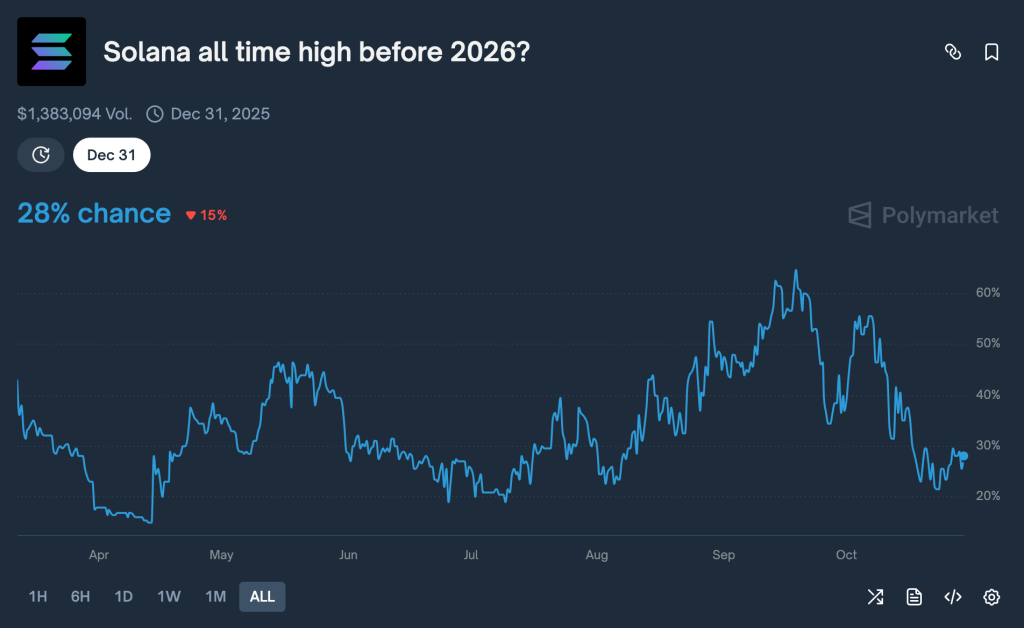
Solana ETF Race Heats Up as Grayscale Joins Bitwise on Wall StreetSource: Polymarket

Solana Challenges Ethereum’s Institutional Dominance

Speaking with Cryptonews, Maria Carola, CEO of StealthEX, views the Solana ETF launch as a defining moment in the battle for Layer 1 blockchain dominance.

The launch of a spot ETF on Solana is a signal that has broken out in the protracted battle for dominance in the Layer 1 blockchain space,” she said.

For the first time, institutional investors are being invited to consider Solana as a standalone macro asset.

Carola notes that projections of $3 billion in ETF inflows over the next 12-18 months depend on Solana maintaining its 2024 momentum in DeFi expansion and network stability.

She acknowledges that while Solana offers technological advantages in speed and scalability, “it’s Ethereum’s fundamentals, such as stability, institutional reputation, and integration into the global financial system, that maintain its leadership.

Ethereum currently holds over $60 billion locked in DeFi with a mature staking ecosystem that continues to set the standard for institutional investors seeking predictability and reliability.

However, Carola suggests a potential coexistence model where “Ethereum serves as the underlying trust and settlement layer in the on-chain economy, while Solana becomes its high-performance execution engine.”

She adds that if ETF inflow projections are met by the end of 2025, “Solana could become the first blockchain since Ethereum to break the institutional glass ceiling.

Regulatory Momentum Builds Across Multiple Blockchains

The Solana ETF wave follows Hong Kong’s October approval of China Asset Management’s SOL spot fund, which began trading on October 27 with a minimum investment of $100.

The product carries a 0.99% management fee and a 1.99% total expense ratio, making Solana the third cryptocurrency, after Bitcoin and Ethereum, to receive spot ETF clearance in the territory.

Multiple U.S. issuers, including VanEck, Canary Capital, Franklin Templeton, Fidelity, and CoinShares, have also received approval for Solana ETF proposals.

Recently, Bloomberg analyst Eric Balchunas also confirmed that the SEC is expected to approve the first Hedera and Litecoin ETFs, with listing notices for Canary’s HBAR and LTC products scheduled for October 28.

Sorumluluk Reddi: Bu sitede yeniden yayınlanan makaleler, halka açık platformlardan alınmıştır ve yalnızca bilgilendirme amaçlıdır. MEXC'nin görüşlerini yansıtmayabilir. Tüm hakları telif sahiplerine aittir. Herhangi bir içeriğin üçüncü taraf haklarını ihlal ettiğini düşünüyorsanız, kaldırılması için lütfen [email protected] ile iletişime geçin. MEXC, içeriğin doğruluğu, eksiksizliği veya güncelliği konusunda hiçbir garanti vermez ve sağlanan bilgilere dayalı olarak alınan herhangi bir eylemden sorumlu değildir. İçerik, finansal, yasal veya diğer profesyonel tavsiye niteliğinde değildir ve MEXC tarafından bir tavsiye veya onay olarak değerlendirilmemelidir.

Ayrıca Şunları da Beğenebilirsiniz

Crypto Market Cap Edges Up 2% as Bitcoin Approaches $118K After Fed Rate Trim

Crypto Market Cap Edges Up 2% as Bitcoin Approaches $118K After Fed Rate Trim

The global crypto market cap rose 2% to $4.2 trillion on Thursday, lifted by Bitcoin’s steady climb toward $118,000 after the Fed delivered its first interest rate cut of the year. Gains were measured, however, as investors weighed the central bank’s cautious tone on future policy moves. Bitcoin last traded 1% higher at $117,426. Ether rose 2.8% to $4,609. XRP also gained, rising 2.9% to $3.10. Fed Chair Jerome Powell described Wednesday’s quarter-point reduction as a risk-management step, stressing that policymakers were in no hurry to speed up the easing cycle. His comments dampened expectations of more aggressive cuts, limiting enthusiasm across risk assets. Traders Anticipated Fed Rate Trim, Leaving Little Room for Surprise Rally The Federal Open Market Committee voted 11-to-1 to lower the benchmark lending rate to a range of 4.00% to 4.25%. The sole dissent came from newly appointed governor Stephen Miran, who pushed for a half-point cut. Traders were largely prepared for the move. Futures markets tracked by the CME FedWatch tool had assigned a 96% probability to a 25 basis point cut, making the decision widely anticipated. That advance positioning meant much of the potential boost was already priced in, creating what analysts described as a “buy the rumour, sell the news” environment. Fed Rate Decision Creates Conditions for Crypto, But Traders Still Hold Back Andrew Forson, president of DeFi Technologies, said lower borrowing costs would eventually steer more money toward digital assets. “A lower cost of capital indicates more capital flows into the digital assets space because the risk hurdle rate for money is lower,” he noted. He added that staking products and blockchain projects could become attractive alternatives to traditional bonds, offering both yield and appreciation. Despite the cut, crypto markets remained calm. Open interest in Bitcoin futures held steady and no major liquidation cascades followed the Fed’s decision. Analysts pointed to Powell’s language and upcoming economic data as the key factors for traders before building larger positions. Powell’s Caution Tempers Immediate Impact of Fed Rate Move on Crypto Markets History also suggests crypto rallies after rate cuts often take time. When the Fed eased in Dec. 2024, Bitcoin briefly surged 5% cent before consolidating, with sustained gains arriving only weeks later. This time, market watchers are bracing for a similar pattern. Powell’s insistence on caution, combined with uncertainty around inflation and growth, has kept short-term volatility muted even as sentiment for risk assets improves. BitMine’s Tom Lee this week predicted that Bitcoin and Ether could deliver “monster gains” in the next three months if the Fed continues on an easing path. His view echoes broader expectations that liquidity-sensitive assets will outperform once the cycle gathers pace. For now, the crypto sector has digested the Fed’s move with restraint. Traders remain focused on signals from the central bank’s October meeting to determine whether Wednesday’s step marks the beginning of a broader policy shift or just a one-off adjustment
Paylaş
CryptoNews2025/09/18 13:14
Vitalik Buterin Reveals Ethereum’s Long-Term Focus on Quantum Resistance

Vitalik Buterin Reveals Ethereum’s Long-Term Focus on Quantum Resistance

TLDR Ethereum focuses on quantum resistance to secure the blockchain’s future. Vitalik Buterin outlines Ethereum’s long-term development with security goals. Ethereum aims for improved transaction efficiency and layer-2 scalability. Ethereum maintains a strong market position with price stability above $4,000. Vitalik Buterin, the co-founder of Ethereum, has shared insights into the blockchain’s long-term development. During [...] The post Vitalik Buterin Reveals Ethereum’s Long-Term Focus on Quantum Resistance appeared first on CoinCentral.
Paylaş
Coincentral2025/09/18 00:31
Federal Reserve Officials Forecast 2025 Rate Cuts

Federal Reserve Officials Forecast 2025 Rate Cuts

Detail: https://coincu.com/markets/federal-reserve-2025-rate-cuts/
Paylaş
Coinstats2025/09/18 13:11