The post How Bad Weather Is Giving Russia A Tactical Edge In Eastern Ukraine appeared on BitcoinEthereumNews.com. A drone pilot from the Unmanned Systems Battalion of Ukraine’s 110th Separate Mechanized Brigade. Photo: David Kirichenko The fog rolls in across eastern Ukraine, and with it comes danger. For Ukrainian defenders, the murky weather that blankets the front lines has become as much an adversary as Russian forces themselves, grounding the drones that have become Ukraine’s primary defensive tool and allowing small enemy units to infiltrate deep behind Ukrainian positions. The shift comes as Ukraine faces manpower shortages heading into winter. “In this fog, the Russians don’t move the way textbooks say they should,” Anatolii Tkachenko, commander of a mortar battery unit from Ukraine’s 92nd Separate Assault Brigade that until recently was fighting in Pokrovsk, told me. “They cross open fields and suddenly appear eight to ten kilometers deep in our rear. There’s constant contact – with mortar teams, drone pilots, everyone.” The tactical shift represents a significant evolution in how Russian forces are prosecuting their offensive in eastern Ukraine. In recent weeks, Moscow’s troops have exploited poor visibility conditions – fog, precipitation, and low cloud cover – to advance with dramatically reduced exposure to Ukrainian drone surveillance and strikes. For Ukraine, which has increasingly relied on unmanned aerial systems to compensate for manpower shortages, the weather has neutralized a critical advantage, even if for a short period. The Drone Dependency Dilemma With infantry numbers stretched thin across hundreds of kilometers of front line, Ukrainian forces have turned to drone units as a force multiplier. Maria Berlinska, head of the Victory Drones project, said in October that each kilometer of the frontline is guarded by an average of just four to seven Ukrainian infantrymen. That skeletal defense relies heavily on aerial surveillance and FPV (first-person view) kamikaze drones to detect and destroy advancing Russian forces. But bad weather hampers… The post How Bad Weather Is Giving Russia A Tactical Edge In Eastern Ukraine appeared on BitcoinEthereumNews.com. A drone pilot from the Unmanned Systems Battalion of Ukraine’s 110th Separate Mechanized Brigade. Photo: David Kirichenko The fog rolls in across eastern Ukraine, and with it comes danger. For Ukrainian defenders, the murky weather that blankets the front lines has become as much an adversary as Russian forces themselves, grounding the drones that have become Ukraine’s primary defensive tool and allowing small enemy units to infiltrate deep behind Ukrainian positions. The shift comes as Ukraine faces manpower shortages heading into winter. “In this fog, the Russians don’t move the way textbooks say they should,” Anatolii Tkachenko, commander of a mortar battery unit from Ukraine’s 92nd Separate Assault Brigade that until recently was fighting in Pokrovsk, told me. “They cross open fields and suddenly appear eight to ten kilometers deep in our rear. There’s constant contact – with mortar teams, drone pilots, everyone.” The tactical shift represents a significant evolution in how Russian forces are prosecuting their offensive in eastern Ukraine. In recent weeks, Moscow’s troops have exploited poor visibility conditions – fog, precipitation, and low cloud cover – to advance with dramatically reduced exposure to Ukrainian drone surveillance and strikes. For Ukraine, which has increasingly relied on unmanned aerial systems to compensate for manpower shortages, the weather has neutralized a critical advantage, even if for a short period. The Drone Dependency Dilemma With infantry numbers stretched thin across hundreds of kilometers of front line, Ukrainian forces have turned to drone units as a force multiplier. Maria Berlinska, head of the Victory Drones project, said in October that each kilometer of the frontline is guarded by an average of just four to seven Ukrainian infantrymen. That skeletal defense relies heavily on aerial surveillance and FPV (first-person view) kamikaze drones to detect and destroy advancing Russian forces. But bad weather hampers…

How Bad Weather Is Giving Russia A Tactical Edge In Eastern Ukraine

2025/11/26 04:00

A drone pilot from the Unmanned Systems Battalion of Ukraine’s 110th Separate Mechanized Brigade.

Photo: David Kirichenko

The fog rolls in across eastern Ukraine, and with it comes danger. For Ukrainian defenders, the murky weather that blankets the front lines has become as much an adversary as Russian forces themselves, grounding the drones that have become Ukraine’s primary defensive tool and allowing small enemy units to infiltrate deep behind Ukrainian positions. The shift comes as Ukraine faces manpower shortages heading into winter.

“In this fog, the Russians don’t move the way textbooks say they should,” Anatolii Tkachenko, commander of a mortar battery unit from Ukraine’s 92nd Separate Assault Brigade that until recently was fighting in Pokrovsk, told me. “They cross open fields and suddenly appear eight to ten kilometers deep in our rear. There’s constant contact – with mortar teams, drone pilots, everyone.”

The tactical shift represents a significant evolution in how Russian forces are prosecuting their offensive in eastern Ukraine. In recent weeks, Moscow’s troops have exploited poor visibility conditions – fog, precipitation, and low cloud cover – to advance with dramatically reduced exposure to Ukrainian drone surveillance and strikes.

For Ukraine, which has increasingly relied on unmanned aerial systems to compensate for manpower shortages, the weather has neutralized a critical advantage, even if for a short period.

The Drone Dependency Dilemma

With infantry numbers stretched thin across hundreds of kilometers of front line, Ukrainian forces have turned to drone units as a force multiplier. Maria Berlinska, head of the Victory Drones project, said in October that each kilometer of the frontline is guarded by an average of just four to seven Ukrainian infantrymen.

That skeletal defense relies heavily on aerial surveillance and FPV (first-person view) kamikaze drones to detect and destroy advancing Russian forces. But bad weather hampers drone operations by limiting visibility and reducing operational range. The result: both sides gain opportunities to resupply, evacuate wounded, and move more freely – but Russia, with its numerical superiority, benefits more.

“We’ve reduced our artillery work because the sky is never empty,” Tkachenko explained. “Recon drones, adjustment drones – something is always flying.” He added that his mortar unit only works “when there’s fog, rain, or snow.”

Dmytro Zhluktenko, a drone operator from the 413th Separate Battalion of Unmanned Systems, described the compounding effect of weather on Ukraine’s defense model. “We rely heavily on drones in our doctrine, and weather like this in Donetsk is already making defense much harder,” he told me. “There isn’t enough infantry, and in our sector we’ve even had cases where drone pilots ended up in small-arms combat. Obviously that hurts their ability to do real drone work – they’re forced to think about staying alive instead of flying.”

A soldier from the Unmanned Systems Battalion of Ukraine’s 110th Separate Mechanized Brigade deploys a drone in Donetsk Oblast.

Photo: David Kirichenko

As The Economist reported in October, Ukrainian artillery crews now work from firing positions dug below ground level so muzzle flashes are hidden from Russian drones. These dugouts are concealed beneath foliage-covered trap doors, allowing crews to surface only long enough to fire before disappearing underground again.

Bohdan Garkavyy, a drone pilot from the Unmanned Systems Battalion of Ukraine’s 110th Separate Mechanized Brigade, told me that the Russians often send in “expendable infantry just so a Mavic drone can spot where our artillery is firing from.”

Russian commanders increasingly treat infantry as a low-cost tool for flushing out Ukrainian guns – forcing contact, exposing positions, and drawing fire for follow-on strikes. “It’s more efficient to work with artillery, especially if they’re in the treeline,” Garkavyy told me.

FPV drones can take seven to ten minutes to reach a target, long enough for an enemy to change direction several times, while artillery can land rounds within 30 seconds once it has a fix. “It takes me 10 minutes to reach him; in that time, he could change direction five times,” Garkavyy said.

The Wall Street Journal reported that in Pokrovsk, overhead drone activity has become constant, with as many as 10 Russian craft for every Ukrainian one. Tkachenko confirmed the saturation: “In one nearby town, they launched thirty-seven Shaheds in a single day. That’s the kind of saturation we’re dealing with.”

The “1,000 Bites” Strategy

Mick Ryan, a retired Australian Army major general writing for the Center for Strategic and International Studies, has described Russia’s evolving tactical approach as “1,000 bites” – a method where small teams systematically probe for weaknesses in Ukrainian defensive lines.

According to Ryan’s analysis, these positions can be separated by up to 1,000 meters and generally lack depth positions. When Russian units identify a gap, they rapidly exploit it by flooding the breach with infantry and drones, specifically targeting headquarters and drone operations centers. Where no gaps exist, Ryan notes, Russian forces employ glide bombs or even Shahed drones to create breaches, particularly in urban terrain.

The commander of the 68th Jaeger Brigade, using the codename “Liutyi,” told Ukrainian outlet Suspilne on Nov. 19 that Russian forces in Pokrovsk are operating like sabotage and reconnaissance groups, complicating defense efforts by dressing as civilians.

“If they identify your position, they erase it,” Tkachenko said. “Sometimes with artillery, sometimes with guided bombs. You don’t get second chances.”

Anatolii Tkachenko, commander of a mortar battery unit from Ukraine’s 92nd Separate Assault Brigade.

Photo: David Kirichenko

Where infiltration isn’t possible, Russian forces use glide bombs or even Shahed drones to create breaches, particularly in urban environments. The combination of weather-enabled infiltration and overwhelming firepower has put Ukrainian defenders in an increasingly precarious position.

Fighting In 360 Degrees

The tactical reality on the ground has forced Ukrainian units to adapt beyond their traditional roles. “FPV drone pilots are incredibly effective at long range, but that doesn’t matter if the enemy reaches your position,” says Tkachenko. “Out here, everyone – pilots, medics, drivers – has to be ready to fight as a universal shooter. The enemy knows that even if they reach the operators, we’re trained to maneuver, set ambushes, and hit back hard.”

The result is what Tkachenko describes as “360-degree” warfare: “There’s no safe direction anymore.”

Ukrainian forces have managed to maintain some operational flexibility despite the challenges. Some roads into Pokrovsk remain usable, soldiers said, and ironically, the same fog that helped Russian troops infiltrate has also allowed Ukraine to rotate soldiers into the Myrnohrad pocket.

“How often we fire depends entirely on the situation,” Tkachenko said. “If we detect the enemy and the sky looks clear – no sound, no visual cues – we work.”

But those windows are becoming narrower. As Russian drone saturation increases and winter weather approaches, Ukraine faces a strategic dilemma: its drone-heavy defense model cannot function in conditions that ground aerial drones and enable infiltration. The solution requires more infantry to hold the line and conventional artillery to operate when drones cannot.

Source: https://www.forbes.com/sites/davidkirichenko/2025/11/25/how-bad-weather-is-giving-russia-a-tactical-edge-in-eastern-ukraine/

Piyasa Fırsatı
Bad Idea AI Logosu
Bad Idea AI Fiyatı(BAD)
$0.00000000168
$0.00000000168$0.00000000168
+0.59%
USD
Bad Idea AI (BAD) Canlı Fiyat Grafiği
Sorumluluk Reddi: Bu sitede yeniden yayınlanan makaleler, halka açık platformlardan alınmıştır ve yalnızca bilgilendirme amaçlıdır. MEXC'nin görüşlerini yansıtmayabilir. Tüm hakları telif sahiplerine aittir. Herhangi bir içeriğin üçüncü taraf haklarını ihlal ettiğini düşünüyorsanız, kaldırılması için lütfen [email protected] ile iletişime geçin. MEXC, içeriğin doğruluğu, eksiksizliği veya güncelliği konusunda hiçbir garanti vermez ve sağlanan bilgilere dayalı olarak alınan herhangi bir eylemden sorumlu değildir. İçerik, finansal, yasal veya diğer profesyonel tavsiye niteliğinde değildir ve MEXC tarafından bir tavsiye veya onay olarak değerlendirilmemelidir.

Ayrıca Şunları da Beğenebilirsiniz

BitGo expands its presence in Europe

BitGo expands its presence in Europe

The post BitGo expands its presence in Europe appeared on BitcoinEthereumNews.com. BitGo, global leader in digital asset infrastructure, announces a significant expansion of its presence in Europe. The company, through its subsidiary BitGo Europe GmbH, has obtained an extension of the license from BaFin (German Federal Financial Supervisory Authority), allowing it to offer regulated cryptocurrency trading services directly from Frankfurt, Germany. This move marks a decisive step for the European digital asset market, offering institutional investors the opportunity to access secure, regulated cryptocurrency trading integrated with advanced custody and management services. A comprehensive offering for European institutional investors With the extension of the license according to the MiCA (Markets in Crypto-Assets) regulation, initially obtained in May 2025, BitGo Europe expands the range of services available for European investors. Now, in addition to custody, staking, and transfer of digital assets, the platform also offers a spot trading service on thousands of cryptocurrencies and stablecoins. Institutional investors can now leverage BitGo’s OTC desk and a high-performance electronic trading platform, designed to ensure fast, secure, and transparent transactions. Aggregated access to numerous liquidity sources, including leading market makers and exchanges, allows for trading at competitive prices and high-quality executions. Security and Regulation at the Core of BitGo’s Strategy According to Brett Reeves, Head of European Sales and Go Network at BitGo, the goal is clear: “We are excited to strengthen our European platform and enable our clients to operate smoothly, competitively, and securely.§By combining our institutional custody solution with high-performance trading execution, clients will be able to access deep liquidity with the peace of mind that their assets will remain in cold storage, under regulated custody and compliant with MiCA.” The security of digital assets is indeed one of the cornerstones of BitGo’s offering. All services are designed to ensure that investors’ assets remain protected in regulated cold storage, minimizing operational and counterparty risks.…
Paylaş
BitcoinEthereumNews2025/09/18 04:28
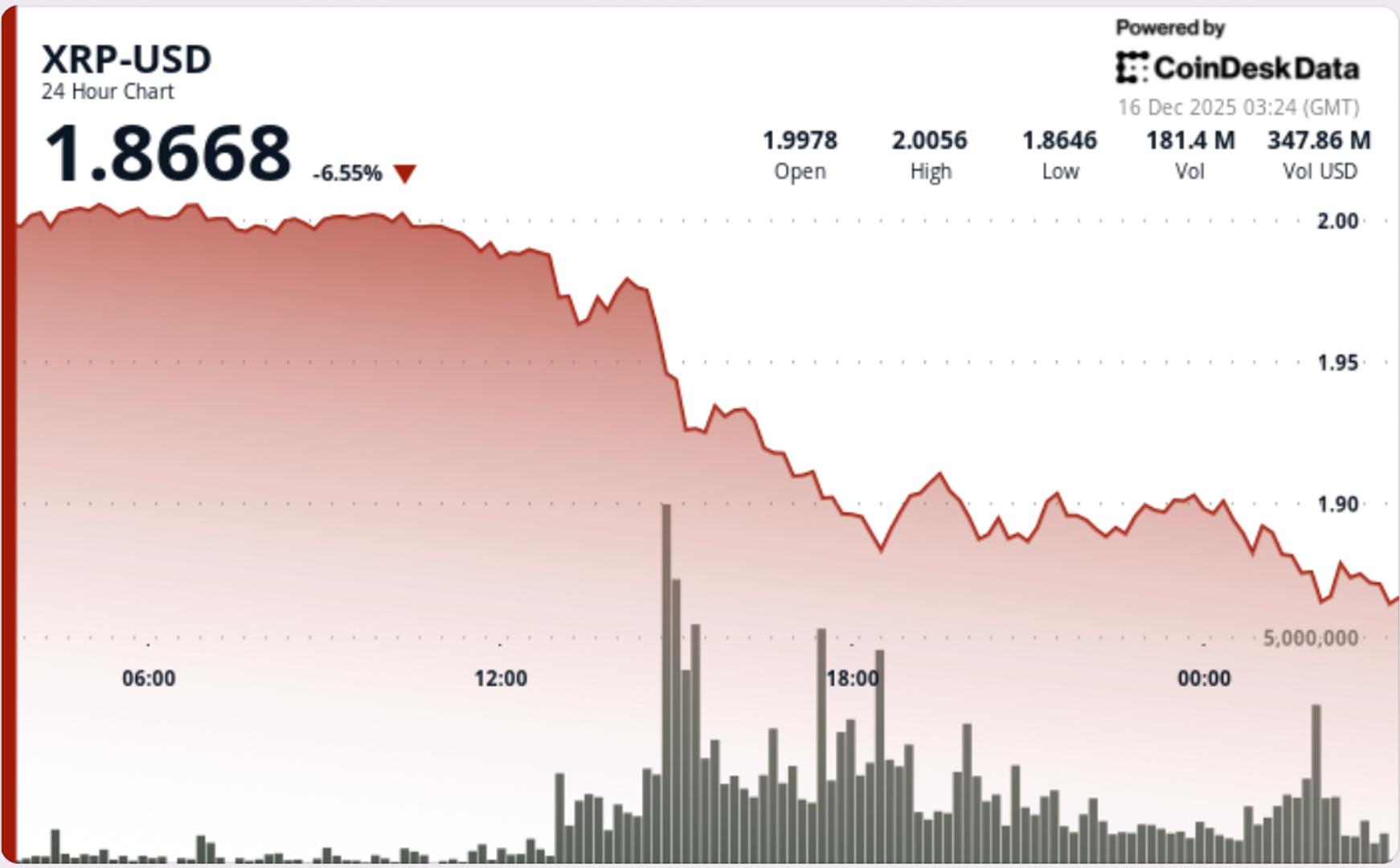
XRP price weakens at critical level, raising risk of deeper pullback

XRP price weakens at critical level, raising risk of deeper pullback

Markets Share Share this article
Copy linkX (Twitter)LinkedInFacebookEmail
XRP price weakens at critical level, raising
Paylaş
Coindesk2025/12/16 11:34
Visa Targets Banks and Fintechs With Stablecoin Advisory Launch as Adoption Pressure Tightens

Visa Targets Banks and Fintechs With Stablecoin Advisory Launch as Adoption Pressure Tightens

The post Visa Targets Banks and Fintechs With Stablecoin Advisory Launch as Adoption Pressure Tightens appeared on BitcoinEthereumNews.com. Visa is moving deeper
Paylaş
BitcoinEthereumNews2025/12/16 11:43