BitcoinWorld Next Fed Chair: The Stunning Trump Shortlist That Could Reshape Crypto Markets In a move that could send shockwaves through global finance, PresidentBitcoinWorld Next Fed Chair: The Stunning Trump Shortlist That Could Reshape Crypto Markets In a move that could send shockwaves through global finance, President

Next Fed Chair: The Stunning Trump Shortlist That Could Reshape Crypto Markets
2025/12/13 07:30
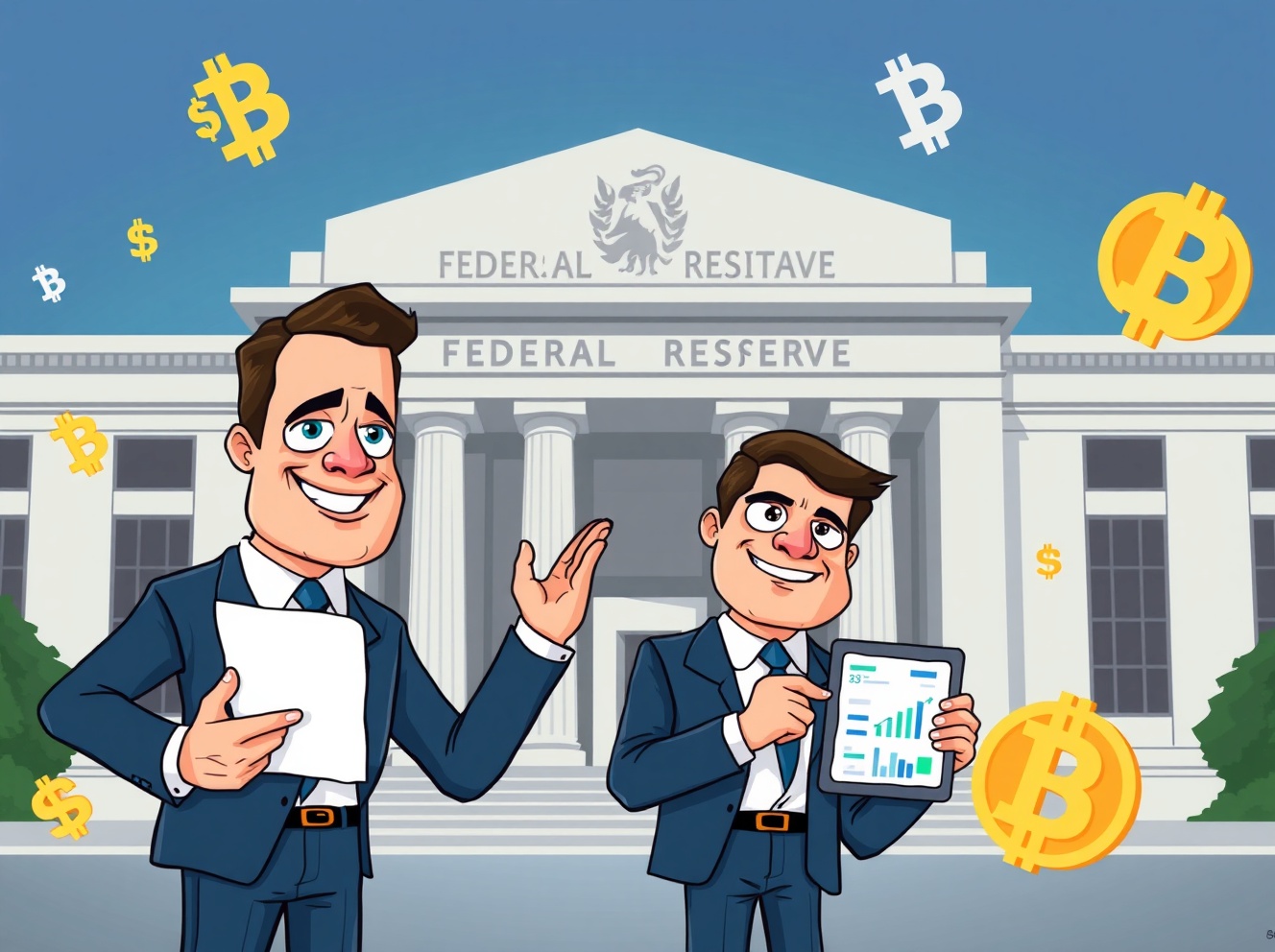
Cartoon illustration of potential next Fed chair candidates debating policy in front of the Federal Reserve.

BitcoinWorld

Next Fed Chair: The Stunning Trump Shortlist That Could Reshape Crypto Markets

In a move that could send shockwaves through global finance, President Donald Trump is reportedly narrowing his search for the next Fed chair. According to a Wall Street Journal report, former Federal Reserve Governor Kevin Warsh and White House economic advisor Kevin Hassett are top contenders. For cryptocurrency investors, this isn’t just political news—it’s a potential pivot point for the monetary policy that shapes our digital asset landscape.

Who Are the Candidates for the Next Fed Chair?

The race for the next Fed chair features two prominent figures with distinct backgrounds. Kevin Warsh served as a Fed Governor from 2006 to 2011, gaining firsthand experience during the global financial crisis. He is often viewed as a critic of the Fed’s post-crisis quantitative easing policies. Conversely, Kevin Hassett, currently the chair of the White House’s Council of Economic Advisers, is a respected economist known for his work on tax policy and market analysis. Their differing philosophies present a stark choice for the future of U.S. monetary policy.

Why Does the Next Fed Chair Matter for Crypto?

The Federal Reserve controls the levers of the U.S. dollar, influencing interest rates and money supply. Therefore, the appointment of the next Fed chair is a monumental event for all markets, especially cryptocurrencies. Here’s why crypto traders are watching closely:

  • Interest Rate Policy: A hawkish chair (favoring higher rates to fight inflation) could strengthen the dollar, potentially applying downward pressure on crypto prices.
  • Regulatory Stance: The Fed’s view on digital currencies and stablecoins will shape the regulatory environment for years.
  • Market Sentiment: The appointment signals the administration’s broader economic priorities, affecting investor confidence and risk appetite.

Historically, periods of loose monetary policy (low rates, money printing) have correlated with strong crypto bull markets. The new chair’s approach will define the next chapter.

What Challenges Will the Next Fed Chair Face?

Whoever becomes the next Fed chair will inherit a complex economic puzzle. The post-pandemic world presents unique challenges that directly intersect with the crypto economy. The new leader must navigate persistent inflation concerns, a potential economic slowdown, and a massive federal debt. Moreover, they will need to formulate a stance on Central Bank Digital Currencies (CBDCs), a development that could compete with or legitimize the existing crypto ecosystem. Their decisions will ripple through every asset class.

Actionable Insights for Crypto Investors

While the political process unfolds, savvy investors can prepare. First, monitor the Senate confirmation hearings for clues on the nominee’s philosophy. Second, pay attention to statements regarding inflation and digital currency innovation. Finally, consider how your portfolio is positioned for different monetary policy scenarios. A shift towards tighter policy may favor different assets than an era of continued liquidity. Staying informed about the next Fed chair selection is not just about politics—it’s a fundamental part of risk management in the crypto space.

The Bottom Line: A Decision with Lasting Impact

The selection of the next Fed chair is more than a personnel change; it’s a signal that will define monetary policy for a critical period. For the cryptocurrency community, understanding the leanings of Kevin Warsh versus Kevin Hassett is essential. Their approach to interest rates, balance sheet management, and financial innovation will create the macroeconomic backdrop for Bitcoin, Ethereum, and the entire digital asset class. As President Trump moves closer to his decision, the entire market holds its breath for a choice that will resonate from Wall Street to the blockchain.

Frequently Asked Questions (FAQs)

Who is currently the most likely candidate for the next Fed chair?
As of the WSJ report, Kevin Warsh and Kevin Hassett are the leading contenders, though the President’s final decision is pending.

How quickly could a new Fed chair be appointed?
President Trump stated he would nominate a candidate early next year. The nominee must then be confirmed by the U.S. Senate, a process that can take several months.

What is the main difference between Warsh and Hassett’s economic views?
Warsh is generally seen as more hawkish, critical of expansive Fed balance sheets. Hassett’s public focus has been more on tax policy and growth, making his precise monetary policy stance less defined.

Why should a cryptocurrency investor care about the Fed chair?
The Fed controls the U.S. money supply and interest rates, which are primary drivers of global liquidity and investor risk appetite—two factors that profoundly influence cryptocurrency valuations.

Could this decision impact Bitcoin’s price directly?
Not directly, but indirectly and powerfully. The Fed’s policies affect the dollar’s strength and the flow of capital into risk assets like tech stocks and crypto, creating a strong correlative environment.

Has a Fed chair ever made public statements about Bitcoin?
Yes, past chairs like Janet Yellen and Jerome Powell have commented on cryptocurrencies, typically highlighting volatility and regulatory concerns, setting a tone for institutional engagement.

Join the Conversation

Do you think a Warsh or Hassett-led Fed would be better for cryptocurrency innovation and markets? Share your analysis and this article on social media to discuss this critical development with other investors. Your perspective helps build a more informed community.

To learn more about how macroeconomic trends shape digital assets, explore our article on key developments shaping Bitcoin and Ethereum price action amid shifting monetary policy.

This post Next Fed Chair: The Stunning Trump Shortlist That Could Reshape Crypto Markets first appeared on BitcoinWorld.

Piyasa Fırsatı
OFFICIAL TRUMP Logosu
OFFICIAL TRUMP Fiyatı(TRUMP)
$5.23
$5.23$5.23
-2.20%
USD
OFFICIAL TRUMP (TRUMP) Canlı Fiyat Grafiği
Sorumluluk Reddi: Bu sitede yeniden yayınlanan makaleler, halka açık platformlardan alınmıştır ve yalnızca bilgilendirme amaçlıdır. MEXC'nin görüşlerini yansıtmayabilir. Tüm hakları telif sahiplerine aittir. Herhangi bir içeriğin üçüncü taraf haklarını ihlal ettiğini düşünüyorsanız, kaldırılması için lütfen [email protected] ile iletişime geçin. MEXC, içeriğin doğruluğu, eksiksizliği veya güncelliği konusunda hiçbir garanti vermez ve sağlanan bilgilere dayalı olarak alınan herhangi bir eylemden sorumlu değildir. İçerik, finansal, yasal veya diğer profesyonel tavsiye niteliğinde değildir ve MEXC tarafından bir tavsiye veya onay olarak değerlendirilmemelidir.

Ayrıca Şunları da Beğenebilirsiniz

Volante Technologies Customers Successfully Navigate Critical Regulatory Deadlines for EU SEPA Instant and Global SWIFT Cross-Border Payments

Volante Technologies Customers Successfully Navigate Critical Regulatory Deadlines for EU SEPA Instant and Global SWIFT Cross-Border Payments

PaaS leader ensures seamless migrations and uninterrupted payment operations LONDON–(BUSINESS WIRE)–Volante Technologies, the global leader in Payments as a Service
Paylaş
AI Journal2025/12/16 17:16
Fed Acts on Economic Signals with Rate Cut

Fed Acts on Economic Signals with Rate Cut

In a significant pivot, the Federal Reserve reduced its benchmark interest rate following a prolonged ten-month hiatus. This decision, reflecting a strategic response to the current economic climate, has captured attention across financial sectors, with both market participants and policymakers keenly evaluating its potential impact.Continue Reading:Fed Acts on Economic Signals with Rate Cut
Paylaş
Coinstats2025/09/18 02:28
Google's AP2 protocol has been released. Does encrypted AI still have a chance?

Google's AP2 protocol has been released. Does encrypted AI still have a chance?

Following the MCP and A2A protocols, the AI Agent market has seen another blockbuster arrival: the Agent Payments Protocol (AP2), developed by Google. This will clearly further enhance AI Agents' autonomous multi-tasking capabilities, but the unfortunate reality is that it has little to do with web3AI. Let's take a closer look: What problem does AP2 solve? Simply put, the MCP protocol is like a universal hook, enabling AI agents to connect to various external tools and data sources; A2A is a team collaboration communication protocol that allows multiple AI agents to cooperate with each other to complete complex tasks; AP2 completes the last piece of the puzzle - payment capability. In other words, MCP opens up connectivity, A2A promotes collaboration efficiency, and AP2 achieves value exchange. The arrival of AP2 truly injects "soul" into the autonomous collaboration and task execution of Multi-Agents. Imagine AI Agents connecting Qunar, Meituan, and Didi to complete the booking of flights, hotels, and car rentals, but then getting stuck at the point of "self-payment." What's the point of all that multitasking? So, remember this: AP2 is an extension of MCP+A2A, solving the last mile problem of AI Agent automated execution. What are the technical highlights of AP2? The core innovation of AP2 is the Mandates mechanism, which is divided into real-time authorization mode and delegated authorization mode. Real-time authorization is easy to understand. The AI Agent finds the product and shows it to you. The operation can only be performed after the user signs. Delegated authorization requires the user to set rules in advance, such as only buying the iPhone 17 when the price drops to 5,000. The AI Agent monitors the trigger conditions and executes automatically. The implementation logic is cryptographically signed using Verifiable Credentials (VCs). Users can set complex commission conditions, including price ranges, time limits, and payment method priorities, forming a tamper-proof digital contract. Once signed, the AI Agent executes according to the conditions, with VCs ensuring auditability and security at every step. Of particular note is the "A2A x402" extension, a technical component developed by Google specifically for crypto payments, developed in collaboration with Coinbase and the Ethereum Foundation. This extension enables AI Agents to seamlessly process stablecoins, ETH, and other blockchain assets, supporting native payment scenarios within the Web3 ecosystem. What kind of imagination space can AP2 bring? After analyzing the technical principles, do you think that's it? Yes, in fact, the AP2 is boring when it is disassembled alone. Its real charm lies in connecting and opening up the "MCP+A2A+AP2" technology stack, completely opening up the complete link of AI Agent's autonomous analysis+execution+payment. From now on, AI Agents can open up many application scenarios. For example, AI Agents for stock investment and financial management can help us monitor the market 24/7 and conduct independent transactions. Enterprise procurement AI Agents can automatically replenish and renew without human intervention. AP2's complementary payment capabilities will further expand the penetration of the Agent-to-Agent economy into more scenarios. Google obviously understands that after the technical framework is established, the ecological implementation must be relied upon, so it has brought in more than 60 partners to develop it, almost covering the entire payment and business ecosystem. Interestingly, it also involves major Crypto players such as Ethereum, Coinbase, MetaMask, and Sui. Combined with the current trend of currency and stock integration, the imagination space has been doubled. Is web3 AI really dead? Not entirely. Google's AP2 looks complete, but it only achieves technical compatibility with Crypto payments. It can only be regarded as an extension of the traditional authorization framework and belongs to the category of automated execution. There is a "paradigm" difference between it and the autonomous asset management pursued by pure Crypto native solutions. The Crypto-native solutions under exploration are taking the "decentralized custody + on-chain verification" route, including AI Agent autonomous asset management, AI Agent autonomous transactions (DeFAI), AI Agent digital identity and on-chain reputation system (ERC-8004...), AI Agent on-chain governance DAO framework, AI Agent NPC and digital avatars, and many other interesting and fun directions. Ultimately, once users get used to AI Agent payments in traditional fields, their acceptance of AI Agents autonomously owning digital assets will also increase. And for those scenarios that AP2 cannot reach, such as anonymous transactions, censorship-resistant payments, and decentralized asset management, there will always be a time for crypto-native solutions to show their strength? The two are more likely to be complementary rather than competitive, but to be honest, the key technological advancements behind AI Agents currently all come from web2AI, and web3AI still needs to keep up the good work!
Paylaş
PANews2025/09/18 07:00