Liquidity movements provide a clearer and more reliable picture of market strength than price alone. Prices can rise in thin market conditions,driven by short bursts of activity or limited participation, but liquidity reveals whether a market can actually absorb trading volume without
causing sharp slippage or unstable execution. Strong liquidity reflects depth and resilience, not just directional movement.
In professional market structure analysis, liquidity is most often measured through order-book depth rather than raw trading volume. Depth-based metrics, such as liquidity available within one percent of the mid price, are widely used by institutional data providers because they capture real execution capacity. This approach is consistently outlined in centralized exchange liquidity research from
Kaiko Research, where depth is treated as a more meaningful indicator of market health than headline volume figures.
These depth shifts can be monitored in real time across major trading venues and through aggregated market views. Importantly, changes in liquidity distribution often emerge before price momentum becomes obvious on charts. Educational market structure resources, including those published on
MEXC Learn, frequently highlight this distinction, emphasizing that price movement without supporting liquidity often lacks durability and increases execution risk.
Stablecoins function as the liquidity spine of crypto markets. Their movement often signals changes in risk appetite before traders consciously recognize a shift. When stablecoins flow into active trading environments or DeFi ecosystems, capital is being positioned for deployment. When they remain idle or exit higher-risk venues, markets typically move into a more cautious phase.
This behavior has drawn increasing attention from regulators and central banks. As stablecoins scale, their liquidity dynamics can introduce systemic stress during periods of market uncertainty. Rapid redemptions and forced asset sales can amplify instability, a risk discussed in the
BIS Annual Economic Report from BIS.
From a market microstructure perspective, research from the Federal Reserve highlights that stablecoins are vulnerable to run-like dynamics during periods of crypto market stress. Liquidity often evaporates at the exact moment demand for conversion spikes, as analyzed by the
Federal Reserve Bank of Boston.
Empirical data shows that short-term increases in stablecoin inflows, often measured in several percentage points over brief periods, have historically coincided with rising volatility as previously dormant capital re-enters active markets.
Stablecoin inflows increasing by five to ten percent over a short period often lead to elevated volatility as new capital transitions back into active trading conditions.
Stablecoin inflows increasing by 5–10 percent over a short period often lead to elevated volatility as new capital enters the market.
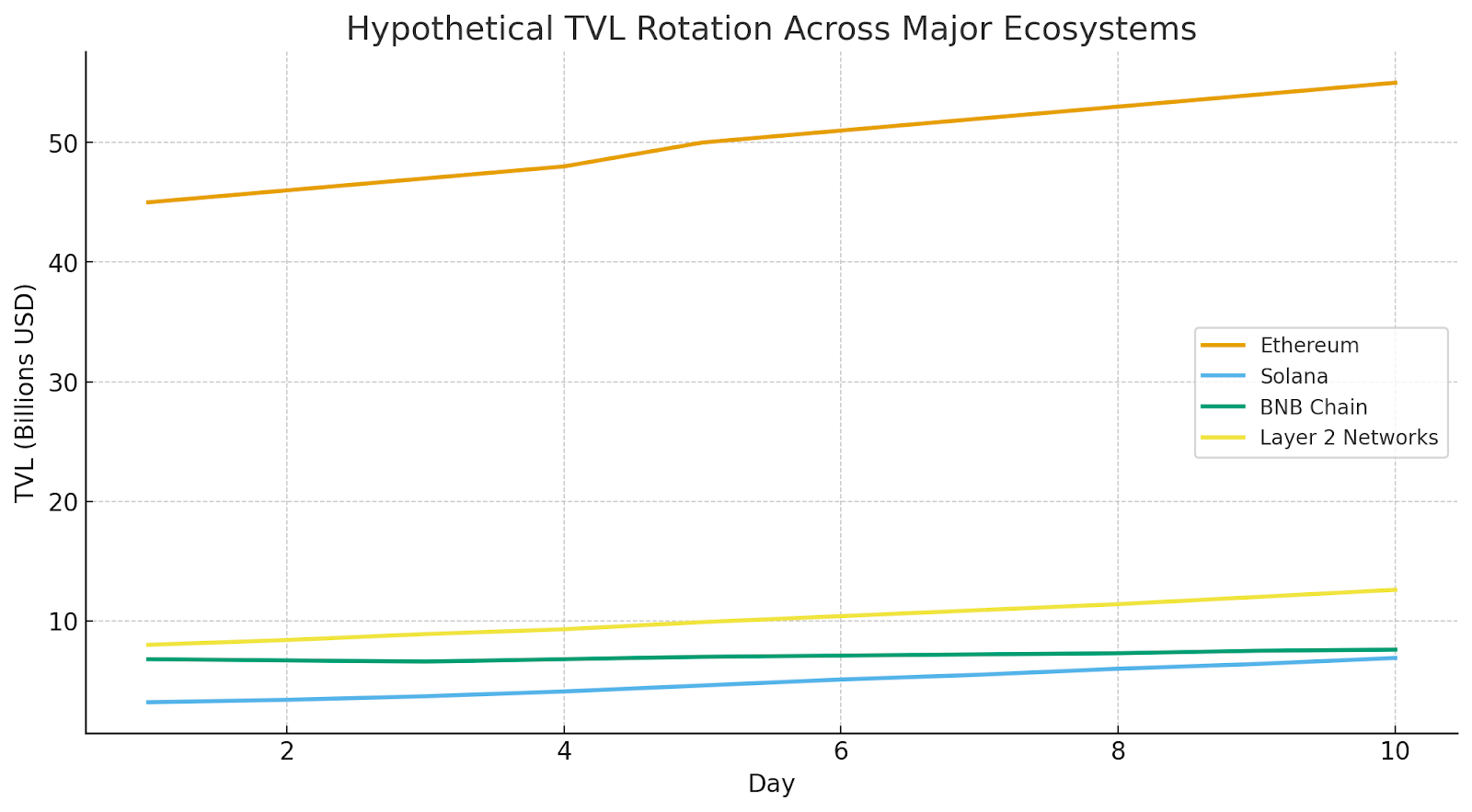
Liquidity does not remain fixed. It flows toward ecosystems offering better execution conditions, stronger incentives, or higher activity. This migration is one of the clearest structural signals in modern crypto markets.
Lower transaction costs and faster settlement have pulled liquidity toward scaling networks, while yield-driven environments tend to attract capital during expansionary phases. Conversely, during periods of stress, liquidity consolidates into deeper, more liquid venues. These shifts can be tracked by observing how liquidity redistributes across the broader market, rather than focusing on isolated assets, a perspective visible in consolidated market overviews such as
MEXC Markets.
These rotations are often the earliest indicators of emerging narratives. Capital clusters first; attention follows later.
Every crypto narrative begins with capital movement. It never starts with social media. It starts with liquidity clustering in a specific sector:
liquid staking,
RWAs, meme tokens, gaming, new L2 ecosystems, or cross-chain bridges.
Recent
market insights highlight how liquidity movement often shifts well before price reacts. This is why liquidity watchers consistently outperform sentiment-driven traders.
Narratives do not “appear.” They form when liquidity builds in the background.
Volatility is directly tied to liquidity distribution. When order books thin out or liquidity pools shrink, price movements become sharp and sudden. When liquidity deepens, price discovery becomes more stable.
This is why traders constantly track depth, slippage, and order-book thickness. Real-time BTC flow can be analyzed through tools such as
BTC market views to understand whether conditions favor stability or volatility.
Thin liquidity usually produces impulsive price swings. Deep liquidity favors smoother trends.
Large wallet behavior is one of the clearest indicators of where markets are heading. Institutions and sophisticated participants tend to move liquidity early and with minimal emotional bias. Their allocation patterns reveal accumulation, rotation, and exit phases long before those shifts become visible in price.
When large wallets accumulate stablecoins, markets are often preparing for transition rather than immediate movement. When that liquidity is deployed across chains or protocols, new narratives begin to form. These capital reallocations typically precede broader participation and set the tone for the next market phase.
Tracking smart money flows gives traders a meaningful edge because these moves appear well before retail behavior adjusts. By the time sentiment changes, positioning is often already complete.
Liquidity does not only shift between assets, it also expands and contracts within individual protocols. Lending platforms, staking systems, and automated market makers each reveal distinct liquidity patterns that reflect changing risk preferences.
Rising liquidity in lending pools often signals increased appetite for leverage. Growing deposits into staking protocols tend to suggest longer term confidence and reduced urgency to trade. Conversely, liquidity draining from decentralized exchange pools can indicate mounting uncertainty, reduced participation, or rotation into safer positions.
Protocol-level liquidity offers one of the most reliable lenses for understanding sector-level trends and anticipating market rotation before it becomes obvious.
Liquidity has evolved into a comprehensive framework for analyzing the crypto market. Traders who rely solely on price action often miss the structural forces shaping market behavior. Liquidity reveals where capital is moving, when narratives are forming, which assets carry real momentum, and how resilient or fragile market structure truly is.
Tools that visualize live trading data make it easier to evaluate liquidity across pairs and understand how markets respond under shifting conditions. By analyzing stablecoin flows, chain-to-chain rotation, large-wallet activity, and protocol-level deposits together, traders can develop a clearer view of market structure and position themselves ahead of major moves.
Liquidity also reveals market asymmetry, which is often invisible in price charts. When liquidity becomes unevenly distributed across chains or sectors, price efficiency breaks down. Assets with shallow liquidity react disproportionately to relatively small capital movements, while deeply liquid assets absorb similar flows with minimal disruption. This imbalance explains why certain sectors experience explosive moves while others remain stagnant despite similar narrative exposure. By comparing liquidity depth rather than price performance, traders can identify where markets are fragile versus where they are resilient.
Liquidity Persistence and Structural Strength
Another overlooked dimension is liquidity persistence. Not all capital entering an ecosystem behaves the same way. Short-term liquidity tends to chase incentives and exit quickly when conditions change, while long-term liquidity remains locked through staking, lending, or infrastructure participation. Markets dominated by transient liquidity are prone to sharp reversals, whereas ecosystems supported by persistent liquidity tend to form more stable trends. Distinguishing between these two types helps traders avoid mistaking temporary inflows for structural growth.
Network Mechanics and Liquidity Migration
Liquidity dynamics are also closely tied to network-level mechanics such as transaction validation, fee structures, and block production. During periods of heightened activity, constraints in these systems can amplify congestion, raise costs, and indirectly influence liquidity behavior as capital seeks more efficient environments. Processes like
blockchain mining influence these conditions by shaping transaction throughput, confirmation timing, and overall network reliability. When mining activity tightens capacity or increases costs, liquidity often migrates toward networks or layers offering smoother execution, reinforcing structural shifts across the market.
Applying liquidity signals effectively requires shifting focus away from short-term price reactions and toward capital behavior. Stablecoin inflows and outflows are often the earliest indicators of changing market conditions. Inflows suggest that sidelined capital is preparing to enter, while outflows typically reflect either risk reduction or a move toward longer-term positioning. These movements frequently appear well before major price shifts, offering early context rather than immediate trade signals.
Large-wallet accumulation patterns provide additional confirmation. Sophisticated participants tend to position gradually, spreading orders over time to avoid disrupting market structure. When accumulation occurs during periods of low volatility, it often reflects strategic positioning rather than speculative activity. Observing where and how this capital is deployed helps reveal directional bias before sentiment shifts at the retail level.
Protocol-level deposits and withdrawals add another layer of insight. Rising deposits into lending or staking platforms often signal increased confidence and a willingness to commit capital for longer durations. Sharp with drawals, particularly when coordinated across multiple protocols, can indicate rising caution or preparation for reallocation. These changes frequently align with shifts in risk appetite rather than immediate price action.
When analyzed together, stablecoin flows, large-wallet behavior, and protocol-level liquidity form a cohesive framework for understanding market conditions. Rather than predicting exact price levels, these signals help traders assess whether markets are expanding, consolidating, or preparing for transition. This perspective allows positioning ahead of the crowd by aligning with capital movement instead of reacting to headline-driven volatility.
Disclaimer:This article was written by Deborah Martin. All rights reserved.
This information does not provide advice on investment, taxation, legal, financial, accounting, or any other related services, nor does it constitute advice to purchase, sell, or hold any assets. MEXC Learn provides information for reference purposes only and does not constitute investment advice. Please ensure you fully understand the risks involved and exercise caution when investing. The platform is not responsible for users' investment decisions.