Helium’s HNT token has lost 36% of its value since hitting $4.03 in mid-July, trading at $2.95 on ahead of it’s third halving.  The drop has extended by 12% in the past 24 hours and nearly 20% over the past…Helium’s HNT token has lost 36% of its value since hitting $4.03 in mid-July, trading at $2.95 on ahead of it’s third halving.  The drop has extended by 12% in the past 24 hours and nearly 20% over the past…

HNT dips 36% from July peak — will Helium’s August 1 halving spark a rebound?

3 min read

Helium’s HNT token has lost 36% of its value since hitting $4.03 in mid-July, trading at $2.95 on ahead of it’s third halving. 

Summary
  • HNT falls 36% from July peak ahead of Helium’s August 1 halving, with the token now 94% below its all-time high.
  • The halving cuts daily emissions by 50% to 20,548 HNT and introduces new governance and reward requirements via veHNT delegation.
  • Market signals remain mixed, with a 31% rise in trading volume but falling open interest and bearish technical indicators across key metrics.

The drop has extended by 12% in the past 24 hours and nearly 20% over the past week. At its current level, Helium (HNT) sits 94% below its all-time high of $54.88 set in November 2021. 

Trading volume has picked up, with $14.7 million traded in the past 24 hours, a 31.2% increase, indicating a recent uptick in activity. Derivatives data from CoinGlass shows a 15.8% rise in volume to $6.37 million, though open interest has dropped 12% to $5.96 million. This suggests that some long positions have been closed or liquidated.

Halving reduces HNT emissions but shifts reward dynamics

The latest halving, which is set to go live today, Aug. 1, is part of Helium’s long-term supply strategy. As outlined in the network’s HIP-20, Helium reduces its daily token emissions by 50% every two years.

As a result, the amount of new HNT issued each year will decrease from 15 million to 7.5 million, or slightly more than 20,500 HNT per day. Although this shift affects miner incentives, it also promotes a deflationary model that aims to achieve long-term economic balance.

Rewards across the ecosystem will be impacted by the halving in different ways. Earnings from proof-of-coverage are immediately reduced, but rewards for data transfers, which are given out according to actual usage, are unaffected.

Despite a steep decline in rewards for passive earners, this distinction may help support active Hotspot operators who contribute to mobile and IoT data flows.

Importantly, the event also ties into Helium’s governance structure, where staking and delegation play a central role. To remain eligible for network rewards, veHNT holders who lock their HNT to obtain governance power must re-delegate by August 1.

This includes designating proxies to cast votes in their behalf if they are inactive, with a growing emphasis on guiding how emissions are split between Helium’s Mobile and IoT sub-networks.

Helium technical analysis

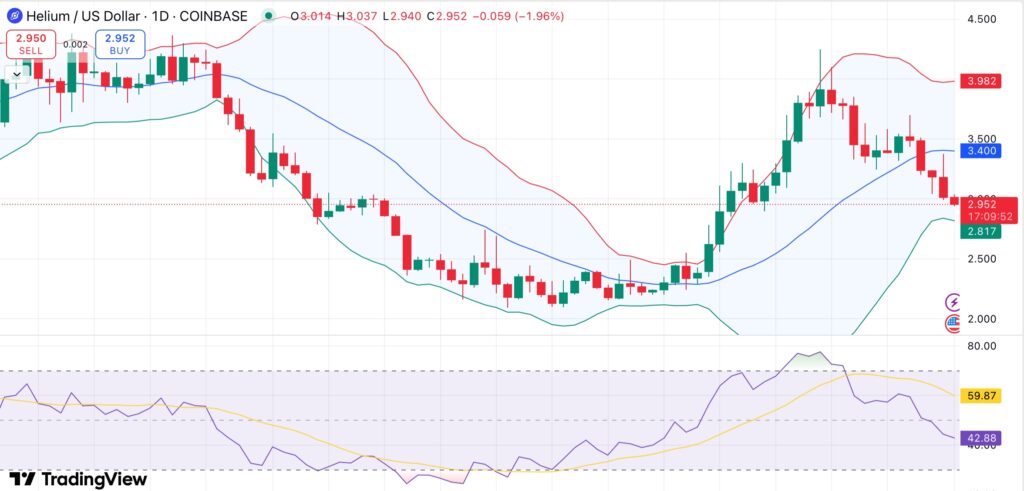
Price action is still weak despite the halving’s long-term significance. Short-term technical indicators point to a bearish outlook. At 43, the relative strength index is still neutral but on the decline. Momentum and MACD both display sell signals, while the Stochastic %K has fallen below 6, suggesting possible oversold conditions.
HNT dips 36% from July peak — will Helium’s August 1 halving spark a rebound? - 1

Moving averages paint a more bearish picture. HNT is trading below its 10-day to 200-day EMAs, with only the 50-day simple moving average showing support. The ADX at 35 points to trend strength but no reversal as of yet, and the Awesome Oscillator is still positive but flat.

A short-term bounce is still possible if the price stays above the crucial support level around $2.85 and there is stronh buying volume. However, the halving might not be sufficient to promote a long-term recovery unless sentiment improves or usage metrics increase.

Market Opportunity
TokenFi Logo
TokenFi Price(TOKEN)
$0.004067
$0.004067$0.004067
+9.65%
USD
TokenFi (TOKEN) Live Price Chart
Disclaimer: The articles reposted on this site are sourced from public platforms and are provided for informational purposes only. They do not necessarily reflect the views of MEXC. All rights remain with the original authors. If you believe any content infringes on third-party rights, please contact [email protected] for removal. MEXC makes no guarantees regarding the accuracy, completeness, or timeliness of the content and is not responsible for any actions taken based on the information provided. The content does not constitute financial, legal, or other professional advice, nor should it be considered a recommendation or endorsement by MEXC.

You May Also Like

XRPR and DOJE ETFs debut on American Cboe exchange

XRPR and DOJE ETFs debut on American Cboe exchange

The post XRPR and DOJE ETFs debut on American Cboe exchange appeared on BitcoinEthereumNews.com. Today is a historical milestone for two of the biggest cryptocurrencies, XRP and Dogecoin. REX-Osprey announced the official listing of two spot exchange-traded funds (ETFs) that track the price of XRP and Dogecoin in the United States. The new crypto funds are available for US investors on the Cboe BZX Exchange. The REX-Osprey XRP ETF is trading with ticker XRPR, while the DOGE ETF is listed with ticker DOJE. The first XRP and DOGE ETFs were listed today, and they provide direct spot exposure to Dogecoin and XRP. XRPR and DOJE are gates to crypto exposure XRPR provides exposure to XRP, the native token of the XRP Ledger, which is a blockchain that enables fast and low-cost cross-border transactions. DOJE, on the other hand, is the first-ever Dogecoin ETF. It offers investors regulated access to the first memecoin that built global recognition through its Shiba Inu mascot and active online community. Both funds use a structure under the Investment Company Act of 1940, which governs open-end mutual funds and ETFs in the US. This law was designed to protect investors from fraud, conflicts of interest, and poor oversight. This route gives investors the protections of a regulated open-end ETF. Each fund will hold a majority of its assets in spot XRP or DOGE, while also investing at least 40% in other crypto ETFs and ETPs, including those traded outside the United States. According to the SEC filing, XRPR charges an expense ratio of 0.75%, while DOJE charges 1.50%. The funds may also use a Cayman Islands subsidiary to buy crypto directly. This setup copies REX-Osprey’s Solana + Staking ETF (SSK), which launched in July and quickly grew past $275 million in assets. Greg King, the CEO and founder of REX Financial and Osprey Funds, said, “Investors look to ETFs as…
Share
BitcoinEthereumNews2025/09/19 03:14
Over 60% of crypto press releases linked to high-risk or scam projects: Report

Over 60% of crypto press releases linked to high-risk or scam projects: Report

A data analysis shows crypto press release wires are dominated by scam-linked projects, hype-driven content and low-impact announcements, raising concerns about
Share
Crypto.news2026/02/04 22:02
Outlook remains cautious – TD Securities

Outlook remains cautious – TD Securities

The post Outlook remains cautious – TD Securities appeared on BitcoinEthereumNews.com. TD Securities analysts anticipate that the Bank of England’s Monetary Policy
Share
BitcoinEthereumNews2026/02/04 22:15