Bitcoin’s quantum risk is real, but the network is not sleepwalking into it. That is the core conclusion of a March 19 research note from Galaxy Digital, whichBitcoin’s quantum risk is real, but the network is not sleepwalking into it. That is the core conclusion of a March 19 research note from Galaxy Digital, which

Bitcoin Is Rising To The Quantum Challenge, Galaxy Report Says

2026/03/20 23:30
4 min read
For feedback or concerns regarding this content, please contact us at [email protected]

Bitcoin’s quantum risk is real, but the network is not sleepwalking into it. That is the core conclusion of a March 19 research note from Galaxy Digital, which argues that while a sufficiently powerful quantum computer could one day threaten exposed Bitcoin wallets, developers are already doing substantial work on mitigation and migration.

Will Owens, a research analyst at Galaxy, frames the current debate as more polarized than the underlying facts justify. On one side are those who argue quantum computing is still decades away. On the other are those warning that the window may be far shorter and that Bitcoin needs to move now. Galaxy’s position sits between those camps: urgency is warranted, but so is perspective.

Bitcoin Is Getting Ready For The Quantum Threat

The report makes one point repeatedly. Not all bitcoin is equally exposed. Funds are only vulnerable when public keys are visible on-chain, which means the biggest long-term risk sits with legacy wallet formats, reused addresses, some exchange or custodian setups, and older outputs including coins believed to be tied to Satoshi Nakamoto. Citing analysis from Project Eleven, Galaxy says roughly 7 million BTC, worth about $470 billion at recent prices, may be vulnerable under a broad “long exposure” definition, though it notes other estimates come in lower depending on methodology.

That distinction matters because Bitcoin’s UTXO model still gives it structural protection that account-based chains do not. As Galaxy puts it, “In Bitcoin, public keys are typically revealed only when coins are spent, meaning a large share of the supply remains protected behind hashed addresses until transaction time.” The report adds: “This distinction does not eliminate risk for Bitcoin, but it does materially affect the scope and sequencing of exposure in a potential Q-day event.” In other words, Bitcoin has a narrower attack surface than many casual discussions imply.

Galaxy also pushes back hard on the idea that Bitcoin developers are ignoring the issue. Owens writes that recent social media criticism has overstated the gap between public perception and actual technical work. Ethan Heilman, one of the co-authors of BIP 360, said the proposal has received “more comments than any other BIP so far in history of BIPs,” according to the report.

It also cites two blunt remarks from active contributors: “Yes, developers are working on [quantum resistance]. I can point to many people working on this,” said Matt Corallo. Hunter Beast struck a similar tone: “We are working very hard on this very serious problem, and we think that it is the most serious concern that people have raised about Bitcoin.”

The technical path forward is beginning to take shape. Galaxy highlights BIP 360, or Pay-to-Merkle-Root, as the leading protective proposal. The design would remove Taproot’s always-visible key-path spend and create a more quantum-resilient output structure via soft fork, reducing long-exposure risk without forcing Bitcoin to immediately choose a final post-quantum signature standard.

From there, the conversation branches into harder territory. One layer is protection for future outputs. Another is mitigation for coins that are already exposed and may never migrate. That is where proposals like Hourglass enter the discussion. Rather than freezing vulnerable coins outright or allowing quantum-capable actors to sweep and dump them freely, Galaxy describes Hourglass as a “harm reduction” approach designed to limit the rate at which exposed coins could be extracted and sold during a quantum event.

The report also surveys fallback and emergency ideas, including hash-based signatures such as SLH-DSA, Tadge Dryja’s commit/reveal design for a worst-case early CRQC scenario, and seed phrase zero-knowledge proofs for recovery and authentication. None solves the entire problem alone. Together, though, they suggest Bitcoin’s response is becoming broader and more concrete.

Galaxy is careful not to understate the governance problem. Bitcoin upgrades remain slow by design, and the report points to the long timelines around SegWit and Taproot as reminders that even well-supported changes can take years. Still, Owens argues this threat is different. “There is no constituency,” he writes, “that benefits from Bitcoin being vulnerable to quantum attack.” That alignment of incentives may prove decisive if the risk becomes more immediate.

Overall, Galaxy’s message is straightforward: the threat is serious, the debate is no longer theoretical, and the work to prepare for it is already underway.

At press time, BTC traded at $70,360.
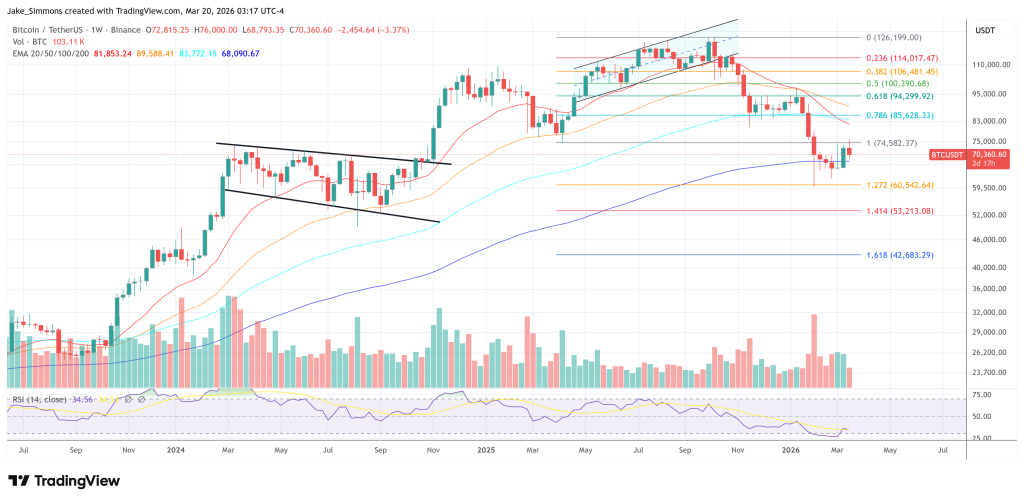
Bitcoin price chart
Market Opportunity
QUANTUM Logo
QUANTUM Price(QUANTUM)
$0.00279
$0.00279$0.00279
+1.41%
USD
QUANTUM (QUANTUM) Live Price Chart
Disclaimer: The articles reposted on this site are sourced from public platforms and are provided for informational purposes only. They do not necessarily reflect the views of MEXC. All rights remain with the original authors. If you believe any content infringes on third-party rights, please contact [email protected] for removal. MEXC makes no guarantees regarding the accuracy, completeness, or timeliness of the content and is not responsible for any actions taken based on the information provided. The content does not constitute financial, legal, or other professional advice, nor should it be considered a recommendation or endorsement by MEXC.

You May Also Like

Ethereum Price Prediction: ETH Targets $10,000 In 2026 But Layer Brett Could Reach $1 From $0.0058

Ethereum Price Prediction: ETH Targets $10,000 In 2026 But Layer Brett Could Reach $1 From $0.0058

Ethereum price predictions are turning heads, with analysts suggesting ETH could climb to $10,000 by 2026 as institutional demand and network upgrades drive growth. While Ethereum remains a blue-chip asset, investors looking for sharper multiples are eyeing Layer Brett (LBRETT). Currently in presale at just $0.0058, the Ethereum Layer 2 meme coin is drawing huge [...] The post Ethereum Price Prediction: ETH Targets $10,000 In 2026 But Layer Brett Could Reach $1 From $0.0058 appeared first on Blockonomi.
Share
Blockonomi2025/09/17 23:45
Best Crypto to Buy as Saylor & Crypto Execs Meet in US Treasury Council

Best Crypto to Buy as Saylor & Crypto Execs Meet in US Treasury Council

The post Best Crypto to Buy as Saylor & Crypto Execs Meet in US Treasury Council appeared on BitcoinEthereumNews.com. Michael Saylor and a group of crypto executives met in Washington, D.C. yesterday to push for the Strategic Bitcoin Reserve Bill (the BITCOIN Act), which would see the U.S. acquire up to 1M $BTC over five years. With Bitcoin being positioned yet again as a cornerstone of national monetary policy, many investors are turning their eyes to projects that lean into this narrative – altcoins, meme coins, and presales that could ride on the same wave. Read on for three of the best crypto projects that seem especially well‐suited to benefit from this macro shift:  Bitcoin Hyper, Best Wallet Token, and Remittix. These projects stand out for having a strong use case and high adoption potential, especially given the push for a U.S. Bitcoin reserve.   Why the Bitcoin Reserve Bill Matters for Crypto Markets The strategic Bitcoin Reserve Bill could mark a turning point for the U.S. approach to digital assets. The proposal would see America build a long-term Bitcoin reserve by acquiring up to one million $BTC over five years. To make this happen, lawmakers are exploring creative funding methods such as revaluing old gold certificates. The plan also leans on confiscated Bitcoin already held by the government, worth an estimated $15–20B. This isn’t just a headline for policy wonks. It signals that Bitcoin is moving from the margins into the core of financial strategy. Industry figures like Michael Saylor, Senator Cynthia Lummis, and Marathon Digital’s Fred Thiel are all backing the bill. They see Bitcoin not just as an investment, but as a hedge against systemic risks. For the wider crypto market, this opens the door for projects tied to Bitcoin and the infrastructure that supports it. 1. Bitcoin Hyper ($HYPER) – Turning Bitcoin Into More Than Just Digital Gold The U.S. may soon treat Bitcoin as…
Share
BitcoinEthereumNews2025/09/18 00:27
One Of Frank Sinatra’s Most Famous Albums Is Back In The Spotlight

One Of Frank Sinatra’s Most Famous Albums Is Back In The Spotlight

The post One Of Frank Sinatra’s Most Famous Albums Is Back In The Spotlight appeared on BitcoinEthereumNews.com. Frank Sinatra’s The World We Knew returns to the Jazz Albums and Traditional Jazz Albums charts, showing continued demand for his timeless music. Frank Sinatra performs on his TV special Frank Sinatra: A Man and his Music Bettmann Archive These days on the Billboard charts, Frank Sinatra’s music can always be found on the jazz-specific rankings. While the art he created when he was still working was pop at the time, and later classified as traditional pop, there is no such list for the latter format in America, and so his throwback projects and cuts appear on jazz lists instead. It’s on those charts where Sinatra rebounds this week, and one of his popular projects returns not to one, but two tallies at the same time, helping him increase the total amount of real estate he owns at the moment. Frank Sinatra’s The World We Knew Returns Sinatra’s The World We Knew is a top performer again, if only on the jazz lists. That set rebounds to No. 15 on the Traditional Jazz Albums chart and comes in at No. 20 on the all-encompassing Jazz Albums ranking after not appearing on either roster just last frame. The World We Knew’s All-Time Highs The World We Knew returns close to its all-time peak on both of those rosters. Sinatra’s classic has peaked at No. 11 on the Traditional Jazz Albums chart, just missing out on becoming another top 10 for the crooner. The set climbed all the way to No. 15 on the Jazz Albums tally and has now spent just under two months on the rosters. Frank Sinatra’s Album With Classic Hits Sinatra released The World We Knew in the summer of 1967. The title track, which on the album is actually known as “The World We Knew (Over and…
Share
BitcoinEthereumNews2025/09/18 00:02