Airdrop

An Airdrop is a distribution of free tokens to a community, typically used as a marketing tool or a reward for early protocol adopters and testers. In 2026, the "points-to-airdrop" model has matured into merit-based incentive programs that utilize Sybil-resistance and Proof-of-Humanity to filter out bots. Airdrops remain a primary method for decentralized governance (DAO) bootstrapping. Follow this tag for the latest on retroactive rewards, eligibility criteria, and how to participate in the most anticipated token distributions in the ecosystem.

5434 Articles
Created: 2026/02/02 18:52
Updated: 2026/02/02 18:52

CZ responds to the controversy surrounding "listing fees": If a project is strong, there is no need to list the token.

CZ responds to the controversy surrounding "listing fees": If a project is strong, there is no need to list the token.

PANews reported on October 15th that CZ posted on the X platform that if a project is dissatisfied with an exchange's "airdrop" or "listing fee," they can choose not to pay; if the project is strong enough, exchanges will naturally compete to list its token. He pointed out: There is no need to list strong projects, instead we should reflect on the ownership of their value. If you question the listing fees he charges, you can set it to 0, "or even all fees can be set to 0." If the coin holder is dissatisfied with the fact that the currency has not been launched, he should contact the project owner, not the exchange; DEX can also be used. PancakeSwap has no listing fees and a large trading volume. He also listed various listing models used by exchanges, including "full-chain open listing," "fee-based screening," and "airdrops + margin to prevent fraud," emphasizing that all models are viable. Finally, he suggested that project owners focus on their own development rather than complaining about others.

Author: PANews
Aster Price Breaks Out, Will Whale Moves and Airdrop Fuel a Rally?

Aster Price Breaks Out, Will Whale Moves and Airdrop Fuel a Rally?

The post Aster Price Breaks Out, Will Whale Moves and Airdrop Fuel a Rally? appeared first on Coinpedia Fintech News Over the past 24 hours, Aster price surged by an impressive 12.14%, clawing back from a sharp 21.92% weekly decline. This rebound isn’t just about a bounce, it’s driven by 3 compelling factors. First, the anticipation of Stage 2 airdrop claims, unlocking 4% of ASTER’s supply worth $570 million. Active whale accumulation during last week’s …

Author: CoinPedia
XRP Forms Death Cross vs. Bitcoin, Dogecoin (DOGE) Jumps 13%, Shiba Inu Erases Zero — Crypto News Digest

XRP Forms Death Cross vs. Bitcoin, Dogecoin (DOGE) Jumps 13%, Shiba Inu Erases Zero — Crypto News Digest

The post XRP Forms Death Cross vs. Bitcoin, Dogecoin (DOGE) Jumps 13%, Shiba Inu Erases Zero — Crypto News Digest appeared on BitcoinEthereumNews.com. Shiba Inu suffers steep decline amid crypto market turmoil Shiba Inu fell to low of $0.0000085 during recent crash before recovering. Severe impact. Shiba Inu (SHIB) ranks among the worst-hit assets following Friday’s flash crash XRP just locked in a death cross against Bitcoin as the 23-day moving average fell under the 200-day, the kind of textbook bearish signal traders better not dismiss. The pair trades at 0.00002247 BTC with Bitcoin quoted near $111,000, and XRP’s price is at $2.49 in dollar terms. Loss of support. SHIB broke below the key $0.000010 level, a crucial psychological and technical support. The formation arrives on the back of last week’s violent liquidation, when XRP/BTC collapsed to 0.000013 BTC before recovering. That spike low was temporary, but the chart now shows what happens after panic fades: rallies start hitting a ceiling. The moving averages cluster near 0.00002400–0.000025 per BTC, and until XRP clears that band, it is capped. The last time this happened was in 2022: the cross dragged on for months, not days. This time, the backdrop looks worse. Bitcoin dominance has surged, altcoin liquidity is thinner and post-liquidation order books leave XRP exposed. XRP confirms bearish death cross against Bitcoin XRP prints a dangerous death cross versus Bitcoin, and here’s the worst scenario. Death cross confirmed. XRP has officially formed a death cross against Bitcoin as the 23-day moving average dropped below the 200-day XRP just locked in a death cross against Bitcoin as the 23-day moving average fell under the 200-day, the kind of textbook bearish signal traders better not dismiss. The pair trades at 0.00002247 BTC with Bitcoin quoted near $111,000, and XRP’s price is at $2.49 in dollar terms. Aftermath of liquidations. The cross follows last week’s violent liquidation event. The formation arrives on the back of last week’s violent…

Author: BitcoinEthereumNews
Sreeram Kannan: Building a Trust Layer for Ethereum

Sreeram Kannan: Building a Trust Layer for Ethereum

Despite the controversy, EigenLayer remains at the core of Ethereum’s evolution. Written by Thejaswini MA Compiled by: Block unicorn Preface The Caltech interviewer leaned forward and asked an interesting question. “Suppose I give you unlimited resources, unlimited talent, and 30 years. You lock yourself in a lab like a hermit. After 30 years, you come out and tell me what you invented. What would you create?” Kanan, then a postdoctoral researcher applying for faculty positions, was stunned. His mind went blank. This problem required unconstrained thinking on a scale he had never attempted before. He had been tackling computational genomics problems for years, building on existing knowledge and making incremental progress. But this problem presented no constraints. No budget constraints. No time pressures. No talent shortages. There's just one request: What would you build if there were no obstacles? “I was completely blown away by the scope of the problem,” Kanan recalls. The level of freedom terrified him. He didn’t get the Caltech position. But the problem planted a seed in him that would later grow into one of Ethereum’s most controversial innovations: EigenLayer. Yet, the journey from a Caltech interview room to running a multi-billion dollar crypto company required Kanan to answer the 30-year-old question in three separate stages, changing his answer with each new phase. Academic Journey and Transformation Kannan grew up in Chennai, southern India, where pure mathematics captured his imagination early on. He remained in India to pursue his undergraduate degree at the Guidance College of Engineering, where he participated in the development of ANUSAT, India's first student-designed microsatellite. This project sparked his interest in complex systems and coordination problems. He arrived in the United States in 2008 with just $40 in funding. He studied telecommunications engineering at the Indian Institute of Science in Bangalore and went on to earn a master's degree in mathematics and a doctorate in electrical and computer engineering from the University of Illinois at Urbana-Champaign. His doctoral research focused on network information theory, or how information flows through networks of nodes. He spent six years solving long-standing problems in the field. When he finally cracked them, only twenty people in his subfield took notice. No one else paid attention. The disappointment prompted a moment of reflection. He had been pursuing curiosity and intellectual beauty, not impact. If you don't deliberately pursue it, you can't expect real-world changes to appear as random byproducts. He drew a two-dimensional graph. The X-axis represented technical depth, and the Y-axis represented impact. His work fell firmly into the high-depth, low-impact quadrant. It was time to move on. In 2012, he attended a lecture on synthetic genomics by Craig Venter, one of the founders of the Human Genome Project. The field was creating new species, talking about making biological robots rather than mechanical ones. Why waste time optimizing download speeds when you could reprogram life itself? He transitioned completely to computational genomics, focusing on it during his postdoctoral research at Berkeley and Stanford, where he investigated DNA sequencing algorithms and built mathematical models to understand gene structure. Then, artificial intelligence caught him off guard. A student proposed using AI to solve the DNA sequencing problem. Kanan rejected the idea. How could his carefully crafted mathematical model be outperformed by a neural network? The student built the model anyway. Two weeks later, the AI crushed Kanan's best benchmark. The message was: within ten years, AI will replace all his mathematical algorithms. Everything he relied on for his career will be obsolete. He faced a choice: delve deeper into AI-driven biology or try a new direction. In the end, he chose the new one. From Buffalo to Earth The Caltech question had always troubled him. Not because he couldn't answer it, but because he had never thought about it that way before. Most people work incrementally. You have X capabilities, and you try to build X plus incrementally. Making small improvements on what you already have. The 30-year question requires a completely different kind of thinking. It asks us to imagine a destination without worrying about the path. After joining the University of Washington as an assistant professor in 2014, Kanan set out on his first 30-year project: decoding how information is stored in living systems. He gathered collaborators and made progress. Everything seemed to be on track. Then, in 2017, his PhD advisor called and told him about Bitcoin. It had throughput and latency issues—exactly what Kanan had studied during his PhD. His first reaction? Why would he abandon genomics for "wild guesswork"? The technological fit was clear, but it seemed far removed from his grand vision. Then he reread Yuval Noah Harari's "Sapiens: A Brief History of Humankind." One idea struck him: What makes humans special isn't our innovation or cleverness, but our ability to coordinate on a massive scale. Coordination requires trust. The internet connected billions of people, but it left a gap. It allowed us to communicate instantly across continents, but it provided no mechanism to ensure people would keep their promises. Email could transmit promises in milliseconds, but enforcing them still required lawyers, contracts, and centralized institutions. Blockchains fill this gap. They're not just databases or digital currencies; they're execution engines that transform promises into code. For the first time, strangers can reach binding agreements without relying on banks, governments, or platforms. The code itself holds people accountable. This became Kanan's new 30-year goal: to build a coordination engine for humanity. But here, Cannan learned something that many academics often overlook. Having a 30-year vision doesn't mean you can jump straight to 30 years. You have to gain an advantage to solve bigger problems. Moving the Earth requires a million times more energy than moving a buffalo. If you want to eventually move the Earth, you can't just declare it and hope the resources arrive. According to Kannan, you must first move a buffalo. Then maybe a car. Then a building. Then a city. Each success gives you a bigger chip to take on the next challenge. The world is designed this way for a reason. Give someone who has never moved a buffalo the power to move the Earth, and the whole world might explode. Incremental leverage prevents catastrophic failure. Kanan's first attempt at moving buffaloes was Trifecta, a high-throughput blockchain he and two other professors were building. They proposed a blockchain capable of 100,000 transactions per second. But no one funded it. Why? Because no one needed it. The team optimized the technology without understanding market incentives or identifying the customer. They hired people who thought like them—all PhDs who were solving theoretical problems. Trifecta failed. Kanan returned to academia and research. He tried again, creating an NFT marketplace called Arctics. He was previously an advisor to Dapper Labs (which runs NBA Top Shot). The NFT space seemed promising. But as he built the marketplace, he kept running into infrastructure challenges. How could he get reliable price oracles for NFTs? How could he bridge NFTs between different chains? How could he run different execution environments? This market also failed. He didn’t understand the mindset of NFT traders. If you are not your own customer, you can’t build a meaningful product. Every problem requires the same thing: a network of trust. Should he build an oracle? A bridge? Or should he build the metathing that solves all these problems—the trust network itself? He understood this. He was exactly the kind of person who could build an oracle or a bridge. He could become his own client. In July 2021, Kanan founded Eigen Labs. The name comes from the German word for "own," meaning that anyone can build whatever they want. Its core philosophy is to enable open innovation through shared security. The technological innovation is re-staking. Ethereum validators lock up ETH to secure the network. What if they could also use those assets to secure other protocols? Instead of building their own security from scratch, new blockchains or services could leverage Ethereum's established validator set. Kanan pitched the idea to a16z five times before securing funding. One early pitch was memorable for the wrong reasons. Kanan wanted to build on Cardano because it had an $80 billion market cap but no working smart contracts. An a16z partner answered the phone from outside the Solana conference. Their reaction: "That's interesting. Why did you choose Cardano?" The feedback forced Kanan to think about focus. Startups are exponential games. You want to transform linear work into exponential impact. If you think you have three exponential ideas, you probably don't have one. You need to choose the one with the highest exponential value and go all in. He refocused on Ethereum, a decision that proved to be a good one. By 2023, EigenLayer had raised over $100 million from firms including Andreessen Horowitz. The protocol was rolled out in phases, reaching a total value locked of $20 billion at its peak. Developers are beginning to build “Active Verification Services” (AVS) on EigenLayer, from data availability layers to AI inference networks, each of which can leverage Ethereum’s security pool without having to build a validator from scratch. However, with success comes scrutiny. In April 2024, EigenLayer announced its EIGEN token distribution, which sparked a backlash. The airdrop locked up tokens for months, preventing recipients from selling them. Geographic restrictions excluded users in jurisdictions like the United States, Canada, and China. Many early adopters, who deposited billions of dollars, felt the distribution favored insiders over community members. The reaction caught Kanan off guard. The protocol's total locked value plummeted by $351 million, and users withdrew their funds in protest. The controversy exposed the gap between Kanan's academic thinking and the expectations of the crypto world. Then came the conflict of interest scandal. In August 2024, CoinDesk reported that Eigen Labs employees received nearly $5 million in airdrops from projects built on EigenLayer. Employees collectively claimed hundreds of thousands of tokens from projects like EtherFi, Renzo, and Altlayer. At least one project, under pressure, included its employees in its distribution. The revelation sparked accusations that EigenLayer was compromising its “trusted neutrality” stance by using influence to reward projects that offered tokens to employees. Eigen Labs responded by banning ecosystem projects from airdropping to employees and implementing a lock-up period. But its reputation has been damaged. Despite these controversies, EigenLayer remains at the heart of Ethereum’s evolution. The protocol has already secured partnerships with major players like Google Cloud and Coinbase, which serves as a node operator. Kanan’s vision goes far beyond restaking. “Crypto is our coordination superhighway,” he said. “Blockchains are commitment engines. They enable you to make and keep commitments.” He thinks in terms of quantity, diversity, and verifiability. How many promises can humans make and keep? How diverse can those promises be? And how easily can we verify them? “This is a crazy, century-long project,” Kanan said. “It’s going to upgrade the human species.” The protocol launched EigenDA, a data availability system designed to handle the aggregate throughput of all blockchains. The team introduced a subjective governance mechanism to resolve disputes that cannot be verified solely on-chain. But Kanan admits the work is far from done. “Until you can run education and healthcare on the blockchain, the work is not done. We are far from done.” His approach combines top-down vision with bottom-up execution. You need to know where the mountain is. But you also need to find the slope leading there from where you stand today. “If you can’t do anything with your long-term vision today, it’s useless,” he explains. Verifiable cloud is the next frontier for EigenLayer. Traditional cloud services require trust in Amazon, Google, or Microsoft. Kanan's version lets anyone run cloud services—storage, compute, AI inference—and cryptographically prove they're executing correctly. Validators stake their integrity. Malicious actors lose their stake. Now in his 40s, Kanan remains an affiliated professor at the University of Washington and runs Eigen Labs. He still publishes research and thinks in terms of information theory and distributed systems. But he's no longer the academic who couldn't answer Caltech's 30-year-old question. He's now answered it three times—with genomics, with blockchain, and with the Coordination Engine. Each answer builds on the lessons learned from the previous attempt. The buffalo had been moved. The car had been turned on. The building had begun to move. Whether he could ultimately move the Earth remained to be seen. But Kanan had learned something many scholars never did: the path to solving big problems begins with solving small ones, which build upon the foundations for solving even bigger ones. This is the story about the founder of EigenLayer.

Author: PANews
Check Your MONAD Airdrop!

Check Your MONAD Airdrop!

Monad has officially announced its airdrop today, October 14, 2025, on its blog. With a total expected token supply of 100 billion MON and tokens allocated to over 230,000 wallets across various community and power user tracks, this event marks one of the most significant token distributions of the year for the wider crypto community, developers, and onchain power users. About Monad Monad is a new, high-performance EVM-compatible Layer 1 blockchain built by Monad Labs, a team with former Jump Trading background. Specifically, Monad’s core mission is to solve the bottleneck of scalability by introducing Parallel Execution to the Ethereum Virtual Machine, which allows it to achieve a throughput of 10,000 transactions per second and sub-second finality. As a result, this approach provides full compatibility for existing Ethereum applications while offering superior performance, thus positioning Monad as a powerful new infrastructure for DeFi and complex decentralized applications. Finally, the project is backed by top-tier venture capital, including a $225 million funding round led by Paradigm. Learn more: What is Monad (MON)? Layer 1 Solution to Blockchain Trilemma On October 14, Monad officially announced its airdrop for users: The Monad Airdrop Claim Portal is live Claim your MON here: https://t.co/WAKIvKK8xmhttps://t.co/WAKIvKK8xm — Monad (mainnet arc) (@monad) October 14, 2025 MON Tokenomics While the definitive, detailed tokenomics are yet to be fully disclosed, the key aspects of the MON token model are: Total Supply: The widely anticipated total supply is 100 billion MON, based on market speculation and pre-market trading data. Airdrop Allocation: The exact quantity of tokens allocated to the airdrop pool is To be officially announced (TBA). Learn more: Monad Confirms MON Airdrop Date, Allocation Rules Still a Secret No Insiders: The Monad Foundation has confirmed that full-time team members from Monad Foundation and Category Labs are expressly prohibited from claiming tokens in the airdrop. MON Token Airdrop Details The main details of the airdrop are as follows: Claim Portal Opening: October 14, 2025 (Today). Snapshot Date: The primary snapshot date for onchain user activity was September 30, 2025, at 23:59 UTC. Total Eligible Wallets: Over 230,000 wallets are allocated tokens. Claim Window: The claim portal will be open from October 14 until November 3, 2025. The airdrop recipients were determined through an extensive analysis of onchain and offchain data. Furthermore, anti-sybil efforts were conducted by the Monad Foundation in partnership with Trusta AI. It is important to note that individuals who qualify through multiple allocation tracks are eligible to receive the combined total of their allocations. MON Airdrop Criteria The MON airdrop is divided into five main tracks, rewarding individuals for diverse and long-term participation in the Monad ecosystem and the broader crypto space: Monad Community: This is the largest component of the airdrop. It rewards core members identified through exhaustive manual effort, social graph analysis, and input from community-driven apps like the Monad Community Recognizer. Onchain Users: Targets power users of major EVM and Solana mainnets, focusing on high-value, sustained activity. Criteria include: Significant DEX traders (spot and perpetuals). Significant depositors into major DeFi protocolsa (e.g., Aave, Pendle, Uniswap, etc.).  Longtime holders of notable NFT collections (e.g., Pudgy Penguins, Mad Lads, CryptoPunks, etc.).  Recently active DAO governance participants. Crypto Community: Includes members of the wider crypto community identified through: Participation in the Monad Cards initiative. Users of platforms like Backpack, Fantasy Top, and Legion. Active users on Farcaster. Crypto Contributors: Allocates tokens to individuals who contributed to the betterment of crypto through: Security Research (e.g., SEAL 911, select Cantina auditors).  Protocol Development (e.g., Protocol Guild members). Educational Efforts (e.g., RareSkills, SheFi). Monad Builders: Rewards individuals and teams growing the Monad ecosystem:  Teams building natively on Monad. Developers who made qualified submissions in hackathons (Monad Blitzes, Dev Missions). How to Check Your MON Airdrop Eligibility Step-by-Step Step 1: Go to the official claim page: The only valid portal is https://claim.monad.xyz. Be extremely cautious and beware of imposter websites and scams. Source: Monad Step 2: Connect your Wallet/Account: The portal uses Privy for authentication. You can connect by signing a message with your EVM or Solana wallets that you used for activities. You can also link your social accounts (Twitter, Discord, Telegram, Farcaster, or email). Read more at Monad’s blog. If you are eligible for the airdrop, your total MON allocation will be displayed. Remember to claim your tokens before the window closes on November 3, 2025. Learn more: Best Upcoming Airdrops to Watch in 2025 The post Check Your MONAD Airdrop! appeared first on NFT Plazas.

Author: Coinstats
Critical Warning Concerning Shiba Inu (SHIB) Users: Details

Critical Warning Concerning Shiba Inu (SHIB) Users: Details

The SHIB army should only rely on official sources and avoid suspicious websites that may embezzle their funds.

Author: CryptoPotato
Nearly 40,000 addresses received the first batch of "Rebirth Support" airdrops, totaling 8,923.1 BNB.

Nearly 40,000 addresses received the first batch of "Rebirth Support" airdrops, totaling 8,923.1 BNB.

PANews reported on October 15th that according to analyst @dethective, nearly 40,000 addresses received airdrops in the first round of the $45 million "Rebirth Support" airdrop from BNB Chain and Four.Meme, totaling 8,923.1 BNB. The highest airdrop was 33.33 BNB (worth approximately $40,000), while the lowest was 0.01166 BNB. The address that received the most, 33.33 BNB, lost 200 BNB in trading.

Author: PANews
Long-Awaited Airdrop Has Finally Begun: Here’s Who Can Receive It

Long-Awaited Airdrop Has Finally Begun: Here’s Who Can Receive It

The post Long-Awaited Airdrop Has Finally Begun: Here’s Who Can Receive It appeared on BitcoinEthereumNews.com. The Monad Foundation announced that the long-awaited MON airdrop is now available for claiming. A total of 5,500 Monad community members and approximately 225,000 members of the broader cryptocurrency community will be able to receive MON tokens from this distribution. The airdrop claim period will run until November 3, 2025. The MON airdrop, divided into five categories, is designed to target users with significant on-chain and off-chain activity. The distribution includes Monad Card holders, active Farcaster users, security researchers (e.g., ZachXBT and SEAL 911 members), local development teams within the Monad ecosystem, and users active in DeFi protocols. The Monad Foundation stated that the goal of this airdrop was to “turn genuine crypto users and active members of the Monad community into the network’s first users.” The foundation designed this process to combat fake accounts and bots. To this end, it partnered with a third-party organization called Trusta AI to eliminate sybil (bot) addresses. The Monad Foundation advises that there is no advantage to claiming early, so users should proceed with caution. *This is not investment advice. Follow our Telegram and Twitter account now for exclusive news, analytics and on-chain data! Source: https://en.bitcoinsistemi.com/long-awaited-airdrop-has-finally-begun-heres-who-can-receive-it/

Author: BitcoinEthereumNews
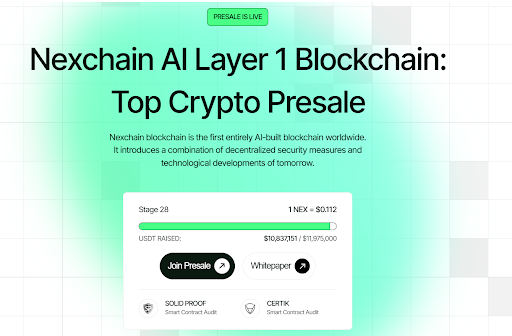
Nexchain AI Token Presale Gains Momentum As Investors Seek Alternatives Beyond Ethereum

Nexchain AI Token Presale Gains Momentum As Investors Seek Alternatives Beyond Ethereum

For several years now, Ethereum has maintained its position as the second-largest digital asset by market capitalization. However, its growth has slowed, and limited price movement has caused investors to The post Nexchain AI Token Presale Gains Momentum As Investors Seek Alternatives Beyond Ethereum appeared first on CryptoNinjas.

Author: Crypto Ninjas
BNB Chain and Four.Meme Complete First Batch of $45 Million “Reload Airdrop”

BNB Chain and Four.Meme Complete First Batch of $45 Million “Reload Airdrop”

PANews reported on October 15th that BNB Chain announced on the X platform that the first round of its $45 million "Reload Airdrop," a partnership with Four.Meme, has been completed. The airdrop will be distributed in four tranches, with recipient addresses announced for each round to allow the community to verify each step of the process. This is only the first phase; subsequent tranches are being processed and will follow soon. Further tranches will be distributed in the coming weeks, with all distributions expected to be completed by early November 2025. Updates will be released on official channels as each tranche is finalized. Important: There will be no website or form for claiming this airdrop. All recipient addresses will automatically receive the airdrop. Please verify information only through official BNB Chain and Four.Meme channels.

Author: PANews