Dapp

Dapps are digital applications that run on a P2P network of computers rather than a single server, typically utilizing smart contracts to ensure transparency and uptime. In 2026, Dapps have achieved mass-market appeal through Account Abstraction, allowing for a "Web2-like" user experience with the security of Web3. This tag covers the entire ecosystem of decentralized software—from social media and productivity tools to governance platforms and identity management.

4953 Articles
Created: 2026/02/02 18:52
Updated: 2026/02/02 18:52
Best Crypto Presales to Buy as Peter Brandt Predicts Bitcoin Dip Before ATH

Best Crypto Presales to Buy as Peter Brandt Predicts Bitcoin Dip Before ATH

The post Best Crypto Presales to Buy as Peter Brandt Predicts Bitcoin Dip Before ATH appeared on BitcoinEthereumNews.com. Good things come to those who wait when it comes to Bitcoin’s resurgence, at least according to veteran trader Peter Brandt. KEY POINTS: ➡️ Bitcoin could see a new ATH within the next week, according to veteran trader Peter Brandt – but a slide to $50K is still possible. ➡️ Several factors could influence Bitcoin’s price in the foreseeable future, including new rate cuts by the US Fed that investors expect. ➡️ In the meantime, the best crypto presales to buy, like Bitcoin Hyper and Snorter Token, offer viable alternatives to investors looking for coins with predictable returns. Peter Brandt was quoted by Cointelegraph as saying that a new ATH could be on the table within the next week or so, although he didn’t entirely dismiss the possibility of a slide to the $50K to $60K level. For traders who are looking to continue investing in crypto and but prefer more predictable returns, presales could be the way to go. As such, the likes of Bitcoin Hyper ($HYPER) and Snorter Token ($SNORT) are two of the best crypto presales to get into right now. There are also other silver linings on the horizon apart from presales. This includes the potential for further rate cuts by the US Federal Reserve. In a speech yesterday, US Fed Chair Jerome Powell said that the country is seeing ‘very low levels of job creation, and yet people are spending,’ adding that they are going to see how things will play out. Investors take this as a strong signal that the Fed could announce rate cuts in the next two weeks. Should this happen, it could fuel risk-on sentiment among investors and revive the crypto market, which saw $19B of positions liquidated over the weekend. In the meantime, here are several presales that continue to…

Author: BitcoinEthereumNews
Check Out the Best Presales to Buy Now as Peter Brandt Predicts New ATH for Bitcoin

Check Out the Best Presales to Buy Now as Peter Brandt Predicts New ATH for Bitcoin

Good things come to those who wait when it comes to Bitcoin’s resurgence, at least according to veteran trader Peter Brandt.

Author: Brave Newcoin
Avalanche Whales Buy $6M in AVAX as Blazpay Presale Heats Up – Analysts Say It’s the Best Crypto Coin to Buy Now

Avalanche Whales Buy $6M in AVAX as Blazpay Presale Heats Up – Analysts Say It’s the Best Crypto Coin to Buy Now

Timing separates the watchers from the winners in crypto. Avalanche (AVAX), now trading around $28.20 after a minor 5% dip, is witnessing renewed accumulation from major wallets. Over 200,000 AVAX tokens (~$6 million) have been acquired by whales in the last 24 hours, signaling growing confidence in the network’s long-term strength. With over 44 million […] The post Avalanche Whales Buy $6M in AVAX as Blazpay Presale Heats Up – Analysts Say It’s the Best Crypto Coin to Buy Now appeared first on Live Bitcoin News.

Author: LiveBitcoinNews
Is Solana Building Crypto’s Manhattan? Grayscale Says Yes

Is Solana Building Crypto’s Manhattan? Grayscale Says Yes

The post Is Solana Building Crypto’s Manhattan? Grayscale Says Yes appeared on BitcoinEthereumNews.com. Grayscale Research has labeled Solana “crypto’s financial bazaar,” highlighting its deep on-chain economy, strong user growth, and dominant transaction activity as the foundation for long-term value creation. Meanwhile, analysts cite a notable surge in Solana’s on-chain activity, but major holders reducing futures exposure creates uncertainty around SOL’s next breakout. Sponsored Sponsored Solana’s Economic Engine Remains Hot Despite Whale Caution In a new report, Grayscale argues that the network’s diversity of decentralized applications (dApps), from DeFi to physical infrastructure, positions it as the leading smart contract platform by usage. “Solana is an active community and on-chain economy: an invisible metropolis with millions of users conducting thousands of transactions per second,” Grayscale wrote. “It’s the category leader in users, transaction volume, and transaction fees — arguably the three most important measures of blockchain activity,” read an excerpt in the report. With a market capitalization of nearly $111 billion, Solana’s native token, SOL, ranks sixth-largest cryptocurrency and the fifth-most liquid asset after Bitcoin and Ethereum. Grayscale notes that SOL has significantly outperformed its peer group since 2023, while stakers currently earn around 7% nominal rewards, which translates to a real yield near 3%. Solana’s ecosystem spans over 500 applications, powering decentralized finance, consumer apps, and real-world infrastructure. DeFi platforms like Raydium and Jupiter have facilitated over $1.2 trillion in trading volume year-to-date, while social and meme coin platforms like Pump.fun generate more than $1.2 million in daily revenue from roughly 2 million monthly users. In the DePIN sector, Helium continues to expand its decentralized wireless network with over 112,000 hotspots and major telecom partnerships with AT&T and Telefonica. Collectively, the Solana ecosystem generates an estimated $5 billion in annualized transaction fees, a direct reflection of on-chain demand, hence Grayscale’s crypto bazaar thesis. Sponsored Sponsored Competitive Design and Developer Growth Meanwhile, Solana’s speed, processing…

Author: BitcoinEthereumNews
Sreeram Kannan: Building a Trust Layer for Ethereum

Sreeram Kannan: Building a Trust Layer for Ethereum

Despite the controversy, EigenLayer remains at the core of Ethereum’s evolution. Written by Thejaswini MA Compiled by: Block unicorn Preface The Caltech interviewer leaned forward and asked an interesting question. “Suppose I give you unlimited resources, unlimited talent, and 30 years. You lock yourself in a lab like a hermit. After 30 years, you come out and tell me what you invented. What would you create?” Kanan, then a postdoctoral researcher applying for faculty positions, was stunned. His mind went blank. This problem required unconstrained thinking on a scale he had never attempted before. He had been tackling computational genomics problems for years, building on existing knowledge and making incremental progress. But this problem presented no constraints. No budget constraints. No time pressures. No talent shortages. There's just one request: What would you build if there were no obstacles? “I was completely blown away by the scope of the problem,” Kanan recalls. The level of freedom terrified him. He didn’t get the Caltech position. But the problem planted a seed in him that would later grow into one of Ethereum’s most controversial innovations: EigenLayer. Yet, the journey from a Caltech interview room to running a multi-billion dollar crypto company required Kanan to answer the 30-year-old question in three separate stages, changing his answer with each new phase. Academic Journey and Transformation Kannan grew up in Chennai, southern India, where pure mathematics captured his imagination early on. He remained in India to pursue his undergraduate degree at the Guidance College of Engineering, where he participated in the development of ANUSAT, India's first student-designed microsatellite. This project sparked his interest in complex systems and coordination problems. He arrived in the United States in 2008 with just $40 in funding. He studied telecommunications engineering at the Indian Institute of Science in Bangalore and went on to earn a master's degree in mathematics and a doctorate in electrical and computer engineering from the University of Illinois at Urbana-Champaign. His doctoral research focused on network information theory, or how information flows through networks of nodes. He spent six years solving long-standing problems in the field. When he finally cracked them, only twenty people in his subfield took notice. No one else paid attention. The disappointment prompted a moment of reflection. He had been pursuing curiosity and intellectual beauty, not impact. If you don't deliberately pursue it, you can't expect real-world changes to appear as random byproducts. He drew a two-dimensional graph. The X-axis represented technical depth, and the Y-axis represented impact. His work fell firmly into the high-depth, low-impact quadrant. It was time to move on. In 2012, he attended a lecture on synthetic genomics by Craig Venter, one of the founders of the Human Genome Project. The field was creating new species, talking about making biological robots rather than mechanical ones. Why waste time optimizing download speeds when you could reprogram life itself? He transitioned completely to computational genomics, focusing on it during his postdoctoral research at Berkeley and Stanford, where he investigated DNA sequencing algorithms and built mathematical models to understand gene structure. Then, artificial intelligence caught him off guard. A student proposed using AI to solve the DNA sequencing problem. Kanan rejected the idea. How could his carefully crafted mathematical model be outperformed by a neural network? The student built the model anyway. Two weeks later, the AI crushed Kanan's best benchmark. The message was: within ten years, AI will replace all his mathematical algorithms. Everything he relied on for his career will be obsolete. He faced a choice: delve deeper into AI-driven biology or try a new direction. In the end, he chose the new one. From Buffalo to Earth The Caltech question had always troubled him. Not because he couldn't answer it, but because he had never thought about it that way before. Most people work incrementally. You have X capabilities, and you try to build X plus incrementally. Making small improvements on what you already have. The 30-year question requires a completely different kind of thinking. It asks us to imagine a destination without worrying about the path. After joining the University of Washington as an assistant professor in 2014, Kanan set out on his first 30-year project: decoding how information is stored in living systems. He gathered collaborators and made progress. Everything seemed to be on track. Then, in 2017, his PhD advisor called and told him about Bitcoin. It had throughput and latency issues—exactly what Kanan had studied during his PhD. His first reaction? Why would he abandon genomics for "wild guesswork"? The technological fit was clear, but it seemed far removed from his grand vision. Then he reread Yuval Noah Harari's "Sapiens: A Brief History of Humankind." One idea struck him: What makes humans special isn't our innovation or cleverness, but our ability to coordinate on a massive scale. Coordination requires trust. The internet connected billions of people, but it left a gap. It allowed us to communicate instantly across continents, but it provided no mechanism to ensure people would keep their promises. Email could transmit promises in milliseconds, but enforcing them still required lawyers, contracts, and centralized institutions. Blockchains fill this gap. They're not just databases or digital currencies; they're execution engines that transform promises into code. For the first time, strangers can reach binding agreements without relying on banks, governments, or platforms. The code itself holds people accountable. This became Kanan's new 30-year goal: to build a coordination engine for humanity. But here, Cannan learned something that many academics often overlook. Having a 30-year vision doesn't mean you can jump straight to 30 years. You have to gain an advantage to solve bigger problems. Moving the Earth requires a million times more energy than moving a buffalo. If you want to eventually move the Earth, you can't just declare it and hope the resources arrive. According to Kannan, you must first move a buffalo. Then maybe a car. Then a building. Then a city. Each success gives you a bigger chip to take on the next challenge. The world is designed this way for a reason. Give someone who has never moved a buffalo the power to move the Earth, and the whole world might explode. Incremental leverage prevents catastrophic failure. Kanan's first attempt at moving buffaloes was Trifecta, a high-throughput blockchain he and two other professors were building. They proposed a blockchain capable of 100,000 transactions per second. But no one funded it. Why? Because no one needed it. The team optimized the technology without understanding market incentives or identifying the customer. They hired people who thought like them—all PhDs who were solving theoretical problems. Trifecta failed. Kanan returned to academia and research. He tried again, creating an NFT marketplace called Arctics. He was previously an advisor to Dapper Labs (which runs NBA Top Shot). The NFT space seemed promising. But as he built the marketplace, he kept running into infrastructure challenges. How could he get reliable price oracles for NFTs? How could he bridge NFTs between different chains? How could he run different execution environments? This market also failed. He didn’t understand the mindset of NFT traders. If you are not your own customer, you can’t build a meaningful product. Every problem requires the same thing: a network of trust. Should he build an oracle? A bridge? Or should he build the metathing that solves all these problems—the trust network itself? He understood this. He was exactly the kind of person who could build an oracle or a bridge. He could become his own client. In July 2021, Kanan founded Eigen Labs. The name comes from the German word for "own," meaning that anyone can build whatever they want. Its core philosophy is to enable open innovation through shared security. The technological innovation is re-staking. Ethereum validators lock up ETH to secure the network. What if they could also use those assets to secure other protocols? Instead of building their own security from scratch, new blockchains or services could leverage Ethereum's established validator set. Kanan pitched the idea to a16z five times before securing funding. One early pitch was memorable for the wrong reasons. Kanan wanted to build on Cardano because it had an $80 billion market cap but no working smart contracts. An a16z partner answered the phone from outside the Solana conference. Their reaction: "That's interesting. Why did you choose Cardano?" The feedback forced Kanan to think about focus. Startups are exponential games. You want to transform linear work into exponential impact. If you think you have three exponential ideas, you probably don't have one. You need to choose the one with the highest exponential value and go all in. He refocused on Ethereum, a decision that proved to be a good one. By 2023, EigenLayer had raised over $100 million from firms including Andreessen Horowitz. The protocol was rolled out in phases, reaching a total value locked of $20 billion at its peak. Developers are beginning to build “Active Verification Services” (AVS) on EigenLayer, from data availability layers to AI inference networks, each of which can leverage Ethereum’s security pool without having to build a validator from scratch. However, with success comes scrutiny. In April 2024, EigenLayer announced its EIGEN token distribution, which sparked a backlash. The airdrop locked up tokens for months, preventing recipients from selling them. Geographic restrictions excluded users in jurisdictions like the United States, Canada, and China. Many early adopters, who deposited billions of dollars, felt the distribution favored insiders over community members. The reaction caught Kanan off guard. The protocol's total locked value plummeted by $351 million, and users withdrew their funds in protest. The controversy exposed the gap between Kanan's academic thinking and the expectations of the crypto world. Then came the conflict of interest scandal. In August 2024, CoinDesk reported that Eigen Labs employees received nearly $5 million in airdrops from projects built on EigenLayer. Employees collectively claimed hundreds of thousands of tokens from projects like EtherFi, Renzo, and Altlayer. At least one project, under pressure, included its employees in its distribution. The revelation sparked accusations that EigenLayer was compromising its “trusted neutrality” stance by using influence to reward projects that offered tokens to employees. Eigen Labs responded by banning ecosystem projects from airdropping to employees and implementing a lock-up period. But its reputation has been damaged. Despite these controversies, EigenLayer remains at the heart of Ethereum’s evolution. The protocol has already secured partnerships with major players like Google Cloud and Coinbase, which serves as a node operator. Kanan’s vision goes far beyond restaking. “Crypto is our coordination superhighway,” he said. “Blockchains are commitment engines. They enable you to make and keep commitments.” He thinks in terms of quantity, diversity, and verifiability. How many promises can humans make and keep? How diverse can those promises be? And how easily can we verify them? “This is a crazy, century-long project,” Kanan said. “It’s going to upgrade the human species.” The protocol launched EigenDA, a data availability system designed to handle the aggregate throughput of all blockchains. The team introduced a subjective governance mechanism to resolve disputes that cannot be verified solely on-chain. But Kanan admits the work is far from done. “Until you can run education and healthcare on the blockchain, the work is not done. We are far from done.” His approach combines top-down vision with bottom-up execution. You need to know where the mountain is. But you also need to find the slope leading there from where you stand today. “If you can’t do anything with your long-term vision today, it’s useless,” he explains. Verifiable cloud is the next frontier for EigenLayer. Traditional cloud services require trust in Amazon, Google, or Microsoft. Kanan's version lets anyone run cloud services—storage, compute, AI inference—and cryptographically prove they're executing correctly. Validators stake their integrity. Malicious actors lose their stake. Now in his 40s, Kanan remains an affiliated professor at the University of Washington and runs Eigen Labs. He still publishes research and thinks in terms of information theory and distributed systems. But he's no longer the academic who couldn't answer Caltech's 30-year-old question. He's now answered it three times—with genomics, with blockchain, and with the Coordination Engine. Each answer builds on the lessons learned from the previous attempt. The buffalo had been moved. The car had been turned on. The building had begun to move. Whether he could ultimately move the Earth remained to be seen. But Kanan had learned something many scholars never did: the path to solving big problems begins with solving small ones, which build upon the foundations for solving even bigger ones. This is the story about the founder of EigenLayer.

Author: PANews
Sorare’s Move to Solana Could Boost Fantasy Sports Scalability, CEO Says, While Ethereum Support Continues

Sorare’s Move to Solana Could Boost Fantasy Sports Scalability, CEO Says, While Ethereum Support Continues

The post Sorare’s Move to Solana Could Boost Fantasy Sports Scalability, CEO Says, While Ethereum Support Continues appeared on BitcoinEthereumNews.com. COINOTAG recommends • Exchange signup 💹 Trade with pro tools Fast execution, robust charts, clean risk controls. 👉 Open account → COINOTAG recommends • Exchange signup 🚀 Smooth orders, clear control Advanced order types and market depth in one view. 👉 Create account → COINOTAG recommends • Exchange signup 📈 Clarity in volatile markets Plan entries & exits, manage positions with discipline. 👉 Sign up → COINOTAG recommends • Exchange signup ⚡ Speed, depth, reliability Execute confidently when timing matters. 👉 Open account → COINOTAG recommends • Exchange signup 🧭 A focused workflow for traders Alerts, watchlists, and a repeatable process. 👉 Get started → COINOTAG recommends • Exchange signup ✅ Data‑driven decisions Focus on process—not noise. 👉 Sign up → Sorare migration to Solana is a strategic upgrade shifting its fantasy-sports NFT games and more than 10 titles from Ethereum to Solana to improve scalability, reduce user friction and support higher transaction throughput while retaining Ethereum access via Base and ETH deposits. COINOTAG recommends • Professional traders group 💎 Join a professional trading community Work with senior traders, research‑backed setups, and risk‑first frameworks. 👉 Join the group → COINOTAG recommends • Professional traders group 📊 Transparent performance, real process Spot strategies with documented months of triple‑digit runs during strong trends; futures plans use defined R:R and sizing. 👉 Get access → COINOTAG recommends • Professional traders group 🧭 Research → Plan → Execute Daily levels, watchlists, and post‑trade reviews to build consistency. 👉 Join now → COINOTAG recommends • Professional traders group 🛡️ Risk comes first Sizing methods, invalidation rules, and R‑multiples baked into every plan. 👉 Start today → COINOTAG recommends • Professional traders group 🧠 Learn the “why” behind each trade Live breakdowns, playbooks, and framework‑first education. 👉 Join the group → COINOTAG recommends • Professional traders…

Author: BitcoinEthereumNews
Metya Joins Forces with Stability World AI to Boost Web3 Social Engagement And User Experience

Metya Joins Forces with Stability World AI to Boost Web3 Social Engagement And User Experience

Stability World AI, an innovative generative artificial intelligence platform, announced a strategic partnership with Metya.com, an AI-driven Web3 social platform. According to information shared today by Stability World AI, this collaboration aims to redefine AI-driven social empowerment and payments in Web3, fostering accessibility and growth. Stability World AI is a generative AI platform that allows Web3 enthusiasts, creators, and communities to develop, train, and deploy AI agents for various specific needs. On the other hand, Metya is a Web3 social platform that combines AI-driven dating features with tokenized rewards. It is a decentralized social platform that incentivizes social interactions such as date matching, chatting, and content creation. PARTNERSHIP ANNOUNCEMENT Stability World AI x @metyacomWe’re thrilled to announce our collaboration with Metya, the largest AI-driven Web3 social platform, pioneering the next era of SocialFi + PayFi.This partnership bridges AI x Social x Payments, pushing forward a new… pic.twitter.com/yEjOUClJjc— Stability World AI (@StabilityW_AI) October 14, 2025 What This Collaboration Means for Web3 Social Users   As explained in the data above, this partnership led to the integration of Stability World AI’s machine learning algorithms and natural language processing solution into Metya’s social applications. By combining their respective advanced AI capabilities and multiplayer infrastructure for Web3 social applications, Stability World AI and Metya now provide users with unparalleled access to AI-powered content creation/social activities and decentralized machine learning solutions. This means that Stability World AI’s cutting-edge machine intelligence provides Metya users with important automation capabilities, enabling them to: Access insights tailored to their needs. Interact with diverse DApps. Efficiently execute DeFi trades and payments. And advance their social interactions. With Stability World AI’s machine intelligence, AI models on Metya’s social platform can now connect with several decentralized platforms through APIs, a move that allows Metya users to automate cross-chain interactions, access engagement insights, and trend analytics. The system is user-centric as Metya customers simply give out inputs and set parameters, and obtain AI-powered results. How Stability World AI and Metya Unlock New Possibilities in Web3 The partnership between Stability World AI and Metya showcases how AI technology can enhance reliability in the Web3 environment. The newly integrated AI capabilities are set to improve the usefulness, accessibility, and reliability of Metya’s social networking platform. The collaboration promotes the spirit of innovation and development in Web3, synergizing cooperation and knowledge exchange between Stability World AI’s audience and Metya’s social network of users. In other words, this integration presents an important opportunity for a co-working relationship between the two decentralized projects. Stability World AI is better positioned to gain from advanced visibility and exposure to Metya’s network. Stability World AI’s agents interacting with Metya customers and helping them handle various digital social and trading activities demonstrates how Web3 social platforms can take advantage of intelligent machine learning systems to introduce new possibilities and advance user capability.

Author: Coinstats
3 Next Crypto to Explode as UK’s Farage Becomes a Bitcoin Champion

3 Next Crypto to Explode as UK’s Farage Becomes a Bitcoin Champion

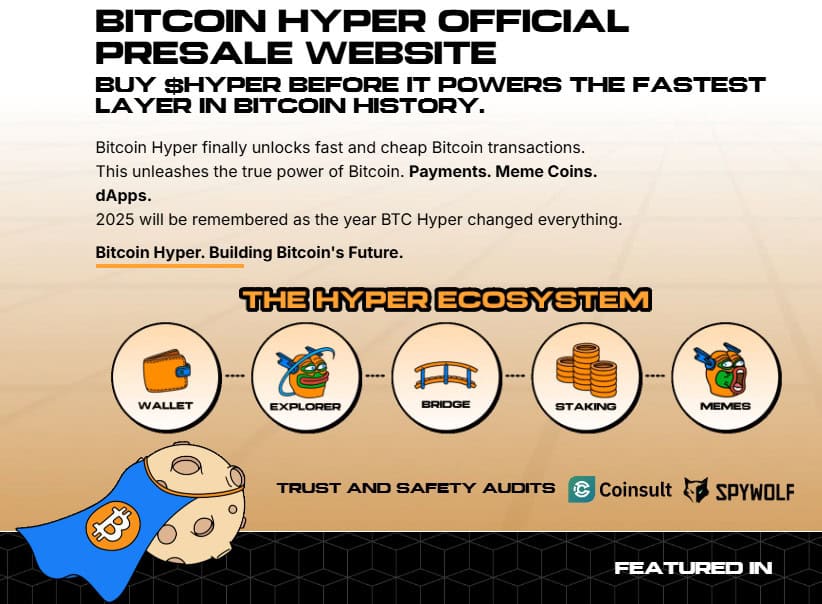
The post 3 Next Crypto to Explode as UK’s Farage Becomes a Bitcoin Champion appeared on BitcoinEthereumNews.com. Crypto News Takeaways: Nigel Farage’s push for a national Bitcoin reserve signals a major shift toward pro-crypto policy in the UK. A friendlier regulatory climate could spark massive growth in Britain’s digital asset market. Projects like Bitcoin Hyper, Best Wallet Token, and Remittix stand out as the next crypto to explode in this new environment. Nigel Farage’s recent loud pledge to turn Britain into a Bitcoin haven has lit a spark across crypto circles. He promises to build a state-backed Bitcoin reserve, cut crypto capital gains taxes to 10%, and ban CBDC rollouts, echoing the kind of populist crypto playbook that Trump used. That kind of messaging is more than political theatre – it’s an open door for new crypto narratives to ride into the spotlight. If the UK does follow that path, the stage will be set for new crypto projects, especially those that align with ‘Bitcoin first,’ decentralization, and freedom in finance. Now is a moment to ask: which tokens are ready to explode in such an environment? In that spirit, here are 3 next crypto that could ride the Farage-crypto wave. 1. Bitcoin Hyper ($HYPER) – The Fastest Bitcoin Layer 2 Built for a New Era If Nigel Farage wants to turn the UK into a Bitcoin-powered economy, Bitcoin Hyper ($HYPER) might just be the tech blueprint for that vision. Priced at $0.013115 and having already raised over $23.5 M in its presale, Bitcoin Hyper positions itself as the fastest Bitcoin Layer 2 ever built – a full-scale blockchain designed to finally make Bitcoin usable for everything. Bitcoin Hyper believes Bitcoin shouldn’t just sit in wallets as a store of value. Its Hyper Layer 2 opens the door to low gas fees, lightning-fast transactions, and full cross-chain compatibility. Imagine Bitcoin connecting seamlessly to Ethereum, Solana, and other…

Author: BitcoinEthereumNews
MOBU, SOL, TRX, BZIL, CULEX

MOBU, SOL, TRX, BZIL, CULEX

The post MOBU, SOL, TRX, BZIL, CULEX appeared on BitcoinEthereumNews.com. Crypto News Discover MoonBull’s Stage 5 presale and why it leads the list of best cryptos to buy right now alongside Solana and BullZilla. The best cryptos to buy right now are turning heads as meme-inspired tokens evolve into serious contenders. The 2025 market isn’t just about hype anymore, it’s about community, structure, and innovation. Coins like MoonBull, Solana, and BullZilla are defining that shift, giving both newcomers and veterans a reason to load up their portfolios before the next surge. MoonBull’s presale is live at Stage 5, and it’s already becoming a magnet for early adopters. With a stage-based pricing system and soaring ROI projections, its tokenomics favor conviction over hesitation. Each stage sells out faster than the last, and every minute delay means a higher entry price.  MoonBull ($MOBU): The Best Crypto to Buy Right Now MoonBull ($MOBU) leads the charge among the best cryptos to buy right now, designed for those who value fairness, transparency, and community-first economics. Built on Ethereum, it transforms each transaction into an ecosystem-strengthening event: 2% feeds liquidity, 2% rewards holders through reflections, and 1% gets burned forever. The result? A deflationary asset that becomes stronger with every trade. At its core lies Mobunomics, MoonBull’s balanced token framework. Out of the total 73.2 billion supply, 50% powers the presale, 20% fuels the 95% APY staking pool, 11% funds referral bonuses, and the rest supports liquidity, incentives, and burns. This setup not only rewards participation but also ensures long-term sustainability. Analysts already rank MoonBull among the best cryptos to buy right now in Q4 because it gives small investors whale-level advantages. MoonBull’s Launch Plan is equally thoughtful. Once the presale ends, liquidity will lock for 48 hours, protecting early supporters from volatility. No vesting, no gimmicks just instant access once live trading begins. A…

Author: BitcoinEthereumNews
Solana Locks in $223M “Real Value,” Tops All Chains in Q3 2025

Solana Locks in $223M “Real Value,” Tops All Chains in Q3 2025

According to recent reports, Solana economic value surged to $223 million in Q3 2025, earning it the top rank among blockchains in on-chain activity. That figure reflects more than hype; it shows real usage and flow of value across the network. For crypto readers, that raises a key question: what drives that value, and how sustainable is it? What the $223M Means Solana economic value measures transactions, token transfers, and flow of real funds not speculative trades. The methodology filters out wash trading and inflated volumes. The number shows that people are moving real capital through Solana with practical intent. One chart from ARK’s report highlights Solana leading all blockchains this quarter in that metric. In other words, its utility beat many rivals. Also Read: Top Altcoin Predictions 2025–2027: Ethereum, BNB, XRP, Solana, and Tron Stay in Focus Comparing to Other Chains In ARK’s quarterly review of DeFi and blockchain metrics, several chains were benchmarked. While others saw bursts of activity, Solana stood out in consistency. In some chains, much of the value came from speculative trades. On Solana, value was more tied to genuine use. For example, another report notes that Solana has now led in quarterly revenue for four straight quarters. That persistence matters: capturing high value one quarter is noise; doing it across periods suggests structural strength. Drivers of Value What pushed the value upward? Growth in decentralized exchanges and lending protocols Stablecoin transfers inside Solana’s ecosystem More developer activity and dApps are deploying on Solana Institutional backing and staking initiatives Notably, ARK’s analysis says open data gives insights into which chains actually move money, not just volume. How Solana Generated $223M in Real Economic Value in Q3 2025 Price Impact and Market  Solana’s price during this period responded, rising alongside the value metrics. The $223M reading reinforced confidence that the network isn’t just speculative noise. Some institutional moves also give extra weight. ARK added exposure to staked Solana in some of its ETFs. That makes Solana economic value part of how big players judge whether to place capital there. Still, risks remain: if DeFi momentum slows or competing chains improve, Solana must keep delivering value to maintain its edge. Conclusion Based on the latest research, Solana economic value proves more than a headline; it points to real traction. That $223 million in Q3 suggests the network is doing more than riding waves: it’s becoming a preferred route for genuine on-chain flows. Watch future quarters closely. If Solana economic value keeps rising, that’s a signal many in crypto may not ignore. For expert insights and the latest crypto news, visit our platform. Summary Solana economic value reached $223 million in Q3 2025, leading all blockchains in real on-chain activity. The figure signals strong user engagement, developer momentum, and trust from institutions. As open data reshapes how value is tracked, Solana’s growth shows what genuine blockchain utility looks like beyond speculation. Glossary of Key Terms Real economic value: A Measure of real capital moved on the chain after excluding wash trading On-chain activity: Transactions and flows recorded directly on the blockchain DEX: Decentralized exchange dApp: Decentralized application Staking: Locking tokens to support network security and earn rewards FAQs About Solana Economic Value Q: Why use “Solana economic value” rather than just “Solana”? It emphasizes tangible activity and moves away from price speculation. Q: Will the $223M hold next quarter? That depends on continued usage, DeFi growth, and competition. No guarantee. Q: Does this guarantee the SOL token price will go up? Not always. Value and price correlate, but sentiment, macro factors, and regulation matter too. Q: Can other chains match or beat it? Yes: if they boost utility, scale, and low fees, they could challenge Solana’s economic value. Read More: Solana Locks in $223M “Real Value,” Tops All Chains in Q3 2025">Solana Locks in $223M “Real Value,” Tops All Chains in Q3 2025

Author: Coinstats