Index

A crypto Index provides a way for investors to gain diversified exposure to a specific basket of digital assets through a single tokenized product. These indices often track specific sectors, such as DeFi, DePIN, or RWA, and are automatically rebalanced via smart contracts. In 2026, AI-managed thematic indices have become the gold standard for passive investing, allowing users to track the "blue chips" of the Web3 economy without manual portfolio management. This tag covers index methodology, rebalancing frequency, and the benefits of diversified crypto baskets.

25212 Articles
Created: 2026/02/02 18:52
Updated: 2026/02/02 18:52

Strategy Buys The Bitcoin Dip: Saylor Unveils New $357 Million Purchase

Strategy Buys The Bitcoin Dip: Saylor Unveils New $357 Million Purchase

Michael Saylor’s Strategy has just announced a new Bitcoin purchase, suggesting the price dip hasn’t stopped the company from buying more. Strategy Has Made A Fresh Addition To Its Bitcoin Treasury As announced by Strategy chairman Michael Saylor in a new post on X, the company has completed a new Bitcoin acquisition involving 3,018 BTC. […]

Author: Bitcoinist
Bitcoin fell below 110,000, 900 million funds were liquidated, is the September curse coming early?

Bitcoin fell below 110,000, 900 million funds were liquidated, is the September curse coming early?

By BitpushNews Crypto market volatility intensified on Monday. Bitcoin briefly dipped below $110,000, hitting a low of $109,324, its lowest point since early July. Ethereum also briefly fell below $4,400, a 24-hour drop of nearly 8%. This decline triggered massive liquidations across the market: According to CoinGlass data, as of this writing, 24-hour liquidations exceeded $900 million, with Ethereum longs losing approximately $322 million and Bitcoin longs $207 million. The market chain reaction was rapid, and mainstream altcoins were under pressure across the board: Solana plummeted by more than 8% in a single day, XRP fell by 6%, and small and medium-sized market capitalization tokens such as PENDLE, LDO, and PENGU recorded double-digit declines, with a single-day drop of as much as 13%. Historical Patterns: The September Curse Investors’ caution is not without reason. Statistics from CoinGlass show that September was one of the worst performing months for Bitcoin and Ethereum. The chart above compares the actual rise and fall of BTC and ETH in September from 2017 to 2024. It can be seen that: BTC performed negatively in September in most years, with only 2023 (+3.91%) and 2024 (+7.29%) recording increases. ETH’s September decline is usually larger, with 2017 (–21.65%), 2020 (–17.08%), and 2022 (–14.49%) all significantly underperforming BTC. Only in 2019 (ETH +5.72% vs BTC –13.38%), 2023 and 2024 did ETH perform better. This "September curse" has appeared in every bull market cycle. In 2013, 2017, and 2021, Bitcoin experienced a sharp pullback in September after a strong rebound in the summer. Analyst view: Short-term trend reversal Renowned analyst Benjamin Cowen noted that strong performances in July and August often reverse in September, and Bitcoin is likely to fall to its bull market support band near $110,000. He also warned that Ethereum could briefly reach a new high before falling 20-30%, and altcoins could even see declines of 30-50%. Doctor Profit, another active market analyst, offered a more pessimistic assessment from a macro and psychological perspective. He believes the Fed's September rate cut is more of a trigger for uncertainty than a positive development. Unlike the "soft landing" rate cut in 2024, this one could be a true "major turning point," triggering a simultaneous correction in both the stock and crypto markets. Regarding price, he also emphasized that the CME gap between 93k and 95k still exists on the BTC chart, where a significant amount of liquidity is concentrated, while retail investors generally enter positions in the 110k to 120k range or even higher. To flush out these "weak hands," the price must fall into their "maximum pain point range." In his strategy, he said he has gradually reduced his positions in BTC and ETH spot and turned to short-term short positions. The latest fund flow data suggests that the enthusiasm for ETFs is cooling. According to SoSoValue, last week, spot Bitcoin ETFs saw $1.17 billion in outflows, the second-largest weekly net outflow on record; spot Ethereum ETFs saw $237.7 million in outflows, the third-largest on record. This suggests that institutional funds are temporarily shifting to a wait-and-see approach, weakening support for the spot market. On-chain data also reveals structural signals. Glassnode notes that all groups of Bitcoin holders have "collectively entered the distribution phase," a consistent pattern that highlights widespread selling pressure in the market. Ethereum, after hitting a new high of $4,946, retreated, with the MVRV indicator rising to 2.15, meaning the average investor holds over 2x unrealized gains. Historically, this level is similar to December 2020 and March 2024, both of which preceded significant volatility and profit-taking. Macroeconomic factors: The Federal Reserve and interest rate risk Macroeconomic uncertainty has further exacerbated market tensions. Last Friday, Federal Reserve Chairman Powell hinted at a possible rate cut in September, spurring market optimism. However, both Cowen and Doctor Profit cautioned that rate cuts are not necessarily positive and could actually lead to an increase in long-term Treasury yields, suppressing risk assets. This is similar to the situation in September 2023, when a rate cut marked a low in the bond market, followed by a surge in yields. Furthermore, Benjamin Cowen noted that recent Producer Price Index (PPI) data showed inflation "running hotter than expected," undoubtedly adding additional pressure to the market. Without fully easing inflationary pressures, a Fed policy shift could trigger renewed market volatility. Outlook and Conclusion Looking at historical patterns, analyst opinions, and the macro environment, we can see that September put several pressures on the crypto market: Seasonal downturn – September historically averages significant losses; Macro uncertainty – the Fed’s policy could become a watershed moment for the market; Imbalanced capital structure - institutional funds outflow, retail investors chasing high prices; On-chain selling pressure intensifies - all coin holding groups enter distribution, and whale transactions disrupt the market. Although Cowen and Doctor Profit have different views on the extent of the adjustment, the consensus is that September is not the time for the bull market to turn upward, but a test that must be faced. However, from a longer-term perspective, this cleansing may also be a necessary step for the bull market to continue. The market needs to clear out overheated positions in the "greatest pain points" to make room for the next round of gains. If the cleansing is thorough, BTC may still hit new highs in subsequent cycles, and ETH's long-term upward trend will not be altered.

Author: PANews
Altcoins That Developers Have Focused On the Most in the Last 30 Days Have Been Published – Here’s the List

Altcoins That Developers Have Focused On the Most in the Last 30 Days Have Been Published – Here’s the List

The post Altcoins That Developers Have Focused On the Most in the Last 30 Days Have Been Published – Here’s the List appeared on BitcoinEthereumNews.com. Cryptocurrency analytics firm Santiment has revealed the projects with the highest developer activity over the past 30 days. The list is based on notable activity on Github. According to the data, Internet Computer (ICP) ranked first, followed by ChainLink (LINK) and Starknet (STRK). Here are the top 10 projects and developer activities in order of developer activity: Internet Computer (ICP) – 369.37 ChainLink (LINK) – 293.5 Starknet (STRK) – 218.37 Sui (SUI) – 195.5 DeepBook Protocol (DEEP) – 195.5 Cardano (ADA) – 182.07 Avalanche (AVAX) – 181.83 DeFiChain (DFI) – 143.67 Stellar (XLM) – 141.07 Ethereum (ETH) – 140.93 However, the increase in developer activity hasn’t been reflected in prices. All of the top 10 projects in the last 24 hours remained in negative territory. Starknet (STRK) fell by -6.23%, DeepBook Protocol (DEEP) by -6.14%, and Avalanche (AVAX) by -5.96%. In terms of market capitalization, Ethereum (ETH) was the largest project on the list with $554.47 billion, followed by Cardano (ADA) with $31.01 billion and ChainLink (LINK) with $16.59 billion. *This is not investment advice. Follow our Telegram and Twitter account now for exclusive news, analytics and on-chain data! Source: https://en.bitcoinsistemi.com/altcoins-that-developers-have-focused-on-the-most-in-the-last-30-days-have-been-published-heres-the-list/

Author: BitcoinEthereumNews
Liquidity and economic growth can keep fueling the rally.

Liquidity and economic growth can keep fueling the rally.

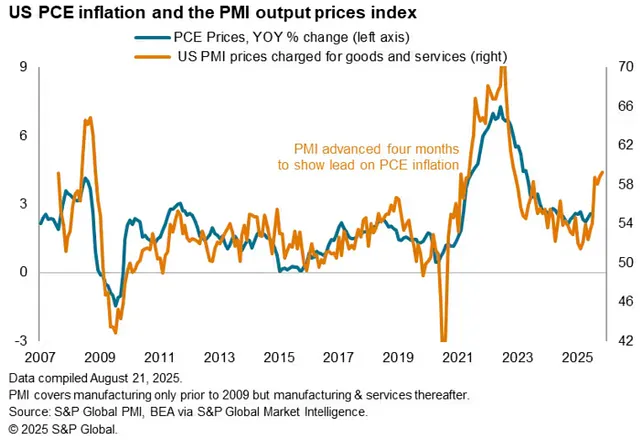
A speech from Federal Reserve Chair Jerome Powell at the Fed’s Jackson Hole symposium flagged concerns over the labor market and ignited hopes for interest rate cuts. Powell commented that policy is “in restrictive territory” and that “the shifting balance of risks may warrant adjusting our policy stance” in a nod to weakness in the July payrolls report and downward revisions to job growth in prior months. The comments came just two days following the minutes of the Fed’s most recent rate-setting meeting, which took place before the July payrolls report was released. The minutes noted that the majority of FOMC members saw upside to inflation outweighing employment risk. The chart below shows prices paid (orange line) from a business survey, which tends to lead PCE inflation (blue line). The sudden pivot to concerns over the labor market is sparking hopes that rate cuts will resume. After cutting rates by 1.0% at the end of last year, the Fed has been on hold for eight months. Odds for a 0.25% rate cut at the next meeting in September jumped back to 90% following Powell’s comments. But hopes for a prolonged cutting cycle could be misplaced. In the same speech, Powell noted that the Fed’s policy framework of “flexible average inflation targeting” would be scrapped. That’s where the Fed tolerated an overshoot of its 2% inflation target if it meant supporting the labor market. That’s interesting given that core consumer inflation is running at 3.1% and looks poised to move higher. If abandoning average inflation targeting means the Fed is becoming less tolerant of inflation above the 2% target, then you wouldn’t expect a dovish tone out of the Fed. That will make upcoming inflation and payrolls reports ahead of September’s rate-setting meeting crucial datapoints for the Fed. This week, let’s look at why reducing rates could ignite the “risk-on” trade. We’ll also look at metrics pointing to a huge rebound in the average stock and why a looming commodities breakout could be the next warning on the inflation outlook. The Chart Report Liquidity and overall financial conditions play a key role in supporting speculative areas of the capital markets including stocks. Liquidity along with the cost and availability of credit are positively correlated with economic activity, and a strong economy is critical to support the corporate earnings outlook. The prospect of the Fed resuming its easing cycle while conditions are already loose is a massive tailwind for all sorts of risk assets like stocks and cryptocurrencies. The chart below shows a measure of financial conditions from the Chicago Fed district, where below zero points to looser than average conditions. Loose financial conditions are positively correlated to economic growth, and rate cuts could boost the economy at a time when growth is likely stronger than feared. While much has been made of the weak July payrolls report, other estimates of economic activity are holding up. The most recent evidence comes from S&P Global’s Flash US PMI estimate. The PMI is built off a survey of senior executives, with a reading above 50 signaling expansion while below 50 indicates contracting activity. The composite PMI came in at 55.4 which is consistent with 2.5% annualized GDP growth. The chart below breaks down activity between the manufacturing (blue line) and services (orange line) sector. While services is holding up, manufacturing activity is seeing a bounce back following the drop around the start of the trade war. A combination of falling interest rates and positive economic outlook should be driving outperformance in the average stock, and breadth metrics are confirming. While the S&P 500 and Nasdaq Composite have led the way to new record highs, the Dow Jones Industrial Average and average stock in the S&P 500 (i.e. the equal-weight RSP ETF) are moving to new highs last week. Surging breadth is also showing up in advance/decline indicators. On Friday following Powell’s Jackson Hole speech, up volume on the NYSE as a percent of all volume was over 90%. The NYSE advance/decline ratio surged to 10/1 (chart below), which is the third highest reading on the year. If the Fed resumes the rate-cutting cycle, then small-caps and the average stock in general could see a big boost. Small-caps get more of their revenues and earnings from the domestic economy, where falling rates could help the growth outlook. And approximately 33% of companies in the Russell 2000 Index of small-cap stocks are financed with floating rate debt compared to just 6% in the S&P 500. Historically, small-caps have outperformed both mid- and large-caps during the three-, six-, and 12-month periods when the Fed cuts rates using data going back to the 1950s (chart below). While the Fed is shifting focus toward risks facing the labor market, the risk of accelerating inflation continues facing investors. Core CPI has moved higher over the past two months, and various leading indicators of inflation point to further rising price levels ahead. Commodities in general have a high inflation beta, and rising inflation expectations could happen alongside a breakout in broad commodity indexes and ETFs. The chart below plots an equal weight commodity index against 10-year inflation breakeven rates. A rally in commodity prices could present another tailwind for rising inflation (and headache for central bankers).Chart from Tavi Costa on X Heard in the Hub The Traders Hub features live trade alerts, market update videos, and other educational content for members. Here’s a quick recap of recent alerts, market updates, and educational posts: Evidence that core inflation will move higher. Economic signals from the junkiest of junk bonds. Why it remains a constructive trading environment. Historic precedent shows the Fed won’t cut rates by much. New additions to the model portfolio to take advantage of strong breadth. You can follow everything we’re trading and tracking by becoming a member of the Traders Hub. By becoming a member, you will unlock all market updates and trade alerts reserved exclusively for members. 🚨Come see how we’re creating “asymmetry” in our model portfolio by letting our winners run and keeping losses small. You can join the Traders Hub with a special discount offer below: 👉You can click here to join now👈 Trade Idea Applovin Corp (APP) The stock had a huge run starting late last year that took the stock to the $500 level in February. APP is trading in a new basing pattern since then with a series of higher lows. The stock is making a smaller pullback off a recent test near prior resistance. I’m watching for over $500. Key Upcoming Data Economic Reports Earnings Reports I hope you’ve enjoyed The Market Mosaic, and please share this report with your family, friends, coworkers…or anyone that would benefit from an objective look at the stock market. Become a member of the Traders Hub to unlock access to: ✅Model Portfolio ✅Members Only Chat ✅Trade Ideas & Live Alerts ✅Mosaic Vision Market Updates + More Our model portfolio is built using a “core and explore” approach, including a Stock Trading Portfolio and ETF Investment Portfolio. Come join us over at the Hub as we seek to capitalize on stocks and ETFs that are breaking out! Come join the Hub! Disclaimer: these are not recommendations and just my thoughts and opinions…do your own due diligence! I may hold a position in the securities mentioned in this report. Liquidity and economic growth can keep fueling the rally. was originally published in Coinmonks on Medium, where people are continuing the conversation by highlighting and responding to this story

Author: Medium
Decoding The Crucial Neutral Market Sentiment At 48

Decoding The Crucial Neutral Market Sentiment At 48

The post Decoding The Crucial Neutral Market Sentiment At 48 appeared on BitcoinEthereumNews.com. Crypto Fear & Greed Index: Decoding The Crucial Neutral Market Sentiment At 48 Skip to content Home Crypto News Crypto Fear & Greed Index: Decoding the Crucial Neutral Market Sentiment at 48 Source: https://bitcoinworld.co.in/crypto-fear-greed-index-39/

Author: BitcoinEthereumNews
Trump Fires Fed Governor Cook Over Mortgage Fraud Allegations

Trump Fires Fed Governor Cook Over Mortgage Fraud Allegations

The post Trump Fires Fed Governor Cook Over Mortgage Fraud Allegations appeared on BitcoinEthereumNews.com. US President Donald Trump fired Federal Reserve Governor Lisa Cook on Monday, marking an unprecedented escalation in his battle with the central bank. The dismissal represents the first time a president has ousted a Fed governor in the institution’s 111-year history. Trump cited allegations of mortgage fraud against Cook as grounds for removal, though she has not been charged with wrongdoing. Central Bank Independence Under Fire The firing stems from accusations by Federal Housing Finance Agency Director Bill Pulte that Cook falsified mortgage documents. The Justice Department has indicated it will investigate these claims. Cook previously stated she would not be “bullied” into resigning over allegations made on social media. Trump’s letter to Cook questioned her “integrity” and “trustworthiness as a financial regulator.” The president claimed Cook’s alleged conduct exhibited “gross negligence in financial transactions.” Legal experts remain divided on whether Trump can remove Fed governors without a clear statutory cause. Markets reacted negatively to the announcement, with the dollar index falling 0.3% immediately after the news. Treasury yields and S&P 500 futures also declined. The unprecedented move raises questions about central bank independence, a cornerstone of effective monetary policy. Implications for Monetary Policy Cook’s removal allows Trump to reshape the Fed’s seven-member board. Another Biden appointee, Adriana Kugler, has already announced plans to vacate her position early, which could give Trump a four-person majority on the board. The timing is significant as the Fed prepares for its September 16-17 policy meeting. Chair Jerome Powell recently signaled potential rate cuts due to labor market concerns. Trump has consistently criticized the Fed for maintaining high interest rates. Cook became the first Black woman on the Fed’s Board of Governors in 2022. Her term was scheduled to run until 2038. It remains unclear whether she will challenge the dismissal in court. The…

Author: BitcoinEthereumNews
Canary Capital Files for ‘American-Made’ Crypto ETF Focused on U.S. Coins

Canary Capital Files for ‘American-Made’ Crypto ETF Focused on U.S. Coins

The post Canary Capital Files for ‘American-Made’ Crypto ETF Focused on U.S. Coins appeared on BitcoinEthereumNews.com. Canary Capital has filed a Form S-1 with the U.S. Securities and Exchange Commission to launch the Canary American-Made Crypto ETF, a spot fund that will invest solely in digital assets with strong domestic ties—those created in the United States, predominantly mined here or operated mainly from the country. The proposed vehicle, expected to list on the Cboe BZX Exchange under the ticker MRCA, is designed to track the Made-in-America Blockchain Index and could also generate additional income by participating in on-chain validation activities such as staking. According to the filing, U.S.-origin cryptocurrencies collectively represent more than $520 billion in market value, with projects such as XRP, Solana and Cardano often cited as candidates that meet the fund’s criteria. By limiting exposure to coins rooted in U.S. development and infrastructure, Canary aims to tap demand from investors seeking thematic exposure that aligns with domestic technology and regulatory frameworks. The application adds to a flood of increasingly specialized crypto ETF proposals that has followed this year’s approvals of spot Bitcoin and Ether funds. “Get ready for ETFs to try every combination imaginable,” Bloomberg ETF analyst Eric Balchunas said, noting that issuers are racing to differentiate products as they await the SEC’s next window for decisions, expected in the fourth quarter. Canary Capital also lodged separate filings for a Staked Injective ETF and a Trump Coin ETF; the SEC on Monday opened a public comment period on the Injective proposal, indicating preliminary review is under way. No timeline was given for decisions on any of the three products. This is an AI-generated article powered by DeepNewz, curated by The Defiant. For more information, including article sources, visit DeepNewz. Source: https://thedefiant.io/news/cefi/canary-capital-files-american-made-crypto-etf-focused-on-u-s-coins-4f42eae1

Author: BitcoinEthereumNews
Altcoin Season Index Plunges: What This Crucial Drop to 46 Means

Altcoin Season Index Plunges: What This Crucial Drop to 46 Means

BitcoinWorld Altcoin Season Index Plunges: What This Crucial Drop to 46 Means The cryptocurrency market is a dynamic space, constantly shifting between periods of Bitcoin dominance and altcoin surges. Recently, the Altcoin Season Index has taken a notable dip, falling three points to a score of 46. This shift is sparking discussions among investors and analysts alike. What exactly does this decline signify for your crypto portfolio? Are we truly heading into a ‘Bitcoin Season’? Let’s unpack the implications of this crucial movement and understand what a score of 46 means for the future of altcoins. Understanding the Altcoin Season Index: How Is It Measured? To truly grasp the significance of the recent drop, it’s essential to understand how the Altcoin Season Index works. CoinMarketCap, a trusted name in crypto data, provides this valuable metric. It’s not just a random number; it’s a carefully calculated indicator designed to give us a snapshot of the market’s sentiment towards alternative cryptocurrencies compared to Bitcoin. The Calculation: The index evaluates the price performance of the top 100 cryptocurrencies by market capitalization. Exclusions: Stablecoins and wrapped coins are intentionally left out to ensure the index reflects true market sentiment for volatile assets. The Timeframe: Performance is measured over the past 90 days, providing a medium-term view rather than daily fluctuations. Defining a Season: An altcoin season is officially declared if 75% or more of these top 100 coins have outperformed Bitcoin. If not, it’s considered a Bitcoin season. A score closer to 100 strongly indicates an altcoin season, suggesting that a broad range of altcoins are seeing significant gains relative to Bitcoin. Conversely, a lower score points towards Bitcoin’s dominance. Why Did the Altcoin Season Index Drop to 46? The recent three-point fall in the Altcoin Season Index to 46 suggests a notable shift in market dynamics. This decline doesn’t happen in a vacuum; it reflects a period where a significant number of the top 100 altcoins have underperformed Bitcoin over the last 90 days. While the exact reasons can be multifaceted, several factors often contribute to such movements: Bitcoin’s Strength: Often, when Bitcoin experiences a strong rally, capital tends to flow from altcoins into Bitcoin, causing altcoins to lag. Macroeconomic Factors: Broader economic trends or regulatory news can impact the entire crypto market, but altcoins, being generally riskier, might see larger pullbacks. Specific Altcoin Performance: If several major altcoins within the top 100 face project-specific challenges or lack significant development news, their underperformance can collectively drag down the index. A score of 46 places us firmly outside of an ‘altcoin season’ (which requires 75 or higher). It indicates a period of relative neutrality or even slight Bitcoin dominance, where altcoins are generally struggling to keep pace. Navigating Market Shifts: What Does a 46 Mean for Your Portfolio? When the Altcoin Season Index hovers around 46, it signals a time for careful consideration rather than panic. This isn’t a strong ‘Bitcoin season’ either, as that would typically be a much lower score. Instead, it suggests a more balanced, perhaps uncertain, market environment where capital isn’t overwhelmingly favoring one side. For savvy investors, this period presents both challenges and opportunities. Re-evaluate Your Holdings: It’s a good moment to assess your altcoin positions. Are they still strong projects with solid fundamentals? Consider Diversification: While altcoins might be struggling, Bitcoin could be consolidating or preparing for its next move. A balanced portfolio can help mitigate risks. Focus on Fundamentals: During periods of uncertainty, projects with clear use cases, strong development teams, and active communities tend to weather the storm better. Risk Management: This environment underscores the importance of not over-allocating to speculative altcoins. Remember, market cycles are natural. A dip in the index doesn’t mean altcoins are doomed forever; it simply reflects the current performance trend. Understanding these trends helps you make more informed decisions. Is an Altcoin Resurgence Still Possible? Despite the recent dip in the Altcoin Season Index, the potential for an altcoin resurgence is always present in the volatile crypto market. Historically, crypto markets move in cycles, and periods of Bitcoin dominance are often followed by altcoin rallies once Bitcoin consolidates or reaches new highs. What could trigger such a shift? Bitcoin Stability: A stable Bitcoin price often allows capital to flow into altcoins as investors seek higher returns. Technological Breakthroughs: Major upgrades or significant adoption news for key altcoin projects can ignite rallies. New Narratives: Emerging trends like GameFi, NFTs, or specific Layer-2 solutions can create new interest and drive altcoin performance. While the index currently sits at 46, market sentiment can change rapidly. Staying informed about project developments and broader market trends is crucial. The crypto landscape is constantly evolving, and yesterday’s underperformers can quickly become tomorrow’s stars. In conclusion, the fall of the Altcoin Season Index to 46 is a clear indicator that altcoins are currently facing headwinds against Bitcoin. This crucial shift encourages investors to practice caution, re-evaluate their strategies, and focus on robust projects. While an altcoin season isn’t imminent based on this metric, the dynamic nature of crypto means vigilance and informed decision-making remain paramount. Keep an eye on the index and broader market signals to navigate these fascinating shifts effectively. Frequently Asked Questions About the Altcoin Season Index Q1: What exactly is the Altcoin Season Index? A1: The Altcoin Season Index is a metric provided by CoinMarketCap that indicates whether altcoins are generally outperforming Bitcoin. It’s calculated by comparing the performance of the top 100 cryptocurrencies (excluding stablecoins and wrapped coins) against Bitcoin over the past 90 days. Q2: How is an Altcoin Season officially declared? A2: An altcoin season is declared when 75% or more of the top 100 altcoins have outperformed Bitcoin during the preceding 90-day period. Otherwise, it is considered a Bitcoin season. Q3: What does a score of 46 on the Altcoin Season Index signify? A3: A score of 46 means that less than 75% of the top 100 altcoins have outperformed Bitcoin over the last 90 days. It indicates that we are currently not in an altcoin season and suggests a period of relative neutrality or slight Bitcoin dominance. Q4: Should I sell all my altcoins if the index falls? A4: Not necessarily. A falling Altcoin Season Index suggests altcoins are underperforming Bitcoin, but it doesn’t mean they won’t recover. It’s a signal to re-evaluate your portfolio, focus on strong fundamentals, and practice good risk management. Market cycles are common, and a dip can be a temporary phase. Q5: What factors can cause the Altcoin Season Index to fall? A5: The index can fall due to several reasons, including strong Bitcoin rallies that draw capital away from altcoins, broader macroeconomic uncertainties, or collective underperformance of several major altcoin projects due to lack of development or specific challenges. Did you find this analysis of the Altcoin Season Index insightful? Share this article with your fellow crypto enthusiasts and help them stay informed about crucial market trends. Your shares help our community grow! To learn more about the latest crypto market trends, explore our article on key developments shaping altcoins and Bitcoin market sentiment. This post Altcoin Season Index Plunges: What This Crucial Drop to 46 Means first appeared on BitcoinWorld and is written by Editorial Team

Author: Coinstats
Crypto Fear & Greed Index: Decoding the Crucial Neutral Market Sentiment at 48

Crypto Fear & Greed Index: Decoding the Crucial Neutral Market Sentiment at 48

BitcoinWorld Crypto Fear & Greed Index: Decoding the Crucial Neutral Market Sentiment at 48 Are you wondering what the current mood is in the crypto market? The widely followed Crypto Fear & Greed Index recently registered a score of 48, firmly placing it in a neutral zone. This crucial metric offers a snapshot of market sentiment, helping investors gauge whether participants are feeling fearful or overly greedy. Understanding this index can provide valuable insights into potential market movements, allowing you to make more informed decisions. What Does a Neutral Crypto Fear & Greed Index Mean for You? When the Crypto Fear & Greed Index sits at 48, it signals a balanced market environment. This score is just one point up from the previous day, indicating a steady, unwavering sentiment. A neutral reading suggests that investors are neither panicking and selling off their assets nor are they excessively exuberant and buying everything in sight. Instead, there’s a cautious equilibrium. No Extreme Pressure: Unlike extreme fear (closer to 0), which often precedes market bottoms, or extreme greed (closer to 100), which can signal a market top, a neutral 48 means less immediate pressure from either side. Opportunity for Calm Analysis: This period allows for a more rational assessment of the market without the emotional pull of FOMO (Fear Of Missing Out) or FUD (Fear, Uncertainty, and Doubt). Watch for Shifts: While neutral, it’s a dynamic score. Smart investors watch for slight movements as potential precursors to a shift towards fear or greed. Unpacking the Crypto Fear & Greed Index: How is it Calculated? The Crypto Fear & Greed Index is not just a random number; it’s a sophisticated blend of various market indicators. Data provider Alternative meticulously calculates this index, offering a comprehensive view of investor psychology. Let’s break down the key components that contribute to its score: Volatility (25%): Measures the current volatility and maximum drawdowns of Bitcoin compared to its average over 30 and 90 days. Higher volatility often indicates fear. Market Volume (25%): Compares current trading volume and market momentum to average values. High buying volume in a positive market can signal greed. Social Media Mentions (15%): Analyzes specific keywords on social media platforms. A surge in mentions, especially with positive sentiment, can suggest increasing greed. Surveys (15%): Although currently paused, these polls previously asked investors about their market outlook, directly gauging sentiment. Bitcoin Dominance (10%): An increasing Bitcoin dominance often indicates fear, as investors might be fleeing altcoins for the relative safety of Bitcoin. A decreasing dominance can signal greed as money flows into riskier altcoins. Google Search Volume (10%): Tracks search queries related to Bitcoin and other cryptocurrencies. Sudden spikes in searches for terms like “Bitcoin price manipulation” can indicate fear, while searches for “how to buy crypto” might suggest growing interest and greed. These factors combine to paint a holistic picture of the market’s collective mood, which is invaluable for traders and long-term holders alike. Navigating Market Sentiment: Why the Crypto Fear & Greed Index is Crucial Understanding the sentiment conveyed by the Crypto Fear & Greed Index is a powerful tool in your investment arsenal. It helps you recognize the prevailing emotions that often drive market behavior, providing a crucial counter-perspective to your own biases. For instance, when the index screams “extreme greed,” it might be a signal to exercise caution, as markets can be due for a correction. Conversely, an “extreme fear” reading often presents a unique opportunity for those brave enough to buy when others are selling. However, it’s vital to remember that this index is just one indicator. It should always be used in conjunction with fundamental analysis, technical analysis, and your own risk management strategy. Relying solely on sentiment can be misleading, as markets can remain irrational longer than you can remain solvent. Actionable Insights from the Crypto Fear & Greed Index at 48 With the Crypto Fear & Greed Index maintaining its neutral stance at 48, what are some smart moves for investors? This period is an excellent time for strategic planning rather than impulsive trading. Here are some actionable insights: Re-evaluate Your Portfolio: A neutral market provides a calm environment to assess your current holdings. Are your investments aligned with your long-term goals? Research New Opportunities: Without the distraction of extreme market swings, dedicate time to researching promising projects and understanding their fundamentals. Practice Dollar-Cost Averaging (DCA): If you’re building a position, a neutral market can be a good time to continue or start a DCA strategy, buying small amounts regularly to average out your purchase price. Set Realistic Expectations: Avoid expecting parabolic gains or sudden crashes. A neutral index suggests a more measured pace for the market. Strengthen Your Knowledge: Use this period to deepen your understanding of market cycles and how different indicators interact. Remember, patience and informed decision-making are your best allies in the dynamic world of cryptocurrency. The Crypto Fear & Greed Index is a guide, not a crystal ball. In conclusion, the current neutral reading of 48 on the Crypto Fear & Greed Index offers a valuable moment of equilibrium in the often-turbulent crypto market. It’s a reminder that while emotions can run high, understanding these underlying sentiments, coupled with sound research and a disciplined approach, is paramount for successful navigation. By staying informed about the index and its components, investors can better understand market psychology and make choices that align with their personal financial strategies, fostering a more resilient and profitable investment journey. Frequently Asked Questions (FAQs) Q1: What is the Crypto Fear & Greed Index? The Crypto Fear & Greed Index is a tool that measures the current sentiment of the cryptocurrency market. It ranges from 0 (extreme fear) to 100 (extreme greed), providing insight into whether investors are feeling anxious or overly optimistic. Q2: How is the Crypto Fear & Greed Index calculated? It’s calculated based on several factors, including market volatility (25%), trading volume (25%), social media mentions (15%), surveys (15%), Bitcoin’s market cap dominance (10%), and Google search volume (10%). These components are weighted to produce a single sentiment score. Q3: What does a neutral score (like 48) on the Crypto Fear & Greed Index indicate? A neutral score, such as 48, suggests that the market is in a state of equilibrium. Investors are neither experiencing extreme fear nor extreme greed, indicating a period of cautious balance and potentially more rational decision-making. Q4: Can I use the Crypto Fear & Greed Index to predict market movements? While the Crypto Fear & Greed Index offers valuable insights into market psychology, it should not be used as a standalone prediction tool. It’s best utilized as one of many indicators, alongside fundamental and technical analysis, to inform your investment strategy. Q5: What are the limitations of the Crypto Fear & Greed Index? Its main limitation is that it’s a sentiment indicator, not a definitive market predictor. Markets can remain irrational, and the index doesn’t account for all external factors or fundamental changes. It’s a snapshot, not a crystal ball. Found this analysis of the Crypto Fear & Greed Index insightful? Share this article with your fellow crypto enthusiasts and help them navigate the market with greater confidence! Your insights can make a difference. To learn more about the latest crypto market trends, explore our article on key developments shaping Bitcoin price action. This post Crypto Fear & Greed Index: Decoding the Crucial Neutral Market Sentiment at 48 first appeared on BitcoinWorld and is written by Editorial Team

Author: Coinstats
Canary Capital files 'American-Made' crypto ETF amid SEC delays

Canary Capital files 'American-Made' crypto ETF amid SEC delays

                                                                               Canary Capital has filed for a US-only crypto ETF, aiming to track an index of American-rooted digital assets as the SEC weighs other fund applications.                     US digital asset investment firm Canary Capital Group has filed with the Securities and Exchange Commission (SEC) to launch the Canary American-Made Crypto ETF (MRCA). According to a Friday filing, the proposed fund would track an index of cryptocurrencies created, mined or primarily operated in the United States, with shares slated to trade on Cboe BZX under the ticker MRCA. The trust also plans to stake its proof-of-stake holdings through third-party providers, adding rewards to its net asset value. The Made-in-America Blockchain Index will admit only assets that meet strict criteria set by an oversight committee. Tokens must be eligible for custody with a regulated US trust or bank, maintain minimum liquidity, and trade on multiple established venues. Read more

Author: Coinstats