Lending

Lending protocols form the backbone of the decentralized money market, allowing users to lend or borrow digital assets without intermediaries. Using smart contracts, platforms like Aave and Morpho automate interest rates based on supply and demand while requiring over-collateralization for security. The 2026 lending landscape features advanced permissionless vaults and institutional-grade credit lines. This tag covers the evolution of capital efficiency, liquidations, and the integration of diverse collateral types, including LSTs and tokenized RWAs.

14661 Articles
Created: 2026/02/02 18:52
Updated: 2026/02/02 18:52
DeFi Saver Launches New Protocol Exploration Tool

DeFi Saver Launches New Protocol Exploration Tool

The post DeFi Saver Launches New Protocol Exploration Tool appeared on BitcoinEthereumNews.com. The new Aave DeFi Explore page lets users browse and analyze the most important Aave market metrics and Aave positions across all six currently supported chains. Additionally, the Price slider tool enables users to simulate price changes and observe their impact on specific positions. DeFi Saver has just launched the Aave DeFi Explore page, a comprehensive dashboard designed to keep users up to date with real-time Aave analytics and market changes.  Designed to reduce uncertainty and improve transparency, Aave DeFi Explore aims to provide users with actionable insights by giving them a clearer understanding of the health and activity within the Aave protocol. What is Aave DeFi Explore? DeFi Saver’s Aave DeFi Explore page is a dashboard made to help users stay up to date with Aave market metrics and positions across all six currently supported chains on DeFi Saver: Ethereum Mainnet, Arbitrum, Optimism, Base, Linea, and the recently launched Plasma chain.  Once users access it, they will be met with a live feed of all Aave positions as they’re being opened. By clicking on any of the positions shown, users can view a detailed breakdown that includes key metrics, collateral and debt composition, and full position history, thus making position analysis much easier, accessible, and comprehensive. One highlighted feature users could find especially useful is the Price slider. Once a user clicks on a certain position, they can simulate price oscillations of the collateral and borrowed assets, and assess liquidation risks for the position in question. With that said, the new protocol explorer now allows users to: Access a live feed of the latest transactions and detailed market stats via the Homepage; Research specific chains, their total supply and borrow amounts, as well as the total number of positions on that chain; Check e-modes and supply and borrow details…

Author: BitcoinEthereumNews
Anchorage Digital Integrates Jupiter Into Porto Wallet

Anchorage Digital Integrates Jupiter Into Porto Wallet

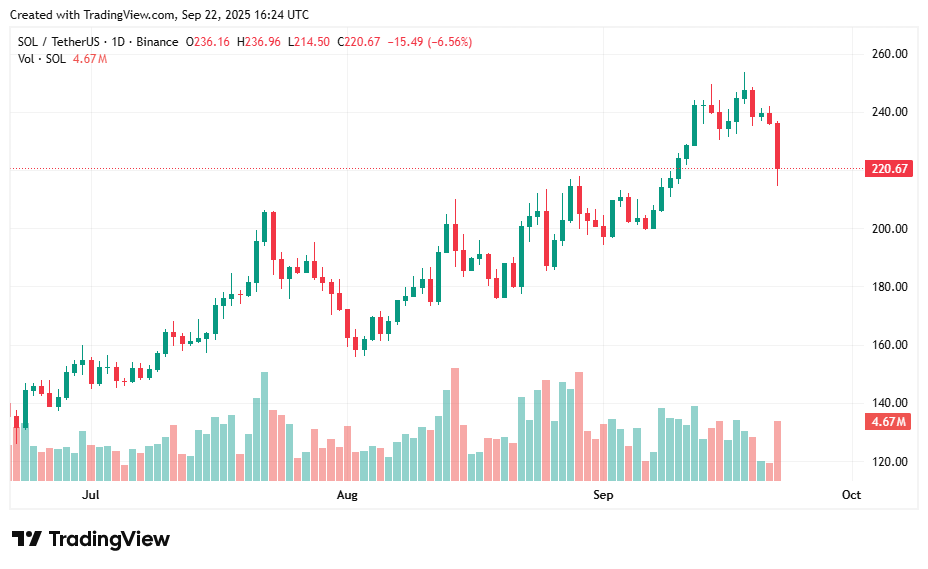
The post Anchorage Digital Integrates Jupiter Into Porto Wallet appeared on BitcoinEthereumNews.com. The integration allows direct Jupiter swaps within Anchorage’s institutional wallet. Crypto platform Anchorage Digital announced on Tuesday, Sept. 30, that it has integrated Jupiter – a Solana-based swap and liquidity aggregator – into its institutional wallet Porto. The integration enables institutional users to execute Jupiter swaps directly from the Porto dashboard, eliminating the need to access external decentralized applications. Anchorage said the update is designed to streamline trading workflows, reduce operational risks, and maintain Porto’s security model, which keeps private keys offline during signing, according to a press release viewed by The Defiant. Jupiter currently ranks as the 15th largest protocol in decentralized finance (DeFi), with over $3.3 billion in total value locked (TVL), according to DeFiLlama. At press time, its native token, JUP, was trading just under $0.41, down 5% over the past 24 hours and more than 19% over the past week, according to CoinGecko. JUP Chart Anchorage Digital’s move reflects ongoing efforts to make DeFi more accessible to traditional financial institutions, highlighting the importance of secure, reliable on-chain infrastructure. “We believe that true institutional adoption of DeFi requires foundational infrastructure that meets the highest standards of security and compliance,” said Nathan McCauley, CEO and co-founder of Anchorage Digital. “This isn’t just about a new feature; it’s about providing the market with the robust, secure on-ramps needed to participate in the next wave of financial innovation.” The integration comes amid a broader trend of projects integrating with protocols built on Solana, driven by on-chain yield opportunities, composability, and fast, low-cost transactions. Solana currently has a TVL of over $13 billion, up 73% since April. Its native token SOL is currently trading at $205, down 2% on the day. It also comes as the broader DeFi market continues to expand, with TVL surging in the third quarter of 2025…

Author: BitcoinEthereumNews
A Path Toward Less Restrictive Regulation

A Path Toward Less Restrictive Regulation

The post A Path Toward Less Restrictive Regulation appeared on BitcoinEthereumNews.com. power cord over us dollar bills getty My colleague Travis Fisher recently co-wrote a piece in the Wall Street Journal on utility reform in New Hampshire. The New Hampshire story should be quite familiar to anyone who studies financial markets. The state’s highly regulated electricity industry is struggling to provide consumers with the power they need. To solve the problem, the legislature came up with a simple solution: Anyone who produces electricity in New Hampshire won’t be subject to public-utility regulation provided they don’t connect to the existing grid. The financial sector can learn from this example. It is also overregulated, and something akin to a light version of this New Hampshire solution has already been a success for a slice of the banking sector. (More about that below.) An expanded version is exactly what’s needed in financial markets. Yes, that’s right—financial markets do not need to be regulated like public utilities. The fact that financial markets, especially banks, are increasingly regulated as if they were utilities is nothing to be happy about. The existing regulatory framework makes it harder for people to provide financial services, and the supposed benefit from this approach—financial stability—has remained elusive for centuries. Bank Regulation Has Yet to Provide Stability Supposedly, financial markets need prescriptive rules to guarantee safety, and if we can just get the rules right, everything will be fine. The fact that this approach has never worked should not surprise anyone. If we are going to allow people to take financial risks, something which a free society must allow, then there is simply no way to compile a set of rules that guarantees everything will be fine. Thinking it will one day work is akin to thinking socialism will finally work once we try the “right” version. It’s wishful thinking. Regulators make…

Author: BitcoinEthereumNews
Whitelist Launch 2025: Why Investing in Crypto With Zero Knowledge Proof Could Be the Big Break

Whitelist Launch 2025: Why Investing in Crypto With Zero Knowledge Proof Could Be the Big Break

Hurry: Zero Knowledge Proof’s whitelist launch could shape 2025. Join before access ends and see why it’s seen as the best crypto choice.

Author: Blockchainreporter
Dr. Jonathan Chang Joins 0G Foundation Board to Drive Decentralized AI Adoption

Dr. Jonathan Chang Joins 0G Foundation Board to Drive Decentralized AI Adoption

The post Dr. Jonathan Chang Joins 0G Foundation Board to Drive Decentralized AI Adoption appeared on BitcoinEthereumNews.com. Dr. Chang will contribute to the growth of the understanding and adoption of decentralized artificial intelligence (DeAI) in his role as Director. Moreover, Dr. Chang will use his worldwide network and business expertise in his new position as Director of the 0G Foundation, with an emphasis on promoting AI education. Dr. Jonathan Chang has been appointed to the board of directors of the 0G Foundation, which is in charge of the development of the global 0G ecosystem. Dr. Chang will contribute to the growth of the understanding and adoption of decentralized artificial intelligence (DeAI) in his role as Director. Dr. Chang is a dedicated technologist, researcher, educator, and entrepreneur who will advocate for the deployment of DeAI as a public benefit at 0G Foundation. He is well-positioned to promote the decentralized and transparent use of artificial intelligence in the real world thanks to his wide-ranging commercial and public sector relationships worldwide. Commenting on his appointment, Dr Jonathan Chang said: “I’m excited to support Web3’s largest decentralized AI operating system and Layer-1 ecosystem in its mission to make AI a public good. 0G’s infinitely scalable infrastructure composed of an L1 modular blockchain, cost-efficient storage, verifiable AI, generative agents, and a unified service marketplace, forms a thriving ecosystem that has secured over USD $350M in committed funding.” “My mandate is to work with policymakers, governments, and institutions worldwide to advance decentralized AI, while funding education and research with top universities to prepare for a fast-changing AI world.” Before joining the 0G Foundation, Dr. Chang was the CEO of Heritage Singapore, where he oversaw immersive cultural experiences and contributed to the advancement of innovation in the museum and heritage industry. These featured major events that draw millions of tourists each year, such the Singapore Night Festival and the Singapore Heritage Festival. Prior to this,…

Author: BitcoinEthereumNews
Anchorage Digital boosts Solana DeFi with Jupiter integration

Anchorage Digital boosts Solana DeFi with Jupiter integration

Jupiter, the decentralized exchange and liquidity aggregator on Solana, has integrated with Anchorage Digital’s institutional-grade wallet Porto, a move that could accelerate the institutional access to Solana’s decentralized finance ecosystem. Anchorage Digital, a leading crypto bank and digital assets platform,…

Author: Crypto.news
BlockDAG Locks BWT Alpine F1® Deal, While SOL, AVAX, & ADA Flash Mixed Signals: Which Is the Top Crypto Project Today?

BlockDAG Locks BWT Alpine F1® Deal, While SOL, AVAX, & ADA Flash Mixed Signals: Which Is the Top Crypto Project Today?

BlockDAG has raised over $411 million in its presale, selling more than 26.4 billion coins, with current availability at just $0.0013 despite its original batch 30 price of $0.03, marking a 2900% ROI since batch 1.  Unlike most blockchain projects, BlockDAG is delivering real-world value through its partnership with BWT Alpine F1® Team, offering fans [...] The post BlockDAG Locks BWT Alpine F1® Deal, While SOL, AVAX, & ADA Flash Mixed Signals: Which Is the Top Crypto Project Today? appeared first on Blockonomi.

Author: Blockonomi
Surviving Disruption, Following The Money

Surviving Disruption, Following The Money

The post Surviving Disruption, Following The Money appeared on BitcoinEthereumNews.com. The Future of Green Jobs Photo by @micheile It has been a brutal year for many of the most senior sustainability leaders in financial institutions across Europe and the US, with teams downsized, leadership positions cut, and reporting functions absorbed into mainstream departments. In Asia, by contrast, green finance jobs are growing as capital flows into clean energy, grids and electric mobility reach record levels. The macro direction is clear: disruption is inevitable. We are already deep into a turbulent transition – messy, uneven, and impossible to reconcile with business as usual. Plausible disruption scenarios include the breakdown of parts of the food system, a climate-induced credit crunch through uninsurability, or major supply-chain shocks. Any of them would have immediate implications for financial institutions and jobs within them. Disruption will not be contained to sustainability teams. It will cascade through risk, strategy, lending, investment, technology, and client functions. At the same time, turbulence and innovation will unlock major economic opportunities. The next wave of growth will come from new technologies and business models designed for a carbon- and resource-constrained world. But these will not be “green jobs” in the way they were understood in the past. Green jobs in finance have never been a constant. Early roles often emerged out of CSR, communications or technical compliance teams. As societal concerns about the future grew, financial institutions chased the zeitgeist – creating dedicated sustainability teams to manage those expectations and support the development of ambitious targets and new ‘green’ products. These teams swelled during the ESG boom, in response to burgeoning reporting burdens – then shrank in the ensuing backlash. The pattern is clear: jobs follow market cycles and political winds, and sustainability teams are no longer immune from the cyclicality of the markets. Only work that is clearly tied to…

Author: BitcoinEthereumNews
Amberdata launches AI-powered crypto intelligence platform for institutions

Amberdata launches AI-powered crypto intelligence platform for institutions

Amberdata has launched Amberdata Intelligence, an AI-powered crypto intelligence platform for institutional investors. Financial institutions are increasingly leveraging AI in market research. On Tuesday, September 30, analytics firm Amberdata launched Amberdata Intelligence, an AI crypto platform for institutional investors. The…

Author: Crypto.news
BOB and LayerZero Enable BTC Transfers Across 11 Major Blockchains

BOB and LayerZero Enable BTC Transfers Across 11 Major Blockchains

The post BOB and LayerZero Enable BTC Transfers Across 11 Major Blockchains appeared on BitcoinEthereumNews.com. Decentralized finance (DeFi) protocol Build on Bitcoin (more commonly known as “BOB”) unveiled a system that lets BTC$112,877.60 holders move their assets into decentralized trading apps with a single click, the company said on Tuesday. “BOB Gateway” connects native Bitcoin to LayerZero’s “omnichain fungible token” (OFT) version of wrapped BTC, an asset issued by BitGo. The integration extends to 11 blockchains including Ethereum, Avalanche and Base, bringing access to nearly 15,000 decentralized apps that can now support direct Bitcoin deposits. Until now, most of these blockchains lacked a straightforward way to connect to Bitcoin. Users often had to navigate complex bridging processes, which carried both technical friction and security risks. With BOB Gateway, they can move between native BTC and wBTC.OFT in one step, a change that could make strategies such as yield farming or looping trades more accessible to retail and institutional investors alike. Yield farming and looping supply liquidity to DeFi platforms, acting as the foundation for lending, borrowing, and trading. This process allows users to earn significant passive income. Making these trades easier with native BTC — the largest and most trusted digital asset — would mobilize a massive pool of capital, increasing DeFi’s liquidity, security, and overall market maturity. More than $2.3 billion worth of wBTC.OFT has already been bridged across 67,000 transfers on LayerZero, the companies said. By enabling direct inflows from native BTC, the gateway could bring fresh liquidity into DeFi markets that rely on wrapped bitcoin as collateral or trading pairs. Alexei Zamyatin, co-founder of BOB, said the update “makes wBTC.OFT instantly accessible” across supported chains, while LayerZero’s Simon Baksys described the move as adding utility to “one of the most trusted assets in crypto.” The rollout includes Ethereum, Avalanche, Base, Unichain, Soneium, Bera, Optimism, Sei, Sonic and BOB itself, covering much of…

Author: BitcoinEthereumNews