NFT

NFTs are unique digital identifiers recorded on a blockchain that certify ownership and authenticity of a specific asset. Moving past the "PFP" craze, 2026 NFTs emphasize utility, representing everything from IP rights and digital fashion to RWA titles and event ticketing. This tag explores the technical standards of digital ownership, the growth of NFT marketplaces, and the integration of non-fungible tech into the broader Creator Economy and enterprise solutions.

13270 Articles
Created: 2026/02/02 18:52
Updated: 2026/02/02 18:52
Russia May Drop ‘Superqual’ Rule to Open Crypto to More Investors

Russia May Drop ‘Superqual’ Rule to Open Crypto to More Investors

TLDR Russia may drop top-tier rule limiting legal crypto to ultra-wealthy. Regulators aim to ease access and grow the domestic crypto market. Ministry of Finance and Central Bank now agree on most crypto issues. Crypto may gain traction in Russia amid inflation and payment shifts. Russia’s Ministry of Finance is working to simplify crypto investor [...] The post Russia May Drop ‘Superqual’ Rule to Open Crypto to More Investors appeared first on CoinCentral.

Author: Coincentral
Crypto Scam Geographic Map: From Silicon Valley to Mumbai, Victims Worldwide

Crypto Scam Geographic Map: From Silicon Valley to Mumbai, Victims Worldwide

Author: Mars_DeFi Compiled by: Chopper, Foresight News In the early days of cryptocurrency development, many people believed that fraud was an inevitable price to pay for innovation, and that "project collapses" or "exit scams" were limited to a small number of criminals in unregulated corners of the internet. But over the years, independent investigative journalists like ZachXBT have gradually revealed a disturbing truth: cryptocurrency scams have become globalized. Between 2022 and 2025 alone, ZachXBT documented 118 cases of financial fraud of various types, ranging from multi-million dollar NFT scams to sophisticated cross-chain money laundering networks. His investigative reports exposed fraudsters across continents: from Memecoin projects endorsed by Silicon Valley influencers to Telegram scam groups in Mumbai and pump-and-dump schemes in Istanbul. The consistency presented by the data is alarming: no country or region is immune to scammers. The Myth of Regional Fraudsters The location display feature recently added to the social platform X, intended to improve transparency, has sparked discussions related to xenophobia. Many users have begun attacking others based on the account's country of origin, particularly targeting accounts related to India, Nigeria, and Russia, labeling all people in these countries as "fraudsters." But ZachXBT's survey tells a completely different story. Here is a brief summary of ZachXBT's survey data from the past three years: Of the 118 verified fraud cases: Approximately 41% originated from Asia (India, China, Southeast Asia). Approximately 28% originated from North America Approximately 15% originates from Europe. Approximately 10% involves Africa. Approximately 6% remain anonymous due to the untraceable nature of the mixer or privacy coin. The geographical distribution of fraudsters in these 118 reports is also noteworthy: Geographical distribution of cryptocurrency scammers identified by ZachXBT The data reveals not just a problem region, but a global moral deficiency. The data above reveals a key fact that is often overlooked in online discussions: despite the frequent and unfair labeling of Africans (especially Nigerians) as cryptocurrency scammers, the reality is quite the opposite. This shows that cryptocurrency scams are not limited to a particular region, but are a global problem that transcends borders, languages, and cultures. Examining Cryptocurrency Scams from a Macro Perspective 1) The country with the highest amount of money stolen from each victim between January 2025 and June 2025. For those who blindly blame Nigeria or India, the first chart is shocking enough. The 10 countries with the highest average amount stolen per victim are: UAE – Approximately US$78,000 United States – Approximately $77,000 Chile – Approximately US$52,000 India – Approximately US$51,000 Lithuania – Approximately US$38,000 Japan — Approximately US$26,000 Iran – Approximately $25,000 Israel – Approximately US$12,000 Norway – Approximately US$12,000 Germany – Approximately US$11,000 Did you notice? Nigeria isn't even on this list, while the UAE, the US, several European countries, and several Asian countries are prominently featured. If those stereotypes were true, Nigeria or India should be at the top of this list, but that's not the case. 2) Global Wallet Victim Map (2022-2025) The geographical distribution becomes clearer when we broaden our perspective to include the total number of victims worldwide. Victims are located in North America, South America, Europe, the Middle East and North Africa, and Asia. Regions with a high number of victims include: Western and Eastern Europe, North America, parts of Asia, the Middle East, and North Africa. What about Africa? Compared to Europe, the Americas, and Asia, the total number of wallets lost in Africa is far fewer. This is not my subjective judgment, but an objective fact presented by the map. 3) Regions with the fastest growth in cryptocurrency scam victims (2024-2025 year-on-year comparison) The third chart shows the regions with the most rapid increase in fraud, with the year-on-year growth rate of victims in each region as follows: Eastern Europe – approximately 380% Middle East and North Africa – Approximately 300% Central Asia/South Asia and Oceania – Approximately 270% North America — Approximately 230% Latin America – Approximately 200% Asia-Pacific region – approximately 140% Europe (as a whole) – approximately 120% Sub-Saharan Africa – Approximately 100% To reiterate, Africa's growth rate ranks last. Meanwhile: The growth of victims in Europe and the Middle East and North Africa is among the highest in the world. North America and Latin America followed closely behind. The Asia-Pacific region and the region where India is located are at a medium level. Africa is the least affected region in the entire dataset. If Nigeria were the global center of fraud, Africa would certainly not be at the bottom of this ranking. The truth is: cryptocurrency scams are not a problem in Nigeria or India, but a global problem. Data completely shatters stereotypes: The country with the highest amount of money stolen from a single victim is not an African or Indian country. The region with the fastest growth in fraud is not Africa or India. Africa has the lowest year-on-year growth rate of victims. So why are Nigerians and Indians unfairly labeled as "scammers"? Because people often judge based on emotions rather than evidence; because a viral scam in one region can become a collective label for 200 million people, and online prejudice spreads much faster than the truth. According to the data: Nigeria is not one of the countries with the highest losses. Africa saw the lowest increase in the number of victims of fraud. The statistics for Europe and North America are even worse. Asian regions such as the UAE and India are facing high-value thefts. If a region has the most scammers, then the victims in that region will also be very numerous (scammers tend to operate in places they are familiar with). However, Africa and India do not exhibit this pattern at all. If Nigerians and Indians were to generalize like others, they could easily point the finger at Europe, the United States, South America, the Middle East, and North Africa. But they didn't do that because responsible people understand that scammers are everywhere—in every race, every region, and every country; and that victims of scams are all over the world; and that no group should be labeled because of the actions of a few criminals. Recent posts by @TheQuartering and others criticizing "Indian scammers" (x.com/TheQuartering/status/1992098997281194375) vividly demonstrate how xenophobia exploits people's real suffering. Portraying an entire country or community as criminals only exacerbates the harm. ZachXBT's investigation also uncovered scams perpetrated by US YouTube bloggers, European DeFi developers, and Asian marketing groups. Cryptocurrency scams are not determined by nationality, but rather by a combination of unchecked anonymity, greed, and regulatory indifference. How can we do better? For cryptocurrencies to mature, they need not only regulation but also a collective ethical shift. This can be addressed through the following approaches: Replace nationality bias with transparency: require project founders to undergo public audits, complete KYC, and disclose on-chain information, rather than making arbitrary judgments based on nationality. Support investigative journalism: Investigators like ZachXBT and small communities of detectives have helped prevent potential losses of millions of dollars. We should disseminate their work, not nationalist noise. Always be cautious: Treat every project as a potential scam until it is proven to be reliable. Report, don't mock: When you discover a suspicious account, use verification channels or reporting resources instead of spreading hatred. summary Cryptocurrencies were born from the ideals of decentralization and freedom, but in the absence of accountability, these ideals have been distorted into tools of global exploitation. Every region has scammers, and every region has victims. Let's stop "on-chain xenophobia."

Author: PANews
MON rose by over 62% on first day of trading

MON rose by over 62% on first day of trading

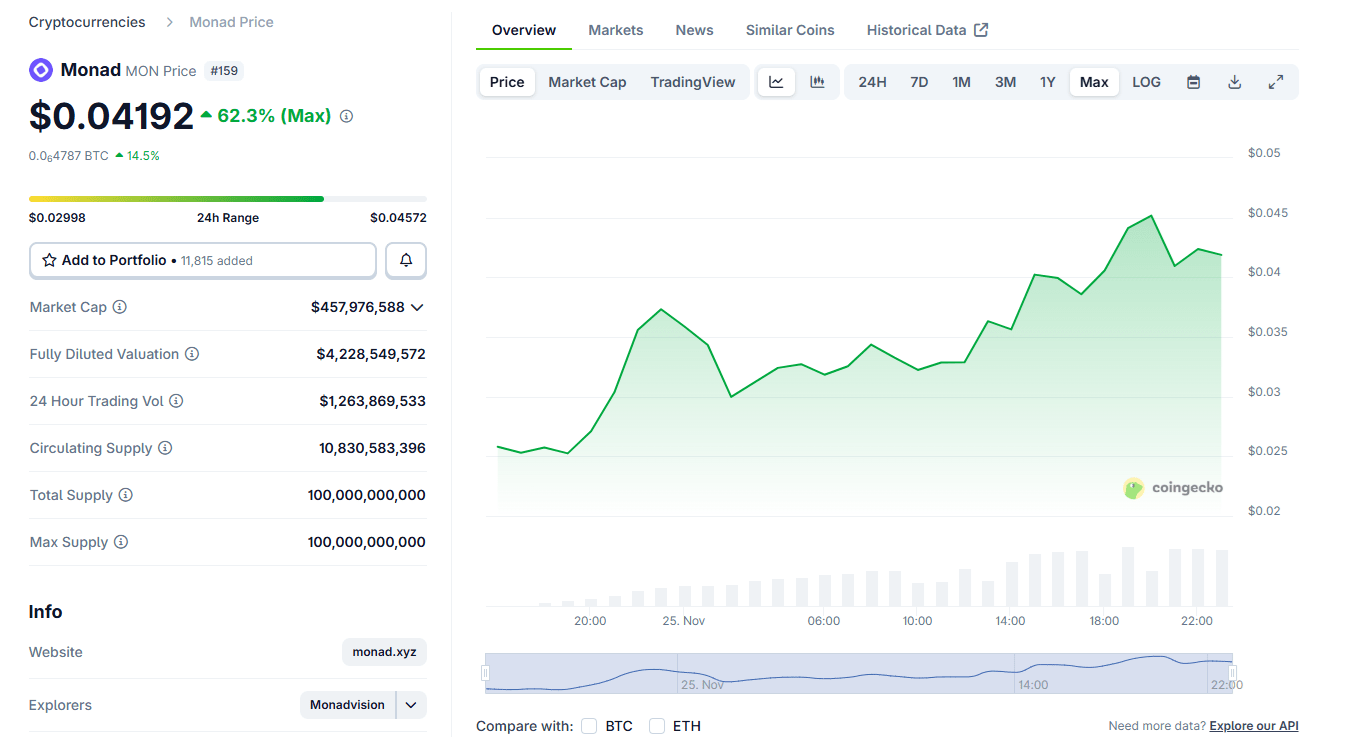
The post MON rose by over 62% on first day of trading appeared on BitcoinEthereumNews.com. Monad launched its main net and opened MON trading, with versions on several chains. MON tokens rose by over 62% on their first day of trading.  The Monad ecosystem is shaping up as the native MON token entered price discovery. On the first day of trading, MON launched as a multichain asset.  MON expanded in the first hours of trading, with a mix of DEX activity and centralized listings. | Source: Coingecko MON traded at $0.04, up over 62% in its first day of trading. The token opened with $1.2B in trading for the first few hours, with 10.8B MON in circulation. The asset retains nearly 90% of its supply for future unlocks, for a total supply of 100B tokens.  Early MON trading was concentrated on a unique set of exchanges, including Coinbase, Bybit, and Upbit. MON trades on a mix of DEX and centralized exchanges. MON has a unique trading profile, with over 62% of early-stage volumes in a pairing with the Korean won. | Source: Cryptocompare Its most active markets make up a unique trading profile, with over 62% of volumes against the Korean Won, and the rest in fiat pairs with the US dollar.  Monad starts building liquidity Monad was a long-awaited airdrop, reaching out to older DeFi and NFT communities. The event was expected to revive the Web3 space while offering a new venue for trading.  Monad is a new EVM-compatible L1 chain, which once again raised questions on whether there is sufficient demand for another network. The Monad main net launched just as the Berachain community noted the new hot network was almost dead, just months after the initial hype.  For now, Monad is showing signs of early activity. Within hours, the main net invited over 100 apps.  Monad also launched with $115M in liquidity,…

Author: BitcoinEthereumNews
Pump.fun Co-Founder Denies $436 Million USDC Cash-Out Allegations

Pump.fun Co-Founder Denies $436 Million USDC Cash-Out Allegations

TLDR Pump.fun co-founder Sapijiju denied claims that the project cashed out over $436 million in stablecoins. Sapijiju explained that the funds were part of Pump.fun’s treasury management process and not a sale. The transfers involved USDC from the PUMP token’s ICO and were moved to internal wallets for business reinvestment. Lookonchain’s report raised concerns, claiming [...] The post Pump.fun Co-Founder Denies $436 Million USDC Cash-Out Allegations appeared first on CoinCentral.

Author: Coincentral
GeeFi (GEE) Gains Analyst Attention While Avalanche Stalls at $13.90, Now Reporting Over $300K in Founding

GeeFi (GEE) Gains Analyst Attention While Avalanche Stalls at $13.90, Now Reporting Over $300K in Founding

The post GeeFi (GEE) Gains Analyst Attention While Avalanche Stalls at $13.90, Now Reporting Over $300K in Founding appeared on BitcoinEthereumNews.com. Advertisement &nbsp &nbsp Disclaimer: The below article is sponsored, and the views in it do not represent those of ZyCrypto. Readers should conduct independent research before taking any actions related to the project mentioned in this piece. This article should not be regarded as investment advice. Avalanche (AVAX) has seen significant institutional interest, with treasury firms like AVAX One acquiring millions of dollars worth of tokens. However, this big-money confidence has not translated into price momentum. With AVAX struggling to break key resistance levels and trading around $13.9, traders are growing impatient with its sideways movement.  This stagnation is pushing many to seek projects with more immediate growth potential, leading them to utility-rich platforms like GeeFi, which analysts are calling the next 100x gem. Avalanche’s Bearish Pressure Despite strong institutional buying, AVAX remains trapped in a bearish trend, with technical indicators suggesting sellers are firmly in control. Analysts are skeptical of its ability to reclaim the $20 mark, as the price is confined within a descending channel and has failed to overcome resistance at $15. This lack of upward momentum, even with positive ecosystem news, highlights the challenge for those seeking significant returns in the current market. GeeFi offers a compelling alternative by providing a diversified and stable foundation for growth. As a multi-chain platform, GeeFi is not subject to the price limitations of a single blockchain. The ecosystem’s core is the non-custodial GeeFi Wallet, which gives you complete control over your assets across more than 14 networks. This multi-chain approach offers security and flexibility, insulating your portfolio from the volatility and stagnation affecting single-chain assets like AVAX. Advertisement &nbsp GeeFi Presale The GeeFi presale is the kind of ground-floor opportunity crypto traders seek. Many experts are suggesting that GeeFi has all the makings of the next $2…

Author: BitcoinEthereumNews
NFT Trading Down 90%+ As Market Shows No Signs of Recovery — Here's What's Replacing It

NFT Trading Down 90%+ As Market Shows No Signs of Recovery — Here's What's Replacing It

NFT volume down 90% from their peak, top collections collapsed, and analysts say the market won't recover — even as NFTs shift to backend tech roles.read more

Author: Coinstats
Why is Monad Price Still Rallying and How Long Will It Last?

Why is Monad Price Still Rallying and How Long Will It Last?

The post Why is Monad Price Still Rallying and How Long Will It Last? appeared on BitcoinEthereumNews.com. Monad’s MON token continues to rally after its long-anticipated mainnet launch, defying the steep post-airdrop declines that dominated 2025. The token has climbed more than 70% above its Coinbase sale price while the broader crypto market trades under heavy pressure.  Data from on-chain activity, exchange flows, and token distribution offer a clear explanation for the outperformance — and reveal how long the rally may realistically last. Strong Day-One Performance Sets the Tone Monad launched its public mainnet and MON token on November 24 with roughly 10–11% of its 100 billion supply unlocked.  The airdrop and public sale provided liquidity, while more than 50.6% of the supply (team, investors, treasury) remained locked through 2029. Large Monad Holders Are Still Not Selling Any MON Token. Source: Nansen Sponsored Sponsored The launch attracted immediate attention. MON dipped about 15% in early trading, hitting $0.02 as airdrop sellers exited.  Buyers quickly absorbed the flow. Within 24 hours, MON traded near $0.03–0.035, and now sits around $0.04, more than 50–70% above its $0.025 public sale price. This strength stands out in a market where Bitcoin has dropped below $90,000 and total crypto market capitalization has fallen by more than a trillion dollars since October. Monad Price Chart. Source: CoinGecko Airdrop and Token Sale Created a Stable Holder Base Monad distributed roughly 4.73 billion MON in airdrops to 289,000 eligible accounts, with 3.33 billion ultimately claimed. The design targeted DeFi power-users, NFT traders, testnet contributors, and DAO participants rather than quest farmers. The Coinbase token sale, which raised $269 million from about 85,820 participants, added a second cohort of committed holders. These buyers anchored around the $0.025 sale price and proved less eager to dump at launch. Because insiders remain locked, early sellers were mostly airdrop recipients. This dynamic helped prevent the heavy cascades that crushed…

Author: BitcoinEthereumNews
Crypto Sees VC Revival With Q3 Investments Hitting $4.65B

Crypto Sees VC Revival With Q3 Investments Hitting $4.65B

The post Crypto Sees VC Revival With Q3 Investments Hitting $4.65B appeared on BitcoinEthereumNews.com. Crypto-focused venture capital investment reached $4.65 billion in the third quarter, the second-highest amount of activity since crypto exchange FTX collapsed in late 2022 and decimated venture bets on crypto. Galaxy Digital’s head of research, Alex Thorn, said in a report on Monday that Q3’s venture bets were a 290% quarter-on-quarter jump and the largest quarter since Q1, which saw $4.8 billion in investments. “Despite remaining below 2021-2022 bull market levels, venture activity remains active and healthy overall. Sectors like stablecoins, AI, blockchain infrastructure, and trading continue to draw deals and dollars, and pre-seed activity remains consistent.”  Venture capital funding for blockchain-focused startups has reached the second-highest level of the year. Source: Galaxy Digital The growing investment activity comes amid a lull period for crypto venture capital, which has largely pulled out of the industry following the uncovering of FTX’s massive fraud in November 2022, which led to the exchange’s collapse into bankruptcy. Small number of deals attracted most funding  Q3 saw 414 venture deals, with seven accounting for half of the capital raised over the quarter. Those included financial technology company Revolut, which attracted $1 billion, crypto exchange Kraken with $500 million and crypto-focused US bank Erebor with $250 million.  Meanwhile, established companies, those founded in 2018, accounted for most of the capital raised, while companies founded in 2024 accounted for the highest number of deals. “Pre-seed deal count as a percentage has trended down consistently as the overall industry has matured,” Thorn said.  “With crypto being adopted by established traditional players, and a large cohort of venture-backed firms having found market fit, it’s increasingly likely that the golden era of pre-seed crypto venture investing has passed.”  VC capital stagnates as ETFs crypto treasuries take focus Prior bull runs in 2017 and 2021 featured a high correlation between VC…

Author: BitcoinEthereumNews
GHOST’s GhostPay gives it an edge over ZEC and XMR

GHOST’s GhostPay gives it an edge over ZEC and XMR

The post GHOST’s GhostPay gives it an edge over ZEC and XMR appeared on BitcoinEthereumNews.com. Disclosure: This article does not represent investment advice. The content and materials featured on this page are for educational purposes only. Privacy coins surge to a $19b market as new Solana-based solutions like GhostwareOS shift focus beyond legacy players. Summary GhostwareOS on Solana offers modular privacy tools, including GhostPay, encrypted messaging, and ID obfuscation. It enables anonymous Solana transactions with fees redistributed to GHOST token holders, not a foundation. GHOST competes with Zcash and Monero in 2025 as privacy coins shift to high-performance, modular solutions. In 2025, the privacy niche is no longer a footnote in the market. Reports from CoinGecko and CoinMarketCap put the privacy coin segment at around US$18-19 billion in total market value, with Zcash and Monero still among the biggest names in the category, while newer projects experiment with private payment layers such as GhostPay built on faster base chains. The conversation about the best privacy crypto coins has started to move away from legacy coins and toward solutions built on top of high-performance infrastructure. This is where GhostwareOS (GHOST) on Solana enters the picture with GhostPay, its native anonymous payments layer, sitting alongside modules for encrypted messaging and identity. Instead of being just another standalone privacy coin, the stack is designed as a modular toolkit for messaging, identity, and GhostPay-powered private transactions. GhostwareOS: Privacy stack designed for Solana Instead of launching its own chain, Ghost is a full-stack privacy layer for Solana. This includes GhostOS, Tx ShadowNet, and Darkrelay Messaging, along with ID obfuscation modules that break the link between different wallets and sessions. All of these building blocks are powered by modern cryptography, such as HPKE, zero-knowledge proofs, and MPC, according to technical reviews from partners and aggregators. GhostPay: Anonymous payments GhostPay turns this infrastructure into a very concrete product, a private payments layer…

Author: BitcoinEthereumNews
Surviving the Meme Apocalypse: Key Factors Behind Memecoin Longevity — Spotlight on BAMBITZ

Surviving the Meme Apocalypse: Key Factors Behind Memecoin Longevity — Spotlight on BAMBITZ

Surviving the Meme Apocalypse: Key Factors Behind Memecoin Longevity — Spotlight on BAMBITZSurviving the meme coin apocalypse, being amongst the

Author: Medium