Oracle

Oracles are essential infrastructure components that feed real-time, off-chain data (such as price feeds, weather, or sports results) into blockchain smart contracts. Without decentralized oracles like Chainlink and Pyth, DeFi could not function. In 2026, oracles have evolved to support verifiable randomness and cross-chain data synchronization. This tag covers the technical evolution of data availability, tamper-proof price feeds, and the critical role oracles play in ensuring the deterministic execution of complex decentralized applications.

5116 Articles
Created: 2026/02/02 18:52
Updated: 2026/02/02 18:52
South Korea Joins UAE’s $22 Billion Stargate AI Infrastructure Project

South Korea Joins UAE’s $22 Billion Stargate AI Infrastructure Project

TLDRs: South Korea partners with UAE in $22 billion Stargate AI project, adding energy and tech expertise. Stargate AI infrastructure aims for 5 GW capacity, backed by global tech companies and investments. Leaders sign seven MoUs covering nuclear, AI, space, and bio-health collaborations. Stargate’s expansion signals opportunities for AI hardware and energy suppliers in Abu [...] The post South Korea Joins UAE’s $22 Billion Stargate AI Infrastructure Project appeared first on CoinCentral.

Author: Coincentral
Why Red Bull Racing Protects Its Data To Stay Competitive

Why Red Bull Racing Protects Its Data To Stay Competitive

The post Why Red Bull Racing Protects Its Data To Stay Competitive appeared on BitcoinEthereumNews.com. Formula 1 has always worshipped the cult of improvement. Every lap-time, every tyre temperature, every braking point is questioned. Each car is equipped with hundreds of sensors, quietly collecting data which is later translated to aid car development. In the cockpit, the driver acts like the final sensor, translating all of the numbers into instinct and instinct into lap time. On 1Password’s Securing The Win, Red Bull Racing drivers Max Verstappen and Yuki Tsunoda discuss the importance of data in their fight for wins. Securing The Win is a docuseries, traversing how Oracle Red Bull Racing protects its competitive edge. “A lot is done by data and it’s also something that I rely on a lot, engineers rely on a lot,” said Verstappen. The entire car is equipped with sensors including the tyres; tyre sensors have to withstand very high temperatures in order to transmit data. This information is used to understand factors such as tyre degradation which can be used to make pitstop plans for the race. ForbesWhat Time Is The 2025 F1 Las Vegas Grand Prix? Here’s How To WatchBy Yara Elshebiny The Driver’s Feel However, numbers alone don’t put that car on the top of the time sheets. The driver is able to understand the car by feel, the understeer, the twitches, how it behaves in real-life conditions. Together with both driver feedback and data collected, engineers and drivers debrief to understand how to extract the most performance out of the car. “When you sit in the car, that’s where the fine-tuning comes in,” said Verstappen. “You really want to fine-tune the car and that’s also a very personal preference that it’s not always data-driven.” Power Of Preparation Both driver and data have a relationship of mutual symbiosis; both work better with each other. The information is…

Author: BitcoinEthereumNews
Enhancing Long-Tailed Segmentation with Gradient Cache and BSGAL

Enhancing Long-Tailed Segmentation with Gradient Cache and BSGAL

Proposes BSGAL, a Generative Active Learning algorithm that uses gradient cache to filter unlimited synthetic data for long-tailed instance segmentation.

Author: Hackernoon
Best Practice AI: How to Use Artificial Intelligence in Trading Safely and Effectively

Best Practice AI: How to Use Artificial Intelligence in Trading Safely and Effectively

To truly leverage AI, it is essential to follow best practices, especially in a complex sector like trading.

Author: The Cryptonomist
MultiVM Support Now Live On a Supra Testnet, Expanding To EVM Compatibility

MultiVM Support Now Live On a Supra Testnet, Expanding To EVM Compatibility

[PRESS RELEASE – Zug, Switzerland, November 19th, 2025] Supra, the vertically integrated Layer 1 powering MultiVM smart contract execution with native oracles, dVRF, automation, and cross-chain communication, announced today the opening of applications for its MultiVM testnet during today’s keynote at Devconnect Buenos Aires, held as part of Multichain Day. The announcement was delivered by […]

Author: CryptoPotato
Landscape of Prediction Markets: Centralization vs. Permissionless Protocols

Landscape of Prediction Markets: Centralization vs. Permissionless Protocols

The post Landscape of Prediction Markets: Centralization vs. Permissionless Protocols appeared on BitcoinEthereumNews.com. Prediction markets, once niche experiments, have evolved into significant financial instruments. These platforms, where participants trade on the outcomes of future events, have attracted significant attention due to their demonstrated ability to be more accurate than traditional polls and commentators, particularly concerning critical political and economic results. Their rise is further fueled by the desire for individuals to leverage their knowledge for profit and a broader cultural obsession with real-time data and future outcomes, leading to hundreds of millions, and sometimes billions, of dollars flowing through these markets weekly. The industry’s success has validated a multi-billion dollar demand. The current environment is primarily shaped by a duopoly, Kalshi and Polymarket. These two platforms, while seemingly in direct competition, represent two different approaches to the same market. Kalshi is positioned as a regulated exchange, while Polymarket is the leading decentralized, crypto-native marketplace. A new contender, Rain, has recently emerged, built with a distinctly different, permissionless architecture aimed at addressing the structural limitations of the incumbents. This comparison examines these three notable platforms, Kalshi, Polymarket, and Rain, focusing on four core areas: scalability and liquidity, outcome resolution and trust, user experience and accessibility, and the fundamental tension between decentralization and centralization. The Central Constraint: Market Creation Liquidity While the prediction market industry often focuses on metrics like trading volume and active users, the true barrier to massive growth is a structural bottleneck known as “Market-Creation Liquidity”. This refers to the speed, cost, and accessibility for any user to create a new, tradable market. The current dominant models Kalshi and Polymarket operate under a “publisher” model, acting as gatekeepers, which limits their ability to fully scale. Kalshi: The Regulatory Bottleneck Kalshi’s market position is defined by its compliance-first approach. As a centralized, US-based platform, it is fully regulated by the CFTC as a…

Author: BitcoinEthereumNews
The Hidden Credit Risk Behind The Trillion Dollar AI Buildout

The Hidden Credit Risk Behind The Trillion Dollar AI Buildout

The post The Hidden Credit Risk Behind The Trillion Dollar AI Buildout appeared on BitcoinEthereumNews.com. The frenzy to finance AI’s data centers and GPUs is jamming bond markets. As issuance surges, capacity limits designed to ensure diversification and reduce risks could turn the boom into a credit contagion. The AI boom has lifted markets to one record high after another. Investors are piling in. Companies are building data centers at a feverish pace. Bankers, jaws agape, are drooling over the fees only a once in a generation debt binge can provide. But the buildout comes with risks that ordinary people rarely think about. At the WSJ Tech Live conference in Laguna Beach this October, OpenAI finance chief Sarah Friar warned that the government might need to backstop the debt fueling the expansion. Such a step would protect corporations and investors while strong-arming the public into absorbing at least some of the risk. Was OpenAI’s CFO asking for a future bailout because she was concerned about the hundreds of billions in debt coming to market in a race to fund the AI infrastructure buildout? Within a day Friar tried to walk back her remark, writing on LinkedIn that she meant “partnership” and not a government imprimatur to make the debt easier to swallow. But the slip revealed what many in finance already know: the bond market may have the sheer capacity to fund AI, but it may not have the risk tolerance for such a large narrow bet. Limits on how much funds can hold from any sector or single issuer, along with the risk of holding AI-related trades across dozens of companies, cap how far this can go. The scale is immense. Analysts at JPMorgan estimate that AI-linked investment grade bond issuance alone could reach $1.5 trillion by 2030. That compares with the average of $1.9 trillion of total U.S. corporate bonds issued each year…

Author: BitcoinEthereumNews
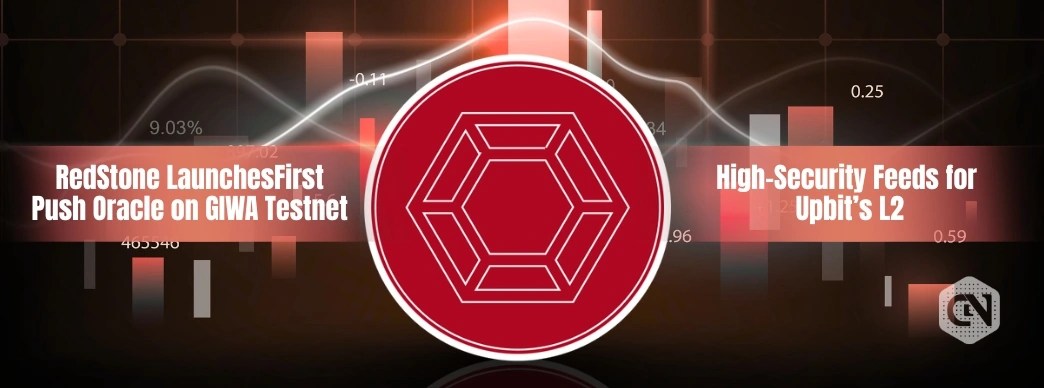
RedStone Deploys First Push Oracle on GIWA Layer-2 Testnet

RedStone Deploys First Push Oracle on GIWA Layer-2 Testnet

The post RedStone Deploys First Push Oracle on GIWA Layer-2 Testnet appeared on BitcoinEthereumNews.com. Key Highlights: RedStone announces launch of its first Push oracle on GIWA testnet today, November 19, 2025. GIWA now supports both push and 300+ Pull feeds. RED token price surged by 0.8% after the announcement was made public. RedStone has announced on social media platform X, the deployment of its first Push oracle model on the GIWA public testnet today, November 19, 2025. Upbit is starting with blue-chip ETH/USD and BTC/USD price feeds to give developers high-security, low-latency data. These feeds will support projects building on GIWA, the exchange’s new Layer 2 network that is designed specifically for builders. RedStone launched the first Push oracle on the GIWA testnet. Starting with blue-chip ETH/USD and BTC/USD, we aim to provide high-security feeds for builders on Upbit’s L2. GIWA is “a Layer 2 by builders, for builders,” a philosophy RedStone has embraced since day one 🧵 pic.twitter.com/25HWeaxs49 — RedStone ♦️ (@redstone_defi) November 19, 2025 The GIWA testnet now features live Push feeds from RedStone, complementing the existing availability of more than 300 RedStone Pull feeds. These pull feeds cover a broad range of digital assets including blue-chip stablecoins, restaked ETH derivatives, real-world assets (RWAs) such as gold and forex, and other tokenized financial instruments. The combined Push and Pull feed models allow GIWA developers to confidently test liquidation mechanisms, on-chain accounting and pricing-sensitive smart contract logic with deterministic and verifiable price data from trusted oracle sources. After the announcement, the price of the RED token has gone up by 0.8% in the past hour and the price of the token stands at $0.2735. RED surges 0.8% as soon as the announcement was made public GIWA: A Vision for Builders and Enterprise Blockchain GIWA is Dunamu’s new Layer-2 blockchain built using Ethereum’s Optimism OP Stack. It is designed in a way that it…

Author: BitcoinEthereumNews
A whale that once made nearly 100 million in unrealized profits: Why did I leave HyperLiquid?

A whale that once made nearly 100 million in unrealized profits: Why did I leave HyperLiquid?

Original title: A Difficult Personal Decision Original author: @TheWhiteWhaleV2 Compiled by: Peggy, BlockBeats Editor's Note: Following the 10.10 incident, the crypto industry underwent a painful but necessary period of self-reflection. When the failure of a centralized trading platform is enough to trigger a network-wide liquidation waterfall, how much pressure can the "decentralization" we trust withstand? The author of this article is a well-known trader with a long history of deep involvement in crypto trading and over 70,000 followers on the X platform, aiming to achieve $100 million in trading results. In August of this year, he publicly recorded total profits of $95 million on HyperLiquid, stating that if performance on other platforms is included, the total has "exceeded $100 million." Entering October, his career profit and loss remains positive, and he has "maintained eight-figure profits for the year." However, on October 10th, he experienced his first liquidation in a massive market-wide sell-off, losing approximately $62 million, a drawdown of about 62%. Even so, he emphasized that he was "still making a positive return" and continued to rebuild his position by selling HYPE tokens. He once publicly praised HyperLiquid founder Jeff Bezos as a "crypto Nobel laureate," but today he chose to leave HyperLiquid. In his view, this is not due to disappointment, but rather a shift in values. He calls on the industry to move from "protecting protocols" to "protecting users," and from celebrating zero bad debts to a truly meaningful risk buffer mechanism. After all, a mature financial system will never rely solely on "good luck" and "hope" as a last resort. The following is the original text: The protocol isn't dead, but the users are. I have made a personal decision: I will no longer trade on HyperLiquid. I want to emphasize the word "personal"—and it was an extremely difficult decision. I didn't ask anyone to follow me; I simply chose to continue acting in accordance with the changes in my values. Many people have witnessed the evolution of my thinking along the way. As human beings, we should evolve, reflect, let go of old frameworks, and build better new frameworks. And I know people often say not to develop an emotional attachment to a protocol. But HyperLiquid is different for me. Jeff created something the market desperately needed. He brought the issue of "structural fairness" into the spotlight, sparking a better discussion across the industry. He and the HL team deserve to leave their mark on crypto history. I sincerely hope they continue writing. But if you've followed me long enough, you'll know I'm an idealist, perhaps even overly so. I can't turn off that part of my brain: the part that sees things as they are and insists they "should" be. October 10th revealed the true nature of the industry to many newcomers. For those who had been there long enough, it served as a reminder that the ecosystem remains fragile and easily manipulated. Can a centralized trading platform trigger a global liquidation waterfall, briefly causing the prices of all protocols to plummet? This is not a "black swan" event; it's a design flaw. Let's briefly review the proceedings of that day: Binance used its own oracle—resulting in its stablecoin becoming unpegged. This triggered a small but manageable liquidation chain. The real chaos began when their API mysteriously went offline. Delta-neutral market makers suddenly couldn't hedge on major OTC exchanges. Unable to hedge, they had to remove quotes from CEXs and DEXs. Liquidity vanished, and prices plummeted instantly. And what about the industry as a whole? A chorus of celebration. "Zero bad debts!" "Perfect liquidation execution!" Great, the protocol isn't dead, but the users are. Protection protocols are important, that's obvious. But "protection protocols" are not the same as "protecting traders." If we want wider adoption, greater legitimacy, and for the crypto industry to continue to grow without being strangled by regulators, we must build genuine consumer protection at the systemic level. TradFi has circuit breakers, market maker obligations, and structural safety barriers. What does the crypto industry have? Hope. And a user manual: "Good luck!" So why did I leave HyperLiquid? Because I chose to support teams that proactively address these design flaws, rather than teams that merely observe the problems. I've spoken with Jeff and another member of Core 11. They don't seem to see this as part of the current roadmap. That's their choice, and I respect that. But it must be made clear that no one has a perfect solution, and there is no silver bullet. What matters to me is: who is moving towards a solution, rather than ignoring the problem. On October 10th, we lost so many people. Real lives were lost. Real families were destroyed. The reason is simply... a design flaw that allows a single entity to control global prices? The crypto industry can't sweep this under the rug. Protecting users shouldn't rely solely on "good luck." So the question becomes: who is actually building a protection mechanism to prevent the next "Binance-style disaster"? On Solana, I only found one. Drift's liquidation protection isn't magic, nor is it perfect, but it really exists. More importantly, it works. It checks: "Does the oracle price deviate from the 5-minute TWAP price by more than 50%?" If so, it temporarily suspends liquidation. This simple logic has saved many people. False breakouts were filtered out. Insurance funds provided a safety net in extreme situations. It was not a grand philosophical revolution, but a crucial step toward reason. I'm not as smart as Jeff, nor would I dare claim to know the best industry-grade solutions. But I am a user, and users vote with their money. The industry keeps repeating the same phrase: "Protection protocols protect traders." But that's not the whole story. A car without a driver isn't a complete system. Both are equally important, forming a beautiful symbiotic relationship. This article felt like a heartbreaking letter to me. It's not an ad for Drift. It's more like a heart-wrenching breakup. Not because the love is gone, but because you finally realize that you're going in different directions. HL will always be a part of my story. It will continue to be on my list of recommendations when people ask me where to trade. But now, it's time for me to move forward—towards my values, towards my ideals. With sincere gratitude, he said to Jeff and the team, "We will always have Paris."

Author: PANews
Bitget – Sự cố AWS làm rung chuyển tiền điện tử: Tác động đến cổ phiếu Amazon và tương lai điện toán đám mây vào năm 2025

Bitget – Sự cố AWS làm rung chuyển tiền điện tử: Tác động đến cổ phiếu Amazon và tương lai điện toán đám mây vào năm 2025

Khi AWS (Amazon Web Services), nền tảng điện toán đám mây hàng đầu thế giới, gặp sự cố gián đoạn, [...] The post Bitget – Sự cố AWS làm rung chuyển tiền điện tử: Tác động đến cổ phiếu Amazon và tương lai điện toán đám mây vào năm 2025 appeared first on VNECONOMICS.

Author: Vneconomics