Oracle

Oracles are essential infrastructure components that feed real-time, off-chain data (such as price feeds, weather, or sports results) into blockchain smart contracts. Without decentralized oracles like Chainlink and Pyth, DeFi could not function. In 2026, oracles have evolved to support verifiable randomness and cross-chain data synchronization. This tag covers the technical evolution of data availability, tamper-proof price feeds, and the critical role oracles play in ensuring the deterministic execution of complex decentralized applications.

5141 Articles
Created: 2026/02/02 18:52
Updated: 2026/02/02 18:52
Investing in RentStac (RNS) Today? Here’s How $10,000 Could Turn Into $800,000

Investing in RentStac (RNS) Today? Here’s How $10,000 Could Turn Into $800,000

As the DeFi sector heads into what analysts expect to be another strong market cycle in early 2026, investor sentiment is shifting away from speculative tokens and meme-driven hype. The spotlight is now on sustainable, utility-based projects with tangible economic value. That’s exactly where RentStac (RNS) comes in. Built around tokenized real estate income, it […]

Author: Cryptopolitan
Lawmakers target Meta, OpenAI, Alphabet, Oracle over AI-driven power costs

Lawmakers target Meta, OpenAI, Alphabet, Oracle over AI-driven power costs

The post Lawmakers target Meta, OpenAI, Alphabet, Oracle over AI-driven power costs appeared on BitcoinEthereumNews.com. Key Takeaways US senators accuse tech giants of contributing to rising energy bills via AI data center expansion Lawmakers urge the White House to impose safeguards and shift costs onto corporations A group of US lawmakers is pressing the White House over rising electric bills linked to AI infrastructure built by tech giants like Meta, OpenAI, Alphabet, and Oracle, according to a Wall Street Journal report. In a letter sent Monday, Senators Bernie Sanders, Richard Blumenthal, Ed Markey, Chris Van Hollen, and Ron Wyden warned that AI data centers are driving up electricity costs across the country, with some households now competing with trillion-dollar firms for power access. The senators demanded details from the Trump administration on how it plans to manage the price impact and ensure corporations bear the brunt of the costs. Blumenthal said the goal isn’t to stop the buildout but to implement federal safeguards to protect consumers. The letter follows a growing wave of local opposition to energy-hungry data centers receiving tax breaks while utilities struggle to keep up. Despite Trump’s pledge to lower energy costs, electric bills rose 5.1% year-on-year in September. Analysts say AI infrastructure is adding pressure to already strained grids, as firms accelerate buildouts powered by fossil fuels and even construct their own energy sources to bypass delays. Source: https://cryptobriefing.com/senators-meta-openai-alphabet-oracle-wsj-letter/

Author: BitcoinEthereumNews
Warren Buffett to step up giving away fortune to his children’s foundations, while supporting successor Abel

Warren Buffett to step up giving away fortune to his children’s foundations, while supporting successor Abel

The post Warren Buffett to step up giving away fortune to his children’s foundations, while supporting successor Abel appeared on BitcoinEthereumNews.com. Warren Buffett speaks during the Berkshire Hathaway Annual Shareholders Meeting in Omaha, Nebraska on May 3, 2025. CNBC Warren Buffett laid out a plan to “step up” the pace of giving away his $149 billion estate to his children’s foundations, while still allowing for a short period that allows Berkshire Hathaway shareholders to gain confidence in incoming CEO Greg Abel. Buffett, in a Thanksgiving letter that will become an annual tradition, said he needs to accelerate the disbursement of his Berkshire stock to his three children’s foundations because of their own advanced ages and that by doing so it will “improve the probability that they will dispose of what will essentially be my entire estate before alternate trustees replace them.” Abel, 63, is set to take over for Buffett, 95, as Berkshire CEO at the start of the new year with the “Oracle of Omaha” remaining chairman. “I would like to keep a significant amount of ‘A’ shares until Berkshire shareholders develop the comfort with Greg that Charlie and I long enjoyed,” wrote Buffett, referring to long-time Berkshire Vice Chairman and his cherished business partner Charlie Munger, who died two years ago.   “That level of confidence shouldn’t take long. My children are already 100% behind Greg as are the Berkshire directors,” said Buffett. Buffett owns about $149 billion worth of Berkshire based on shares held at the end of the second quarter, making him far and away the largest shareholder. Most of his wealth is in the original A shares which trade for around $751,480 a share. He said 1,800 of those Berkshire A shares were converted into 2.7 million B shares and given Monday to four family foundations: The Susan Thompson Buffett Foundation, The Sherwood Foundation, The Howard G. Buffett Foundation and the NoVo Foundation. “The acceleration of…

Author: BitcoinEthereumNews
The ‘Big Short’ Guy Just Bet $1.1 Billion Against AI Giants—And Markets Are Still Absorbing It

The ‘Big Short’ Guy Just Bet $1.1 Billion Against AI Giants—And Markets Are Still Absorbing It

The post The ‘Big Short’ Guy Just Bet $1.1 Billion Against AI Giants—And Markets Are Still Absorbing It appeared on BitcoinEthereumNews.com. In brief Michael Burry is betting $1.1 billion against Nvidia and Palantir, warning that AI stocks are in bubble territory. His fund holds massive put options, representing 80% of Scion’s portfolio as of September 30. Palantir’s CEO fired back, calling the short “batshit crazy” and dismissing Burry’s logic. Michael Burry, the investor (of “The Big Short” fame) who correctly predicted the 2008 housing crisis, disclosed a $1.1 billion short position against Nvidia and Palantir Technologies through put options on Monday, triggering an immediate sell-off across tech markets this week. Palantir dropped as much as 16% on Tuesday before closing down approximately 8%. The decline came despite the company beating third-quarter earnings estimates and raising its full-year guidance. Nvidia fell between 2% and 4% during the same trading session, while the Nasdaq Composite recorded its largest one-day percentage drop in nearly a month at roughly 2%. Every member of the “Magnificent Seven” AI-related stocks closed lower that day. The reaction spread beyond U.S. borders. Asian and European markets recorded sharp declines in the following days, with indices in Japan and South Korea dropping significantly as concerns over tech valuations became a global sentiment driver.  Palantir’s recovery has been sluggish compared to Nvidia’s. The data analytics company trades at a price-to-earnings ratio of approximately 254 and a price-to-sales ratio of around 115, making it particularly vulnerable to sustained bearish pressure. The prices are currently trading below the average of the last 50 days, which is a warning sign for those who trust technical analysis. Nvidia, which controls roughly 80% of the AI chip market, experienced a more modest and contained sell-off. The semiconductor giant’s stock was able to gain better ground today Unlike Palantir, the stock never dropped below its 50-day benchmark, which is a point for analysts that view its…

Author: BitcoinEthereumNews
Tokenization to Hit Trillions: Is RentStac (RNS) the Next Breakout RWA Star?

Tokenization to Hit Trillions: Is RentStac (RNS) the Next Breakout RWA Star?

The decentralized finance (DeFi) market is undergoing a major transformation. While speculative tokens once dominated headlines, a new wave of blockchain projects is reshaping the landscape: tokens backed by real-world assets (RWA). As total value locked (TVL) in DeFi continues to rebound, investors are shifting toward projects that combine yield potential with tangible, income-generating assets. […]

Author: Cryptopolitan
BlockDAG Presale Hits $435M While Ethereum, Uniswap & Chainlink Heat Up: What Makes These the Top Crypto to Buy Now?

BlockDAG Presale Hits $435M While Ethereum, Uniswap & Chainlink Heat Up: What Makes These the Top Crypto to Buy Now?

Every crypto cycle has a few projects that stand out, not just because of hype but because of data-backed results. This season, BlockDAG (BDAG) has made an explosive entry into that shortlist, raising over $435 million before its public launch. Alongside Ethereum (ETH), Uniswap (UNI), and Chainlink (LINK), it represents a blend of infrastructure, utility, [...] The post BlockDAG Presale Hits $435M While Ethereum, Uniswap & Chainlink Heat Up: What Makes These the Top Crypto to Buy Now? appeared first on Blockonomi.

Author: Blockonomi
Hacken creates independent metric for crypto yields

Hacken creates independent metric for crypto yields

Hacken introduced a new framework to assess security, financial logic, and systemic risk across crypto yield products, providing investors a verifiable gauge of sustainability in volatile markets.

Author: Crypto.news
LINK Eyes $50 as Chainlink Sees Massive Adoption Across Major Blockchains

LINK Eyes $50 as Chainlink Sees Massive Adoption Across Major Blockchains

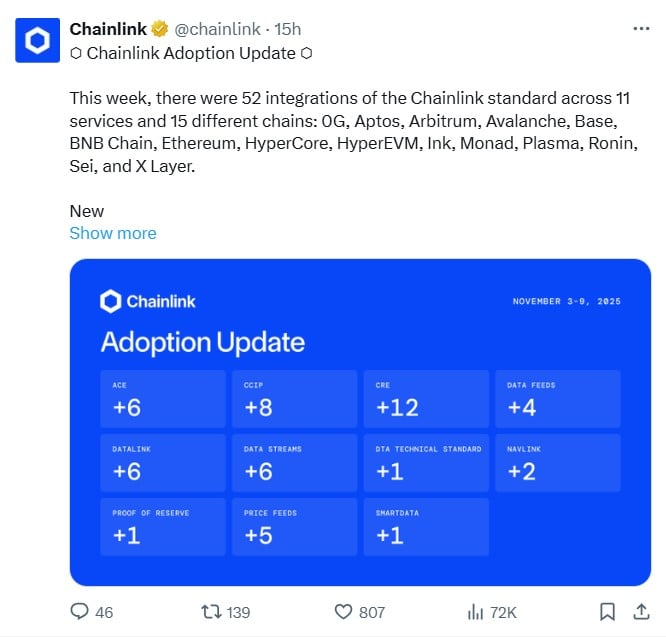
52 different blockchain projects integrated with Chainlink in just one week, highlighting its growing real-world utility. Analysts set high targets for LINK as high as $50 amid massive retail and institutional adoption. LINK, the native token of the Chainlink ecosystem, is currently targeting new prices as high as the $50 psychological level. This potential rally [...]]]>

Author: Crypto News Flash
4 Best Altcoins to Buy Now That Could Outperform Solana ($SOL) by 10x This Cycle

4 Best Altcoins to Buy Now That Could Outperform Solana ($SOL) by 10x This Cycle

Experts name Digitap ($TAP), ZEC, DASH, and LINK as the best altcoins to buy now, with $TAP tipped to outperform Solana by 10x this crypto cycle.

Author: Blockchainreporter
Inside an Aptos Move Smart Contract Audit: What Developers Should Expect

Inside an Aptos Move Smart Contract Audit: What Developers Should Expect

The post Inside an Aptos Move Smart Contract Audit: What Developers Should Expect appeared on BitcoinEthereumNews.com. Discover what to expect in an Aptos Move smart contract audit, from key phases to safety insights for developers. The Move language, initially built for Meta’s Diem and adopted by Aptos, reshapes how developers approach smart contract safety. Move treats assets as resources, owned, transferable, and impossible to duplicate accidentally. This design eliminates many classical attack vectors but introduces new logic and capability risks that require specialized review. A Move smart contract audit validates whether on-chain logic, resource management, and module visibility behave safely under all conditions. It’s not a syntax check; it’s a full examination of how design assumptions hold under Move’s ownership model. This article outlines what developers should expect from a professional Move audit, its phases, typical findings, and how to prepare effectively. Understanding Move’s Security Model Move enforces safety by construction. Every piece of data is either a copyable value or a non-copyable resource, making unauthorized duplication and reentrancy impossible by design. For auditors, this removes many EVM-era risks, such as reentrancy and overflow, but does introduce some new ones: Capability Mismanagement: Untracked or lingering privileges; Friend Module Overexposure: Unintended access to private logic; Resource Lifecycle Mismatches: Assets created or dropped inconsistently. Aptos audits focus on confirming that these guarantees hold across all execution paths, not just under normal conditions. Scoping and Preparing for an Audit Smart contract auditing involves pre-audit preparation, code review, testing, documentation, remediation, and a final review before deployment. A Move audit begins with a well-defined scope. Projects typically provide: Complete Move module files (source or verified package); A dependency list and manifest; Documentation outlining key design assumptions (what each module does, what should never happen); Deployment goals: whether the audit targets testnet, mainnet, or an upgrade. A good audit scope covers both core modules (like liquidity pools, token minting, or vaults)…

Author: BitcoinEthereumNews