Airdrop

An Airdrop is a distribution of free tokens to a community, typically used as a marketing tool or a reward for early protocol adopters and testers. In 2026, the "points-to-airdrop" model has matured into merit-based incentive programs that utilize Sybil-resistance and Proof-of-Humanity to filter out bots. Airdrops remain a primary method for decentralized governance (DAO) bootstrapping. Follow this tag for the latest on retroactive rewards, eligibility criteria, and how to participate in the most anticipated token distributions in the ecosystem.

5490 Articles
Created: 2026/02/02 18:52
Updated: 2026/02/02 18:52
Whale.io Unveils Weekend Minting Sale for Crock Dentist NFTs with 50% Discount

Whale.io Unveils Weekend Minting Sale for Crock Dentist NFTs with 50% Discount

The post Whale.io Unveils Weekend Minting Sale for Crock Dentist NFTs with 50% Discount appeared on BitcoinEthereumNews.com. Advertisement &nbsp &nbsp Disclaimer: The below article is sponsored, and the views in it do not represent those of ZyCrypto. Readers should conduct independent research before taking any actions related to the project mentioned in this piece. This article should not be regarded as investment advice. Whale.io has announced a special Weekend Sale Campaign for its Crock Dentist NFT collection, offering users a 50% discount on minting fees. The promotion begins this Friday and will run through Monday, November 17, 2025, allowing collectors to mint NFTs at 250 USDT, down from the regular price of 500 USDT. The Crock Dentist NFT series, launched last month, has already gained traction with over 300 NFTs minted and active secondary market trading. Following its debut, Whale.io completed its first Solana (SOL) airdrop in late October, distributing roughly $5,000 in SOL to holders, each receiving an average of 0.19 SOL. Initially, minting was restricted to a maximum of five NFTs per account, with prices starting at 100 USDT and gradually rising to 500 USDT. This limit has now been lifted, allowing users to mint an unlimited number of NFTs throughout the weekend sale. Early adopters who secured five NFTs at the introductory rate benefited from approximately $85 worth of SOL rewards from the first airdrop. NFTs That Deliver Recurring Rewards Beyond collectibles, Crock Dentist NFTs serve as reward-generating assets within the Whale Originals gaming ecosystem. Each NFT entitles its holder to a share of the game’s revenue pool, funded through a 3% house edge (with a 97% return-to-player rate). Advertisement &nbsp Proceeds from this pool are periodically distributed to holders through airdrops in SOL, and soon, in $WHALE tokens. Each NFT represents a 0.1% share of the total distribution pool, with allocations scaling based on the number of NFTs owned. Whale.io’s first…

Author: BitcoinEthereumNews
Aztec Network Opens Token Sale via Uniswap’s New CCA Model

Aztec Network Opens Token Sale via Uniswap’s New CCA Model

The post Aztec Network Opens Token Sale via Uniswap’s New CCA Model appeared on BitcoinEthereumNews.com. [Zug, Nov. 13, 2025] Aztec Network, the privacy-native Layer 2 on Ethereum, today announced its token sale, with registration for the token sale beginning today at 3 pm CET. The token sale will leverage Uniswap Labs’ newly launched Continuous Clearing Auction (CCA), a set of smart contracts developed with Aztec as a core contributor that aims to make token distribution more transparent and accessible to a broader audience. Aztec will be the first project to leverage CCA, “Fair, community access should be the foundation of token launches,” said Zac Williamson, Co-Founder of Aztec Network. “Given that the current system heavily favors insiders and whales over long-standing community members, CCA will. It completely changes that unjust dynamic and demonstrates our shared commitment to building infrastructure that truly serves the community.” Rather than conducting a traditional airdrop, Aztec’s token sale uses the CCA protocol to prioritize fairness, accessibility, and fair price discovery for community members who wish to help bootstrap the network’s decentralized staking set and participate in network governance. The community-first distribution offers a starting floor price based on a $350 million fully diluted valuation (FDV), which represents an approximate discount of 75% to an implied network valuation (based on the latest valuation from Aztec Labs’ equity financings). The auction also features per-user participation caps to give community members genuine, bid-clearing opportunities to participate. The CCA protocol aims to address the current challenges in token distribution, where retail participants are often disadvantaged against whales and institutions that hold large amounts of money. “For the past several months, we’ve worked closely with Uniswap Labs as contributors on the CCA protocol,” said Joe Andrews, President and Co-founder at Aztec Labs. “This launch is a first for Ethereum; we have incorporated zero-knowledge proofs into the sale smart contracts by using ZkPassport’s Noir circuits to…

Author: BitcoinEthereumNews
Which Altcoin Is Money Flowing Into in November? XRP, Filecoin or Opter?

Which Altcoin Is Money Flowing Into in November? XRP, Filecoin or Opter?

Traders searching for the next strong altcoin this month are increasingly gravitating toward the OPTER token as momentum shifts across the market. With XRP and Filecoin (FIL) showing slower movement in recent weeks, many investors are exploring assets tied to active platforms and real trading incentives. Opter’s live ecosystem, presale activity, and reward-driven trading model […]

Author: Cryptopolitan
Solana Active Addresses Hit 12-Month Low as Network Activity Cools

Solana Active Addresses Hit 12-Month Low as Network Activity Cools

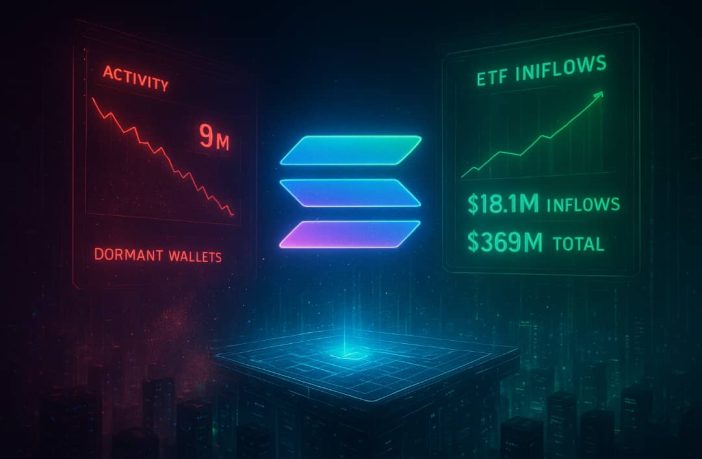
The number of active addresses on the Solana blockchain has fallen sharply to 3.3 million, marking a 12-month low. The drop represents a major pullback from January’s peak of more than 9 million, when the network surged amid the memecoin boom that brought record transaction activity. 🚨 Active Solana addresses number has dropped to a [...]

Author: Null TX
BitMine Bolsters Ethereum Holdings as Retail Money Flows to Opter

BitMine Bolsters Ethereum Holdings as Retail Money Flows to Opter

The post BitMine Bolsters Ethereum Holdings as Retail Money Flows to Opter appeared on BitcoinEthereumNews.com. Bitmine just revealed that it now holds 3.5 million ETH. Experts are buzzing about this accumulation as it may drive market sentiment to ETH. But savvy minds are pointing to something else. Retail money is flowing into $OPTER, a presale coin from Opter, the platform that fuses centralized and decentralized experience.  Opter: Gamified trading with rewards Opter is gaining traction as a decentralized perpetuals exchange that blends the speed of centralized platforms with the transparency and security of on-chain settlements. Why settle for holding ETH when you can leverage and trade it on Opter? It isn’t just about perpetual trading and the power of leverage. The real fun is in the dual nature of Opter. Traders experience the speed and swift order executions of centralized exchanges, but the holders can trade directly from their wallets without KYC, just like a decentralized one. A standout feature is the Opter XP System, which rewards users depending on their trade volume, position duration, and profitability. Users level up to unlock fee discounts, staking boosts, and seasonal airdrop rewards, turning trading into a skill based progression game. The presale allows participants to acquire $OPTER tokens either through direct purchase or by trading on the platform. Traders can rack up 1200 $OPTER for every $100,000 worth of trades. With over $132 million in trading volume, Opter is already demonstrating traction and providing major crypto like leveraged ETH as an active way to earn rewards beyond traditional holding. BitMine: Passive ETH growth and yield BitMine is one of the largest ETH holders, and its recent announcement of nesting 3.5 million ETH has raised many eyebrows. With the recent market dips, BitMine has seen it as the perfect opportunity to swell its coffers. Holding 3.5 million ETH in its reserves demonstrates the potential of simply holding Ethereum…

Author: BitcoinEthereumNews
A Brief Analysis of the New Protocol CCA Jointly Released by Uniswap and Aztec

A Brief Analysis of the New Protocol CCA Jointly Released by Uniswap and Aztec

Author: Zhixiong Pan Let's talk about the new protocol CCA jointly released by Uniswap and Aztec, which stands for "Continuous Clearing Auction." It's specifically designed for price discovery and liquidity initialization of new assets. After the auction process is complete, the project team can import the funds and tokens raised into Uniswap v4, connecting them to secondary market trading. The core objective of this protocol is to address the question of "how to price new assets." Historically, there have been many approaches: team airdrops (essentially free giveaways), Dutch auctions, fixed-price sales, as well as LBP, Bonding Curve, etc., all of which essentially involve "using some mechanism to sell a portion of tokens to the earliest participants." However, Uniswap believes that these existing mechanisms each have their own pitfalls: some have very arbitrary pricing, some are extremely time-dependent, and some cannot provide sustained liquidity. Therefore, they hope that CCA can simultaneously address two issues: relatively fair price discovery and smooth, sustainable liquidity initiation. Essentially, CCA is a protocol independent of Uniswap v4, serving as a complete issuance and pricing framework. However, it can also connect with the AMM kernel through Uniswap v4's hooks mechanism, especially after the CCA auction is completed, automatically injecting liquidity into Uniswap v4 smart contracts. So what does this have to do with Aztec? Aztec's involvement in this matter is actually quite deep: they not only participated in the design of the CCA mechanism, but also became the first project to use CCA for token auctions. Furthermore, the CCA protocol itself can also incorporate KYC/compliance capabilities. Aztec used an identity verification function called ZKPassport in this auction. This is a project within the Aztec ecosystem, developed using their Noir language, and completes compliance checks through zero-knowledge proofs without exposing user privacy details. Returning to CCA, it's not a fixed set of rules or a "single solution," but rather a configurable auction framework. It can be roughly broken down into the following steps: Configuration phase: The auction initiator first sets the rules on the chain, such as the start and end times, the total number of "rounds" or time periods in the auction, the proportion of tokens released in each time period, the minimum price (floor price), whether whitelisting/identity verification is required, and how to import liquidity into Uniswap v4 after the auction ends, etc. Bidding Phase: During the auction, participants can place bids at any time. Each bid includes two parameters: the amount of money invested and the maximum acceptable price per unit. Bids can be increased or adjusted afterward, and each order is recorded independently. Spreading Phase: The system will automatically spread a bid across the remaining "release periods". Therefore, the earlier you place a bid, the longer the time you participate, and the more rounds you have the opportunity to participate in the liquidation. Liquidation Phase: In each round, the system accumulates all valid bids for that round and then uses a unified set of rules to find a price that can sell all the tokens to be released in that round. This price becomes the final transaction price for that round. All bids with a max_price higher than or equal to this price will receive their corresponding share in that round according to the rules. Closing: Once all rounds are completed, the auction ends. Participants can claim their earned tokens and any unsold funds; the protocol then injects the raised assets and the assets prepared by the project team into Uniswap v4 according to the pre-agreed strategy, officially launching the secondary market liquidity pool. I think it's more like a time slice of the traditional "one-off auction": instead of clearing out all at once at a certain moment, it breaks down a large round into multiple smaller stages, allowing prices and the game to unfold over time. This is precisely why it's called a "Continuous Clearing Auction".

Author: PANews
Best Crypto Presales to Watch in November 2025 – Top Tokens Heating Up

Best Crypto Presales to Watch in November 2025 – Top Tokens Heating Up

Understanding the Presale Landscape in 2025 November 2025 marks a pivotal moment for early-stage crypto investors. With Bitcoin stabilizing near $95K and global liquidity returning to risk assets, the presale market has become a launchpad for innovation – and alpha. Crypto presales are early funding rounds where investors buy tokens before their official exchange debut. […] The post Best Crypto Presales to Watch in November 2025 – Top Tokens Heating Up  appeared first on Live Bitcoin News.

Author: LiveBitcoinNews
Zero-Knowledge Identity Startup Self Raises $9M, Introduces Points Program

Zero-Knowledge Identity Startup Self Raises $9M, Introduces Points Program

The post Zero-Knowledge Identity Startup Self Raises $9M, Introduces Points Program appeared on BitcoinEthereumNews.com. Self, a zero-knowledge identity and proof-of-humanity protocol used by Google (GOOG) and Aave, said it raised $9 million in seed funding and introduced a points-based rewards program to promote on-chain identity verification. Investors include Greenfield Capital, Startup Capital Ventures x SBI Fund (SoftBank), Spearhead VC, Verda Ventures, Fireweed Ventures and angel backers such as Casey Neistat, Sreeram Kannan (EigenLayer), Sandeep Nailwal (Polygon), Julien Bouteloup (Curve), Jill Carlson (Espresso) and Hart Lambur (Across Protocol), the company said in a press release Thursday. Self provides privacy-preserving identity infrastructure using zero-knowledge proofs and verifiable credentials to confirm attributes like age or uniqueness without exposing personal data. The protocol supports verification via biometric passports, national IDs and India’s Aadhaar, as well as lightweight mobile onboarding through Self Connect. Zero-knowledge proofs let crypto users confirm something is true, like a transaction’s validity, without exposing any underlying details. They prove the validity of statements on blockchains without offering information that may compromise privacy. Already integrated with Google, Aave and Velodrome, Self powers use cases from Sybil-resistant airdrops to Office of Foreign Assets Control (OFAC)-compliant token distributions. The points program rewards users for verifying identity and interacting across partner platforms, with future integrations expanding earning opportunities. Read more: Boundless Launches Mainnet on Base, Ushering in Universal Zero-Knowledge Compute Source: https://www.coindesk.com/business/2025/11/13/zero-knowledge-identity-startup-self-raises-usd9m-introduces-points-program

Author: BitcoinEthereumNews
3 Indicators of the Best Crypto Presale in 2025

3 Indicators of the Best Crypto Presale in 2025

The post 3 Indicators of the Best Crypto Presale in 2025 appeared on BitcoinEthereumNews.com. Crypto Presales Discover the 3 key signs of the best crypto presale and how Noomez Coin aligns with top-tier tokenomics, scarcity, and early-stage momentum. As investors search for the best crypto presale opportunities in 2025, one trend stands out: early-stage projects with transparent tokenomics and visible scarcity are outperforming speculation-only launches. Established meme coins like Shiba Inu (SHIB $0.000009571, $5.63B market cap) still draw huge volume, but their growth curves have slowed. Traders are now rotating into presales where pricing, burns, and supply shifts are fully tracked on-chain. Noomez ($NNZ) is the newest example, entering Stage 3 at $0.0000151 after climbing from $0.000012320, with 141 holders and $25,334.17 raised as Stage 4 approaches at a higher price. 1. Transparent, Multi-Stage Pricing Structures A credible presale needs a clear, verifiable price path so buyers know exactly how valuation will evolve. This is where many token presale projects fail, providing vague goals without defined mechanics. The strongest presales include: A published starting price and ending price Structured stage progression On-chain verification of each price move Clear rules for when stages advance How Noomez matches it: Noomez operates a 28-stage presale with a fixed progression from $0.00001 to $0.0028, a full 280x curve. Every stage lasts a maximum of seven days, and if it sells out sooner, the next phase begins immediately. Each completed stage lights one segment of the Noom Gauge, a public tracker showing real-time progress. 2. Deflationary Tokenomics and Scarcity Design The best presale crypto 2025 projects prioritize scarcity. Traders want assurance that supply cannot quietly expand behind the scenes. Strong deflationary models usually include: A capped fixed supply No minting after launch Burns tied to verifiable rules On-chain proof of every reduction How Noomez matches it: Noomez has a fixed supply of 280B NNZ, with 140B allocated to presale.…

Author: BitcoinEthereumNews
3 Key Indicators of the Best Crypto Presale (And How Noomez Coin Matches Them)

3 Key Indicators of the Best Crypto Presale (And How Noomez Coin Matches Them)

As investors search for the best crypto presale opportunities in 2025, one trend stands out: early-stage projects with transparent tokenomics […] The post 3 Key Indicators of the Best Crypto Presale (And How Noomez Coin Matches Them) appeared first on Coindoo.

Author: Coindoo